Traders usually lose money when expectations, emotions, recent outcomes, or social pressure weaken their trading process. A single losing trade is normal. The larger problem begins when losses change criteria, risk boundaries, and review habits until reactive decisions become the default.
The issue is rarely one emotion by itself. Fear, greed, FOMO, panic, revenge trading, and overconfidence matter because they can push a trader away from planned criteria. A trader may start by accepting normal uncertainty, then begin forcing trades, increasing size after losses, skipping review, or reacting to price before the original conditions are present.
Core idea: Traders lose money repeatedly when a loss becomes a decision loop. The loop usually moves from pressure to criteria drift, from criteria drift to weaker risk boundaries, and from weaker risk boundaries to trades that are reviewed poorly or not reviewed at all.
The Difference Between Losing Trades and a Loss Process
Losing trades are part of trading because no setup, method, or market view can remove uncertainty. A loss process is different. It appears when the trader responds to uncertainty by lowering standards, trading more often, ignoring prior limits, or treating a recent outcome as proof that the next decision must compensate for it.
Normal losses can occur even when the plan was followed. Repeated loss processes usually show a change in behavior. The trader may move from observing market conditions to chasing them, from reviewing decisions to defending them, or from waiting for criteria to accepting a weaker version of the same idea.
Safe interpretation: Losing money is not caused by one emotion, one bad setup, one market type, or one instrument category. The more useful question is whether the same decision errors keep appearing under pressure.
The Loss Loop Behind Most Trading Mistakes
A common loss loop starts with expectation pressure. The trader expects quick progress, fast recovery after a drawdown, or a clean response from the market. When price movement does not match that expectation, emotional pressure rises and the original decision standard becomes easier to bend.
- Pressure appears: A recent loss, missed move, social proof, or unrealistic expectation creates urgency.
- Criteria drift begins: The trader accepts a weaker setup, a rushed read, or a less defined reason for action.
- Risk boundaries weaken: Size, frequency, or tolerance for uncertainty expands beyond the original plan.
- Reaction replaces process: Price movement becomes the trigger before the planned conditions are complete.
- Review becomes limited: The trader focuses on outcome frustration instead of decision quality.
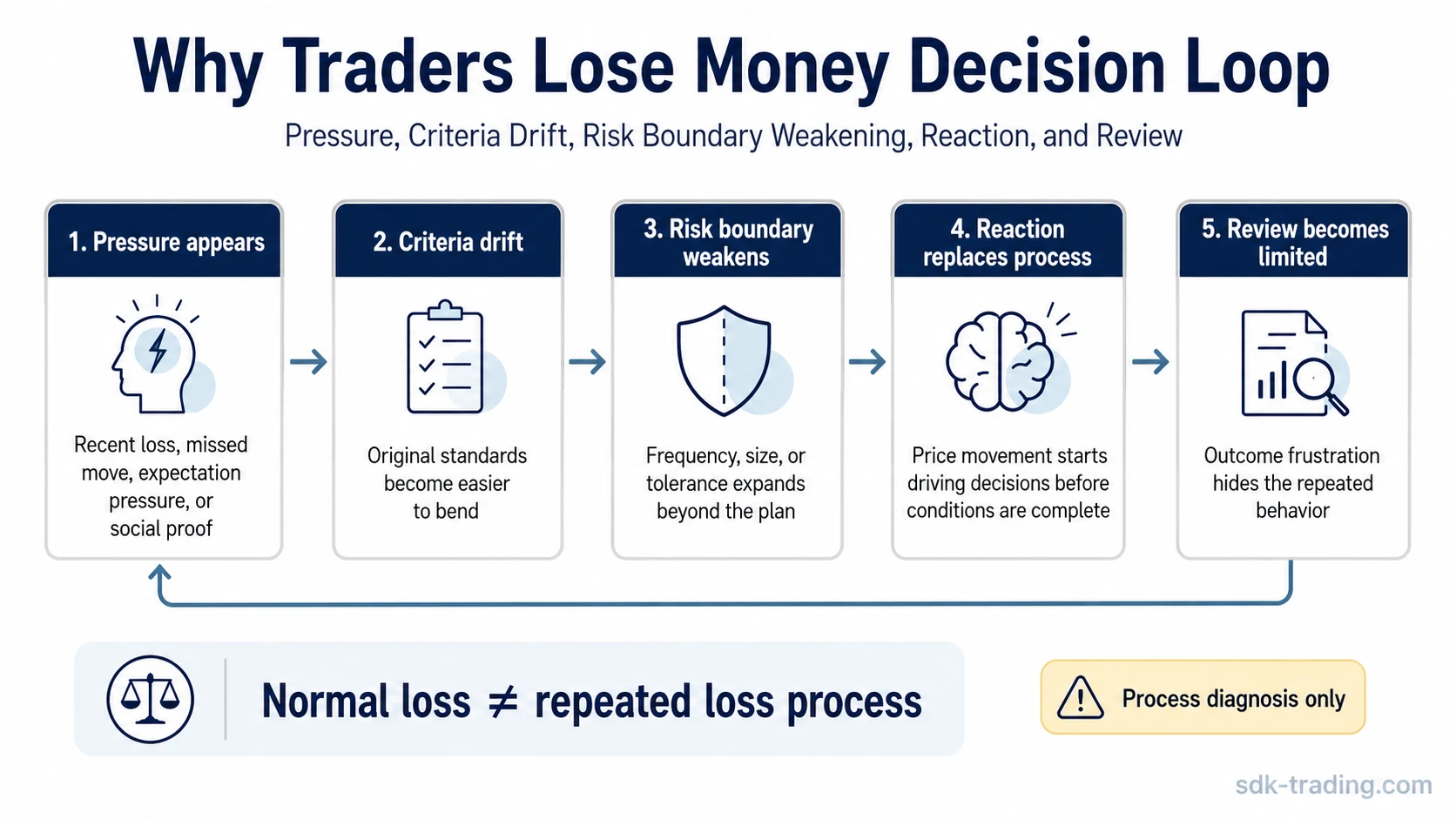
This loop can affect day traders, forex traders, swing traders, and other active market participants. The market type changes the surface behavior, but the internal pattern is similar when pressure changes the trader’s standards.
Emotional Pressure and Criteria Drift
Emotions become damaging when they change what counts as a valid decision. FOMO can turn a late move into a forced opportunity. Revenge trading can turn a loss into a need to recover immediately. Panic can make a trader abandon a plan before the original invalidation logic is clear. Overconfidence can make a trader treat a recent win as proof that weaker criteria are acceptable.
Social proof can create the same problem. When a trader sees others acting with confidence, the pressure to participate may rise even if the trader’s own criteria are incomplete. The decision then becomes less independent. Instead of asking whether the setup fits the plan, the trader starts reacting to perceived majority behavior.
Limitation: Emotional control alone does not solve the problem if the process remains vague. A calm trader can still lose money if criteria are undefined, review is weak, or risk boundaries are allowed to shift after each outcome.
Risk Boundaries, Overtrading, and Review
Risk problems often appear after the decision process has already weakened. A trader may increase frequency after losses, increase exposure to recover faster, or keep acting before conditions are fully met. These are not only risk-management issues. They are signs that pressure has moved from psychology into execution behavior.
Review is the part of the loop that makes the pattern visible. Without review, the trader may only remember the outcome. With review, the trader can separate a valid losing trade from a decision that broke criteria before the outcome was known.
| Cause | How it can create loss | Safer process interpretation |
|---|---|---|
| Unrealistic expectations | The trader expects fast progress and treats slow or negative periods as a problem to fix immediately. | The expectation needs review before it changes trade frequency, size, or criteria. |
| FOMO and social proof | The trader follows perceived crowd confidence before independent criteria are complete. | The decision should still pass the original process standard, even when the market feels urgent. |
| Revenge trading | A previous loss creates pressure to recover, which can lead to rushed decisions and weaker selectivity. | The loss should be reviewed as a decision event, not treated as a reason to force the next decision. |
| Overconfidence | A recent win makes weaker setups feel acceptable because confidence replaces criteria. | Confidence should not replace the same standard used before the win. |
| Skipped review | The trader sees only profit or loss and misses the repeated behavior that caused the process to drift. | Review should separate outcome, criteria quality, risk boundary, and emotional pressure. |
A Short Example of a Loss Loop
A trader takes a planned loss and accepts it at first. Soon after, another market move appears and the trader feels pressure to recover. The next decision uses a weaker version of the original criteria: less waiting, less confirmation, and less review of whether the setup actually fits. If that decision also loses, the trader may increase frequency again. The repeated problem is not the first loss. It is the drift from planned criteria into reactive recovery behavior.
This kind of example is illustrative, not a claim about a specific market event. It shows why the behavior after a loss can matter more than the loss itself.
Why Failure-Rate Statistics Need Caution
Trader failure-rate statistics are often repeated as if they explain the entire problem. They can be useful as a warning that trading is difficult, but they should not be treated as precise universal proof unless the source, market, account type, time period, and methodology are clear.
The more practical lesson is that repeated losses usually need a process explanation. Unsupported percentages do not show whether the issue came from unrealistic expectations, poor risk boundaries, weak review, overtrading, market selection, costs, leverage, or a mismatch between method and trader behavior.
Statistic boundary: Broad failure-rate claims should be handled carefully. They can warn against overconfidence, but they do not replace direct review of criteria drift, risk behavior, and decision quality.
How This Fits Trading Psychology
Trading psychology connects emotions, expectations, discipline, and review into one decision-process problem. Traders lose money more consistently when those parts stop working together. The psychological issue is not only feeling fear or greed. It is allowing those pressures to change the rules while the trader is still acting as if the original process is intact.
A stronger interpretation separates four questions: what conditions were required, whether those conditions were present, what risk boundary was defined, and how the decision was reviewed afterward. That separation does not remove uncertainty, but it makes repeated process drift easier to see.
FAQ
Why do most day traders lose money?
Day traders can lose money when fast feedback, frequent decisions, costs, emotional pressure, and recovery urgency weaken their process. The issue is not only speed. The larger risk is repeated criteria drift under pressure.
Do most traders lose money because of psychology?
Psychology is a major part of the problem, but it is not the only layer. Losses can also come from weak criteria, poor review, unrealistic expectations, excessive frequency, and risk boundaries that change after outcomes.
Is poor risk management the only reason traders lose money?
No. Poor risk management is often part of the loss loop, but it may start earlier when expectations, emotions, or social pressure weaken decision standards. Risk boundaries usually fail faster when the process behind them is unclear.
Are trader failure-rate statistics reliable?
Broad failure-rate statistics should be treated carefully unless the source, account type, market, time period, and methodology are clear. They may warn against overconfidence, but they do not explain the individual process behind repeated losses.