Trading basics are the starting concepts that separate what trading is, how financial markets work, how timeframes change interpretation, and which style or strategy questions come next.
A cleaner first step is separating definitions from tactics before moving into strategy language. Market mechanics, timeframe choice, investing comparison, cycle context, and strategy style each answer a different beginner question.
Start With the Concept You Need
Start with the concept that answers the decision you are trying to clarify: what trading means, how prices form, how long a market view lasts, how trading differs from investing, or how styles and strategies are grouped.
| Beginner question | Concept to clarify | Start here when |
|---|---|---|
| What does trading mean in financial markets? | Trading definition and purpose | What trading means in financial markets is still unclear. |
| How do buyers, sellers, orders, and prices connect? | Market mechanics | How market orders, buyers, sellers, and prices connect needs a clean foundation. |
| Why does the same setup look different on another chart horizon? | Time horizon and chart context | Choosing the right timeframe is creating confusion. |
| Is the goal shorter-term participation or longer-term ownership? | Trading compared with investing | The difference between trading and investing changes the decision lens. |
| Where does the current market move sit in a broader sequence? | Market-cycle context | Market-cycle behavior is needed before reading isolated signals. |
| Which trading style or strategy family fits the problem? | Style and strategy grouping | Trading styles and strategy basics are the next layer after the foundations. |
The route is strongest when the unresolved question is named first. A definition problem, a mechanics problem, a timeframe problem, and a strategy problem do not need the same starting point.
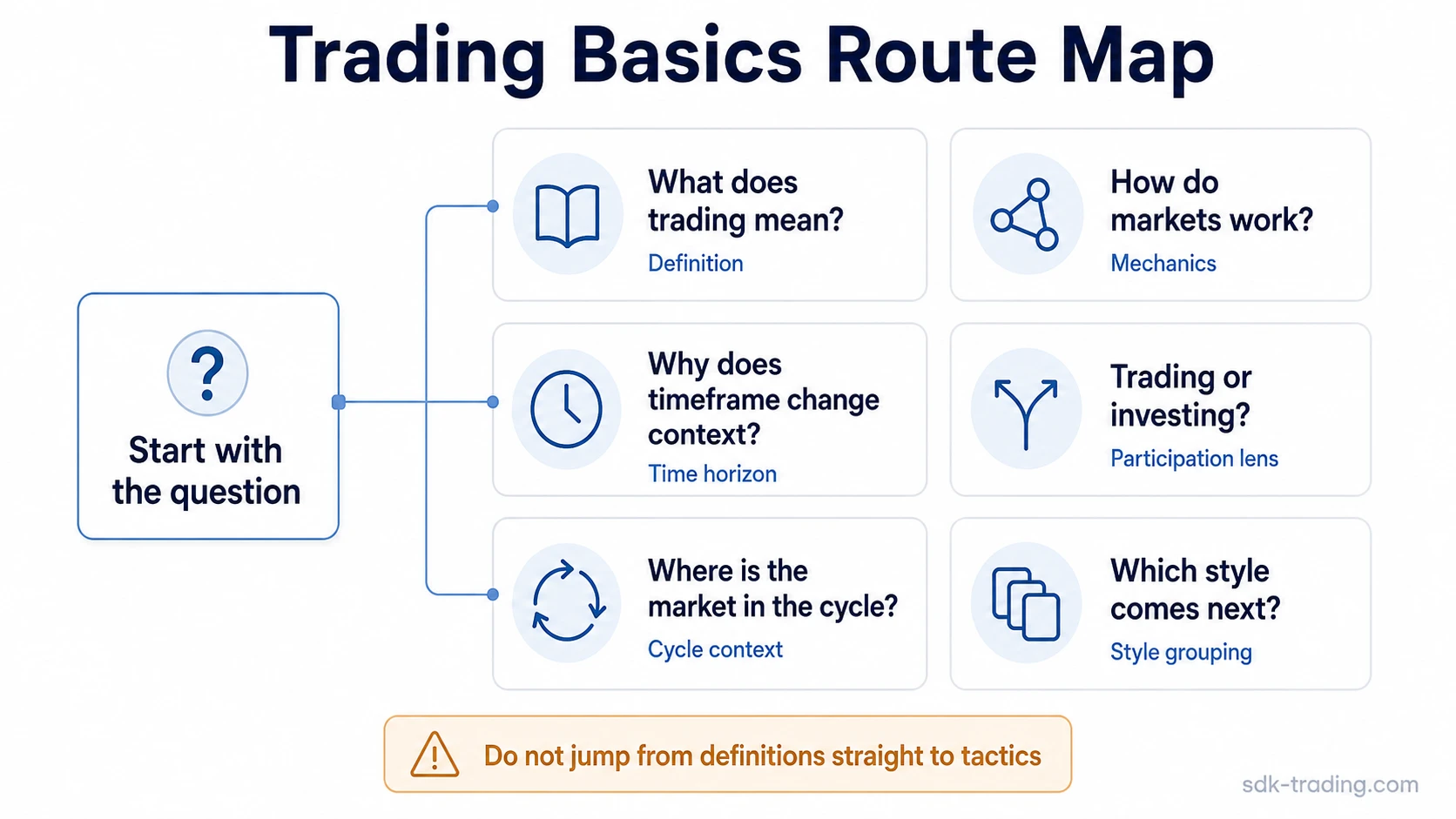
Trading Basics by Beginner Question
Trading basics are easier to learn when market mechanics, timeframe choice, strategy style, and risk language are separated instead of treated as one topic.
Definition first: use the definition route when the basic meaning of trading is still unclear.
Market context: use the mechanics route when price movement feels disconnected from buyers, sellers, orders, and liquidity.
Timing context: use the timeframe route when the same move looks different across chart horizons.
Participation context: use the comparison route when shorter-term trading and longer-term investing are being mixed.
Strategy context: move into style and strategy grouping only after the earlier boundaries are clear.
Core Concepts to Learn First
The first layer is vocabulary and market structure. Trading involves taking positions in financial markets, but the definition alone is too thin unless it is connected to price formation, time horizon, and decision context.
Market mechanics explain why prices change when available supply, demand, order flow, and participation shift. This foundation helps prevent a common beginner error: treating every price move as meaningful without asking what changed around the move.
Timeframes change the meaning of the same chart behavior. A move that looks large on a short horizon may be minor inside a longer cycle, while a slow change on a higher timeframe can shape how lower-timeframe movement is interpreted.
Market cycles add a broader sequence lens. They do not make markets predictable, but they help organize context around expansion, slowing momentum, distribution, decline, stabilization, and renewed participation.
When to Move Into Trading Styles
Trading styles and strategy basics belong after the core concepts are separated. A style describes the broad participation mode, such as shorter-term or longer-term holding behavior. A strategy framework explains how a trader organizes conditions, confirmation, risk, and review.
A beginner route should not jump directly from definitions to tactics. The earlier step is understanding what each concept is responsible for, then moving into style and strategy language without treating it as a signal checklist.
Common Beginner Misreads
One common mistake is treating trading basics as a shortcut to order placement. The more useful sequence is concept first, market mechanics second, timeframe context third, and strategy language later.
Another mistake is mixing trading and investing decisions without naming the difference. Trading usually centers on participation in a market move, while investing usually centers on longer-term ownership logic. The two can interact, but they should not be treated as the same decision.
Common beginner misconceptions can distort the learning path when they turn trading into prediction, certainty, or shortcut-seeking instead of a structured decision process.
FAQ
What are trading basics?
Trading basics are the foundational concepts that explain what trading is, how markets work, how timeframes change interpretation, how trading differs from investing, and how trading styles are grouped.
What should a beginner learn before trading strategies?
A beginner should first understand market mechanics, timeframes, trading versus investing, and basic market-cycle context. Strategy language is easier to interpret after those concepts are separated.
Are trading basics tied to one trading style?
No. Trading basics are broader than any single style. They cover foundational market concepts before day trading, swing trading, position trading, or other strategy families are compared.
Next Concept to Clarify
The next concept depends on the unresolved question: definition, market mechanics, timeframe context, investing comparison, market-cycle behavior, or style grouping. A clean route keeps the foundation separate from tactics.