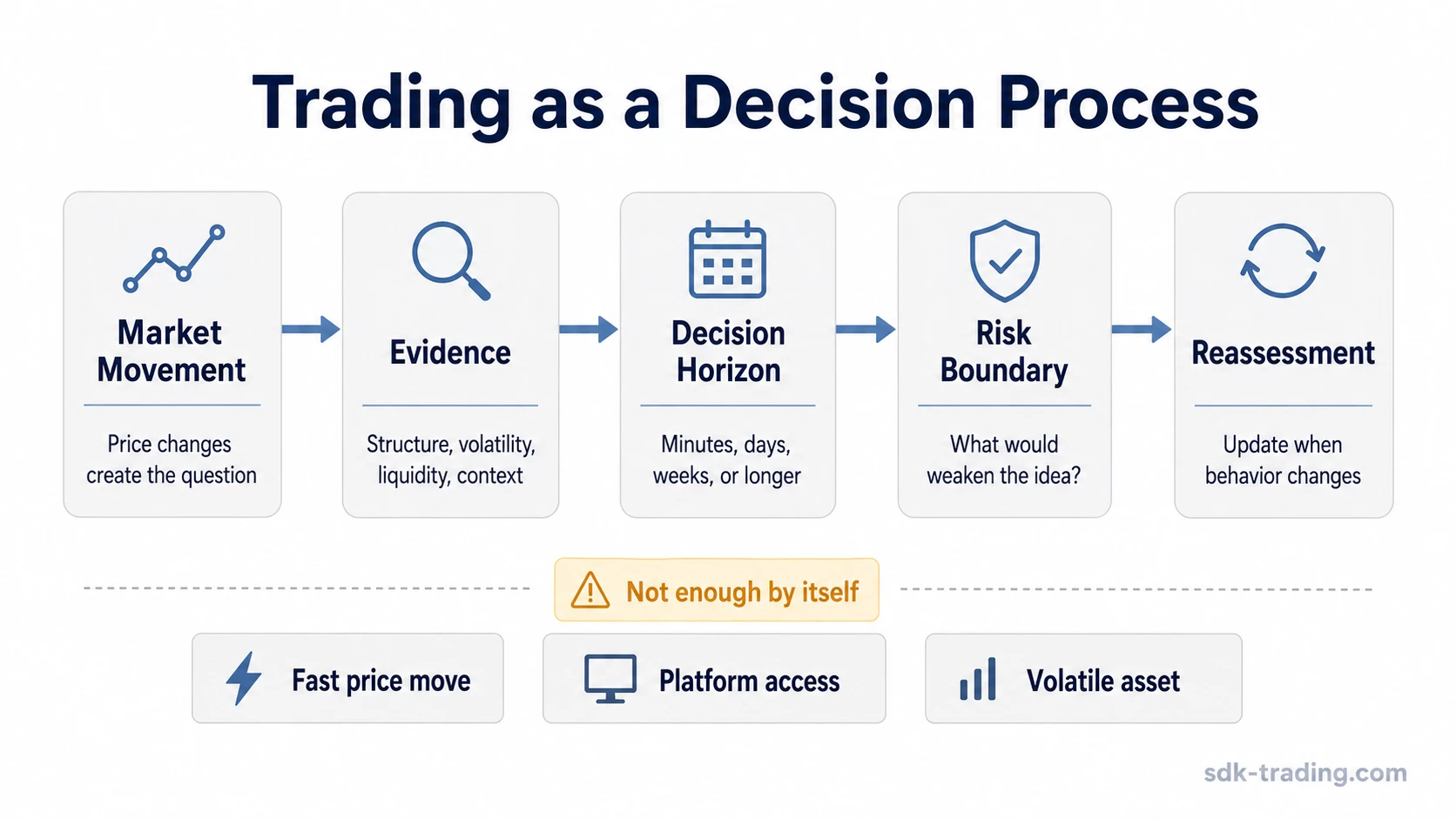
Trading is active participation in financial markets through decisions about changing prices, time horizon, uncertainty, and risk. The common mistake is to treat trading as fast profit-seeking or platform access, when the safer definition is a structured decision process around market movement.
A price move can start the question, but it is not a complete trading process by itself. Disciplined trading needs context, a review horizon, and a clear reason the interpretation would need to change.
Definition: Trading is the process of taking financial-market exposure with the aim of responding to price movement over a defined decision horizon, while accepting that the outcome is uncertain and risk must be controlled.
Key Points
- Trading means making decisions around financial-market price movement, not simply reacting to excitement or volatility.
- An asset, broker, app, or short timeframe does not define trading by itself.
- Trading and investing can use the same markets, but they usually differ by objective, horizon, review cadence, and risk definition.
- Stocks, currencies, commodities, indices, derivatives, and crypto assets can all be traded, but each market has different structure and risk.
- A trading idea is easier to evaluate when the process, time horizon, risk boundary, and reason for reassessment are clear.
What Trading Means
Trading means making an active decision about exposure to a financial market. The decision may be based on price behavior, market structure, volatility, news, technical analysis, fundamental information, or a defined process that combines several forms of evidence.
The word active is important. A trader is not only holding an asset and waiting for long-term ownership value to compound. A trader is usually monitoring whether the market is still behaving in a way that supports the original idea. If the market character changes, the interpretation may need to change as well.
That does not mean trading must be extremely short term. Some trading decisions may be reviewed over minutes, days, weeks, or longer. The defining feature is not speed alone. The defining feature is that the decision depends on market behavior, an intended horizon, and a risk boundary.
The Common Misread About Trading
The most common misread is that trading means finding fast price movement and trying to profit from it. Price movement can create a decision environment, but movement alone does not create a complete trading process.
| Common misread | Safer interpretation |
|---|---|
| Trading means chasing fast moves. | Trading means evaluating whether a price move fits a defined process, time horizon, and risk boundary. |
| Any market access app makes someone a trader. | Platform access only enables activity. The process behind the decision determines whether the activity is disciplined. |
| A volatile asset is automatically a trading opportunity. | Volatility increases movement and uncertainty. It does not automatically improve decision quality. |
| Trading is only short-term speculation. | Trading can use different horizons. The key distinction is the active decision process, not one fixed holding period. |
A cleaner interpretation starts with a question: what market behavior would make the idea more credible, less credible, or still unresolved? Without that boundary, a price move can easily be mistaken for a trading plan.
How Trading Works
Trading works through financial markets where participants exchange exposure to assets or contracts. Prices change as participants update their views, manage liquidity, respond to information, adjust risk, or rebalance capital.
In practical terms, trading happens when buyers and sellers submit orders through a market venue, broker, exchange, or trading platform, depending on the product. Transactions occur when opposing interest can be matched, and prices adjust as available supply, demand, liquidity, and new information change.
At a basic level, a trader forms a view about whether current price behavior offers a reasonable decision environment. That view may involve trend, range behavior, volatility, market structure, volume, macro conditions, or another evidence set. The decision remains conditional because the market can behave differently from the expectation.
Changing price behavior also sits inside broader market cycle context. A price move during expansion, distribution, contraction, or recovery may carry a different meaning even when the chart movement looks similar.
Trading vs Investing
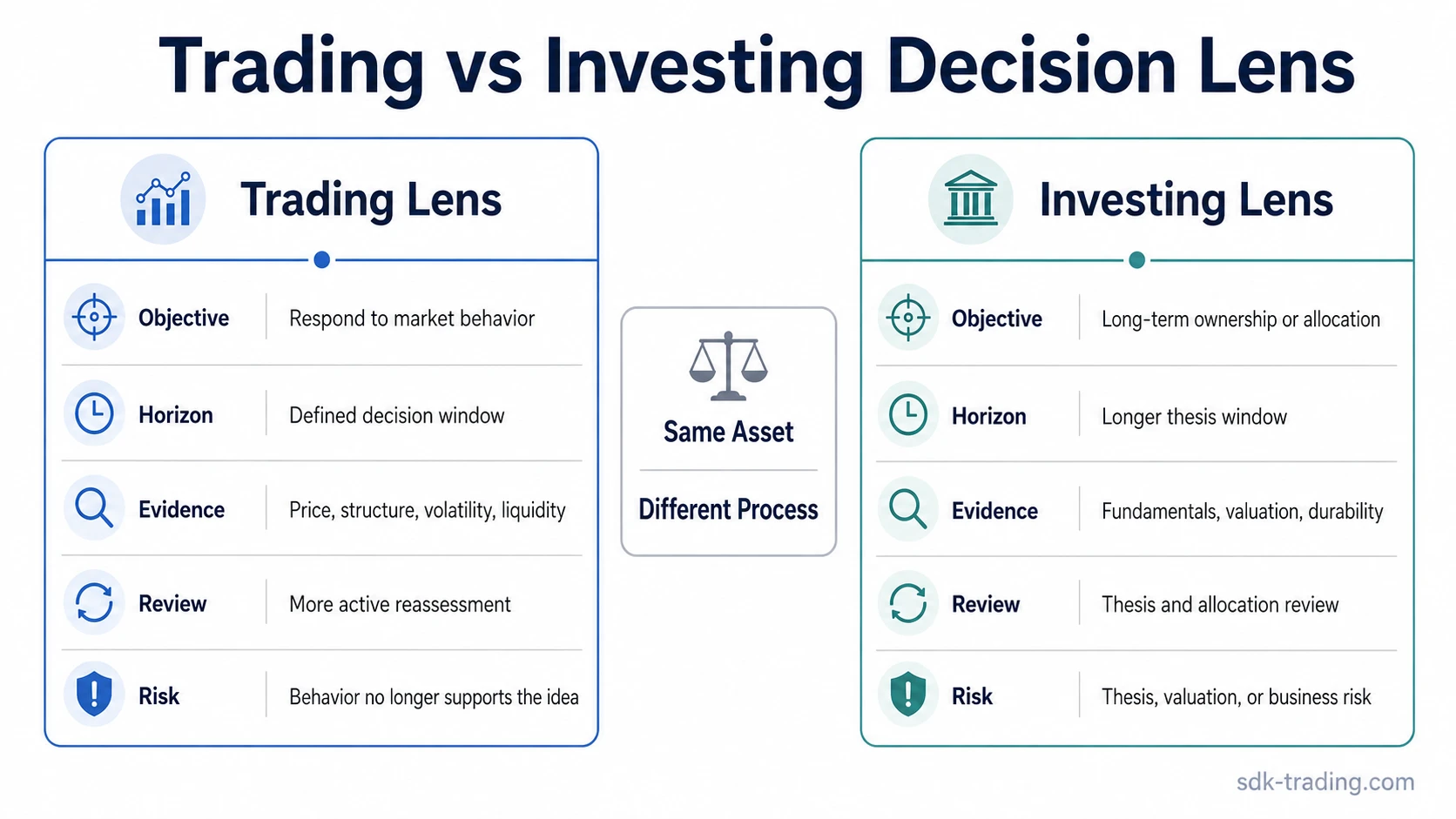
Trading and investing can involve the same asset, but the decision logic is different. The difference is not that one is serious and the other is careless. The difference is the objective, time horizon, review cadence, and risk definition.
| Criteria | Trading | Investing |
|---|---|---|
| Main objective | Respond to price movement or market behavior within a defined decision horizon. | Participate in long-term value, cash flow, ownership quality, or asset appreciation. |
| Review cadence | Usually reviewed more actively as evidence changes. | Usually reviewed around thesis, valuation, business quality, allocation, or long-term conditions. |
| Evidence focus | Price behavior, structure, volatility, liquidity, technical evidence, or event response. | Fundamentals, valuation, durability, portfolio role, and long-term risk. |
| Risk definition | Often tied to whether the market behavior still supports the idea. | Often tied to thesis deterioration, valuation risk, business risk, or allocation risk. |
The same stock, ETF, currency pair, or crypto asset can be approached through either lens. The approach is defined by the decision process, not by the asset label alone.
Markets and Instruments Used in Trading
Trading can occur across many financial markets. Common examples include stocks, ETFs, indices, currencies, commodities, futures, options, contracts for difference where available, and digital assets.
When the traded market is digital assets, crypto trading adds extra considerations around volatility, liquidity fragmentation, exchange risk, and market structure. Those features do not change the basic definition of trading, but they can change how risk and evidence need to be evaluated.
A market list should not be confused with a trading process. Knowing what can be traded is only the scope question. The stronger question is how the decision is formed, what supports it, and what would make the interpretation unreliable.
Risk and Uncertainty in Trading
Trading always involves uncertainty because future market behavior is not known in advance. A structured process can organize decisions, but it cannot remove the possibility of loss, slippage, emotional error, poor liquidity, unexpected news, or a market move that invalidates the original interpretation.
Limitation: A trading idea is incomplete when it only describes potential movement. It also needs a defined horizon, a reason the market behavior matters, and a condition that would make the idea less reliable.
Risk also changes by product. A cash stock position, leveraged derivative, currency trade, futures contract, or crypto asset can all expose the trader to different mechanics. A simple definition of trading is useful only when it is paired with the reality that different markets carry different risk structures.
Common Beginner Mistakes
Many beginner mistakes come from defining trading too loosely. The activity can look simple from the outside because prices move on a screen, but the decision quality depends on process, evidence, and risk control.
| Mistake | Why it creates confusion | Cleaner question |
|---|---|---|
| Equating trading with fast money. | It shifts attention from process quality to outcome desire. | What market evidence supports the decision? |
| Choosing an asset before defining the process. | The asset becomes the focus before the risk and horizon are clear. | What role does this market play in the decision? |
| Reacting to volatility as if movement is enough. | Large movement can increase risk as much as opportunity. | Is the movement accepted, rejected, or still unresolved? |
| Confusing market access with market understanding. | Execution tools do not replace analysis, planning, or review. | What would make the interpretation weaker? |
After the basic definition is clear, trading for beginners can help organize the next concepts, such as market structure, risk control, technical analysis, and review horizon.
Simple Trading Example in Context
Price moves quickly after a market event, and a learner assumes that the movement itself is what trading means. A safer reading separates the event from the process. The move creates a possible decision environment, but the interpretation is still incomplete until the market shows whether the new price area is being accepted, rejected, or left unresolved.
The case is more disciplined if the trader can explain why the move matters, how long the idea is being reviewed, and what later behavior would make the interpretation unreliable. If price only spikes and then fails to hold the new area, the activity is closer to reacting to movement than applying a defined trading process.
Where Trading Fits in Market Context
Trading sits between market observation and risk-aware decision-making. A chart, headline, or fast move may start the question, but the decision needs structure. Market phase, liquidity, volatility, process quality, and time horizon can all change the interpretation.
That is why trading should not be reduced to one asset class, one platform, or one timeframe. A cleaner definition treats trading as a conditional process: observe the market, form a reasoned interpretation, define the horizon, accept uncertainty, and reassess when evidence changes.
FAQ
What is trading in simple terms?
Trading is making active decisions in financial markets based on changing prices, evidence, time horizon, uncertainty, and risk. It is not defined only by speed, asset choice, or platform access.
How does trading work?
Trading works when market participants exchange exposure to financial assets or contracts. A trader forms a decision from market evidence, monitors whether that evidence still holds, and accepts that the outcome is uncertain.
Is trading the same as investing?
Trading and investing can use the same markets, but they usually differ by objective, time horizon, review cadence, and risk definition. Trading is usually more active and evidence-responsive, while investing often focuses on longer-term ownership or allocation logic.
What is the biggest beginner mistake in trading?
A common beginner mistake is treating price movement or profit potential as enough. A trading idea is weaker when the process, time horizon, risk boundary, and invalidating condition are not defined.