Oscillators in trading are technical indicators that transform price, range, momentum, or price-plus-volume data into readings around a defined scale or reference level. Different oscillators can react differently to the same market move because their calculations measure different parts of price behavior.
Definition: Trading oscillators are chart indicators that measure price movement through a bounded scale, a centerline, a range-position formula, or another momentum reference. The main families differ by calculation input, scale design, and the market behavior they are built to measure.
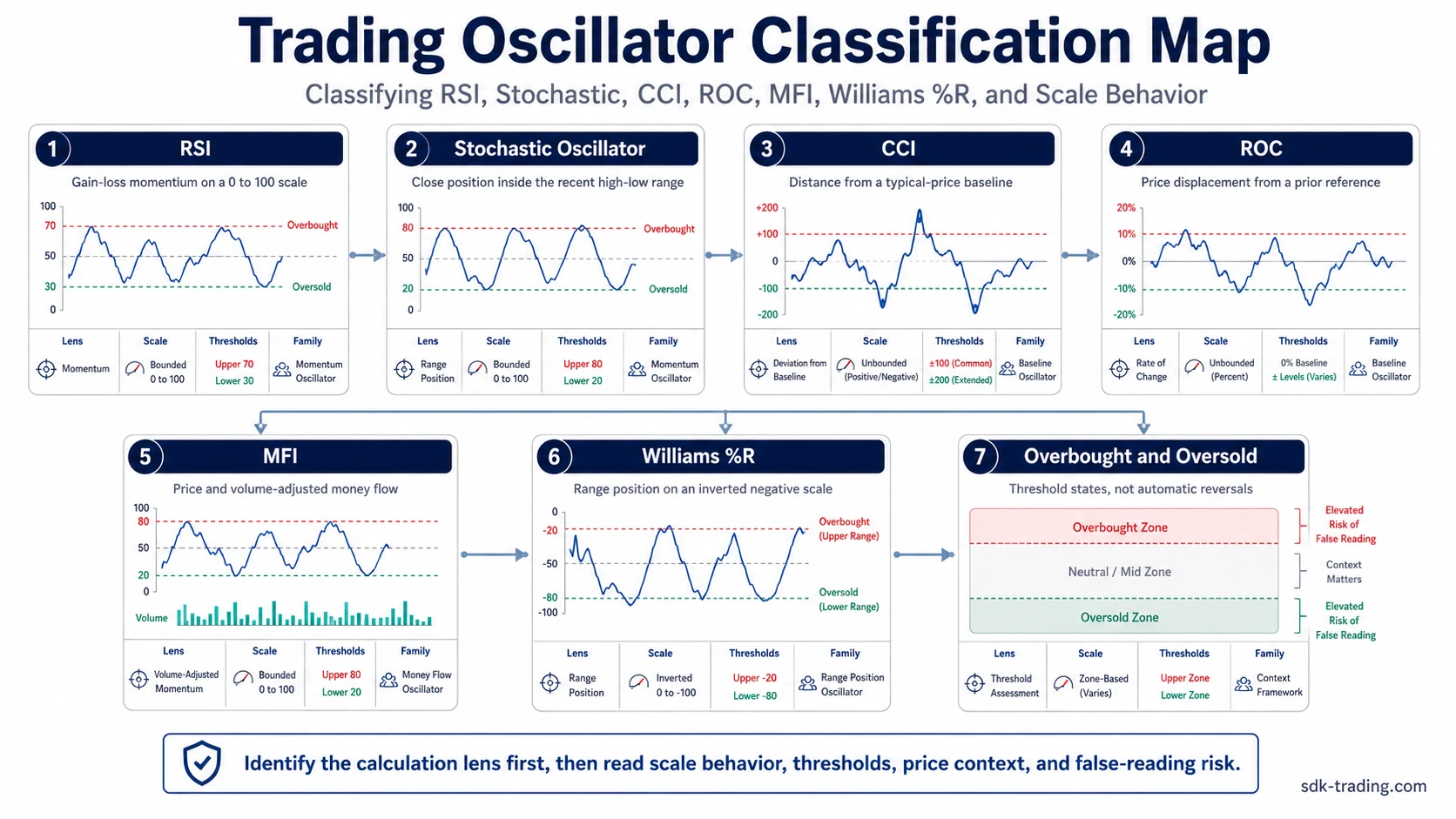
Key Points
- Oscillators do not all measure the same input. Some compare gains and losses, some measure range position, and others track displacement, rate of change, or price-plus-volume behavior.
- Bounded, centered, range-position, and histogram-style oscillators use different reference structures.
- The oscillator should match the question being asked: momentum strength, range position, price displacement, volume-adjusted pressure, or threshold behavior.
- Two oscillator readings can differ without either calculation being wrong because they may be measuring different characteristics of the same move.
Trading Oscillator Choice Map
A practical way to choose an oscillator is to start with the calculation. If the question is about recent gains and losses, range position, distance from an average, rate of change, or volume-adjusted pressure, each problem points to a different indicator family.
| Reader question | Best route | What the calculation measures |
|---|---|---|
| How do recent gains and losses compare inside a bounded scale? | RSI indicator | Compares recent upward and downward price changes inside a 0 to 100 scale. |
| Where is the close relative to the recent high-low range? | Stochastic Oscillator | Measures the closing price relative to the selected high-low range. |
| How does stochastic logic behave when applied to RSI itself? | Stochastic RSI | Measures the position of RSI within its own recent range. |
| How far has typical price moved from an average baseline? | CCI indicator | Measures deviation of typical price from its moving average. |
| How much has price changed from a previous reference point? | ROC indicator | Measures percentage price change across a selected lookback period. |
| How does volume-adjusted money flow change with price? | MFI indicator | Combines price and volume-derived money flow inside a bounded scale. |
| Where does the close sit inside the recent range on an inverted scale? | Williams %R indicator | Measures closing-price position relative to the recent high-low range. |
| How can several momentum windows be combined? | Ultimate Oscillator | Combines buying pressure and true range across multiple lookback periods. |
| How can shorter and longer momentum behavior be compared in a histogram? | Awesome Oscillator | Compares two moving averages of median price and plots their difference. |
| What do high and low oscillator zones mean? | Overbought and oversold readings | Explains threshold states across oscillator types. |
Oscillator Families Use Different Reference Scales
The scale is part of the indicator design. RSI and Stochastic operate inside a fixed 0 to 100 range. Williams %R expresses a similar range-position idea through a negative scale. CCI can move beyond commonly watched reference levels, while ROC measures percentage change around a zero reference. Histogram-style tools such as the Awesome Oscillator display the difference between two calculated series.
| Oscillator family | Reference structure | Typical measurement |
|---|---|---|
| Bounded momentum | Fixed upper and lower limits | Relative strength or pressure inside a defined scale. |
| Range position | Recent high-low range | Where the current close sits within that range. |
| Centered or baseline displacement | Zero line or average reference | Distance or movement relative to a central baseline. |
| Volume-adjusted momentum | Price plus volume input | Momentum behavior with participation included in the calculation. |
| Histogram comparison | Difference between calculated series | Relative change between faster and slower momentum components. |
Why Different Oscillators Can Show Different Readings
Consider one price advance. RSI can rise because recent gains have become larger than recent losses. Stochastic can remain near the upper part of its scale because price keeps closing near the top of the recent range. CCI can expand because typical price has moved farther from its average, while ROC records the size of the change from a previous price.
MFI can add another result because volume is included in its calculation. The readings differ because the inputs and formulas differ. For the broader momentum question, the important distinction is developed further in the dedicated momentum-indicator framework below.
Related Oscillator Comparisons and Frameworks
The individual oscillator pages explain their calculations. The following pages cover questions that require comparison, broader momentum classification, threshold interpretation, or a trading workflow.
| Reader problem | Best route | Use when |
|---|---|---|
| RSI and CCI appear to describe different momentum conditions. | CCI vs RSI | The question is about gain-loss momentum versus displacement from an average baseline. |
| RSI and Stochastic produce different readings. | RSI vs Stochastic Oscillator | The distinction is recent gain-loss behavior versus closing-price position inside a range. |
| The reader wants to understand why momentum tools measure the same move differently. | Momentum indicators explained | The question is about momentum measurement across different formulas and inputs. |
| The reader wants to use oscillator readings inside a trading process. | Oscillators for trading guide | The question has moved from indicator classification into interpretation and workflow. |
| The reader is comparing high and low threshold states. | Overbought vs oversold explained | The main issue is the difference between upper and lower threshold conditions. |
| The reader wants a framework built specifically around RSI. | RSI strategy framework | The question is about applying RSI inside a broader analytical process. |
How to Choose an Oscillator
Start with the variable you want to measure. RSI answers a different question from Stochastic; CCI answers a different question from ROC; MFI adds volume where most price-only oscillators do not.
After the measurement is clear, the scale becomes easier to interpret. A fixed range, a zero line, an average baseline, and a histogram are different output structures. The individual indicator page should then be used for the formula, settings, and detailed interpretation of that specific oscillator.