A take profit is a planned favorable-side exit condition used to close or reduce a trading position when price reaches a predefined profit area. It can be handled manually or through an order, but in both cases the key idea is the same: the favorable exit is defined before the decision becomes reactive.
Definition: Take profit means a planned exit level or order condition for capturing a favorable move. It defines where exposure should be reduced or closed if price reaches the target area, instead of leaving the exit entirely to later discretion.
A take-profit plan helps organize the reward side of a trade. It does not guarantee that the market will reach the planned level, that the order will trigger exactly where expected, or that the final executed fill will match the intended price perfectly.
Key Points
- A take profit is a planned favorable-side exit, not a prediction that price must reach the target.
- A take-profit order can automate the exit process, but trigger logic and final execution are separate parts of the mechanism.
- Take profit and stop loss control opposite sides of a trade plan: one defines reward capture, while the other defines the unfavorable-side boundary.
- A take-profit level can close the whole position or only part of it, depending on the exit design.
- A fixed profit target can improve discipline, but it can also cap exposure before a larger move fully develops.
What Take Profit Means in Trading
Take profit is the planned point where a favorable move has reached an area that justifies changing exposure. The main benefit is not certainty. It is pre-commitment. The trader decides in advance how the position should change if price reaches a chosen area, instead of making the exit only under live emotional pressure.
This is different from casual profit taking. A trader may take profits because of discomfort, impatience, or a changing market view. A take profit, in the stricter order and risk-planning sense, is tied to a predefined level, area, or rule for reducing or closing exposure.
Boundary: A take-profit level defines a planned response if price reaches a favorable area. It does not prove that the move will continue to the target, reverse from the target, or validate the original trade idea by itself.
How a Take-Profit Order Works
A take-profit order turns the planned favorable exit into an order instruction. When the required price condition is met, the order process begins according to the instrument, trading venue, and execution rules. The result may be a full exit, a partial exit, or another predefined reduction of exposure.
The mechanism can be read as a simple sequence:
- Planned favorable area: The trader defines where the position should change if price reaches a chosen reward zone.
- Order setup or manual rule: The exit is prepared either as an automated instruction or as a clearly defined manual action.
- Condition is reached: The relevant market-price condition activates the next step in the process.
- Execution attempt: The position is closed or reduced according to the available liquidity and order-handling logic.
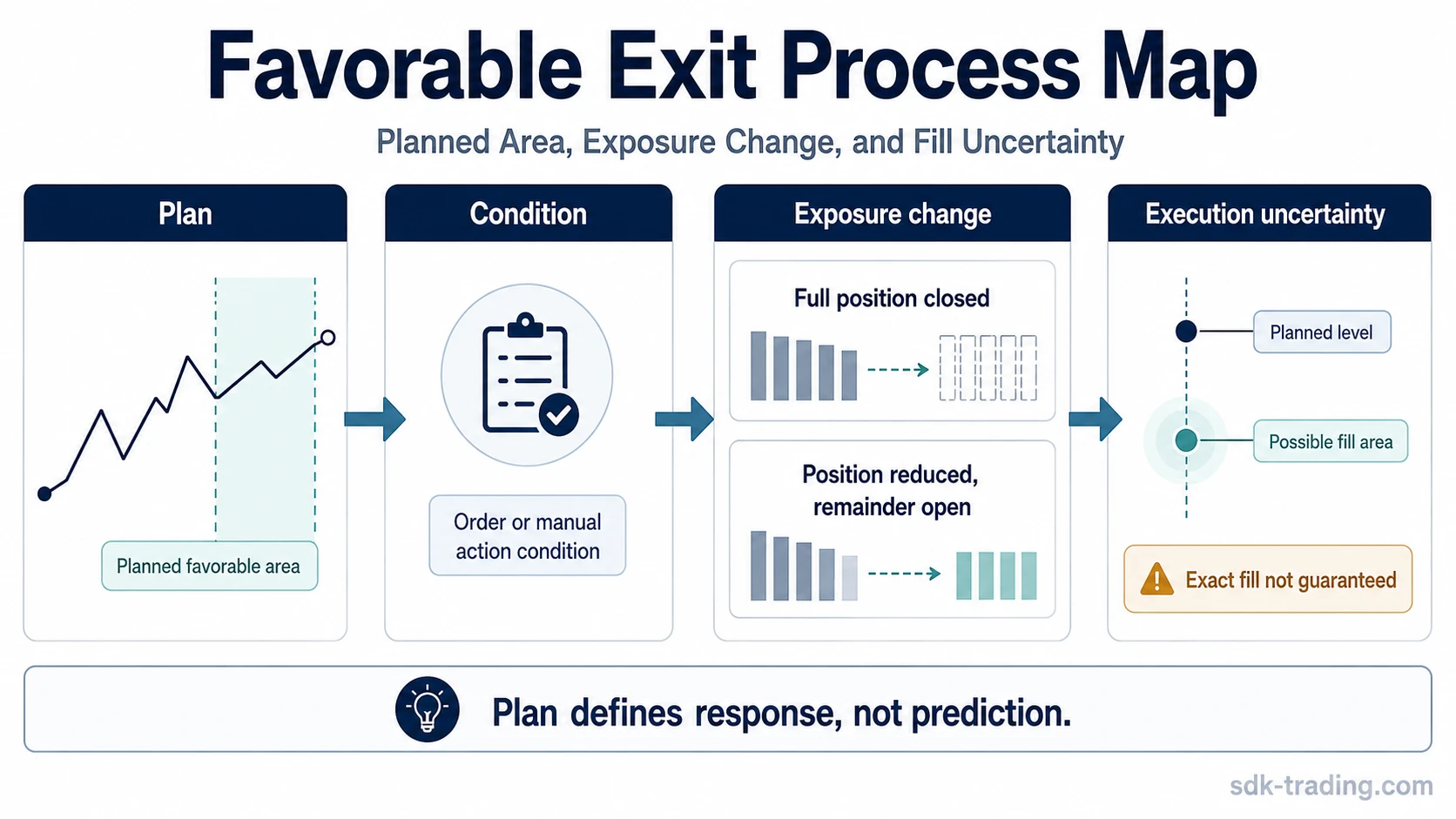
Execution limit: The planned target area and the final executed price are not always identical. Fast movement, thin liquidity, gaps, and order-routing conditions can affect how the exit is actually filled.
Take Profit Level, Trigger Condition, and Final Fill
One of the most important distinctions is that a take-profit plan contains more than one price concept. The planned level, the condition that triggers the order logic, and the final executed fill are related, but they are not the same thing.
| Layer | What it means | Why it matters |
|---|---|---|
| Planned take-profit level | The favorable price area defined in advance as an exit reference. | This is the intended reward-side decision point. |
| Trigger condition | The market-price condition used by the system, broker, or venue to start the exit process. | The trigger may depend on how the instrument and order logic are implemented. |
| Final executed fill | The actual price where the position is closed or reduced. | The final fill can differ from the planned level because execution still depends on liquidity and market conditions. |
This distinction explains a common confusion. A trader may say, “My take profit was at this level,” but three different things may still be involved: the level that was planned, the condition that activated the exit, and the price where the fill actually happened.
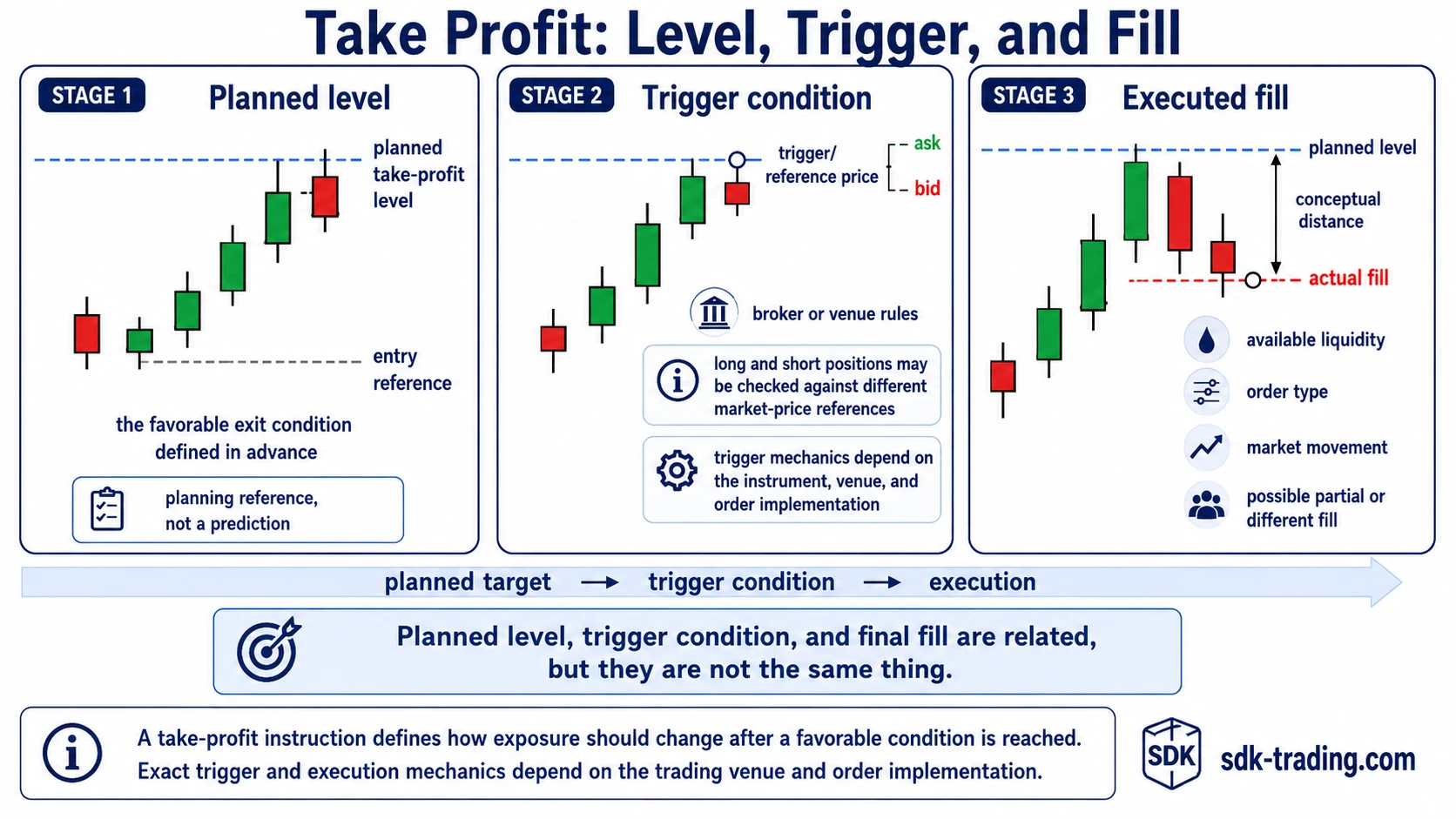
Mechanics distinction: A take-profit instruction defines how exposure should change after a favorable condition is reached. Exact trigger and execution mechanics depend on the instrument, trading venue, and order implementation.
Take Profit vs Stop Loss
Take profit and stop loss both belong to exit planning, but they control different sides of the trade. Take profit deals with the favorable side of price movement. Stop loss defines the unfavorable-side boundary, where the trade premise or the acceptable risk limit is no longer valid.
| Concept | Primary role | Main question it answers |
|---|---|---|
| Take profit | Reward-side exit planning | How should exposure change if a favorable area is reached? |
| Stop loss | Unfavorable-side risk control | Where does the position need protection if the trade goes wrong? |
A trailing stop adds a different kind of exit logic because its boundary can move after price changes. A fixed take-profit area stays in place unless the trader deliberately changes the plan.
Take Profit, Risk-Reward, and Target Realism
A take-profit level helps define the reward side of a risk-reward plan. The stop area defines the risk boundary, while the take-profit area defines the intended favorable outcome. That relationship can make the setup easier to measure, but it does not make the outcome more certain.
Target realism matters because a distant target can make a trade look attractive on paper without making the move more likely to happen. A practical take-profit plan is tied to observable structure, volatility, liquidity, and the behavior of the instrument, not only to a preferred reward multiple.
Planning distinction: A target can describe potential reward, but it does not create that reward. Price still has to travel to the area, the exit still has to trigger, and the fill still depends on market conditions.
Fixed Take Profit and Opportunity Cost
A fixed take-profit level can improve discipline because the exit rule is defined in advance. At the same time, it can cap the position once the target is reached. That tradeoff matters most when a method occasionally produces larger continuation moves instead of only repeated small gains.
This does not mean that fixed targets are wrong. A strategy may still benefit from them if it is designed around frequent, measured profit capture. The key point is simpler: a take-profit rule should fit the actual behavior of the setup, rather than being chosen only because the number looks attractive or psychologically comfortable.
Opportunity-cost tradeoff: Closing early can protect an already favorable move, but it can also remove participation before the move fully extends. That tradeoff should be treated as part of exit design, not as proof that one target style is always best.
Take Profit Example in Context
Example: A trader plans that if price reaches a prior resistance area, part or all of the position will be closed because the intended favorable move has already traveled into that zone. If price reaches the area, the take-profit plan changes exposure. If the move is fast or liquidity is thin, the final fill may still differ from the intended level. If only part of the position is closed, the remaining exposure stays open to future price movement.
The example is about exposure management, not prediction. The planned area does not prove that price must reverse there. It only defines what the trader intends to do if that area is reached.
What Take Profit Controls and What It Does Not Control
Take profit controls the planned response to a favorable price move. It can define where the trader intends to exit, how much exposure may be reduced, and how reward capture fits with the original trade plan.
It does not control whether the market will reach the level, whether execution will be exact, or whether price will continue after the exit. Those are separate uncertainties.
| Controlled by take profit | Not controlled by take profit |
|---|---|
| Planned favorable-side exit area | Whether price will reach that area |
| Amount of exposure intended to close or reduce | Whether the market continues after the exit |
| Reward-side structure of the trade plan | Exact final fill quality in all market conditions |
| Exit discipline before the decision moment | Trade quality, win rate, or future price direction |
Partial Take Profit Boundary
A full take profit closes the entire position at the planned favorable exit. A partial take profit closes only part of the position, which means the remaining portion can still rise, fall, or fluctuate after the first exit.
This matters because partial profit-taking reduces exposure without fully ending the trade. The closed portion is no longer at risk, but the open portion still depends on later price movement and later execution decisions.
Common Misunderstandings About Take Profit
| Misunderstanding | Safer interpretation |
|---|---|
| A take-profit level predicts where price will go. | It defines a planned response if price reaches a favorable area. |
| A take-profit order guarantees the target fill. | Execution can still be affected by liquidity, gaps, routing, and slippage. |
| Planned level, trigger price, and fill price are the same thing. | They belong to the same process, but each describes a different step. |
| Taking profit proves the trade was strong. | A favorable exit does not automatically prove that the original trade quality was strong. |
| The farthest target is always the best one. | A distant target may improve theoretical reward while still being unrealistic for the actual setup. |
Related Order and Exit Concepts
Take profit belongs inside the broader exit-planning process. Stop loss defines the unfavorable-side boundary. A trailing stop defines an exit boundary that may move with price. Partial take profit defines how much exposure is reduced instead of whether the whole position is closed.
The exit price is the actual price where the position changes after execution. That can differ from the intended take-profit level because planning, triggering, and execution are separate parts of the exit process.
FAQ
What is take profit in trading?
Take profit is a planned favorable-side exit level or order condition used to close or reduce a position when price reaches a predefined profit area.
Is take profit the same as stop loss?
No. Take profit is used on the favorable side of a trade to capture planned reward, while stop loss is used on the unfavorable side to limit or control risk.
Does a take-profit order guarantee the final fill price?
No. A take-profit order can automate the exit process, but the planned level, the trigger condition, and the final executed fill are not always identical. Liquidity, gaps, slippage, and execution rules can all affect the result.
What is partial take profit?
Partial take profit means closing only part of the position at a favorable area while leaving the remaining portion open and exposed to future price movement.