Elliott Wave is a technical-analysis framework for organizing market movement into impulse waves, corrections, pattern families, and alternative scenarios. The first task is not to force a wave count, but to decide which structural question is being asked: is price expanding, correcting, compressing, or moving through a transition that still needs more evidence?
Definition: Elliott Wave analysis, often referred to as Elliott Wave Theory or the Wave Principle, maps price movement into recurring wave structures. In trading context, the framework separates directional impulse movement from corrective movement, then uses rules, guidelines, degrees, and pattern relationships to keep a market scenario organized without treating the count as certainty.
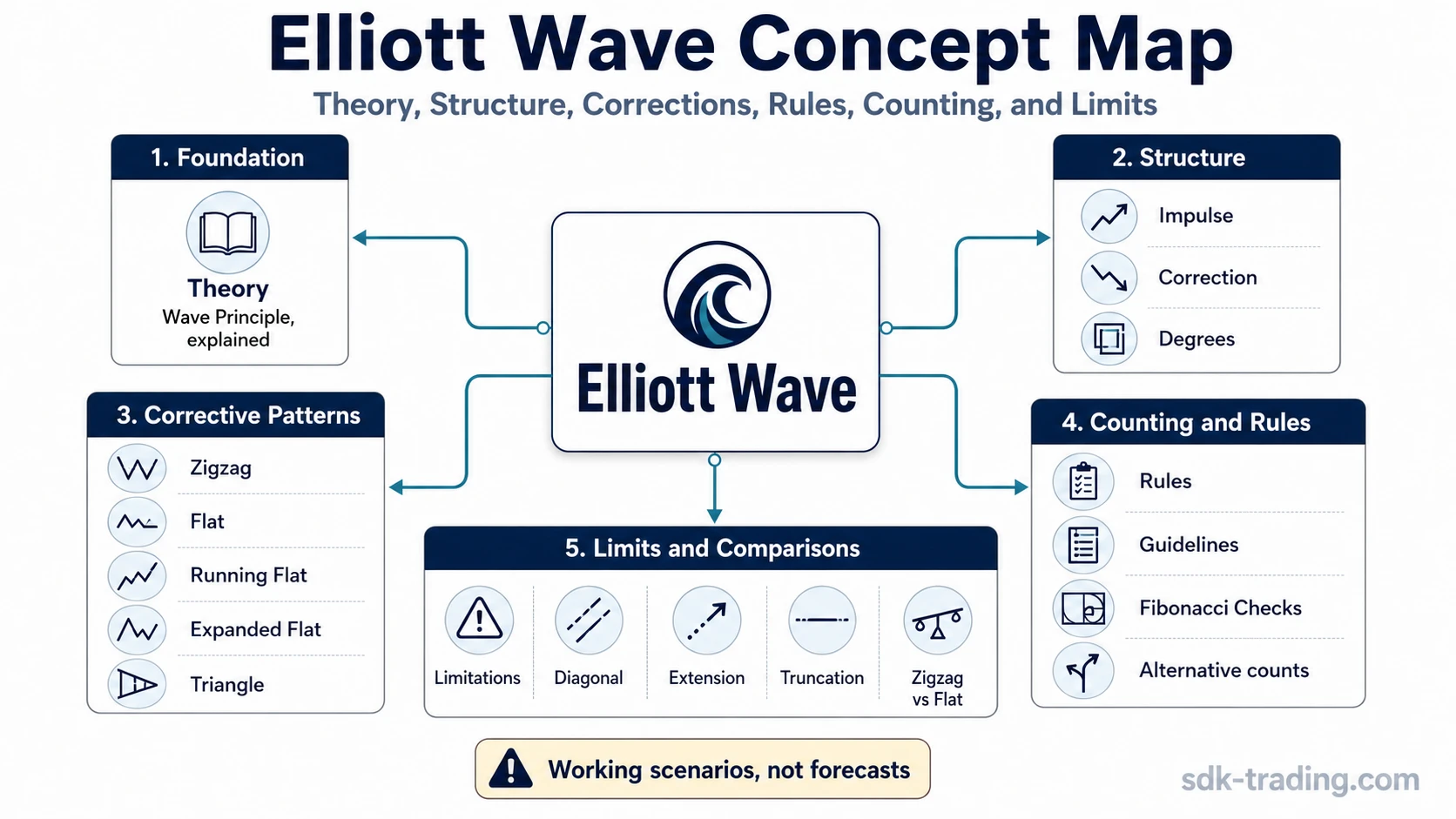
A broad Elliott Wave question can lead in several directions. Some chart situations require a beginner explanation, some require the difference between impulse and correction, and others require specific corrective structures such as zigzags, flats, triangles, running flats, or expanded flats. The useful starting point is the structural layer, not the label that sounds most decisive.
Key Points
- Elliott Wave separates directional impulse movement from corrective movement.
- Wave labels describe working scenarios, not certain forecasts or standalone trade signals.
- Rules help reject invalid counts, while guidelines and proportions help compare possible counts.
- Corrective structures such as zigzags, flats, running flats, expanded flats, and triangles need separate classification.
- A useful Elliott Wave process starts with the broad structure first: foundation, impulse, correction, pattern family, counting process, or specific variant.
Choose the Elliott Wave Question You Need
Start with the structure you are trying to understand. A useful Elliott Wave process should narrow the choice before the chart is forced into a specific count.
| Market question | Concept to study | Use when |
|---|---|---|
| Beginner explanation | Elliott Wave explained | You need the basic idea before studying specific structures. |
| Directional wave structure | Elliott Wave impulse | You are studying a directional expansion phase rather than a corrective phase. |
| Corrective movement | Elliott Wave correction | You are trying to classify a pullback, sideways move, or countertrend structure. |
| Pattern family | Elliott Wave patterns | You need the main pattern families before choosing a narrower structure. |
| Counting process | how to count Elliott waves | You are trying to label a sequence without ignoring invalidation or alternative counts. |
Core Elliott Wave Structures
The first distinction is impulse versus correction. An impulse describes directional expansion in the wave framework. A correction describes movement that interrupts, retraces, or consolidates that expansion. Many Elliott Wave mistakes begin when a trader labels a movement as directional before checking whether the structure is actually corrective or unresolved.
| Structure group | Concept | What to clarify |
|---|---|---|
| Wave size and hierarchy | Elliott Wave degrees | How smaller and larger wave sequences can exist inside the same market movement. |
| Impulse, correction, and pattern families | Impulse waves, corrections, and recurring pattern labels | Whether price is expanding directionally, correcting, compressing, or still unresolved. |
Illustrative scenario: A market can push higher, pause, retrace, and then move sideways before the next directional decision is clear. Elliott Wave vocabulary helps separate broad structural possibilities before a trader studies a specific impulse, correction, triangle, flat, or zigzag.
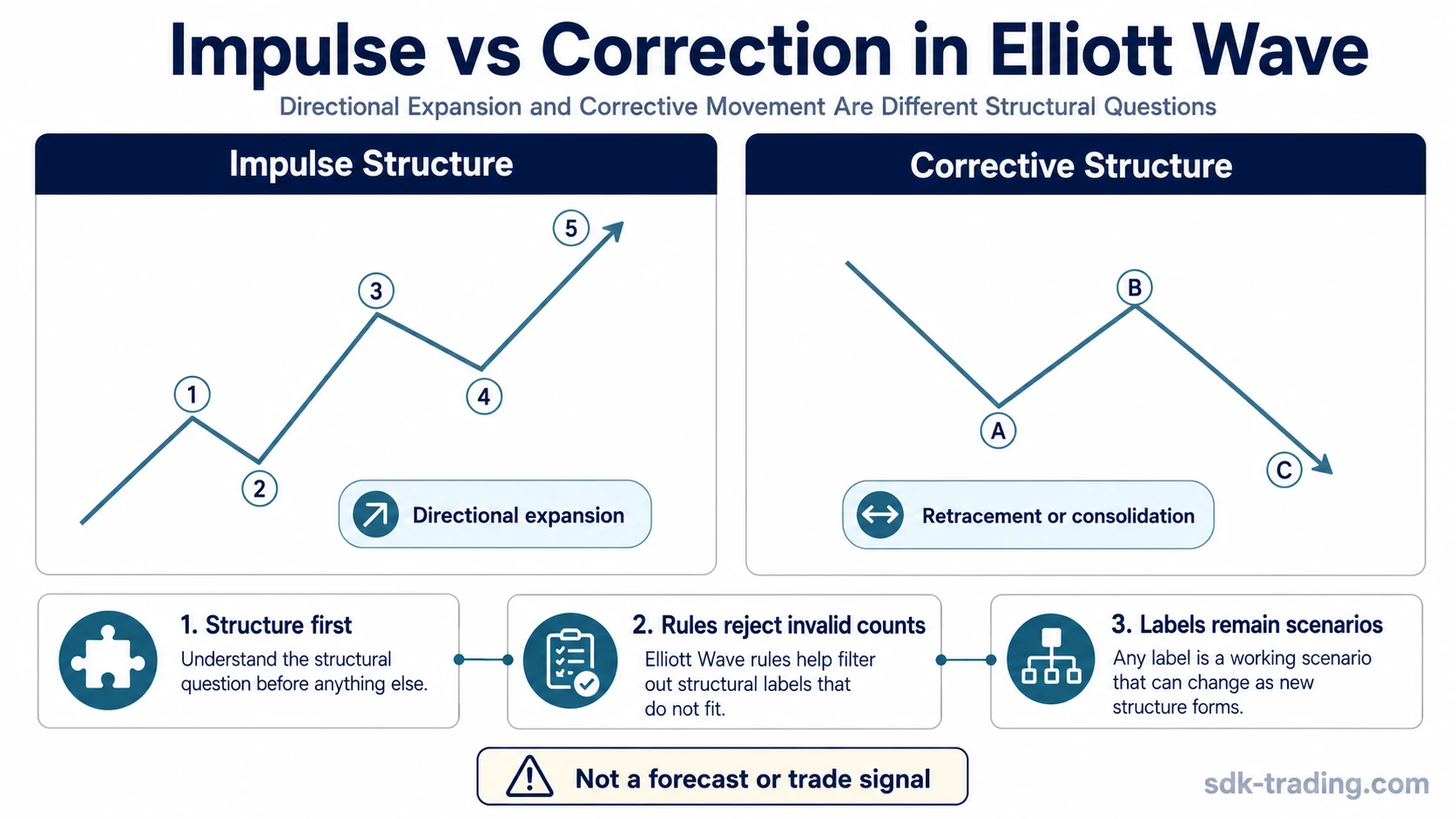
Corrective Elliott Wave Patterns
Corrective structures need separate treatment because they can look similar while carrying different structural meanings. A zigzag, flat, running flat, expanded flat, and triangle can all appear during corrective phases, but they do not describe the same shape, subdivision, or boundary behavior.
Corrective-structure check: Corrective patterns should be separated by family before a specific label is used. A sharp correction, sideways flat, expanded flat, running flat, or triangle can all belong to corrective analysis, but each structure has different boundaries and subdivision logic.
| Corrective structure | Best use | Main distinction |
|---|---|---|
| Elliott Wave zigzag | Sharp corrective movement | Zigzags usually need separate handling from flatter sideways corrections. |
| Elliott Wave flat | Sideways corrective structure | Flats can create confusion because price may revisit prior areas rather than retrace cleanly. |
| Elliott Wave expanded flat | Flat variant with expansion beyond the prior structure | The expanded version can be misread if the extra extension is treated as a simple breakout. |
| Elliott Wave running flat | Flat variant where the correction does not fully retrace in the expected way | The running version needs extra caution because the structure can look incomplete or compressed. |
| Elliott Wave triangle | Contracting or sideways corrective behavior | Triangles require attention to compression, sequence, and where the pattern appears in the larger count. |
Elliott Wave Rules, Counting, and Pattern Boundaries
Elliott Wave analysis depends on structure, but structure does not remove uncertainty. Rules help reject invalid counts. Guidelines help compare one possible count against another. Fibonacci relationships can be used as proportional checks, but they should not be treated as guaranteed targets.
| Question | Concept | What to watch for |
|---|---|---|
| Which wave counts are structurally invalid? | Elliott Wave rules | Use rules to reject weak labels rather than to force a preferred forecast. |
| What happens when a count is too subjective? | Elliott Wave limitations | Check whether the count is clarifying the market or only adding labels after the fact. |
Boundary: Elliott Wave counts are scenario tools. A count can be useful when it organizes impulse, correction, degree, and invalidation logic. It becomes weak when every new candle is forced into the same preferred label or when Fibonacci proportions are treated as certain price outcomes.
Diagonals, Extensions, and Truncations
Some Elliott Wave terms describe variations that can change how a structure is interpreted. These concepts become more useful after the difference between impulse and correction is clear, because the same surface movement can be labeled poorly if the variation is ignored.
| Variation | Concept | Why it matters |
|---|---|---|
| Diagonal | Elliott Wave diagonal | Diagonal structures can appear where a simple impulse reading may be too rigid. |
| Extension | Elliott Wave extension | Extensions help explain when one wave segment becomes unusually developed inside the sequence. |
| Truncation | Elliott Wave truncation | Truncation can show that a simple expectation for a new extreme may not match the actual structure. |
Elliott Wave Comparisons and Adjacent Concepts
Comparison work matters when two labels are close enough to create confusion. The goal is not to choose the label that sounds stronger. The goal is to separate what the structure actually shows.
| Comparison | Use when | What the distinction should prevent |
|---|---|---|
| Elliott Wave zigzag vs flat | A corrective move could be interpreted as either a sharp correction or a flatter sideways structure. | Mislabeling the correction type before the structure has enough evidence. |
After the main structural question is clear, the next step is to study the specific Elliott Wave concept that matches the chart context. Broad orientation helps only when it leads to a more precise structural distinction.
FAQ
What is Elliott Wave in technical analysis?
Elliott Wave is a technical-analysis framework for organizing market movement into impulse waves, corrections, pattern families, and alternative counts. It is used to structure scenarios, not to guarantee what price will do next.
Is Elliott Wave the same as a trading signal?
No. A wave count is not a buy or sell signal by itself. It can help classify market structure, but interpretation still depends on context, invalidation, and whether the count remains coherent as new price action develops.
Why do Elliott Wave counts often differ?
Counts differ because traders may assign different degrees, corrective labels, or alternative scenarios to the same movement. The useful test is whether the count follows clear structure and rules rather than whether it confirms a preferred view.