Elliott Wave patterns are structural classifications used to label repeated wave arrangements inside Elliott Wave analysis. The main distinction is between motive patterns, which move with the larger directional sequence, and corrective patterns, which interrupt, retrace, or reorganize that sequence.
Definition: An Elliott Wave pattern is a conditional structural label. It depends on subdivision, sequence, location, degree, and rule compliance. A visible shape alone does not confirm a forecast, create a trading signal, or prove that the next move is already known.
Key Points
- Elliott Wave patterns classify market structure; they do not predict outcomes by themselves.
- The two broad families are motive patterns and corrective patterns.
- A pattern label remains valid only while subdivision, degree, location, and rule conditions support it.
- Invalidated labels should be relabeled or treated as alternate counts, not defended after the structure changes.
- The safest use of a pattern label is diagnostic classification, not signal confirmation.
What Elliott Wave Patterns Are
Elliott Wave patterns describe how price movement is organized into wave sequences. The label is not assigned only because a chart appears to have five swings or three swings. The visible shape begins the analysis, but the label must still be tested against the internal structure of the move.
A pattern label answers a classification question: does the sequence behave more like a motive structure, a corrective structure, or an incomplete structure that needs an alternate count? That distinction matters because the same visible movement can be interpreted differently when subdivision, overlap, degree, or position in the larger count changes.
Boundary: Elliott Wave patterns are not standalone trading signals. A pattern name does not provide an entry, stop, target, probability, or confirmation that the next move must occur. It only describes the structure that is currently best supported under the wave rules being applied.
A practical way to read the label is to treat it as conditional. The pattern remains useful while the structure supports it. If later price action breaks the structural conditions behind the label, the count should be adjusted rather than forced.
Motive and Corrective Elliott Wave Pattern Families
The first classification split is between motive and corrective structures. Motive patterns are directional structures that move with the larger wave sequence. Corrective patterns move against, pause, or reorganize a prior movement. Subtype names are only useful after the broader family is structurally supported.
| Pattern family | Typical structure | Where it usually appears | What supports the label | What weakens or invalidates the label |
|---|---|---|---|---|
| Impulse | Five-wave motive structure | Directional movement within a larger sequence | Clear five-wave subdivision, rule compliance, and degree consistency | Rule violations, weak subdivision, or overlap behavior that does not fit the claimed impulse |
| Diagonal | Five-wave motive structure with diagonal-specific boundary behavior | Often near the beginning or ending area of a larger movement | Five-wave form, wedge-like boundary behavior, and location that supports a diagonal reading | Generic wedge shape without wave structure, wrong location, or subdivision that does not support the label |
| Zigzag | Corrective structure commonly described as A-B-C | Corrective movement against a larger sequence | Corrective context, clear A-B-C relationship, and subdivision that supports a sharp correction | Internal structure that does not fit the corrective label or a broader count that makes the reading less stable |
| Flat | Corrective A-B-C structure with flat-specific behavior | Corrective phase where wave B and wave C behavior matter heavily | B-wave behavior, C-wave termination, and subdivision consistent with a flat classification | Wrong subdivision, unsupported B-wave behavior, or C-wave behavior that points to another correction type |
| Triangle | Corrective consolidation structure | Corrective or pause-like area inside the larger count | Contracting or sideways wave behavior with subdivisions that support a triangle interpretation | Breaks in the expected internal sequence or a structure that resolves better as another corrective form |
| Combination or complex correction | Multiple corrective structures connected together | Extended corrective environments | Separate corrective segments that remain consistent with the broader count | Overfitting too many labels, ignoring degree, or forcing complexity where a simpler count remains stronger |
The family label should come before subtype confidence. For example, a correction may be visible before the specific corrective form is clear. Calling the subtype too early can make the count look more certain than the structure actually supports.
How Elliott Wave Patterns Are Identified
Identification begins with visible swings, but it does not end there. A five-swing movement may look like an impulse at first glance, while a three-swing movement may look corrective. Those observations are only the first filter.
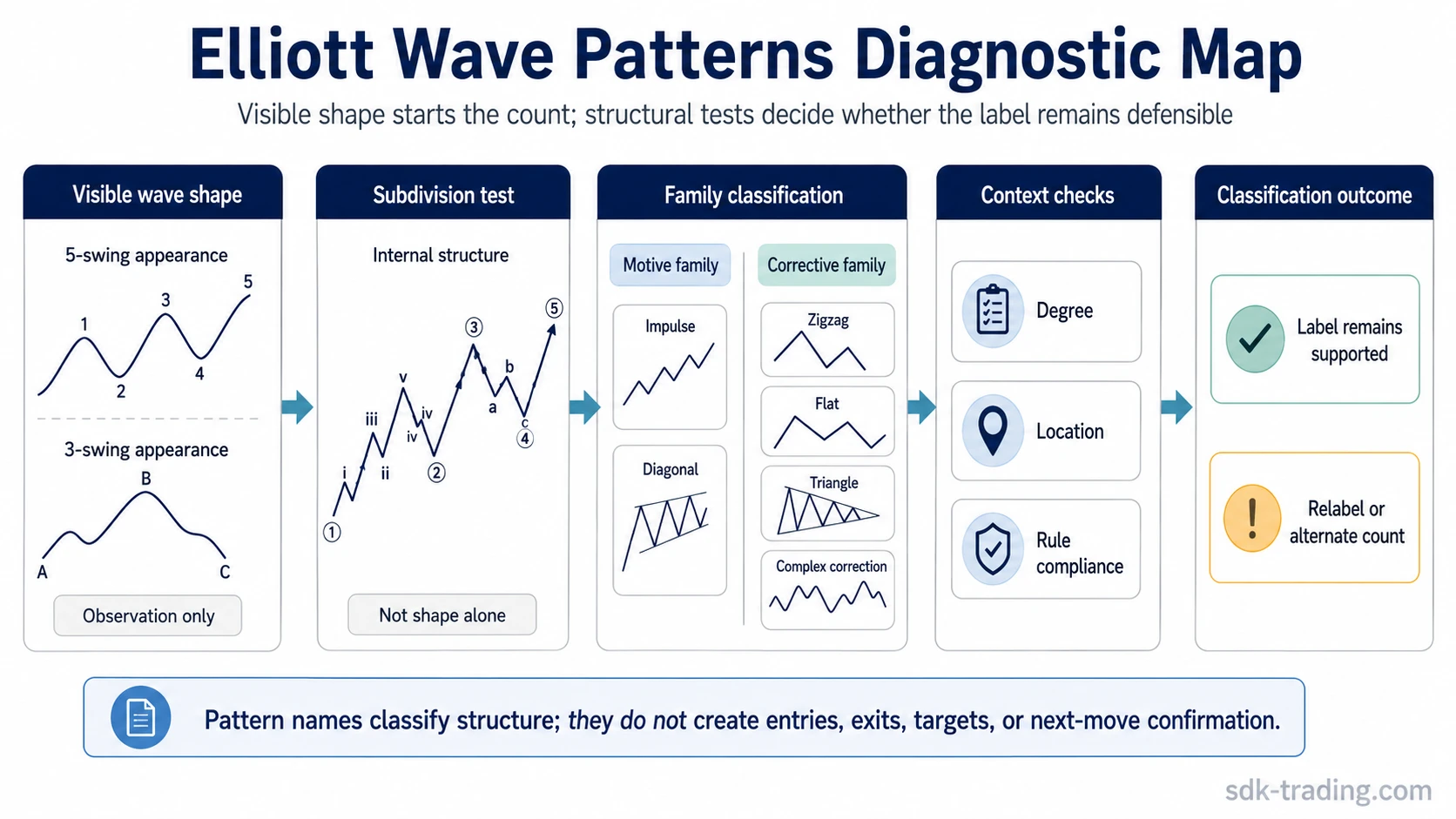
Diagnostic sequence: Visible wave shape -> subdivision test -> motive or corrective family test -> degree and location test -> rule and invalidation test -> label remains supported or must be relabeled.
- Visible sequence: Start by observing whether the movement appears directional, corrective, overlapping, expanding, contracting, or incomplete.
- Subdivision: Check whether each major wave breaks down in a way that supports the proposed pattern.
- Family classification: Decide whether the structure is better classified as motive or corrective before assigning a more specific subtype.
- Location: Test whether the pattern appears in a place where that label is structurally reasonable inside the larger count.
- Degree: Confirm that the wave labels are consistent with the scale of the surrounding structure.
- Rule compliance: Check whether the proposed count violates the rules or boundaries required for that pattern.
- Alternate count: Keep an alternate interpretation active when the structure is incomplete or when two labels remain possible.
Illustrative scenario: A visible five-swing advance may appear impulsive, but the impulse label remains provisional if the internal subdivision is unclear, the overlap behavior does not fit the proposed count, or the degree is inconsistent with the larger structure. In that case, the better reading may be an alternate count until the structure becomes clearer.
Degree is especially important because Elliott Wave analysis is fractal. A small pattern can sit inside a larger pattern, and the same visual shape may mean different things depending on the degree being labeled.
When an Elliott Wave Pattern Label Fails
A pattern label fails when the structure no longer supports the classification. This can happen because the subdivision is wrong, a required rule is violated, the location no longer fits, the degree becomes inconsistent, or a nearby alternate count explains the sequence better.
Invalidation boundary: Relabeling is not a weakness in Elliott Wave analysis. It is the classification process responding to new structural evidence. A count that ignores invalidation becomes less useful because it protects the label instead of reading the structure.
Some failures are direct. If a rule required by the proposed label is broken, the count should be rejected or revised. Other failures are comparative. The original label may not be formally impossible, but an alternate count may explain the sequence with fewer conflicts.
Termination behavior can also change the reading. A corrective form may remain plausible until the final wave behaves in a way that does not match the proposed classification. A motive pattern may remain plausible until overlap, subdivision, or extension behavior points toward another structure.
The useful discipline is to separate the pattern from the expectation. The label should describe the best-supported structure, not defend a preferred market view.
Common Elliott Wave Pattern Mistakes
The most common mistake is treating a visible five-wave or three-wave shape as confirmed before the structure has passed the diagnostic tests. Elliott Wave labels are not visual stickers placed on a chart after the fact. They are conditional classifications that must survive subdivision, degree, location, and rule checks.
| Mistake | Safer interpretation |
|---|---|
| Calling any five-swing move an impulse | A five-swing appearance starts the question, but the subdivision and rule structure decide whether impulse remains supported. |
| Calling every pullback a correction | A corrective label still needs structure. The move may be corrective, incomplete, or part of a larger pattern that has not resolved. |
| Ignoring wave degree | A label can look correct at one scale while conflicting with the larger count. Degree consistency protects the classification from scale confusion. |
| Forcing one count after the evidence changes | Alternate counts are part of the method when the structure remains incomplete or conflicting. |
| Reading the pattern as a trade instruction | A pattern label does not define entry, exit, risk, or outcome. It only classifies the structure being evaluated. |
Corrective structures are a frequent source of overconfidence because they can take several forms. A broad corrective phase may include zigzags, flats, triangles, or combinations, but the specific subtype still depends on structure rather than the label alone.
Related Elliott Wave Concepts
Several nearby Elliott Wave concepts affect how a pattern label is classified.
- Elliott Wave explained covers the broader theory context behind wave sequencing and market structure.
- Elliott Wave correction covers the corrective family that includes zigzags, flats, triangles, and complex corrections.
- Elliott Wave flat covers one specific corrective subtype where B-wave and C-wave behavior define the classification boundary.
- Elliott Wave extension covers a motive-wave condition where one wave becomes unusually elongated relative to the others.
- Elliott Wave degrees covers the scale problem that affects whether a label fits the surrounding count.
FAQ
Are Elliott Wave patterns trading signals?
No. Elliott Wave patterns are structural classifications. A label may help organize analysis, but it does not create an entry, exit, target, probability, or confirmation that the next move must occur.
What are the main Elliott Wave pattern types?
The broad families are motive and corrective patterns. Motive patterns include impulses and diagonals. Corrective patterns include zigzags, flats, triangles, and combination or complex corrections.
What makes an Elliott Wave count invalid?
A count becomes invalid or less defensible when the structure violates required rules, subdivision no longer supports the label, degree becomes inconsistent, or an alternate count explains the sequence better.
Why can Elliott Wave counts differ between analysts?
Counts can differ because analysts may choose different degrees, subdivisions, alternate counts, or pattern boundaries while a structure is still incomplete. The stronger count is the one that best survives the structural tests.