Chart patterns are multi-swing price structures formed by repeated interaction between highs, lows, support, resistance, trendlines, or range boundaries. The first task is to classify the structure before assigning a specific pattern name.
Definition: In trading, chart patterns are broader price formations that develop across several candles or swings. They can be classified by the relationship to the prior move and by geometry such as repeated levels, convergence, parallel boundaries, expansion, curvature, or more complex swing structure.
A visible shape can belong to different families depending on how its boundaries are built. Compression, for example, only tells you that the swing range is contracting. Whether the structure is better classified as a triangle, wedge, or another formation depends on the boundary geometry.
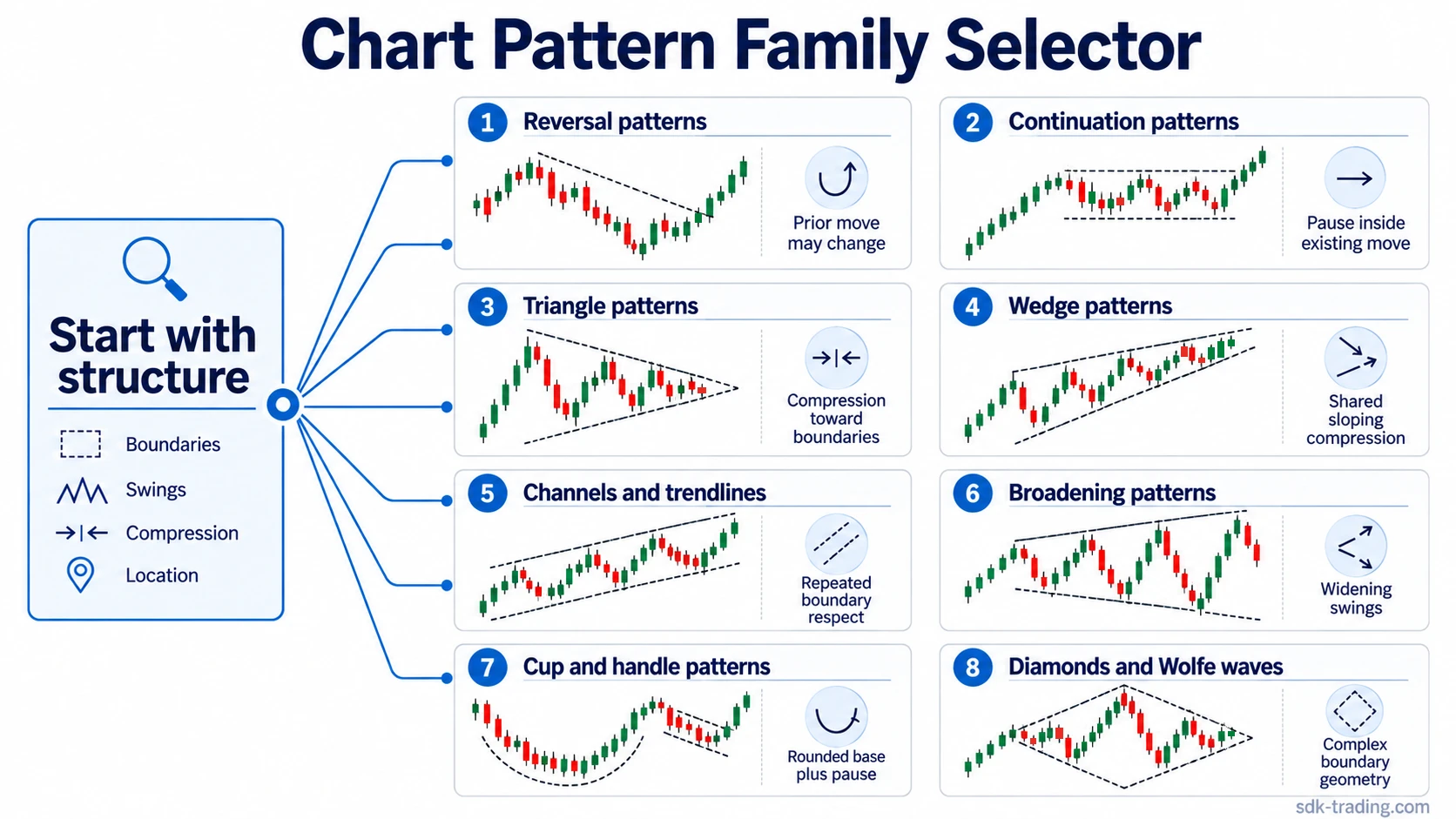
Classify the Structure, Then Choose the Pattern Family
Some chart-pattern families are defined mainly by their relationship to the preceding move. Others are easier to separate through the geometry of their boundaries. The table below is a routing map rather than a substitute for the detailed criteria on each family page.
| What the chart shows | Pattern family | First distinction to make |
|---|---|---|
| The structure develops around a possible change from the prior directional move. | Reversal patterns | Check the preceding trend and the structure that would have to change for the reversal classification to make sense. |
| Price pauses while the prior directional move remains structurally relevant. | Continuation patterns | Separate a controlled pause from a structure that has already become a broader reversal or range. |
| The swing range contracts between converging boundaries, often with one side horizontal or both sides converging. | Triangle patterns | Compare the slope of the upper and lower boundaries and whether the range is actually narrowing. |
| Both boundaries converge while generally moving in the same upward or downward direction. | Wedge patterns | Check for genuine contraction between two sloped boundaries rather than selectively drawn trendlines. |
| Price repeatedly moves between roughly parallel boundaries or follows a persistent trendline path. | Channels and trendlines | Look for repeated boundary interaction and broadly stable separation rather than convergence. |
| Successive swings become wider instead of narrower. | Broadening patterns | Confirm that the expanding highs and lows belong to one developing structure. |
| Price develops a rounded base followed by a smaller handle-like structure near the upper part of the formation. | Cup and handle patterns | Separate the broad base from the smaller handle rather than classifying any rounded structure as the full pattern. |
| The structure uses more complex expansion, contraction, or multi-boundary geometry. | Diamonds and Wolfe waves | Check whether the additional geometry is genuinely present or whether a simpler family explains the swings more cleanly. |
What Compression Means in a Chart Pattern
Compression means that the distance between successive swing highs and lows is shrinking. It describes what the range is doing, but it does not identify the finished pattern by itself.
| Boundary behavior | Structural reading |
|---|---|
| One boundary is nearly horizontal while the opposite boundary converges toward it. | Triangle-family geometry becomes the first classification route to examine. |
| Two boundaries converge while both slope broadly upward or downward. | Wedge-family geometry becomes the first classification route to examine. |
| Two boundaries remain roughly parallel. | The structure is behaving more like a channel than a compression pattern. |
| The distance between successive highs and lows increases. | The structure is expanding rather than compressing and belongs closer to the broadening family. |
This distinction explains why two patterns can both look compressed but still belong to different families. Contraction describes the change in swing range. Boundary geometry determines the more specific classification.
Chart Patterns vs Candlestick Patterns
Chart patterns operate at a broader structural level than candlestick patterns. A chart pattern usually needs several swings, repeated boundary interactions, or a recognizable multi-period formation. A candlestick pattern focuses on one candle or a small group of candles.
| Reading layer | Main unit | Typical classification question |
|---|---|---|
| Chart pattern | Multiple swings, boundaries, ranges, or trendlines | How is the broader price structure being organized? |
| Candlestick pattern | One candle or a small candle sequence | What relationship exists inside this short candle structure? |
When a Structure Is Not Ready to Classify
A pattern label becomes unreliable when the chart only resembles the expected shape after inconvenient swings are ignored or boundaries are repeatedly redrawn. The underlying geometry should be visible before the pattern name is applied.
Common warning signs include too few meaningful reactions, boundaries that depend on selective swing points, a supposed compression structure that no longer contracts, or an expanding range being forced into a converging pattern.
For a narrower review of these errors, chart pattern mistakes separates classification problems from valid structures that are simply imperfect.
Where to Go Next
If the main question is how swings, boundaries, and multi-period structures work before a specific family is chosen, chart patterns explained covers those mechanics in more depth.
If the goal is a broader reference list of the major pattern groups, types of chart patterns provides the dedicated taxonomy view.