Broadening patterns are chart-pattern structures where price swings expand between diverging boundaries. The first classification step is not to predict the next move, but to identify which widening structure is actually visible.
A defensible broadening-pattern reading starts with geometry: wider swings, boundary lines that move away from each other, and enough reactions on both sides to make the structure more than a forced drawing around volatility.
Core idea: a broadening pattern shows range expansion. The classification changes depending on whether the expansion is wedge-like, megaphone-like, rising, falling, top-forming, or bottom-forming.
Key Points
- Broadening patterns are defined by expanding price swings between diverging boundaries.
- The first task is classification, not directional prediction.
- Boundary slope helps separate broadening wedges, ascending variants, descending variants, broadening tops, broadening bottoms, and megaphone patterns.
- A defensible reading needs repeated reactions on both sides, not one volatile move or forced boundary placement.
- The broadening-pattern label should come before any later interpretation of continuation, reversal, breakout, or failure.
How Broadening Structures Widen
A broadening structure widens when later swing highs, swing lows, or both move farther apart than earlier swings. The boundaries should diverge rather than tighten. If the lines narrow toward an apex, the structure belongs closer to wedge or triangle analysis, not broadening-pattern classification.
Boundary slope is the next filter. Some broadening structures expand with one side rising and the other falling. Others expand while both sides slope upward or both sides slope downward. That slope behavior is what separates several broadening-pattern variants from one another.
| Structure clue | Classification meaning | Classification caution |
|---|---|---|
| Upper and lower boundaries move away from each other | The chart may belong to the broadening-pattern family | Do not label it from volatility alone |
| Both boundaries slope upward while the range expands | The structure may fit an ascending broadening wedge | The upper boundary should rise faster than the lower boundary |
| Both boundaries slope downward while the range expands | The structure may fit a descending broadening wedge | Both boundaries should still slope downward, not flatten into noise |
| One side rises while the other side falls | The structure may resemble a megaphone-style expansion or a broadening top/bottom variant | Use swing sequence and boundary quality before naming the variant |
Broadening Pattern Types
A broadening chart pattern is easier to classify when the visible structure is separated from assumptions about direction. Start with the swing shape, boundary slope, and reaction quality, then choose the closest pattern label.
| Visible structure | Closest pattern label | Main classification check | Avoid assuming |
|---|---|---|---|
| A widening structure that needs the general wedge-specific explanation | Broadening wedge pattern | Whether the widening structure behaves like an expanding wedge rather than a simple megaphone | Do not treat every widening chart as the same wedge variant |
| Higher swing highs and higher swing lows inside an expanding upward structure | Ascending broadening wedge structure | Whether both boundaries rise and the upper side expands faster | Do not assume the label from upward slope alone |
| Lower swing highs and lower swing lows inside an expanding downward structure | Descending broadening wedge structure | Whether both boundaries slope downward while the range widens | Do not force a falling channel into a broadening pattern |
| Expanding swings around a high-area structure | Broadening top pattern | Whether higher highs and lower lows create visible expansion near the upper part of a move | Do not treat the name as a prediction |
| Expanding swings around a low-area structure | Broadening bottom pattern | Whether the widening structure forms around a lower area with defensible boundary reactions | Do not label a single volatile low as a full pattern |
| A broad expanding formation with a megaphone-like outline | Megaphone pattern | Whether the structure expands outward with a clear megaphone-style shape | Do not confuse a rough price range with a clean expansion |
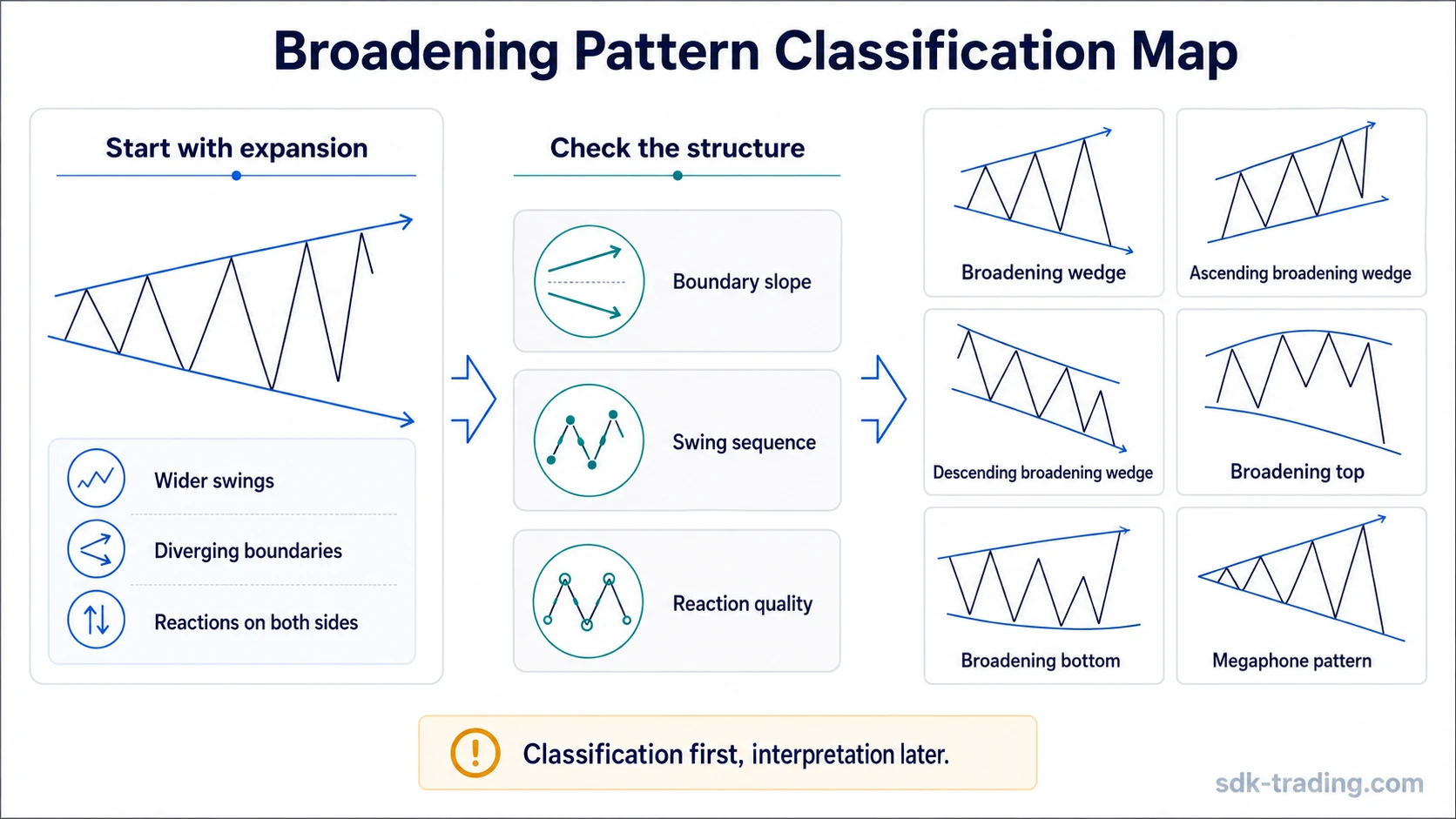
How to Read the Broadening Formation Map
Read the map from structure to label. First decide whether the chart is actually expanding. Then check whether the boundaries rise, fall, or open outward. Only after that should the chart be compared with wedge, top, bottom, or megaphone-style labels.
This order prevents the common mistake of naming a pattern from the expected outcome. A broadening top, broadening bottom, ascending broadening wedge, descending broadening wedge, and megaphone pattern all belong to the same widening family, but they are separated by boundary slope, swing location, and reaction quality.
Classification filter: start with visible expansion, then check boundary slope, swing sequence, and reaction quality. Directional interpretation comes after the structure is named, not before.
Common Broadening Pattern Misreads
Not every volatile chart is a broadening pattern. A single spike, one oversized candle sequence, or two roughly drawn lines around noise can create the appearance of expansion without producing a defensible structure.
| Weak reading | Why it fails | Stronger check |
|---|---|---|
| Only one large swing creates the apparent expansion | The pattern may be an outlier move, not a widening formation | Look for later swings that continue to expand the range |
| Boundaries are parallel or converging | The structure no longer behaves like a broadening pattern | Check whether the distance between the boundaries increases |
| Only one side has meaningful reactions | The opposite boundary may be forced | Require defensible contact on both sides |
| The label depends on future outcome | Classification should come from visible structure | Name the structure before interpreting later behavior |
A Short Classification Example
Suppose a chart makes a higher swing high, then a lower swing low, then a still higher swing high. That sequence may suggest broad expansion, but it is not enough by itself. The next check is whether both outer boundaries can be drawn from repeated reactions and whether the structure is wedge-like, megaphone-like, or better described as a top or bottom variant.
The safer label is the one that best matches boundary slope and reaction quality. If those checks remain unclear, the structure should stay unresolved instead of being forced into a broadening-pattern category.
Broadening Patterns vs Nearby Chart-Pattern Families
Broadening patterns are separated from ordinary wedges and triangles by expansion. Traditional narrowing wedges and many triangle structures contract as the pattern develops. Broadening structures do the opposite: later swings make the range wider.
They also differ from broad reversal or continuation labels. A reversal or continuation label describes an interpretation of market behavior. A broadening label starts with visible structure: boundary divergence, swing expansion, and reaction quality. That structural label should remain separate from any later directional interpretation.
Neutral Criteria for a Defensible Broadening Label
| Criterion | Defensible reading | Weak reading |
|---|---|---|
| Boundary divergence | The upper and lower boundaries move away from each other | The boundaries are flat, unclear, or converging |
| Swing expansion | Later swings expand the visible range | The chart only has one large move or one outlier spike |
| Reaction quality | Both sides show several meaningful reactions | One side is drawn through random points |
| Variant slope | The slope behavior matches the selected broadening variant | The label ignores whether boundaries rise, fall, or open outward |
| Interpretation discipline | The structure is named before any directional interpretation | The label is chosen because of an expected outcome |