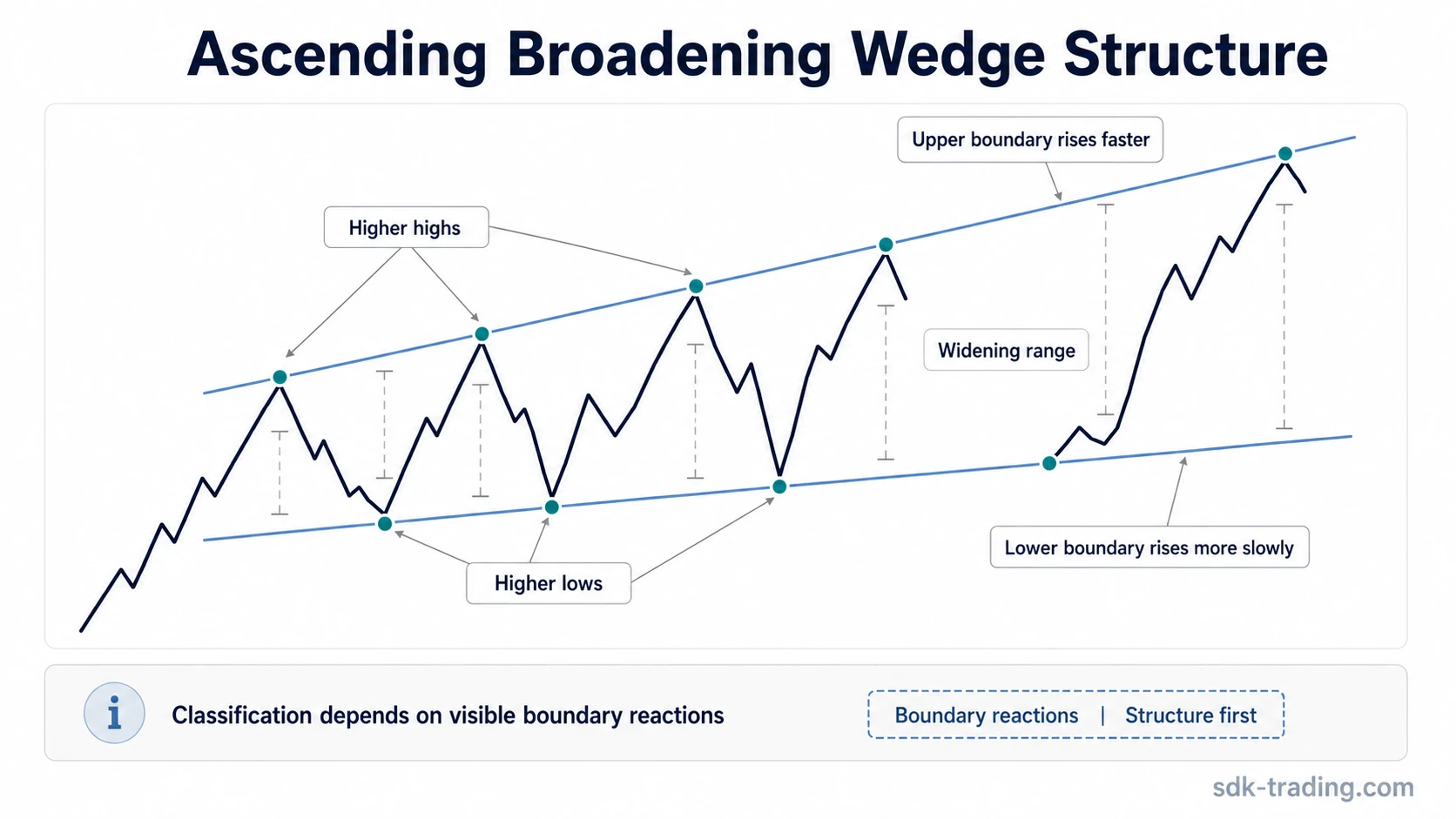
An ascending broadening wedge is identified by higher swing highs and higher swing lows expanding between two upward-sloping boundaries, with the upper boundary rising faster than the lower one. The visible test is whether price is widening upward while the trendline relationship still remains clear enough to classify.
The label describes structure first. It does not decide trade quality, future direction, or outcome by itself. Break direction can remain ambiguous until price behavior around the pattern boundaries becomes observable after the structure has already formed.
Key Points
- An ascending broadening wedge has two upward-sloping, diverging boundaries.
- The upper boundary should rise faster than the lower boundary, creating a widening range.
- The reading improves when repeated swing reactions make both boundaries observable rather than forced.
- The pattern weakens when reactions are sparse, slope quality is unclear, or the structure fits a broader pattern type better.
- The classification should be separated from a broadening wedge, a broadening top, and a descending broadening wedge.
What Is an Ascending Broadening Wedge?
An ascending broadening wedge is a chart pattern formed by a widening upward price structure. It normally requires higher swing highs, higher swing lows, two upward-sloping boundary lines, and a visible expansion between those boundaries as the structure develops.
Definition: An ascending broadening wedge is a broadening chart-pattern subtype where both boundaries slope upward, but the upper boundary rises more sharply than the lower boundary. The result is an upward structure that expands rather than narrows.
The word ascending refers to the upward direction of both boundaries. The word broadening refers to the expanding distance between them. The wedge label comes from the relationship between the two boundary lines, not from a fixed directional forecast.
The safer reading starts with classification before interpretation. A chart may look active or unstable inside the structure, but the label is only defensible when the widening range, higher swing sequence, and slope relationship are visible enough to separate it from nearby broadening patterns.
How to Identify an Ascending Broadening Wedge
The identification process starts with the swing sequence, not with a name placed over the chart. A valid reading needs a structure that can be drawn from observed reactions rather than from adjusted lines added after the fact.
- Price forms a sequence of higher swing highs.
- Price also forms higher swing lows.
- Both the upper and lower boundaries slope upward.
- The upper boundary rises faster than the lower boundary.
- The distance between the two boundaries expands as the pattern develops.
- There are enough repeated reactions to make the boundaries observable.
- The structure remains distinguishable from a generic broadening formation, a megaphone-like shape, or a descending subtype.
The slope-quality filter is important. If both lines rise at nearly the same rate, the structure may be closer to an upward channel. If the lower line does not slope upward, the pattern may belong to another broadening family. If the range does not expand, the broadening label is not doing useful work.
Ascending Broadening Wedge Structure: Clean, Weak, or Invalid
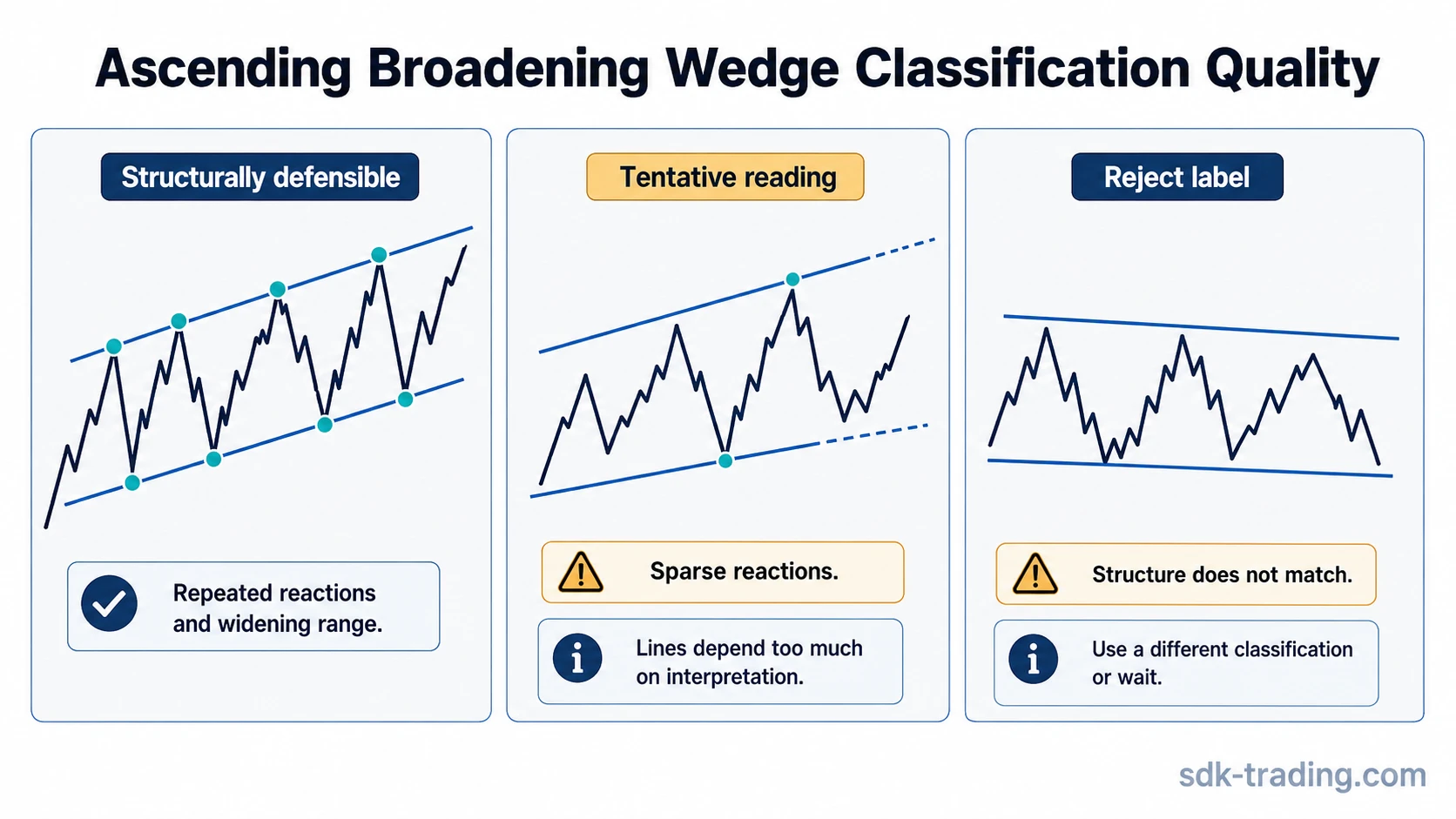
A clean classification depends on observable boundaries and repeated reactions. A weak classification depends too heavily on interpretation. An invalid reading usually appears when the chart shape is being forced into the label even though the boundary behavior does not support it.
| Reading quality | Observable condition | Safer interpretation |
|---|---|---|
| Clean classification | Higher highs and higher lows expand between two upward-diverging boundaries, with repeated reactions on both sides. | The ascending broadening wedge label is structurally defensible, although direction and quality remain separate questions. |
| Weak classification | There are too few reactions, shallow expansion, unclear slope difference, or boundary lines that require heavy adjustment. | The chart may show upward expansion, but the pattern label should be treated as tentative. |
| Invalid / false positive | Both boundaries do not slope upward, the range does not expand, or the structure fits another broadening pattern more naturally. | The ascending broadening wedge label should be rejected or replaced with the more accurate structural category. |
What Confirms the Classification?
Classification becomes more defensible when the structure shows repeated contact with both boundaries and a consistent widening relationship between them. The key evidence is not a single dramatic move, but the repeated ability to map higher swing highs and higher swing lows inside an expanding upward frame.
A boundary reaction can strengthen the reading when it shows that traders are repeatedly responding around the same rising areas. A throwback or pullback after a boundary breach may also help describe post-boundary behavior, but it should be treated as an observation about structure rather than an instruction to act.
Momentum loss may be suspected only when the higher-high sequence becomes harder to sustain, reactions become less orderly, or price repeatedly fails to remain near the upper boundary. That observation can weaken directional certainty, but it does not turn the pattern into a forecast.
What Weakens or Invalidates the Pattern?
The most common problem is resemblance without enough structure. A chart can look like an ascending broadening wedge after lines are placed around it, but the classification is weak if the swings do not repeatedly interact with those lines.
The reading weakens when the upper boundary is based on one extreme point, when the lower boundary is too flat, or when the distance between boundaries does not expand clearly. It also weakens when the label depends on ignoring a larger pattern already visible around the same price action.
Boundary rule: Do not treat a brief movement outside a line as enough evidence by itself. The useful question is whether price remains accepted beyond the prior boundary or returns inside the earlier structure.
An invalid reading usually means the subtype is wrong, not that the chart is useless. The safer correction is to rename the structure or leave it unclassified until more boundary behavior is visible.
Ascending Broadening Wedge vs Related Broadening Patterns
Broadening-pattern names are easy to mix together, so the subtype boundary needs to stay clear. The ascending broadening wedge is only one subtype inside the broader expansion family, and it should not absorb structures with different slope direction, context, or boundary behavior.
| Pattern | Main structural difference | When the distinction matters |
|---|---|---|
| Broadening wedge | A broader wedge category where boundary slope direction can vary by subtype. | Use the broader concept when the chart shows expansion but the ascending subtype is not clearly defined by two upward-sloping lines. |
| Descending broadening wedge | A broadening wedge subtype where the structure slopes downward instead of upward. | The distinction matters when both boundaries lean lower rather than higher. |
| Broadening top | A top-oriented broadening structure where context and boundary behavior may differ from an ascending wedge subtype. | The distinction matters when the chart is better described by top formation behavior than by a two-line upward-diverging wedge. |
| Megaphone pattern | A broad expanding visual shape that may not require the same upward wedge relationship. | The distinction matters when the chart shows expansion but not the specific higher-high, higher-low, upward-diverging subtype. |
Break Direction Ambiguity and Boundary Behavior
An ascending broadening wedge can attract bullish or bearish interpretations, but the structure itself does not confirm either outcome. It describes the shape of expansion first. Later behavior around the boundaries determines whether the market is accepting movement beyond the structure or returning inside it.
A move beyond a boundary is only one observation. The reading changes if price remains outside the prior structure, returns quickly back inside it, or repeatedly tests the same area without clean acceptance. That distinction is more useful than treating the first break as a finished conclusion.
Throwback and pullback language can describe later boundary behavior, but those words should remain descriptive. They do not turn the pattern into an entry rule, target method, or forecast.
Common Misreadings
A common misreading is to draw the boundaries after the fact and then treat the finished drawing as proof. A valid classification should come from repeated swing behavior that was already visible, not from lines adjusted until the chart resembles a known pattern.
- A rising price sequence is not enough unless the range is also expanding.
- One touch on a boundary is not enough to define the structure.
- A widening channel is not automatically an ascending broadening wedge.
- A brief line break is not the same as accepted behavior beyond the boundary.
- A broader megaphone-like shape may be a better label if the upward wedge relationship is unclear.
FAQ
Is an ascending broadening wedge bullish or bearish?
An ascending broadening wedge is not automatically bullish or bearish. The pattern describes an expanding upward structure. Directional interpretation depends on later boundary behavior, not on the label alone.
How many touches are needed to identify an ascending broadening wedge?
There is no fixed number that makes the pattern valid by itself. A cleaner reading needs repeated reactions on both boundaries so the higher highs, higher lows, and widening relationship are observable rather than forced.
What makes an ascending broadening wedge invalid?
The reading becomes invalid when both boundaries do not slope upward, the range does not expand, the upper boundary does not rise faster than the lower boundary, or another broadening pattern fits the structure more naturally.
How is an ascending broadening wedge different from a broadening wedge?
A broadening wedge is the broader family. An ascending broadening wedge is a specific subtype where both boundaries slope upward and the upper boundary rises faster, creating an expanding upward structure.