A broadening top is a widening chart pattern formed by higher swing highs and lower swing lows after an advancing phase or in an upper-area market structure.
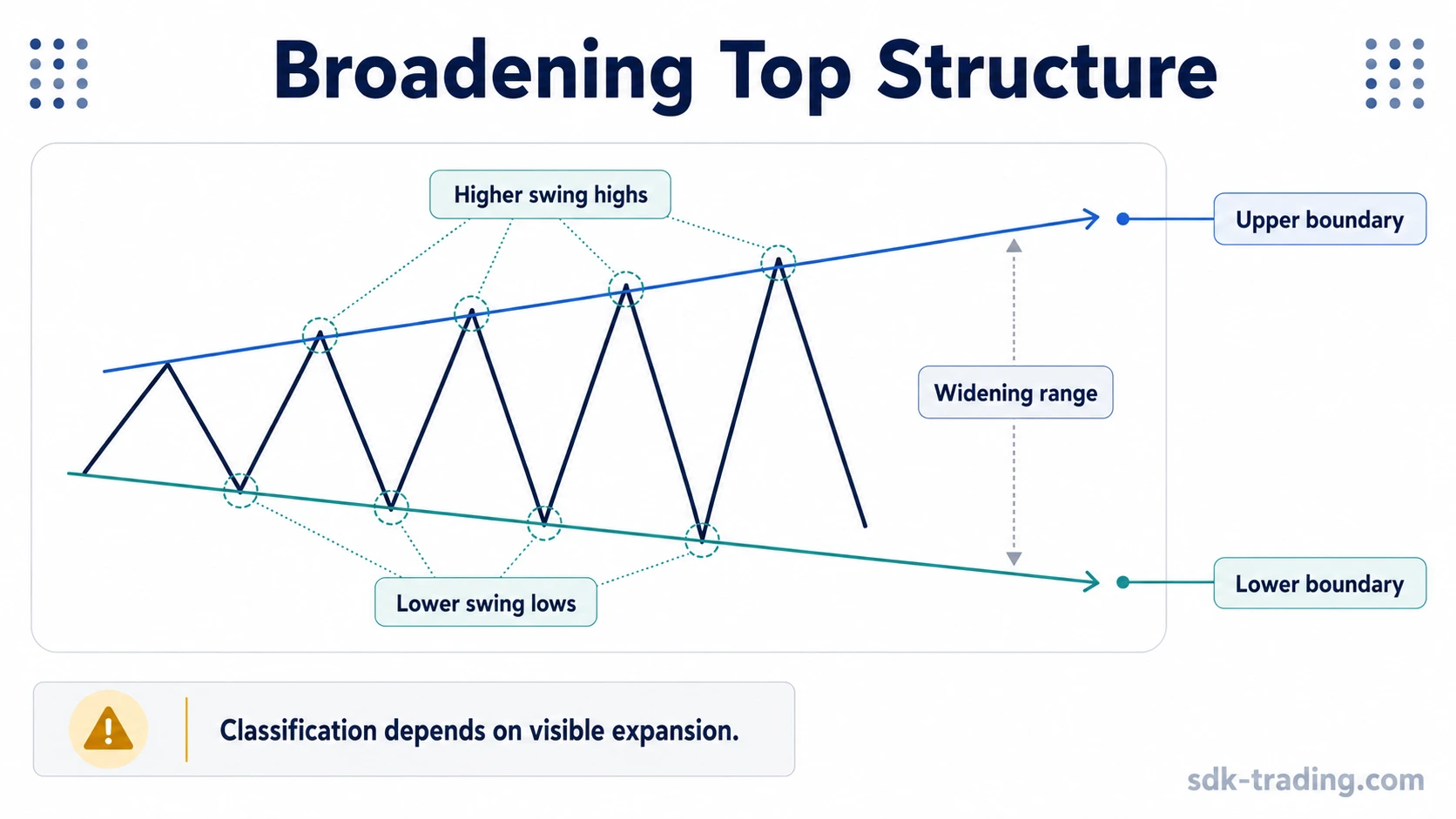
The pattern is defined by visible expansion. The upper boundary rises through successive swing highs, the lower boundary falls through successive swing lows, and the distance between both sides grows as the structure develops. A broadening top is therefore a classification problem first, not a standalone instruction to act.
Key Points
- A broadening top shows a widening price range rather than compression.
- The structure usually contains higher swing highs and lower swing lows.
- The upper and lower boundaries should be visible before the label is trusted.
- Repeated swing reactions matter more than one dramatic move outside a line.
- Forced trendlines can make random volatility look like a finished pattern.
What Is a Broadening Top?
A broadening top is a chart pattern where price forms an expanding range near the upper part of a prior advance or after a strong directional move. Instead of narrowing into a triangle, the swings become wider. Each side of the structure reaches farther than the prior swing, creating a broad, fan-shaped outline.
The term “top” does not mean the pattern has already proved a reversal. It means the structure is being read as an upper-area broadening formation. The label becomes more defensible when the widening shape is visible before interpretation is added.
Definition: A broadening top is a widening chart pattern marked by higher swing highs, lower swing lows, and diverging boundaries near the upper portion of a prior price advance.
Broadening Top Structure
The structure begins with a price range that expands instead of stabilizing. The upper boundary connects rising swing highs. The lower boundary connects falling swing lows. When both sides move away from each other, the visible range becomes wider over time.
A defensible reading needs internal movement between both sides of the structure. If price only touches one side repeatedly while the other side is guessed, the pattern remains weak. A broadening top should show the market reaching beyond prior highs and prior lows, not simply drifting in a loose channel.
The simplest structural test is this: the outline should still look like a widening formation before extra explanation is added. If the shape depends on one adjusted line, one outlier candle, or a late redraw after the fact, the classification is not strong.
How to Identify a Broadening Top
Identification starts with the visible boundary behavior, not with the name of the pattern. A broadening top becomes more credible when several structural conditions appear together.
| Diagnostic check | What to look for | Why it matters |
|---|---|---|
| Upper boundary | Successive swing highs reach higher levels | Shows expansion on the upper side of the structure |
| Lower boundary | Successive swing lows reach lower levels | Shows expansion on the lower side of the structure |
| Range behavior | The distance between swings increases | Separates broadening from sideways consolidation |
| Repeated reactions | Price interacts with both sides more than once | Reduces the risk of labeling one isolated move as a pattern |
| Line quality | Boundaries fit visible swings without heavy adjustment | Prevents forced-line false positives |
A broadening top can be easier to identify after several swings have already formed. That late visibility creates a common problem: the label may look clean only after boundaries are redrawn around past volatility. The stronger reading is the one that remains visible without excessive adjustment.
Broadening Top Definition Boundary
A broadening top qualifies when the market forms a widening upper-area structure with clear expansion on both sides. It does not qualify simply because price becomes volatile, because one high overshoots a prior line, or because two lines can be drawn around a messy range.
The reading is supported when price repeatedly interacts with both widening boundaries, internal swings fill the structure, and the upper and lower limits diverge in a way that is visible without forcing the chart. The reading weakens when the lower boundary is vague, when touches are sparse, or when the entire pattern depends on one extreme outlier.
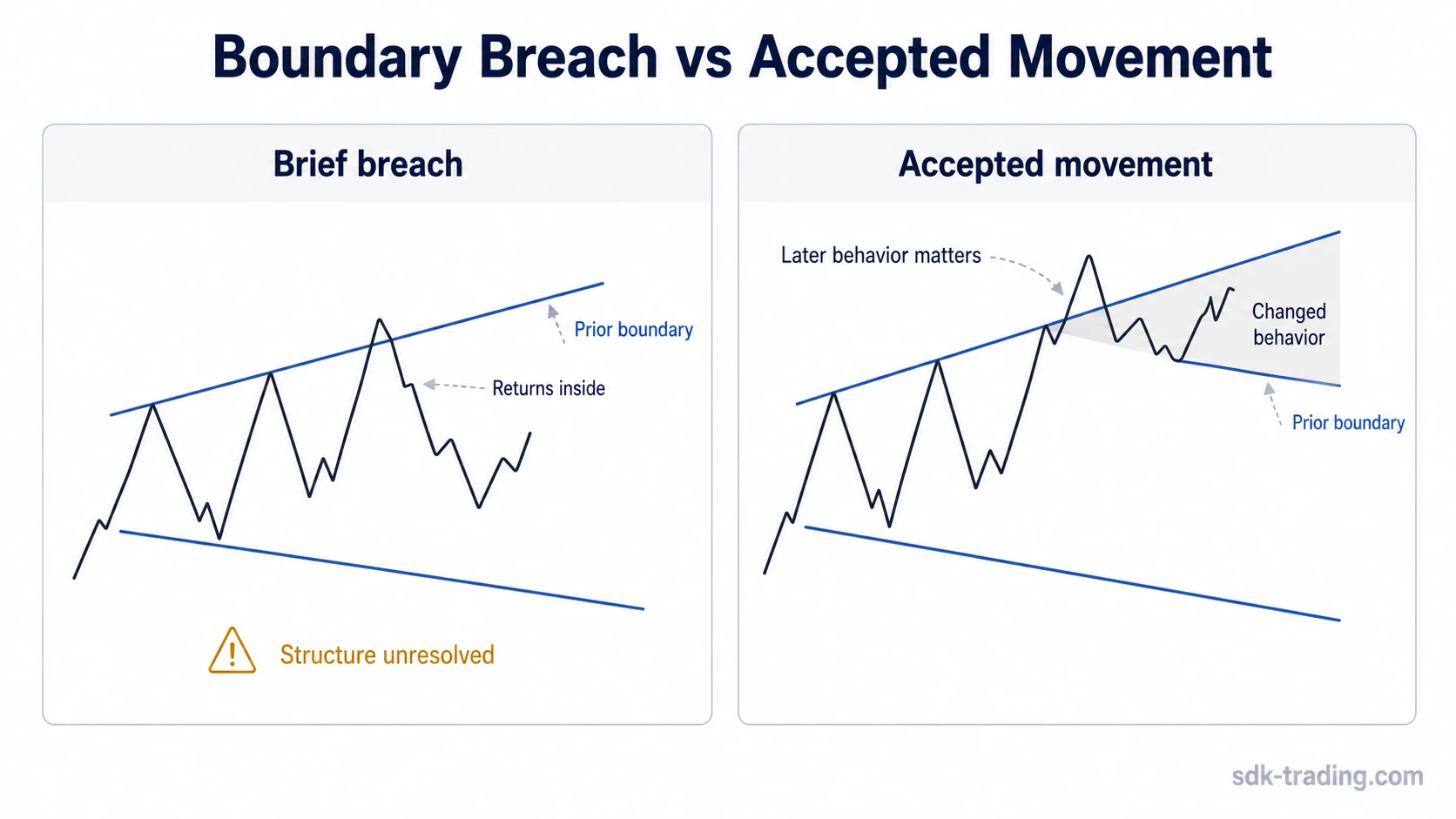
A brief boundary breach is also not the same as accepted behavior outside the prior structure. A single move beyond a boundary can return inside the range and still leave the classification unresolved. A stronger structural change requires later behavior to remain outside or reject the old boundary in a consistent way.
Boundary rule: classify the pattern by repeated structure first. Do not treat one boundary break, one sharp candle, or one late redraw as proof that the broadening top is valid.
Clean, Weak, and Invalid Broadening Top Readings
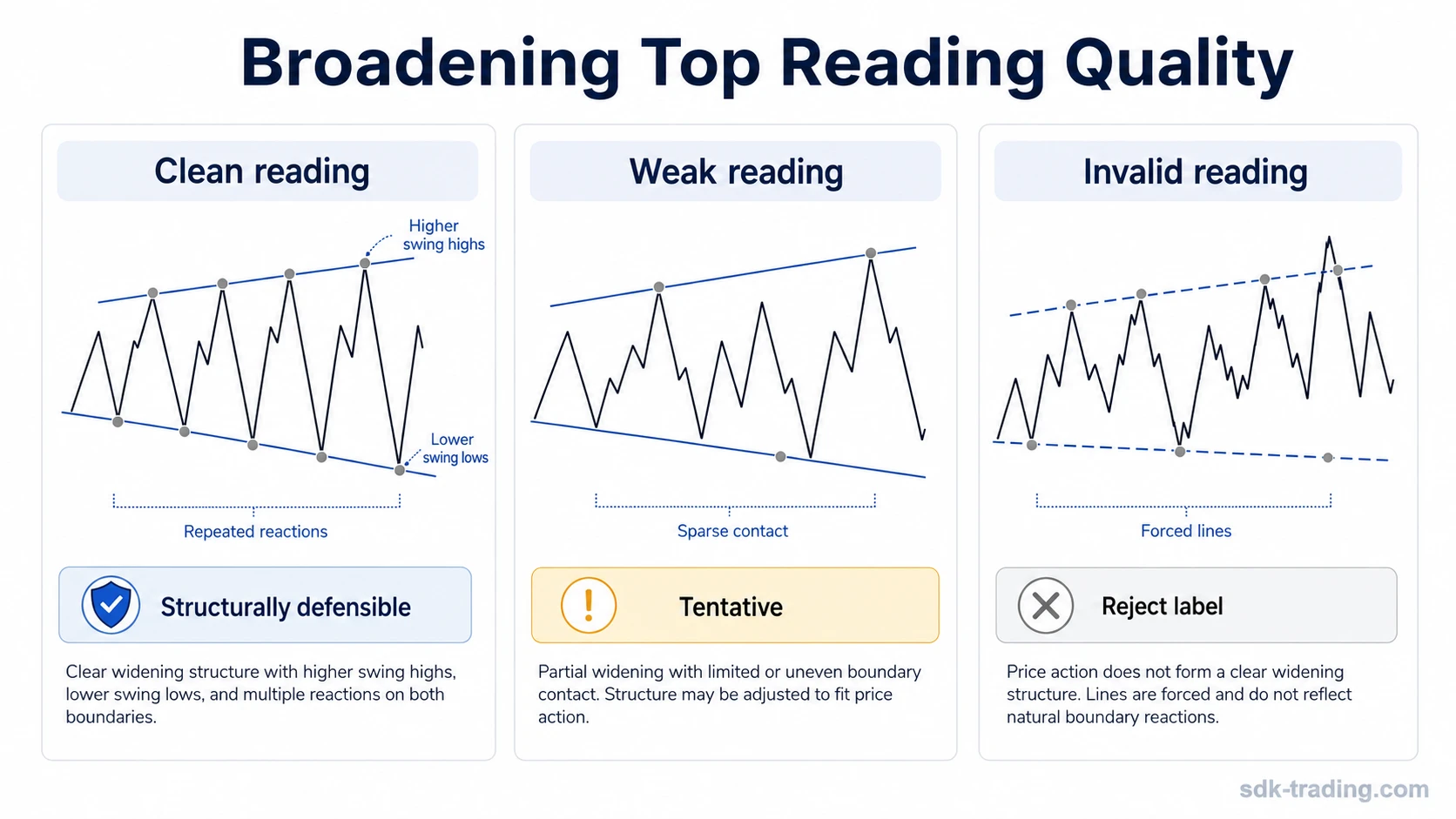
Not every widening shape deserves the same level of confidence. A clean broadening top, a weak reading, and an invalid reading can look similar at first glance, especially when the chart is volatile.
| Reading quality | Typical structure | Interpretation |
|---|---|---|
| Clean reading | Higher swing highs, lower swing lows, visible divergence, and several reactions on both sides | The broadening top label is structurally defensible |
| Weak reading | Some widening is visible, but one boundary is sparse, adjusted, or dependent on a small number of reactions | The label may be useful as a tentative description, but the structure needs caution |
| Invalid reading | Lines are forced around random movement, both boundaries do not diverge, or the shape does not form higher highs and lower lows | The broadening top label should be rejected |
The distinction is not a scoring system. It separates visible structure from resemblance. The more a pattern depends on adjusted lines and selective swing choice, the less useful the label becomes.
Broadening Top vs Related Broadening Patterns
A broadening top sits near several related terms, so the distinction matters. The closest confusion is between a broadening top, a broadening bottom, and the wider broadening family.
| Related term | Main distinction |
|---|---|
| Broadening bottom | A broadening bottom belongs to lower-area or bottoming classification, while a broadening top is read as an upper-area widening structure. |
| Broadening wedge | A broadening wedge is the broader structural family. A broadening top is a narrower top-side interpretation inside that family. |
| Ascending broadening wedge | An ascending broadening wedge has both boundaries sloping upward while the range widens. A broadening top should not be reduced to that exact shape. |
| Megaphone pattern | Megaphone is often used for broadening formations, but it can be broader and less specific than a clean broadening top classification. |
The safest distinction is to start with the visible structure. If the market forms a widening upper-area range with higher highs and lower lows, broadening top may be the closer label. If the structure belongs to a different slope arrangement or location, a related broadening term may fit better.
Common False Positives
The most common false positive is the forced trendline. This happens when lines are drawn after the fact to make unrelated swings look organized. A broadening top should not need heavy adjustment to become visible.
Another false positive is sparse boundary contact. If the upper boundary has several reactions but the lower boundary is based on one low, the structure is not balanced. The same problem appears when a single sharp move outside a prior range is treated as proof of a broadening formation.
Random volatility can also imitate broadening behavior. Wide swings alone are not enough. The structure needs a recognizable relationship between higher highs, lower lows, and diverging boundaries.
Common mistake: labeling volatility as a broadening top before the widening structure has enough reactions on both sides.
Late recognition creates another issue. By the time a broadening top looks obvious, several swings may already be complete. That does not make the label wrong, but it does mean the classification should describe the structure rather than imply a new prediction.
Practical Scenario
Consider a market that has advanced for several weeks and then begins forming wider swings near the upper part of the move. The first pullback is shallow, the next rally pushes to a higher swing high, the following decline drops below the prior reaction low, and the next recovery reaches beyond the previous high again.
At that point, the shape may start to resemble a broadening top. The reading becomes more defensible if both sides of the range continue to show reactions and the boundaries diverge without being forced. The reading remains weak if the entire label depends on one dramatic high or one late line drawn through uneven movement.
The pattern does not predict a specific outcome. Expanding swings make classification harder, so visible structure should be separated from the urge to name the pattern early.
How Boundary Breaches Should Be Read
A boundary breach inside a broadening top needs context. A brief move beyond a boundary can return inside the prior structure and leave the pattern unresolved. Accepted behavior beyond the boundary is different because later observations continue to respect the new side of the structure rather than immediately rotating back inside.
This distinction prevents one of the most common overreads. A single breach does not automatically confirm, invalidate, or complete the pattern. The later behavior around the boundary determines whether the structure remains intact, weakens, or changes into something else.
FAQ
What does a broadening top mean?
A broadening top means price is forming a widening upper-area structure with higher swing highs and lower swing lows. It describes expanding range behavior, not a guaranteed market outcome.
How do you identify a broadening top?
Identify a broadening top by checking whether the upper boundary rises through higher highs, the lower boundary falls through lower lows, and price reacts to both sides of the widening structure more than once.
Is a broadening top the same as a megaphone pattern?
The terms can overlap, but they are not always identical. Megaphone pattern is often used more broadly, while broadening top is a more specific upper-area classification.
Can one breakout confirm a broadening top?
One boundary break is not enough by itself. A brief breach may return inside the structure, while accepted behavior beyond the boundary requires later observations to remain outside or respect the changed boundary.