Market Structure in Trading

Market structure in trading describes how price action is organized through swings, trend sequences, breaks, and shifts. It gives traders a way to classify what price is doing before judging whether a move is trending, ranging, transitioning, or failing to continue.

Core idea: market structure is a price-action framework built from observable swing highs, swing lows, higher highs, higher lows, lower highs, lower lows, structural breaks, and character changes. It organizes context. It does not confirm prediction, entry, exit, stop placement, target placement, or reversal certainty by itself.

A clean structure reading starts with the sequence of swings. If price is building higher highs and higher lows, the chart is showing an upward swing sequence. If price is building lower highs and lower lows, the chart is showing a downward swing sequence. If the sequence becomes mixed, compressed, or repeatedly rejected around the same area, the chart may be moving into range or transition behavior.

The practical value is classification. A trader may be trying to identify basic swing points, read a bullish or bearish sequence, separate a break from a failed break, or understand whether a broader shift is developing. Each question belongs to a different concept.

How Market Structure Organizes Price Action

Market structure organizes price action by grouping individual moves into a visible sequence. A single candle or one isolated wick is not enough. The reading comes from how swing points relate to one another and how later price behavior reacts after a boundary, high, low, or prior structure is tested.

The first layer is swing identification. Swing highs and swing lows mark the turning points that form the structure. Without those reference points, labels such as bullish structure, bearish structure, BOS, CHOCH, or market structure shift become unstable.

The second layer is sequence. A chart making higher highs and higher lows is showing upward progression. A chart making lower highs and lower lows is showing downward progression. The sequence can weaken when later swings stop extending cleanly or when price starts accepting inside an older range.

The third layer is structural change. A break of structure marks a break through a meaningful prior swing point. A change of character describes an early change in behavior that may challenge the prior rhythm. A market structure shift describes a broader transition only when later structure supports the change.

Important distinction: a broader definition of market structure is useful when the full concept matters. In this context, the practical job is to separate swing points, trend sequence, breaks, CHOCH, and broader shifts so each label is used for the right structural question.

Which Market Structure Concept Do You Need?

Different market-structure questions require different labels. The same chart can contain swing points, trend sequence, a break, a possible change of character, and a broader shift. Separating those jobs prevents market structure from becoming a vague catch-all.

What you are trying to identify Best concept What it clarifies
Where visible turning points form Swing highs and swing lows The reference points used to build the structure reading.
Whether upward progression is still intact Higher highs and higher lows The basic bullish swing sequence, without treating it as a guaranteed continuation.
Whether downward progression is still intact Lower highs and lower lows The basic bearish swing sequence, without treating it as a guaranteed continuation.
Whether price has broken a meaningful prior swing Break of structure The difference between a structural break and ordinary noise around a level.
Whether behavior is changing before a full shift is clear Change of character An early behavioral change that still needs later support from structure.
Whether the broader structure is transitioning Market structure shift A larger change in the chart’s swing logic after later price behavior supports the transition.
Whether BOS and CHOCH are being confused BOS vs CHOCH The distinction between continuation-style breaks and early character-change behavior.
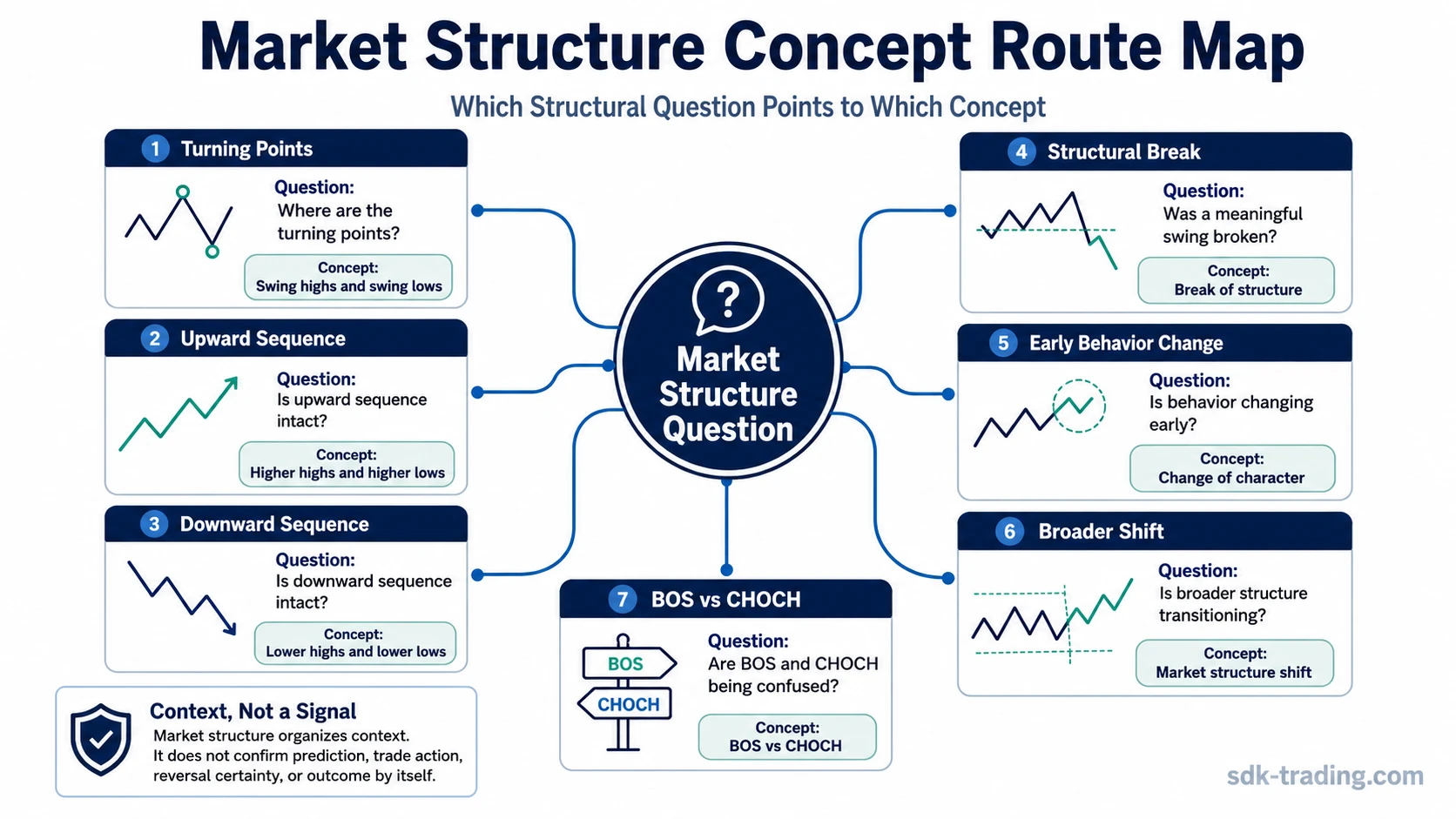
Market structure concept route map showing swing highs and lows, HH/HL, LH/LL, BOS, CHOCH, market structure shift, and BOS vs CHOCH
Market structure concepts answer different questions about swing points, trend sequence, breaks, behavior change, and broader shifts.

Swing Structure, Breaks, CHOCH, and Structure Shifts

Swing structure is the base layer. It starts with visible highs and lows, then asks whether the chart is advancing, declining, ranging, or shifting. A chart can show a clean sequence for several swings and then begin to weaken without immediately proving that the opposite trend has started.

A structural break is more specific than a normal push through a small high or low. It matters when the broken level was a meaningful part of the prior sequence. A break through a minor swing inside noise carries less weight than a break through a clear boundary that previously shaped the chart.

CHOCH is different because it focuses on early behavioral change. It may appear when the prior rhythm stops behaving as expected, but that does not automatically prove a new trend. Later structure decides whether the change develops, stalls, or returns into the older sequence.

The distinction between BOS and CHOCH matters because both can involve a break through a swing point. BOS is usually read through continuation context or a break that later structure supports. CHOCH is usually read through changing behavior that may precede a larger transition. The label depends on context, not on the break alone.

Break of structure examples are useful when the question is whether a visible break actually changes the structure, or whether it is only a temporary probe that later behavior does not support.

What Market Structure Does Not Confirm by Itself

Market structure is context, not a standalone trading signal. A higher high does not guarantee continuation. A lower low does not guarantee further downside. A break of structure does not automatically validate a trade idea. A change of character does not prove that a reversal has started.

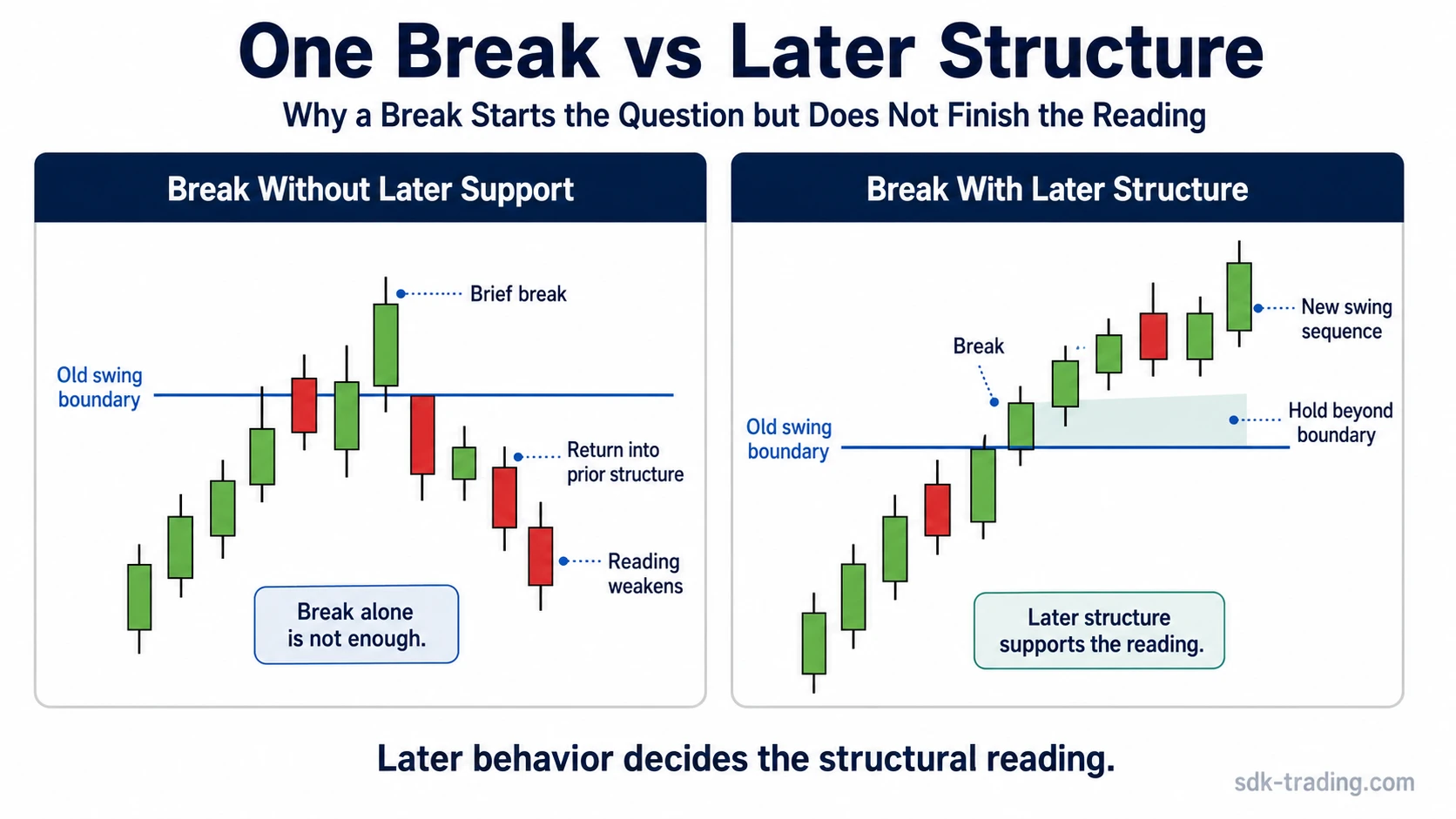
Two-panel market structure diagram comparing a break without later support against a break that holds and builds later structure
A break starts the structural question, but later acceptance, rejection, and swing development decide whether the reading becomes coherent or weakens.

The structure reading becomes stronger when later behavior fits the label. For example, if price breaks a prior high and then holds above the old boundary while building new structure, the break is more coherent. If price breaks the high and quickly returns into the prior range, the break may be weaker or failed.

The same logic applies to downside structure. A lower low can extend a bearish sequence, but it can also become part of a failed breakdown if price cannot keep developing below the prior boundary. The first break starts the question. Later acceptance, rejection, and swing development shape the answer.

Short example: price forms repeated higher lows, breaks above a prior swing high, and then pauses near the old boundary. If later candles hold above that boundary and create another higher low, the upward structure reading becomes cleaner. If price falls back below the boundary and resumes the old range, the break becomes weaker. No entry, exit, stop, or target is confirmed by the break alone.

Common Mistakes When Reading Market Structure

Most mistakes come from using a label before the chart has supplied enough structure. A single event can be important, but the interpretation still depends on location, prior sequence, and later behavior.

Common mistake Safer structure reading
Calling every new high a strong bullish structure Check whether the prior swing sequence is clean and whether later structure accepts above the old high.
Calling every new low a strong bearish structure Check whether price keeps building lower highs and lower lows or quickly returns into prior structure.
Treating one break as a complete trend change A break can begin a structural question, but later swings decide whether the change develops.
Using BOS and CHOCH as interchangeable labels BOS and CHOCH describe different structural jobs; the correct label depends on prior trend context and later behavior.
Ignoring range behavior A chart can break small swings inside a range without creating a clean trend or broader structure shift.
Forcing a trade decision from structure alone Structure can organize context, but it does not provide complete trade instruction by itself.

Market Structure Questions

What is market structure in trading?

Market structure in trading is the organization of price action through swing highs, swing lows, trend sequences, breaks, and shifts. It helps classify whether price is trending, ranging, transitioning, or failing to continue.

Is market structure a trading signal?

No. Market structure gives context, but it does not confirm entry, exit, stop placement, target placement, prediction, or reversal certainty by itself.

What is the difference between BOS and CHOCH?

BOS usually describes a structural break that fits continuation context or later structure that supports the break. CHOCH describes an early change in behavior that may challenge the prior structure but still needs later confirmation.

Does one break confirm a new trend?

No. One break can matter, but a new trend reading needs later structure, acceptance, and swing development that support the change.