Gap candlestick patterns are price discontinuities between one active trading area and the next. Their broad classification starts with where the gap appears in the move: near a prior range, inside an established trend, late after an extended move, or as part of an isolated reversal.
Definition: A trading gap forms when the next active price area begins away from the prior price area, leaving an untraded interval between them. In candlestick analysis, market location is the first broad classifier because similar-looking gaps can belong to different pattern families.
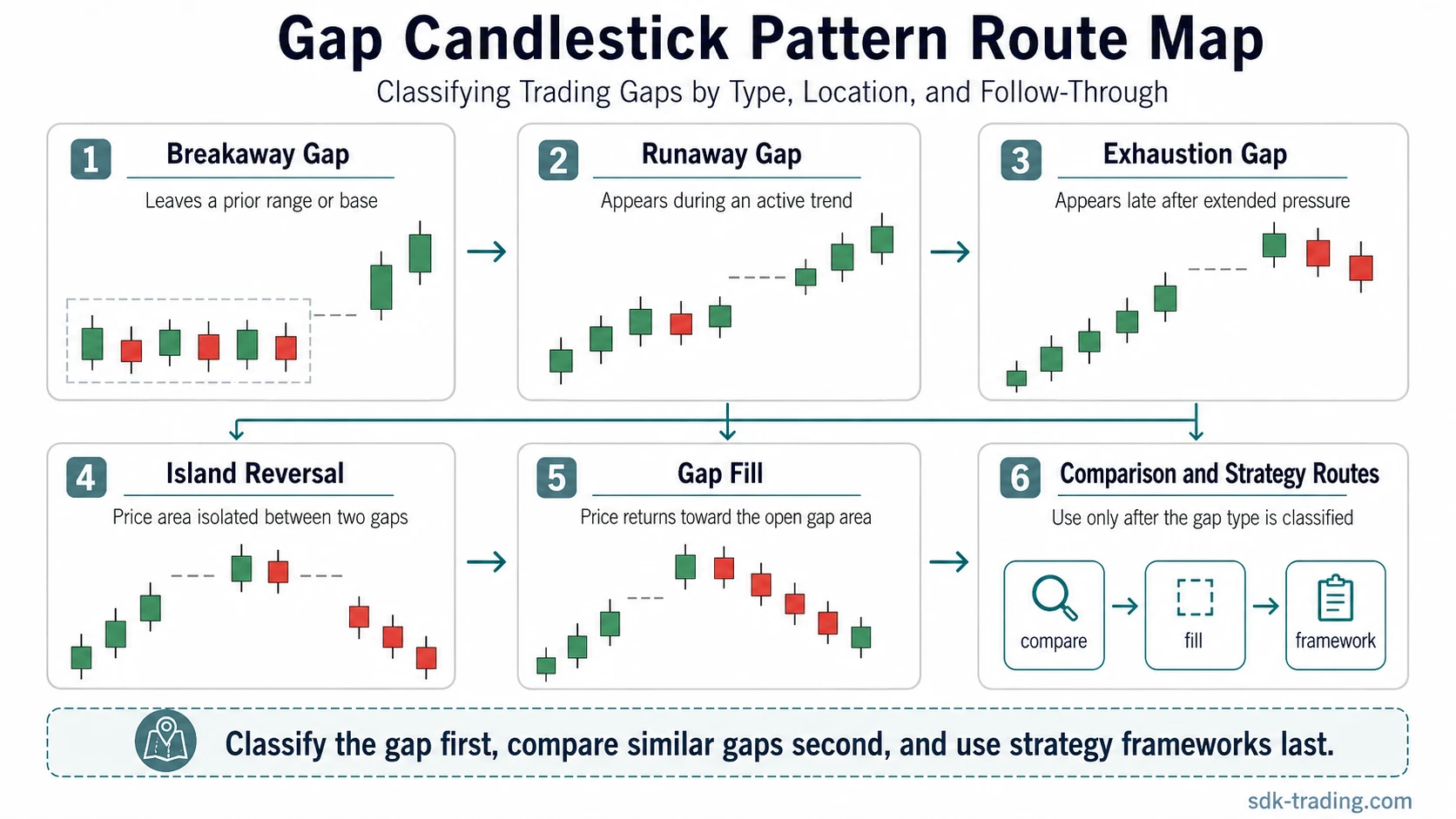
Key Points
- Gap classification begins with the gap’s location inside the surrounding price structure.
- Breakaway gaps appear near a departure from an old price area, while runaway gaps occur inside an established directional move.
- Exhaustion gaps appear late after extended movement, while island reversals require a price area isolated between two gaps.
- A gap fill describes later interaction with an existing gap and does not define the original gap type.
Gap Candlestick Pattern Classification
Start with the position of the gap inside the larger move. That first distinction separates early departure, mid-trend continuation, late-stage extension, isolated reversal structures, and later interaction with an existing gap.
| Market condition | Relevant gap topic | Classification boundary |
|---|---|---|
| Price leaves a prior range, base, or congestion area. | Breakaway gap | The gap marks movement away from an established price area. |
| Price gaps while a directional move is already active. | Runaway gap | The gap appears inside an existing trend rather than at its initial departure. |
| Price gaps late after an extended move. | Exhaustion gap | The gap occurs after substantial prior directional movement. |
| Price gaps away, isolates a small price area, then gaps back. | Island reversal | The defining structure is a price area isolated between two gaps. |
| The broader stock-market meaning of gaps needs clarification. | Stock market gaps | The focus is how gaps form and behave in stocks before narrowing to one named type. |
| The main task is separating the major gap categories. | Types of gaps in trading | The focus is a deeper comparison of the major gap families and their distinguishing conditions. |
| Price returns toward the open space left by a prior gap. | Gap fill in stocks | The question concerns later interaction with an existing gap rather than its original classification. |
| Gap behavior is being evaluated as part of a trading approach. | Gap trading strategy | The gap type is already identified and the next question concerns conditional trading logic. |
Classification check: The same visual distance between two price areas can belong to different gap families. Its position near the beginning, middle, or late stage of a move changes the category being considered.
How Gap Patterns Differ from Nearby Candlestick Groups
Gap patterns are organized around discontinuous price movement. Single-candle patterns are classified from one candle’s body, shadows, open, close, or range. Double and triple candlestick patterns depend on relationships across a defined sequence of candles.
Some continuation formations also contain gaps, including Tasuki-style structures. In those cases, the larger multi-candle formation can be the defining feature even though a gap appears inside it.
Scope boundary: Classify the gap family when the price discontinuity itself is the defining structure. Use the broader candlestick formation when the gap is only one component of a larger multi-candle pattern.
Gap Comparisons
Some gap types can look similar in isolation because the visible open space may be comparable. Their position within the larger move separates early departure, mid-trend continuation, and late-stage extension.
| Comparison problem | Relevant comparison | When it applies |
|---|---|---|
| The gap may be starting a move or appearing after the move is stretched. | Breakaway gap vs exhaustion gap | The confusion is early expansion versus late-stage extension. |
| The gap may be leaving a base or continuing a trend already in progress. | Breakaway gap vs runaway gap | The confusion is initial departure versus mid-trend continuation. |
| The gap may show continuation pressure or late exhaustion. | Runaway gap vs exhaustion gap | The confusion is trend continuation versus late-stage extension. |