A runaway gap vs exhaustion gap comparison separates a mid-trend continuation reading from a late-trend fatigue reading. A runaway gap is usually read as participation during an active move, while an exhaustion gap is usually read as late displacement that struggles to hold.
Both gaps can look forceful when they first appear. Trend position, follow-through, volume quality, gap re-entry, and later acceptance behavior help decide whether the gap still supports continuation or has started to behave more like exhaustion.
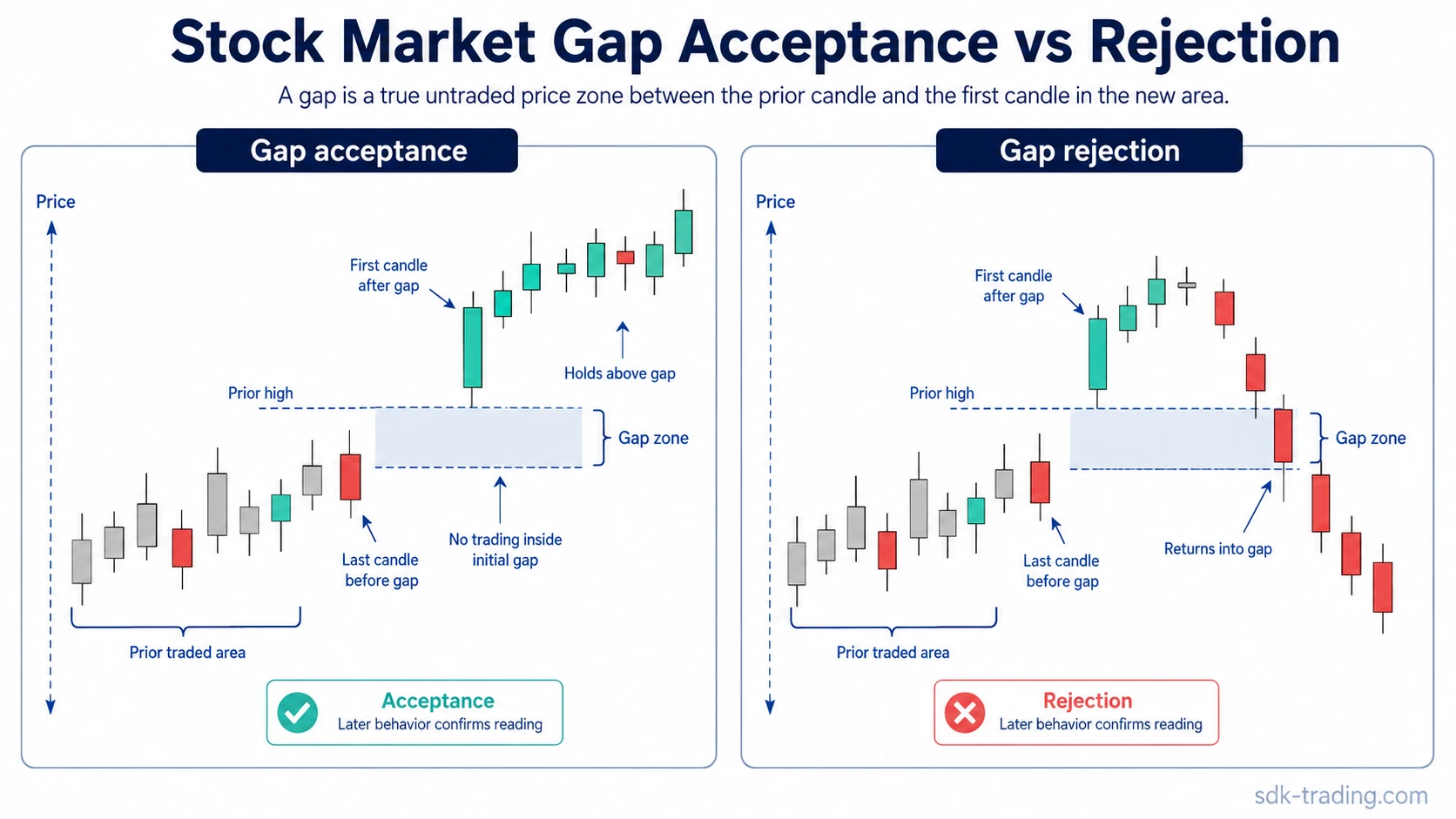
Core distinction: A runaway gap fits a continuation reading when price gaps in the direction of an active trend and continues accepting beyond the gap. An exhaustion gap fits a weaker late-trend reading when price gaps after an extended move, fails to attract durable follow-through, and later returns into the gap area.
Key Points
- A runaway gap usually appears during an active trend and supports a continuation reading only if the new area holds.
- An exhaustion gap usually appears late in a mature move and becomes more plausible when follow-through weakens.
- Volume can support either reading, but it does not classify the gap by itself.
- Gap re-entry and later acceptance are often more useful than the first gap candle alone.
- Early classification can be premature because the same visible gap may change meaning after later price behavior develops.
Runaway Gap vs Exhaustion Gap: The Core Difference
The core difference is lifecycle position. A runaway gap appears while the trend is already active but still behaving like continuation. An exhaustion gap appears after a move has become mature, stretched, or emotionally crowded, and the gap later struggles to hold its new area.
A runaway gap reading becomes stronger when price stays beyond the gap zone and later candles continue accepting in the direction of the trend. An exhaustion gap reading becomes stronger when the gap creates a final-looking extension, then loses follow-through and begins accepting back inside the gap area.
| Comparison point | Runaway gap | Exhaustion gap |
|---|---|---|
| Typical trend position | During an active directional move. | Late in a mature or extended move. |
| Main reading | Continuation participation. | Late-trend fatigue or terminal displacement. |
| Gap direction | Usually in the same direction as the existing trend. | Also often in the trend direction, which is why confusion is common. |
| Follow-through quality | Price continues to hold or build beyond the gap. | Price stalls, overlaps, or fails to extend after the gap. |
| Gap re-entry | Quick re-entry weakens the continuation reading. | Re-entry into the gap can support the exhaustion reading. |
| Later acceptance | Acceptance beyond the gap supports runaway classification. | Acceptance back inside the gap supports exhaustion classification. |
When to Read the Gap as Runaway vs Exhaustion
A gap should not be classified only because it is large or emotional. A large gap can still be continuation if the trend remains accepted. A smaller gap can still become suspect if it appears after a mature move and immediately loses participation.
The cleaner process is to read the gap in sequence: first trend location, then gap direction, then follow-through, then whether price accepts or rejects the new area.
| Diagnostic element | Supports runaway gap | Supports exhaustion gap |
|---|---|---|
| Prior trend condition | The move is active but not obviously stretched or terminal. | The move is mature, extended, or already showing late-stage behavior. |
| Gap location | The gap appears in the body of the trend. | The gap appears after a long directional push. |
| Participation quality | Volume or activity supports continued acceptance. | Activity may be high, but follow-through does not sustain. |
| Immediate reaction | Price holds beyond the gap and avoids fast rejection. | Price hesitates, overlaps, or quickly returns toward the gap. |
| Later behavior | Pullbacks stay controlled and the new area remains accepted. | Price re-enters the gap and begins accepting inside it. |
| Premature classification risk | Calling the gap runaway before price holds and accepts the new area. | Calling the gap exhaustion before follow-through fails or price accepts back inside the gap. |
Same Gap Area, Different Meaning
The same visual gap can carry different meaning depending on what happens next. Runaway and exhaustion gaps are classifications, not automatic signals.
Runaway-style scenario: Price is already moving higher, then gaps above the prior accepted area. After the gap, price continues to trade above the gap zone, pullbacks remain shallow, and later candles keep accepting higher. That behavior supports a mid-trend continuation reading.
Exhaustion-style scenario: Price has already advanced for a long stretch, then gaps higher again. After the gap, follow-through fades, candles overlap, and price later trades back into the gap area. If the market begins accepting inside that area, the gap is more consistent with late-trend exhaustion than clean continuation.
The gap candle starts the classification question, but it does not finish it. Later acceptance separates a stronger reading from an overread assumption.
What Weakens a Runaway Gap Reading
A runaway gap reading weakens when price cannot hold the new area created by the gap. A quick return into the gap does not automatically reverse the entire trend, but it reduces the quality of the continuation label.
Weakness 1: Fast gap re-entry. If price quickly trades back into the gap area, the market is no longer clearly accepting the displacement.
Weakness 2: Poor follow-through. A gap that opens strongly but then stalls, overlaps, or loses progress may reflect temporary urgency instead of durable continuation.
Weakness 3: Late trend location. A gap after a long, mature move may fit exhaustion better than runaway if the trend already shows signs of crowding or fatigue.
Weakness 4: Volume without acceptance. High activity can support the reading, but volume alone is not enough if price fails to hold the new area.
What Weakens an Exhaustion Gap Reading
The exhaustion label becomes less defensible when price keeps accepting beyond the gap instead of returning into it. A trend can look mature and still continue, so the exhaustion label should not be assigned only because the move has already traveled far.
The exhaustion reading also becomes weaker when the candles after the gap continue to expand in the trend direction, avoid heavy overlap, and keep the gap area below price in an uptrend or above price in a downtrend.
| Exhaustion assumption | What would challenge it | Safer reading |
|---|---|---|
| The move is mature, so the gap must be exhaustion. | Price continues accepting beyond the gap. | Maturity alone is not enough; wait for failure or re-entry evidence. |
| High volume means the move is ending. | High volume is followed by continued directional acceptance. | Volume describes activity, not classification by itself. |
| The gap should fill quickly. | Price rejects attempts to re-enter the gap area. | Gap fill is not guaranteed; acceptance behavior matters more. |
Why Classification Can Be Premature
Runaway and exhaustion gaps are often misclassified because the first gap candle is visually dramatic. At the moment of the gap, the chart may not yet show whether the market is attracting fresh participation or showing late-stage emotion.
Hindsight can also change the label. A gap that first looks like continuation may later lose acceptance and behave more like exhaustion. A gap that first looks climactic may hold firmly and become part of a stronger continuation leg.
The safer approach is to treat the first label as provisional. Trend position sets the initial expectation, while follow-through, re-entry, and later acceptance decide how strong that classification becomes.
Runaway Gap vs Exhaustion Gap Reading Checklist
A checklist helps keep the comparison focused on structure instead of emotion. The goal is not to predict what must happen next, but to decide which classification has better evidence.
| Question | If yes | If no |
|---|---|---|
| Was the trend already active before the gap? | Runaway remains possible. | The gap may belong closer to a breakaway or unrelated structure. |
| Was the move already mature or stretched? | Exhaustion risk increases. | Continuation may remain a cleaner first reading. |
| Did price hold beyond the gap? | Runaway classification strengthens. | The continuation reading weakens. |
| Did price re-enter and accept inside the gap? | Exhaustion classification strengthens. | Exhaustion remains unconfirmed. |
| Does volume align with later behavior? | Participation evidence is more useful. | Volume may be noise or late urgency. |
Related Gap Concepts
A runaway gap is the stronger reference when the focus is mid-trend continuation, same-direction displacement, and sustained acceptance beyond the gap area.
An exhaustion gap is the stronger reference when the focus is late-trend displacement, weakening follow-through, and later return into the gap area.
FAQ
Can a gap start as runaway and later look like exhaustion?
Yes. A gap can first look like continuation and later lose that quality if price fails to hold beyond the gap and begins accepting back inside the gap area.
Is volume enough to separate a runaway gap from an exhaustion gap?
No. Volume helps describe participation, but it does not classify the gap by itself. Trend position, follow-through, gap re-entry, and later acceptance carry more diagnostic weight.
Does every exhaustion gap fill quickly?
No. A fast return into the gap can support an exhaustion reading, but the main issue is weakening participation and later acceptance, not a guaranteed fill.