A runaway gap is a trading gap that appears after a directional move is already established and opens further in the same direction, leaving visible untraded space between the prior price area and the new price area.
The reading is more defensible when price initially holds in the new area and weaker when price quickly returns into the prior area or appears after an already mature move. In candlestick analysis, the visible gap is only the starting structure; trend location and acceptance in the new area help separate a runaway reading from weaker gap behavior.
Definition: A runaway gap is a mid-trend continuation gap in which price skips over an area during an existing move and begins trading in a new area without immediate return into the prior price zone.
Key Points
- A runaway gap appears after a trend is already underway, not at the first break from a base.
- The gap opens in the same direction as the existing move and leaves visible untraded space.
- Holding in the new price area supports the classification; a fast return into the old area weakens it.
- A late gap with rejection behavior may fit exhaustion better than runaway.
What Is a Runaway Gap?
A runaway gap is a gap that forms after a market has already begun moving directionally. It is often described as a continuation gap or measured gap because it appears during the body of a move rather than at the first breakout point or at the final stage of a tired trend.
The important distinction is location. A gap above a base can belong to a breakout structure, while a gap after a long, stretched advance may belong closer to a late-stage exhaustion structure. A runaway gap sits between those two readings: the move is already active, but the gap still behaves like continuation rather than rejection.
Volume can support the reading when it shows participation behind the price displacement, but volume alone does not define the gap. A large gap on high activity can still fail if price cannot hold the new area.
How to Identify a Runaway Gap
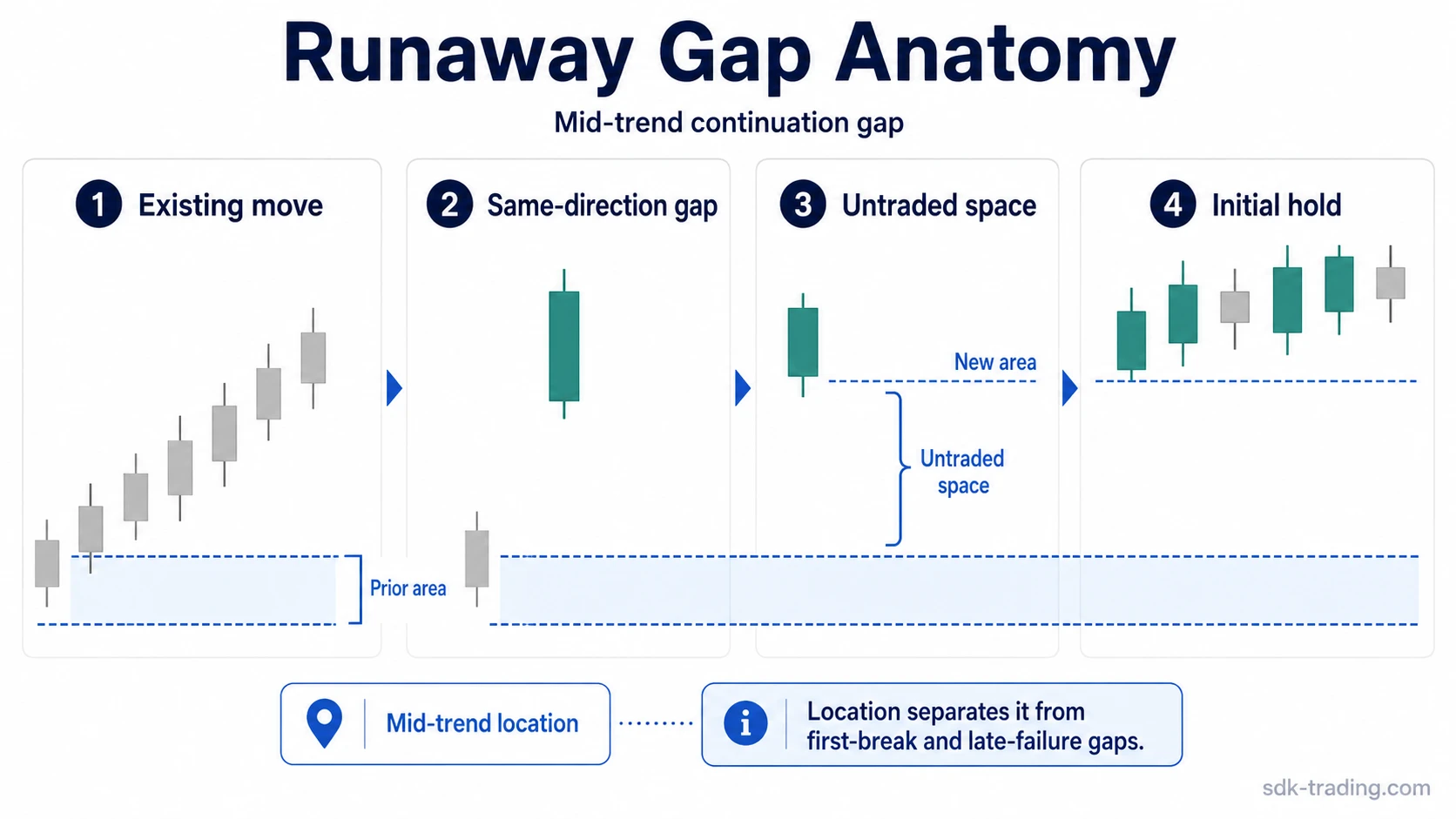
The cleanest runaway gap reading begins with the structure before the label. Price should already be moving in one direction, then skip over a visible area and continue trading beyond the prior accepted area.
| Diagnostic element | What to look for | Why it matters |
|---|---|---|
| Existing directional move | Price has already left a prior consolidation or reaction area. | Separates a runaway gap from the first breakout from a base. |
| Same-direction gap | The gap opens in the direction of the current move. | Supports a continuation classification instead of a reversal reading. |
| Visible untraded space | There is a clear gap between the prior price area and the new trading area. | Shows that price skipped over a zone rather than simply extending inside the same range. |
| Initial hold in the new area | Price does not immediately return into the prior accepted area. | Shows that the new area is being accepted at least initially. |
| Participation as support | Volume or activity may expand, but it is not the only requirement. | Prevents a high-volume gap from being overread without structural acceptance. |
Runaway Gap Boundary: What It Is and What It Is Not
A runaway gap is a structural classification, not a mechanical instruction. The same visible gap can mean different things depending on where it appears in the move and whether the new area is accepted or rejected.
| Boundary question | Runaway gap reading | Weaker or different reading |
|---|---|---|
| Where does it appear? | After the move is already underway. | At the first break from a base or after a very extended move. |
| What does the gap do? | Opens further in the same direction and leaves untraded space. | Only creates a small separation or fills immediately. |
| What supports the reading? | Price holds beyond the prior area and avoids immediate rejection. | Price quickly returns into the old area or stalls near the gap boundary. |
| What weakens the classification? | The gap appears too late, rejects the new area, or fails to hold beyond the prior zone. | The structure may fit another gap type more closely. |
Runaway Gap vs Breakaway Gap vs Exhaustion Gap
Runaway, breakaway, and exhaustion gaps can all leave visible untraded space, but they belong to different parts of a move. The classification changes when the same visual gap appears at a different structural location.
| Gap type | Typical location | Main diagnostic idea | What weakens the reading |
|---|---|---|---|
| Breakaway gap | Near the start of a move, often outside a base or prior range. | Price separates from an old accepted area. | Price quickly falls back into the old range. |
| Runaway gap | During an established directional move. | Price skips forward in the same direction and initially holds the new area. | The gap appears too late or fails back into the prior area. |
| Exhaustion gap | Late in a mature move. | Price gaps in the trend direction but then struggles to continue. | Strong acceptance beyond the gap makes exhaustion less defensible. |
The distinction between a runaway gap and exhaustion gap is especially important when a strong trend is already visible. The runaway gap vs exhaustion gap distinction separates mid-trend continuation structure from late-stage failure behavior.
Clean, Weak, and Invalid Runaway Gap Readings
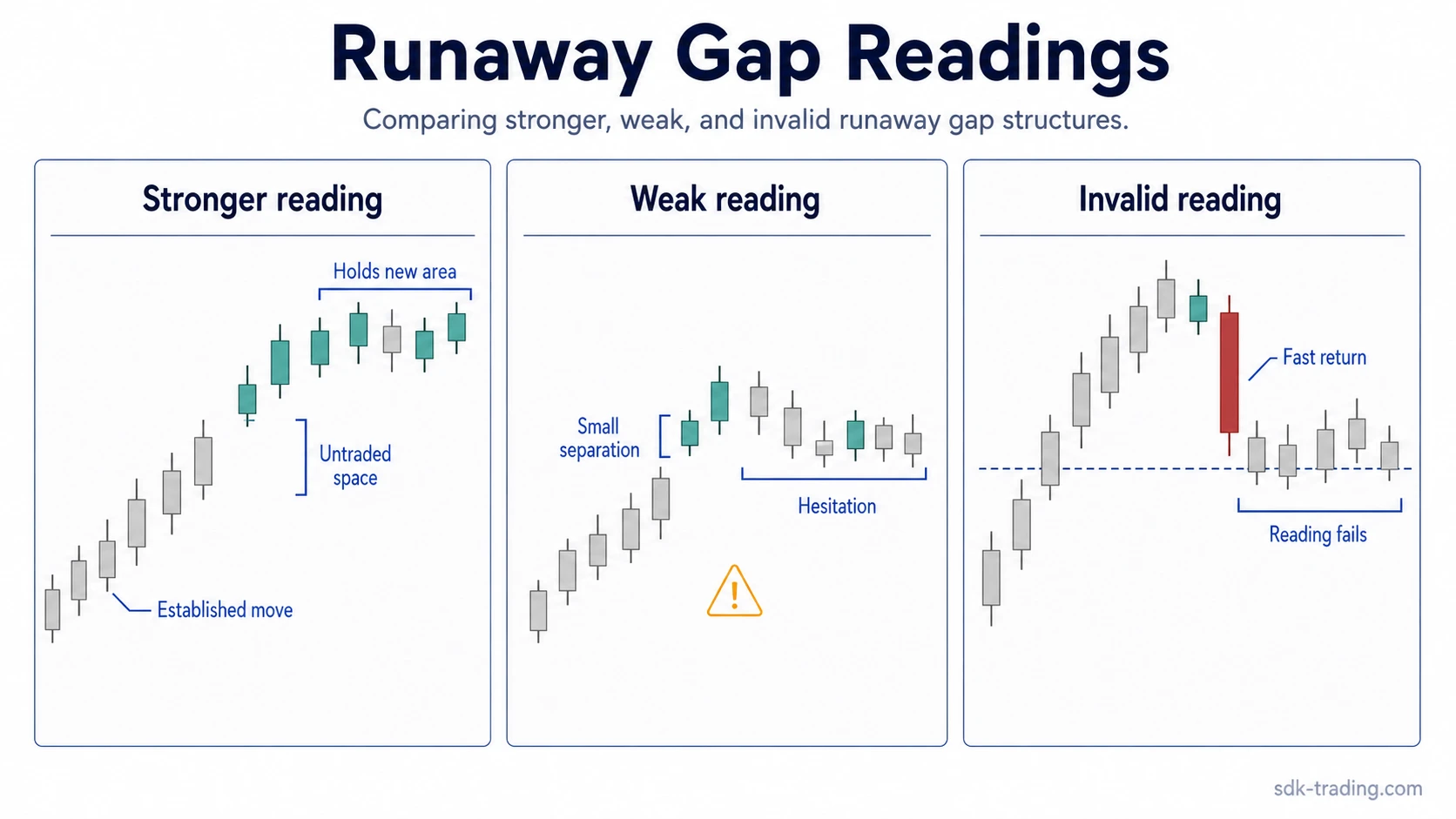
Runaway gap analysis is strongest when clean structure is separated from weaker classification. The label becomes less reliable when the gap is isolated from trend location, acceptance behavior, or later price response.
| Reading quality | Typical structure | Interpretation |
|---|---|---|
| Clean runaway gap | Established trend, same-direction gap, visible untraded space, and initial hold above or below the prior area. | The gap fits a mid-trend continuation classification. |
| Weak runaway gap | The trend exists, but the gap is small, participation is mixed, or price hesitates near the old area. | The classification is possible, but the evidence is incomplete. |
| Invalid runaway gap | The gap appears after an exhausted move, fills quickly, or rejects the new area immediately. | The structure no longer fits a clean runaway reading and may belong to another gap type. |
Example of a Runaway Gap Reading: Price has already advanced through a visible directional move and then opens higher, leaving a clear space above the prior candle area. The next candles continue to trade above the old area rather than immediately returning into it. That behavior supports a runaway classification.
The weaker version appears when the same market gaps higher but quickly trades back into the prior area. The gap is still visible, but the failed hold makes the continuation label less defensible.
Does a Runaway Gap Always Fill?
A runaway gap does not always fill, and it should not be treated as if gap closure is guaranteed. Some gaps remain open for long periods when the new area is accepted. Others fill quickly when the market rejects the gap and returns to the prior price zone.
The safer question is not whether every gap must fill, but whether price accepts the new area or returns into the old one. Broader gap fill stocks behavior depends on liquidity, opening conditions, volatility, and market structure beyond the runaway gap label.
Common Mistakes When Reading Runaway Gaps
Mistake 1: Calling every trend gap a runaway gap. A same-direction gap is only part of the evidence. Trend location, visible separation, and acceptance behavior still matter.
Mistake 2: Confusing a first breakout gap with a runaway gap. If the gap marks the first clear separation from a base or range, the structure may fit a breakaway reading more closely.
Mistake 3: Ignoring late-stage rejection. A gap that appears after a mature move and then fails to hold the new area may be closer to exhaustion than continuation.
Mistake 4: Treating volume as proof. Strong activity can support the reading, but the classification still depends on price location and whether the new area holds.
FAQ
What is a runaway gap in trading?
A runaway gap is a mid-trend trading gap that opens in the direction of an established move and leaves visible untraded space between the prior price area and the new area.
Is a runaway gap the same as a continuation gap?
Runaway gap and continuation gap are often used for the same basic idea: a gap that appears during an existing directional move rather than at the beginning or late failure stage of that move.
How do you identify a runaway gap?
Look for an existing directional move, a same-direction gap, visible untraded space, and initial acceptance in the new price area. A quick return into the old area weakens the reading.
What makes a runaway gap weak?
A runaway gap reading weakens when the gap is small, appears too late in a mature trend, lacks follow-through, or quickly returns into the prior accepted area.
Does a runaway gap always get filled?
No. Some runaway gaps remain open when the new price area is accepted, while others fill quickly if the market rejects the gap and returns into the prior area.
How is a runaway gap different from an exhaustion gap?
A runaway gap usually appears during an active trend and initially holds the new area. An exhaustion gap appears later in a mature move and is more likely to show weak follow-through or rejection behavior.