Continuation candlestick patterns classify pauses or interruptions that form inside an existing directional move. The first task is to identify the structure that carries the continuation reading: a contained multi-candle pause, a gap relationship, a shared-open relationship, or a partial recovery that remains incomplete.
Definition: A continuation candlestick pattern is a multi-candle formation whose required candle relationship develops within an established move and is classically interpreted as continuation. The prior trend and the pattern’s own geometry are both part of the classification.
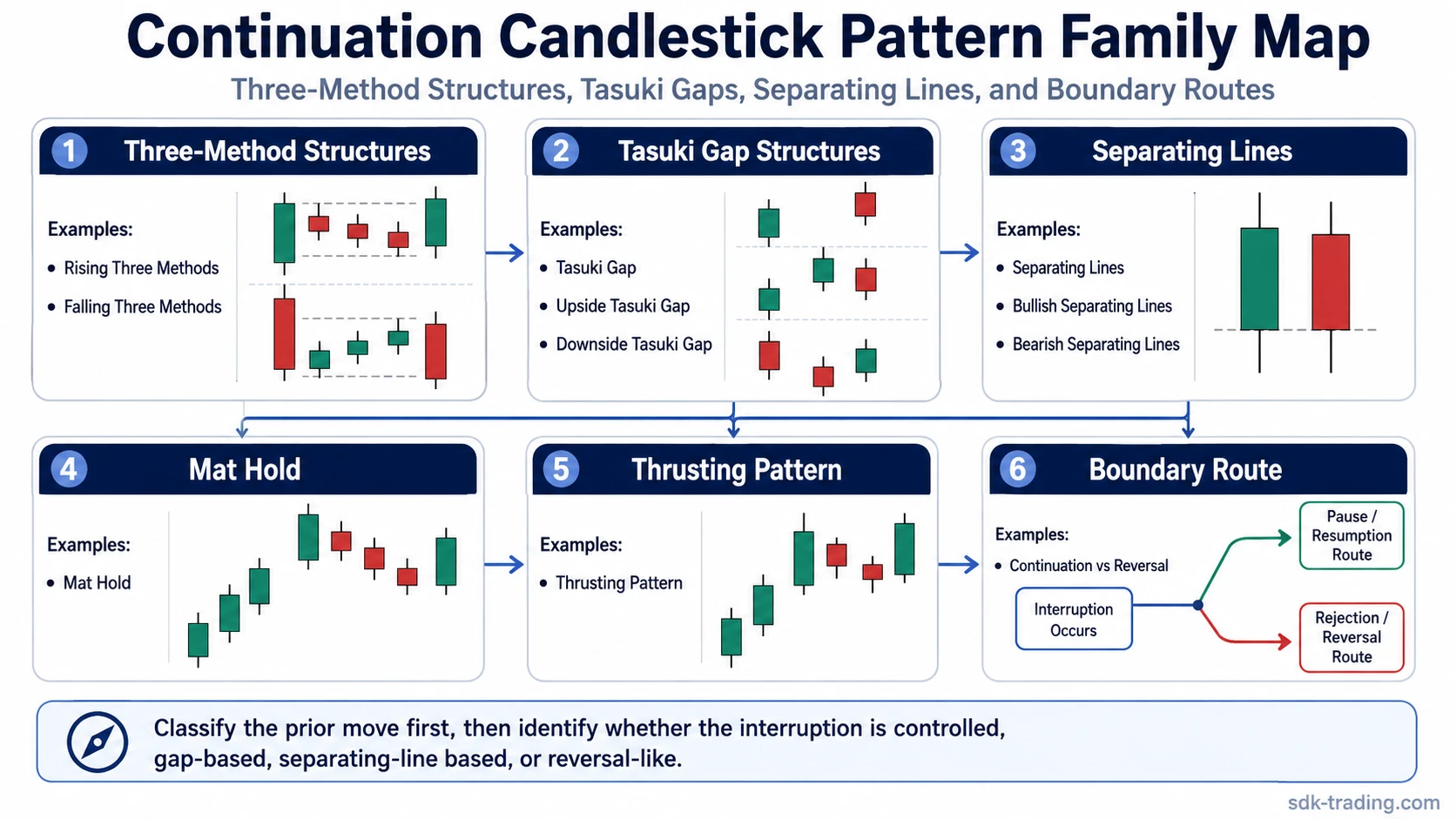
Continuation Pattern Classification
- Three-method patterns use a strong directional candle, a contained counter-move, and a final candle that resumes the original direction.
- Tasuki patterns are defined by a gap relationship and a third candle that moves back into the gap without fully filling it.
- Separating Lines use two opposite-colored candles with the same or nearly the same opening price inside an existing trend.
- Mat Hold is a bullish continuation structure, while the classic Thrusting Pattern is a bearish continuation structure built around an incomplete recovery.
How to Choose the Right Continuation Pattern
Start with the feature that makes the formation identifiable. Candle count alone is not enough because different continuation families rely on different relationships between the prior move and the candles that follow.
| Observed structure | Pattern to study | Defining evidence |
|---|---|---|
| Uptrend, strong bullish candle, contained counter-move candles, then renewed bullish expansion | Rising Three Methods | The middle candles remain contained within the first candle’s range before the final bullish candle completes the sequence. |
| Downtrend, strong bearish candle, contained counter-move candles, then renewed bearish expansion | Falling Three Methods | The middle candles remain contained within the first candle’s range before the final bearish candle completes the sequence. |
| Bullish trend, initial strong candle, gap-up pause, then renewed upside expansion | Mat Hold | The classic structure is a five-candle bullish continuation pattern with a shallow pause that preserves the earlier advance. |
| A directional gap followed by an opposite-color candle that moves back into the gap without filling it | Tasuki Gap | The unfilled portion of the gap is central to the pattern definition. |
| Three-candle Tasuki structure built around an upside gap | Upside Tasuki Gap | The gap direction narrows the broader Tasuki relationship to its bullish version. |
| Three-candle Tasuki structure built around a downside gap | Downside Tasuki Gap | The gap direction narrows the broader Tasuki relationship to its bearish version. |
Separating Lines and Related Continuation Structures
Separating Lines use a two-candle mechanism. The first candle runs against the prevailing trend, while the second opens at or near the same price and resumes the trend direction. The matching opening area is the feature that separates this family from patterns built around matching closes or gap behavior.
| Structure | Pattern to study | Classification boundary |
|---|---|---|
| Shared-open relationship before the directional version is selected | Separating Lines | The two opposite-colored candles begin from the same or nearly the same opening area inside an existing trend. |
| Bearish interruption followed by a bullish same-open recovery inside an uptrend | Bullish Separating Lines | The second candle restores the original bullish direction from the shared opening area. |
| Bullish interruption followed by a bearish same-open recovery inside a downtrend | Bearish Separating Lines | The second candle restores the original bearish direction from the shared opening area. |
| Downtrend, long bearish candle, lower open, then a bullish recovery that closes below the midpoint of the first body | Thrusting Pattern | The bullish recovery remains incomplete because the second candle does not reclaim the midpoint of the first bearish body. |
Continuation Pattern Families
The family boundary comes from the evidence unit that defines the formation. This is the shortest way to separate similar-looking pauses without turning the page into a full tutorial for every individual pattern.
| Pattern family | Evidence unit | What identifies the family |
|---|---|---|
| Three-method patterns | Contained multi-candle pause | A strong trend candle contains the counter-move before the final candle resumes the original direction. |
| Tasuki gap patterns | Gap plus partial retracement | The third candle moves into the gap while leaving part of the gap open. |
| Separating-line patterns | Shared opening price | Two opposite-colored candles open from the same or nearly the same level inside an established trend. |
| Other continuation structures | Pattern-specific interruption | Mat Hold uses a bullish gap-and-pause sequence, while the Thrusting Pattern uses an incomplete bullish recovery inside a downtrend. |
Scope boundary: This page groups the structural families. Detailed identification rules, examples, and pattern-specific limitations belong on the individual pattern pages.
Continuation Versus Reversal Boundaries
A continuation classification starts from an existing move and asks whether the named candle relationship still fits that move. Reversal patterns use different pattern definitions and different prior-trend relationships. A deep pullback or a failed pattern rule can therefore move the chart outside the original continuation classification before any broader market conclusion is made.
When that distinction is the main problem, Continuation vs Reversal Patterns compares the two families directly.
Common Continuation Pattern Confusions
Most confusion comes from using the wrong evidence unit. Three-method patterns are defined by containment, Tasuki patterns by the gap relationship, and Separating Lines by the shared opening price.
| Confusion | Relevant distinction | First feature to compare |
|---|---|---|
| The bullish and bearish three-method versions use the same broad sequence. | Rising and Falling Three Methods | Prior trend direction and the direction of the first and final candles. |
| Continuation and reversal patterns can both follow a strong directional move. | Continuation vs Reversal Patterns | The required candle geometry and its relationship to the prior trend. |
| Upside and downside Tasuki patterns share the same gap logic. | Tasuki Gap | The direction of the gap comes after the broader three-candle relationship is identified. |
| Separating Lines can be mistaken for an ordinary opposite-color candle pair. | Separating Lines | The two candles must share the same or nearly the same opening area. |
When the Broader Continuation Family Is the Question
Some questions are broader than one pattern name. The pages below handle wider orientation and direct comparison while this page stays focused on structural classification.
| Recognition problem | Focused topic | Reason to use it |
|---|---|---|
| The goal is a broader orientation across continuation candlestick structures. | Continuation candlestick patterns overview | The overview covers the wider family context without repeating every pattern definition here. |
| The pause resembles the three-method family. | Rising Three Methods or Falling Three Methods | The comparison isolates the mirrored bullish and bearish sequence. |
| The continuation structure is built around an upside gap. | Upside Tasuki Gap or Downside Tasuki Gap | The directional variants separate the same Tasuki mechanism by gap direction. |
Continuation Pattern Reading Sequence
First establish the prior directional move. Then identify the pattern’s defining evidence unit: containment, gap behavior, shared-open behavior, or a pattern-specific partial recovery. Only after that should the bullish or bearish variant be selected.
If the required geometry is missing, the formation no longer fits the named continuation pattern even when the larger trend eventually continues. Pattern classification and the eventual market outcome are separate questions.