Continuation vs reversal patterns separate two different candlestick interpretations. A continuation pattern fits when a candle sequence interrupts an existing move without breaking the structure that supports trend resumption. A reversal pattern fits when the prior directional structure begins to fail and price starts accepting in the opposite direction.
Definition: In candlestick analysis, continuation patterns describe pause-and-resumption behavior inside an existing trend, while reversal patterns describe evidence that the prior directional move may be losing control and giving way to the opposite side.
The distinction is not based on candle shape alone. The same candle can carry a different meaning depending on prior trend, location, pullback depth, nearby swing structure, and later follow-through. A candle pattern matters most when it appears where structure already gives it context.
Key Points
- Continuation readings fit better when the prior trend remains structurally intact.
- Reversal readings need more than a failed candle; they need evidence that directional control is changing.
- A failed continuation is unresolved first. It is not automatically a confirmed reversal.
- Candlestick names become more useful when checked against location, acceptance, and follow-through.
Continuation vs Reversal Patterns: The Core Difference
A continuation pattern treats the current candle sequence as a pause inside a larger directional move. The market pulls back, consolidates, or interrupts the trend, but the prior structure still holds. The important question is whether price can resume in the original direction without damaging the swing structure that made the trend readable.
A reversal pattern treats the current candle sequence as possible evidence that the previous directional move is failing. The question changes from “can the trend continue?” to “has price started accepting the opposite side?” That requires more than a dramatic candle. It usually needs a failed attempt to continue, a break of meaningful structure, or follow-through that changes the balance of control.
The common mistake is treating continuation and reversal as opposite labels for the same candle. They are better understood as two different lenses. One asks whether trend-resumption conditions remain intact. The other asks whether the prior move is being rejected strongly enough to support a change in interpretation.
When to Use Continuation vs Reversal Pattern Interpretation
| Question | Continuation lens fits better when… | Reversal lens fits better when… |
|---|---|---|
| Prior trend | The trend is still intact and the pullback has not broken the structure that supports the move. | The prior trend is losing structure, with failed pushes or meaningful breaks against the previous direction. |
| Pullback behavior | The interruption remains contained, shallow, or corrective relative to the previous impulse. | The pullback becomes forceful enough to challenge the prior trend rather than simply pause it. |
| Acceptance | Price rejects the interruption and starts accepting again in the trend direction. | Price starts accepting beyond the prior structure in the opposite direction. |
| Follow-through | Later candles support trend resumption instead of stalling immediately after the pattern. | Later candles confirm that the failed move is not just a pause or range expansion. |
| Best fit | Classifying a pause that still belongs inside the existing trend. | Classifying a possible shift in directional control. |
When a Continuation Reading Fits Better
A continuation reading fits better when the market pauses without damaging the structure that supported the prior move. The candles may compress, overlap, gap, or pull back, but the larger move still has room to resume if acceptance returns in the original direction.
Multi-candle continuation patterns often depend on this idea. A Mat Hold pattern is easier to interpret as continuation when the interruption remains controlled after a strong move and the later candle action supports trend resumption rather than structural failure.
Gap-based continuation readings use similar logic. A Tasuki Gap needs the gap context, the response to that gap, and the later acceptance behavior to support the continuation view. The gap alone is not enough.
When a Reversal Reading Fits Better
A reversal reading fits better when price no longer behaves like a controlled pause. The prior move may fail to extend, a recovery attempt may stall, or price may begin accepting beyond a structure that previously held the trend together.
The reversal lens becomes more defensible when the market does not merely hesitate but begins to replace the prior directional behavior. That may appear through a failed push, a break of a prior swing, or repeated inability to reclaim the area that should have supported continuation.
A reversal pattern still needs caution. A strong opposite candle can mark reaction, exhaustion, or range expansion without proving that the previous trend has fully changed. The safer interpretation depends on what price accepts after the candle sequence appears.
Same Candle Setup, Different Meaning
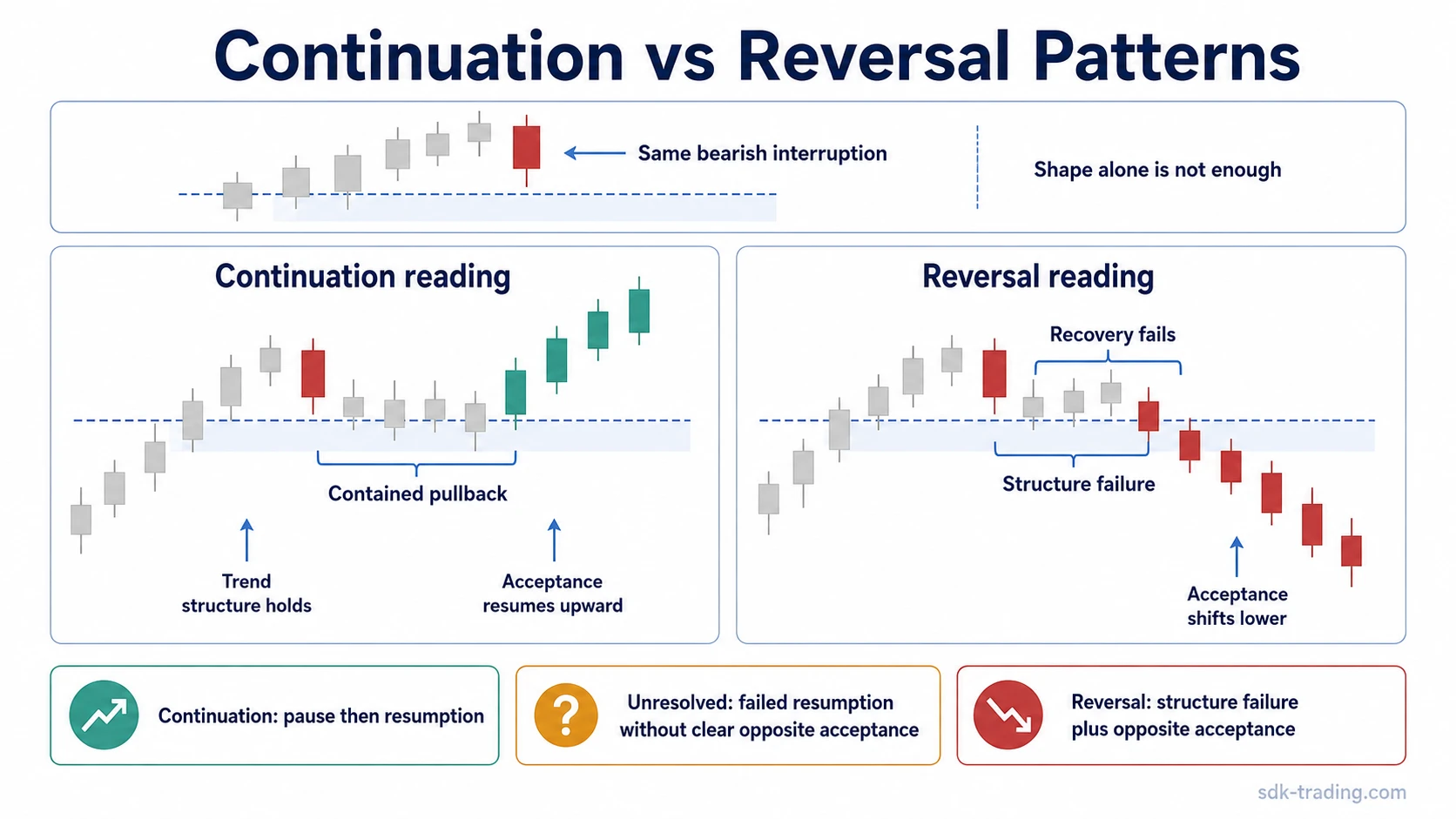
Price advances into a prior resistance area, pauses, and prints a bearish candle after several bullish candles. The first reading can look like a reversal because the candle rejects the upper area. That reading is incomplete until later behavior shows whether sellers can hold control beyond one reaction.
The candle shape starts the comparison, but the later acceptance or rejection decides which interpretation is more defensible.
The continuation case remains stronger if the pullback stays contained, buyers reclaim the tested area, and later candles accept above the pause. The same bearish interruption then behaves more like a temporary interruption inside the advance.
The reversal case becomes more credible if the recovery attempt fails, price accepts back below the prior structure, and later candles stop respecting the earlier trend direction. The original bearish candle then becomes part of a larger change in behavior rather than an isolated reaction.
Failed Continuation Is Not Automatically Reversal
A failed continuation often creates an unresolved state before it creates a reversal. The market may stop trending, rotate sideways, or widen its range without clearly accepting the opposite direction. Calling that reversal too early creates a false equivalence between failed resumption and confirmed directional change.
The distinction matters because a continuation failure only says that the original trend did not resume cleanly. A reversal reading needs the next layer of evidence: structure failing, opposite-side acceptance, and follow-through that supports a change in control.
Safer reading: treat the failed continuation as a warning first. Upgrade it to reversal risk only when price behavior shows more than hesitation.
Common Misreads
| Misread | Why it creates confusion | Cleaner interpretation |
|---|---|---|
| Reading the candle name without location | The same pattern can mean different things in trend, range, or exhaustion conditions. | Start with prior trend, nearby structure, and whether the candle appears at a meaningful area. |
| Calling every failed continuation a reversal | A trend can pause or lose momentum without immediately changing direction. | Separate failed resumption from confirmed opposite-side acceptance. |
| Treating a strong candle as proof | Large candles can reflect reaction, liquidity, or short-term imbalance. | Check follow-through before assigning stronger meaning. |
| Using pattern lists as interpretation | Catalogues show names, but they rarely settle the structure question. | Use the name only after the market context supports the reading. |
Classification Weakens When Context Is Missing
Continuation and reversal labels weaken when there is no clear prior move, when price is rotating inside a noisy range, or when later candles fail to accept either direction. In those conditions, the candle sequence may show temporary imbalance rather than a clean continuation or reversal decision.
Timeframe conflict can also weaken the classification. A candle sequence that looks like reversal on a smaller timeframe may be only a pullback on a larger one. A sequence that looks like continuation on a larger timeframe may still contain short-term rejection inside it. The useful reading comes from matching the pattern to the structure being analyzed.
FAQ
Can the same candlestick pattern be continuation or reversal?
Yes. The same candle shape can carry different meaning depending on prior trend, location, structure, and later follow-through.
Does a failed continuation confirm a reversal?
No. A failed continuation is unresolved first. A reversal reading needs additional evidence that price is accepting in the opposite direction.
Why is follow-through important in candlestick pattern interpretation?
Follow-through helps separate a temporary reaction from a stronger change in behavior. Without it, the pattern label can overstate what the candles actually prove.