Supply and demand trading is a price-action method for marking areas where a compact base was followed by a strong directional departure. The useful chart evidence is the sequence itself: how price entered the base, how it left, where the base boundaries sit, and what happens if price later returns to the same area.
Definition: A supply or demand zone is a price area built around the base that preceded a directional move. An upward departure creates a possible demand zone. A downward departure creates a possible supply zone. The zone is an analytical chart reference rather than direct evidence of specific hidden orders.
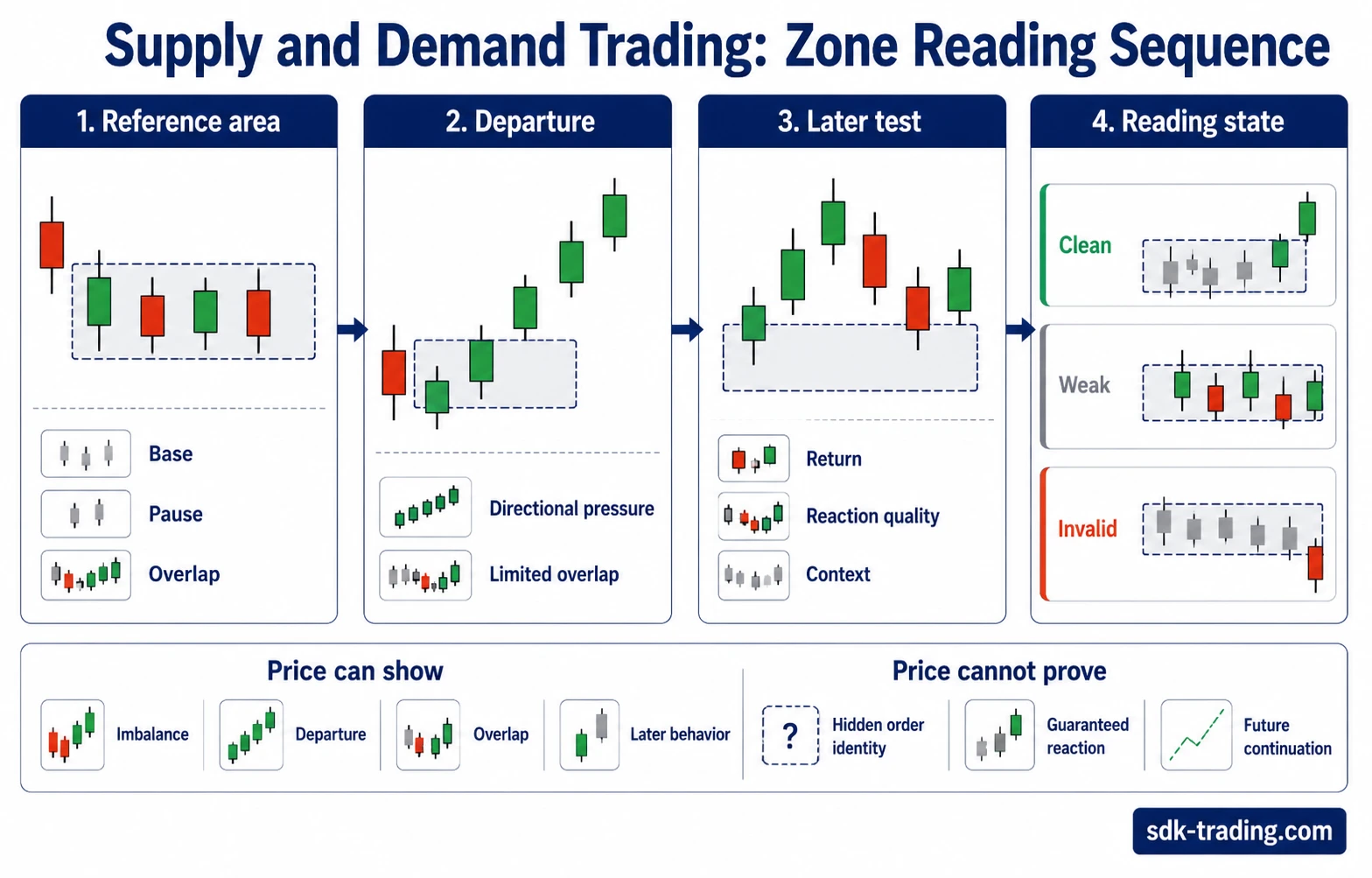
How Supply and Demand Zones Form
The base is the central part of the structure. It is usually a short area of compression, overlapping candles, or reduced directional progress before price expands away from it.
Three parts should be separated when the zone is first marked:
| Structure | What to identify | Why it matters |
|---|---|---|
| Incoming leg | The direction price was moving before the base formed. | It helps distinguish reversal-style formations from continuation-style formations. |
| Base | The compact price area between the incoming and outgoing legs. | This area provides the zone boundaries. |
| Outgoing leg | The directional move that leaves the base. | Its direction determines whether the base is classified as supply or demand. |
A random pause is therefore insufficient for classification. The base becomes relevant to supply and demand analysis because of the directional move that follows it.
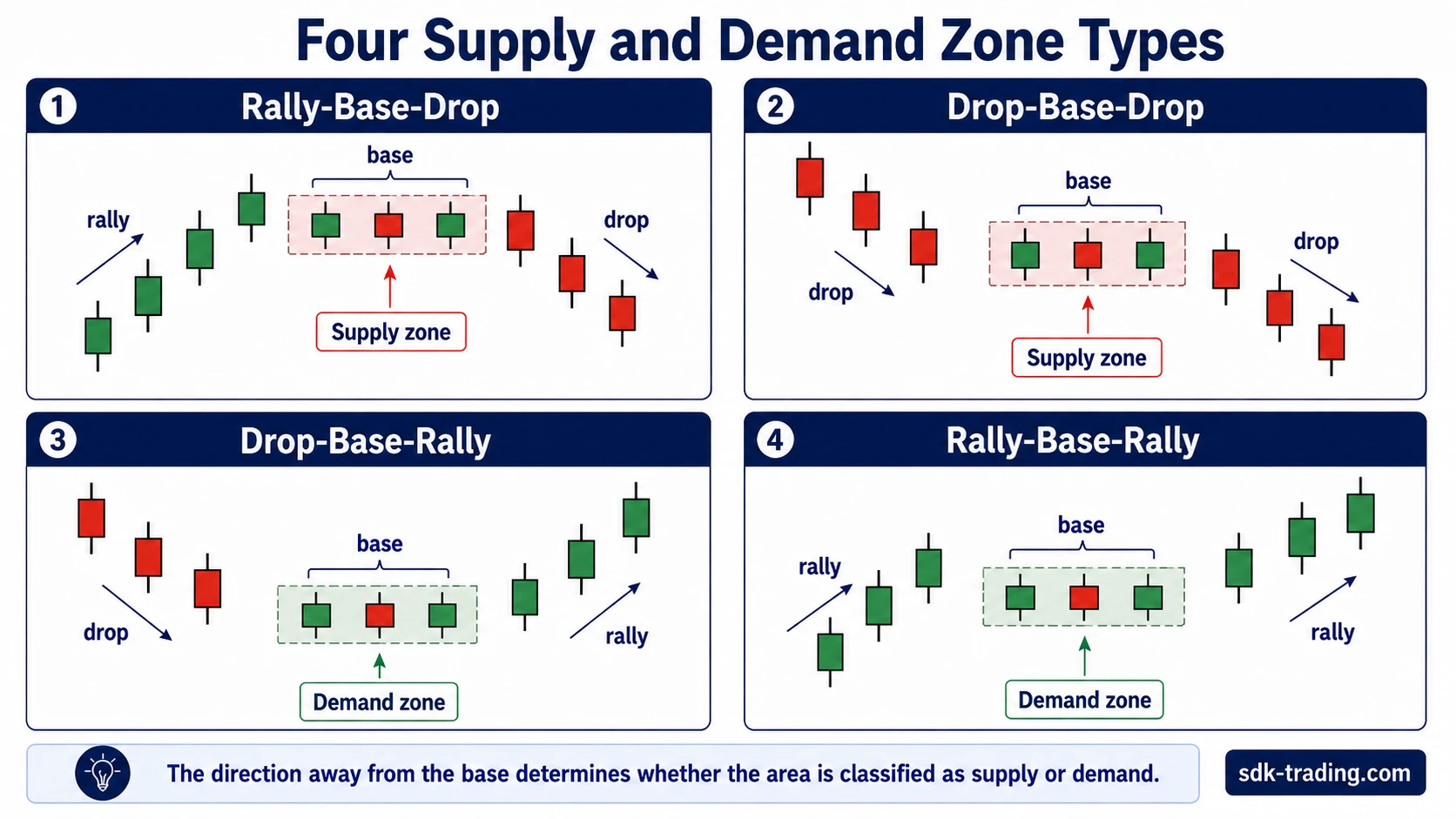
Four Supply and Demand Zone Types
The incoming and outgoing legs produce four common structural combinations. Two finish with a downward departure and are classified as supply. Two finish with an upward departure and are classified as demand.
| Formation | Zone type | Structure |
|---|---|---|
| Rally-Base-Drop | Supply | Price rises into a base and then leaves the base lower. |
| Drop-Base-Drop | Supply | A decline pauses in a base before continuing lower. |
| Drop-Base-Rally | Demand | Price falls into a base and then leaves the base higher. |
| Rally-Base-Rally | Demand | An advance pauses in a base before continuing higher. |
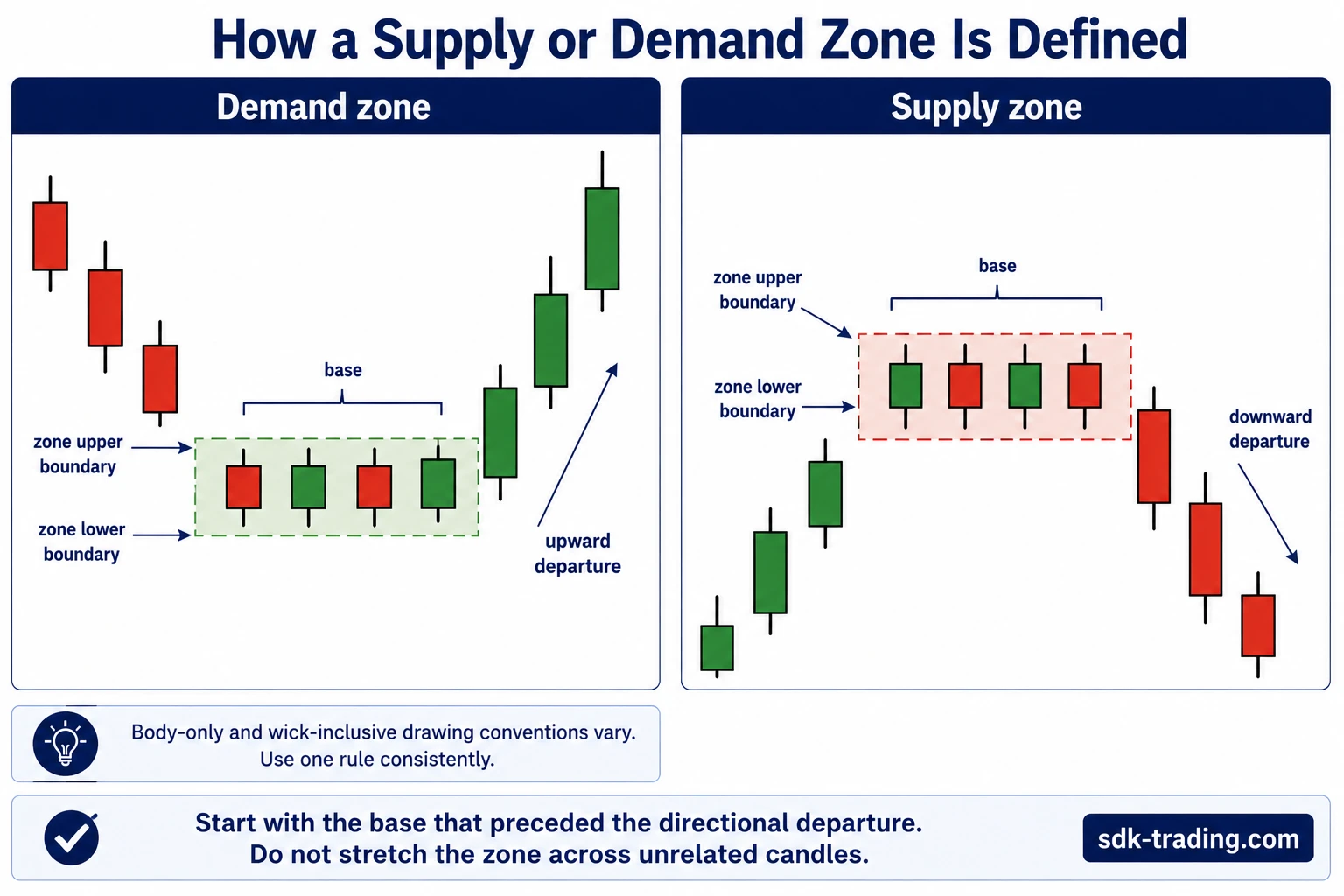
Supply Zones and Demand Zones
A supply zone is built around a base followed by a downward departure. The defining observation is that price moved away from the base to the downside with enough directional progress to make the base worth marking as a reference area.
A demand zone uses the opposite geometry. Price forms a base and then expands upward from it. The area occupied by the base becomes the demand reference.
| Zone | Outgoing move | Chart reference |
|---|---|---|
| Supply | Price leaves the base lower | The base that preceded the downward departure |
| Demand | Price leaves the base higher | The base that preceded the upward departure |
How to Draw a Supply or Demand Zone
A zone should cover the price area belonging to the base rather than every candle near the departure. This makes supply and demand different from drawing a single horizontal line through one exact price.
The upper and lower edges define a working price range. Different supply-and-demand methods use slightly different rules for deciding whether wicks, candle bodies, or both should determine those edges. The important part is to use one convention consistently rather than changing the zone after every revisit.
| Drawing step | Practical check |
|---|---|
| Locate the departure | Find the directional expansion that makes the preceding base relevant. |
| Move back to the base | Identify the compact candles immediately preceding that departure. |
| Mark the base range | Use the chosen body or wick convention consistently for the upper and lower boundaries. |
| Avoid unrelated candles | Do not stretch the rectangle simply to capture nearby price action. |
Departure Quality
The departure is what separates an ordinary consolidation from a base worth evaluating as a supply or demand zone. A larger directional move with relatively little immediate overlap provides a clearer connection between the base and the move that followed.
A slow exit made of heavily overlapping candles is harder to distinguish from normal two-way trading. That does not create a universal minimum candle size or distance. It means the relationship between the base and the outgoing leg should remain visually clear.
| Departure feature | What the chart shows |
|---|---|
| Directional expansion | Price gains distance from the base rather than remaining centered around it. |
| Limited immediate overlap | Later candles do not immediately erase most of the departure. |
| Clear base-to-leg transition | The base can be separated visually from the directional move that follows. |
| Choppy departure | Price repeatedly overlaps the same area, making the proposed zone less distinct. |
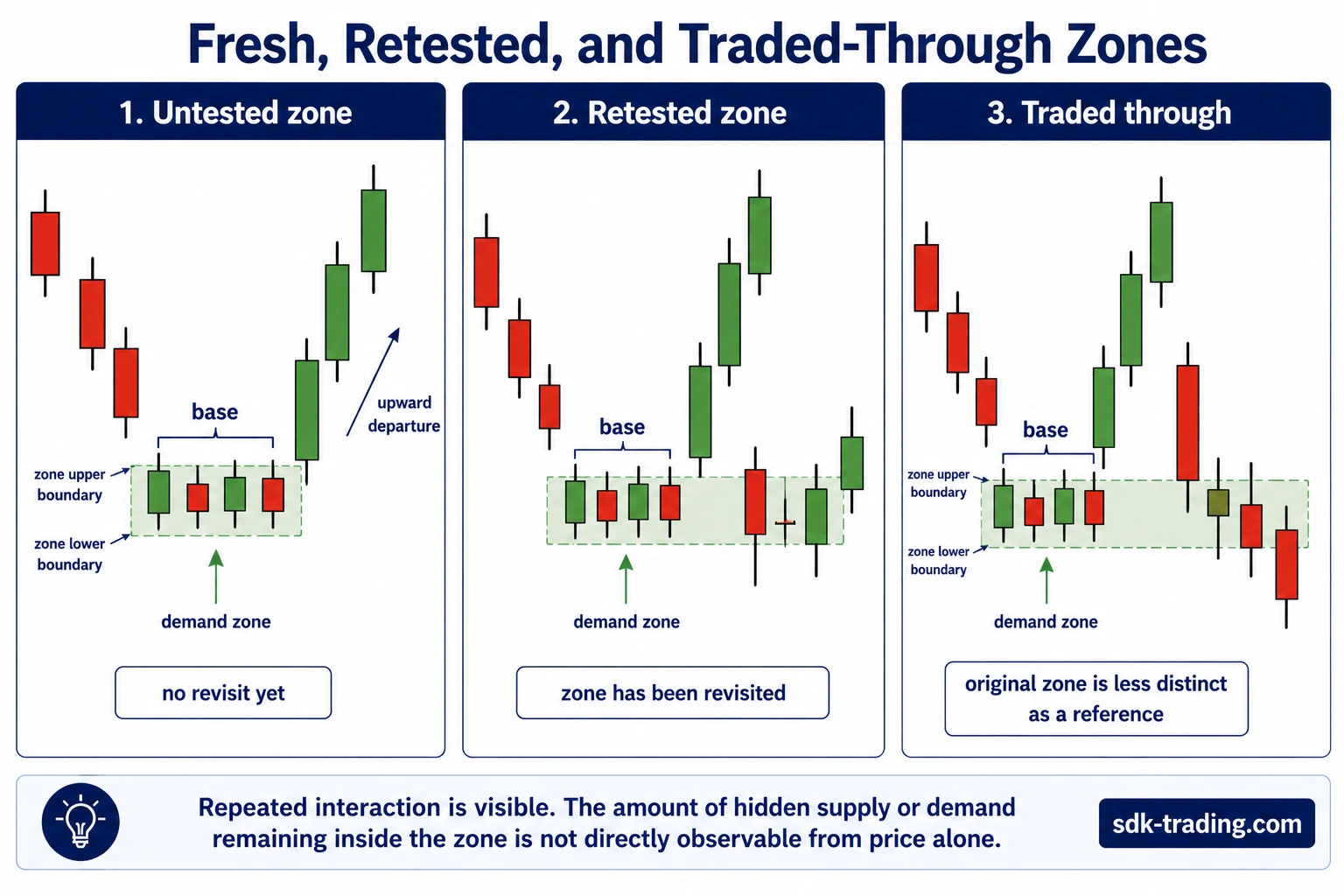
Untested, Retested, and Traded-Through Zones
A zone can remain untouched after its initial departure, receive a later revisit, or become heavily overlapped by subsequent trading. These are observable differences in how price has interacted with the original base.
| Zone state | Visible price behavior |
|---|---|
| Untested | Price has not returned to the original zone since the departure. |
| Retested | Price later trades back into part of the zone. |
| Repeatedly tested | Several later moves interact with the same area. |
| Traded through | Price overlaps deeply across the original zone and spends meaningful time on both sides of its boundaries. |
Repeated interaction changes the visual character of the reference. A clearly separated base and departure can become harder to distinguish from current price structure after extensive two-way trading through the same area.
The chart does not reveal how many hidden orders remain inside a zone. Descriptions such as orders being “consumed” are interpretations of repeated interaction, not directly observable inventory data.
Supply and Demand vs Support and Resistance
Supply and demand zones and classic support or resistance areas can occupy the same part of a chart, but their construction starts from different observations.
Classic resistance identifies an area where upward movement has previously struggled or turned lower. A supply zone begins with a base followed by a downward departure.
Classic support identifies an area where downward movement has previously struggled or turned higher. A demand zone begins with a base followed by an upward departure.
| Concept | Primary observation |
|---|---|
| Supply zone | Base followed by a directional move lower |
| Demand zone | Base followed by a directional move higher |
| Resistance | Area where prior upward movement stalled or reversed |
| Support | Area where prior downward movement stalled or reversed |
What Price Can and Cannot Show
The chart can establish the base, its boundaries, the direction and character of the departure, and every later interaction with the area. Those observations are enough to classify the visible supply-and-demand structure.
Price alone cannot identify every resting order inside the zone, determine which participant placed those orders, or prove why a specific departure occurred. A rapid move may result from several market mechanisms that are not visible in ordinary candle data.
| Observable from price | Not established by price alone |
|---|---|
| Location and width of the base | Exact hidden order inventory |
| Direction and size of the departure | Identity of the participants responsible |
| Number and depth of later revisits | Number of orders supposedly remaining in the zone |
| Whether price trades through the boundaries | Deliberate institutional intent |
Example of a Demand Zone
Suppose price is declining and then forms a narrow three-candle base. The next several candles expand strongly upward and create clear distance from that base. Structurally, this is a Drop-Base-Rally formation, so the base can be marked as a demand zone.
If price does not return, the zone remains untested. A later move back into the rectangle creates a retest. If subsequent trading repeatedly crosses the upper and lower boundaries, the original base becomes increasingly integrated into newer price structure.
Common Supply and Demand Zone Mistakes
| Mistake | Why it causes a classification problem |
|---|---|
| Marking every pause as a zone | The proposed base has no clear directional departure tied to it. |
| Drawing the rectangle too broadly | Unrelated candles become part of the zone and reduce precision. |
| Changing boundaries after each revisit | The original reference can no longer be evaluated consistently. |
| Ignoring repeated overlap | The chart may no longer show the original base as a distinct price area. |
| Assuming hidden orders from the shape alone | The candle sequence does not reveal exact participant identity or resting order inventory. |
FAQ
What is supply and demand trading?
Supply and demand trading is a price-action method that marks bases followed by directional departures. A base followed by an upward departure can form a demand zone, while a base followed by a downward departure can form a supply zone.
What are the four basic supply and demand zone formations?
The four common structures are Rally-Base-Drop and Drop-Base-Drop for supply zones, and Drop-Base-Rally and Rally-Base-Rally for demand zones.
How is a supply or demand zone drawn?
The zone is usually drawn around the base immediately preceding the directional departure. Exact body-versus-wick conventions vary, so the same boundary rule should be applied consistently.
Does repeated testing mean the orders inside a zone have been consumed?
Repeated testing and deep overlap are visible on the chart, but the remaining hidden order inventory is not. Heavy trading through a zone can make the original reference less distinct without proving exactly which orders remain there.