Reading a stock chart starts with the frame, not with one isolated signal. A chart becomes easier to understand when timeframe, price structure, key reference areas, candles, volume, and supporting tools are checked in a consistent order.
Definition: Reading a stock chart means organizing market-generated data so price behavior can be interpreted in context. The main task is to separate the larger structure from the smaller signal before drawing any conclusion.
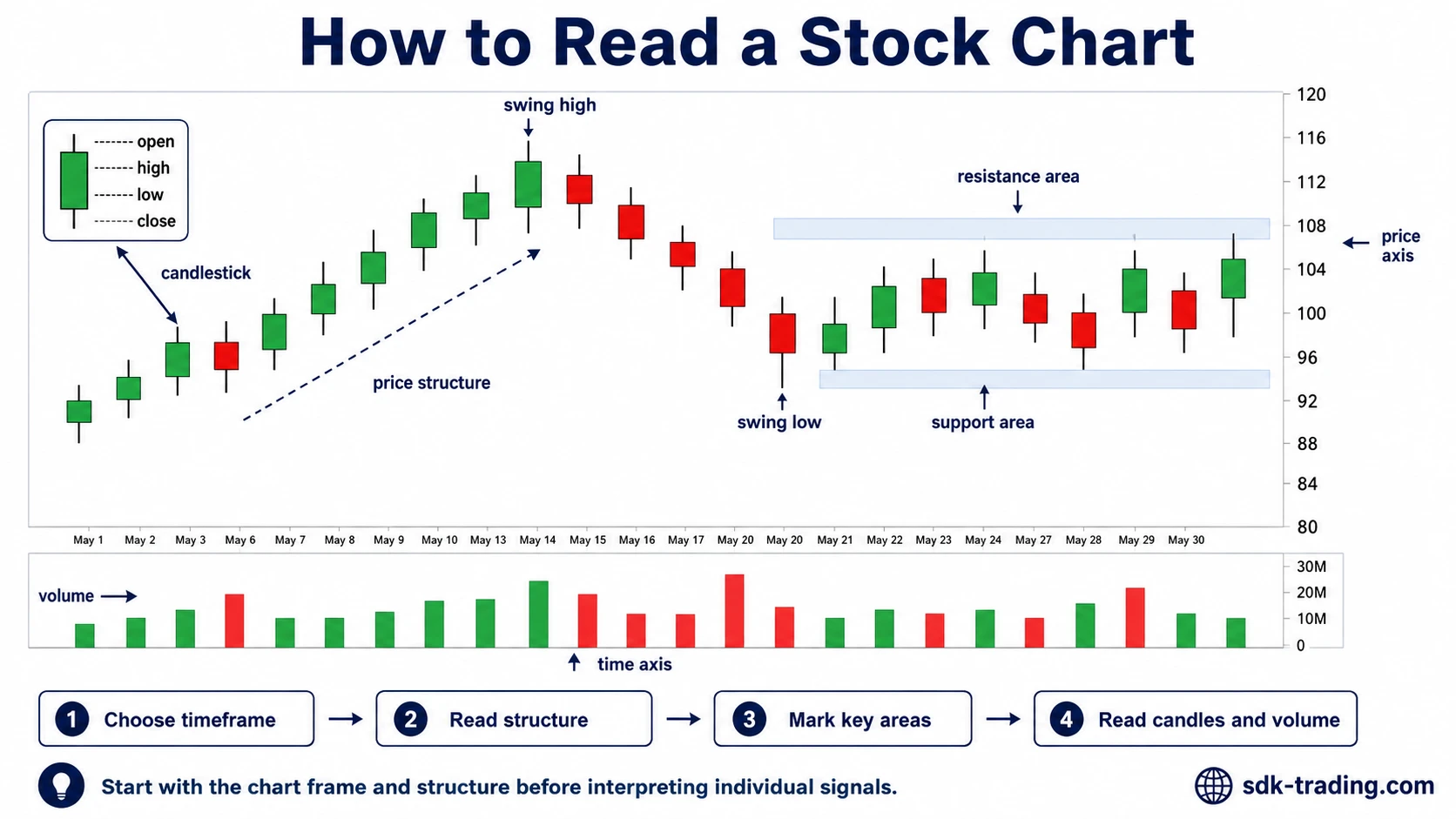
Stock chart reading is part of technical analysis. The same candle, breakout, higher high, or indicator reading can mean different things when the timeframe or structural location changes. A practical chart-reading process therefore starts broad and becomes more specific step by step.
A Practical Order for Reading Stock Charts
The quickest way to reduce confusion is to read a chart in a fixed sequence. That prevents one candle, one pattern, or one indicator from taking control of the whole interpretation too early.
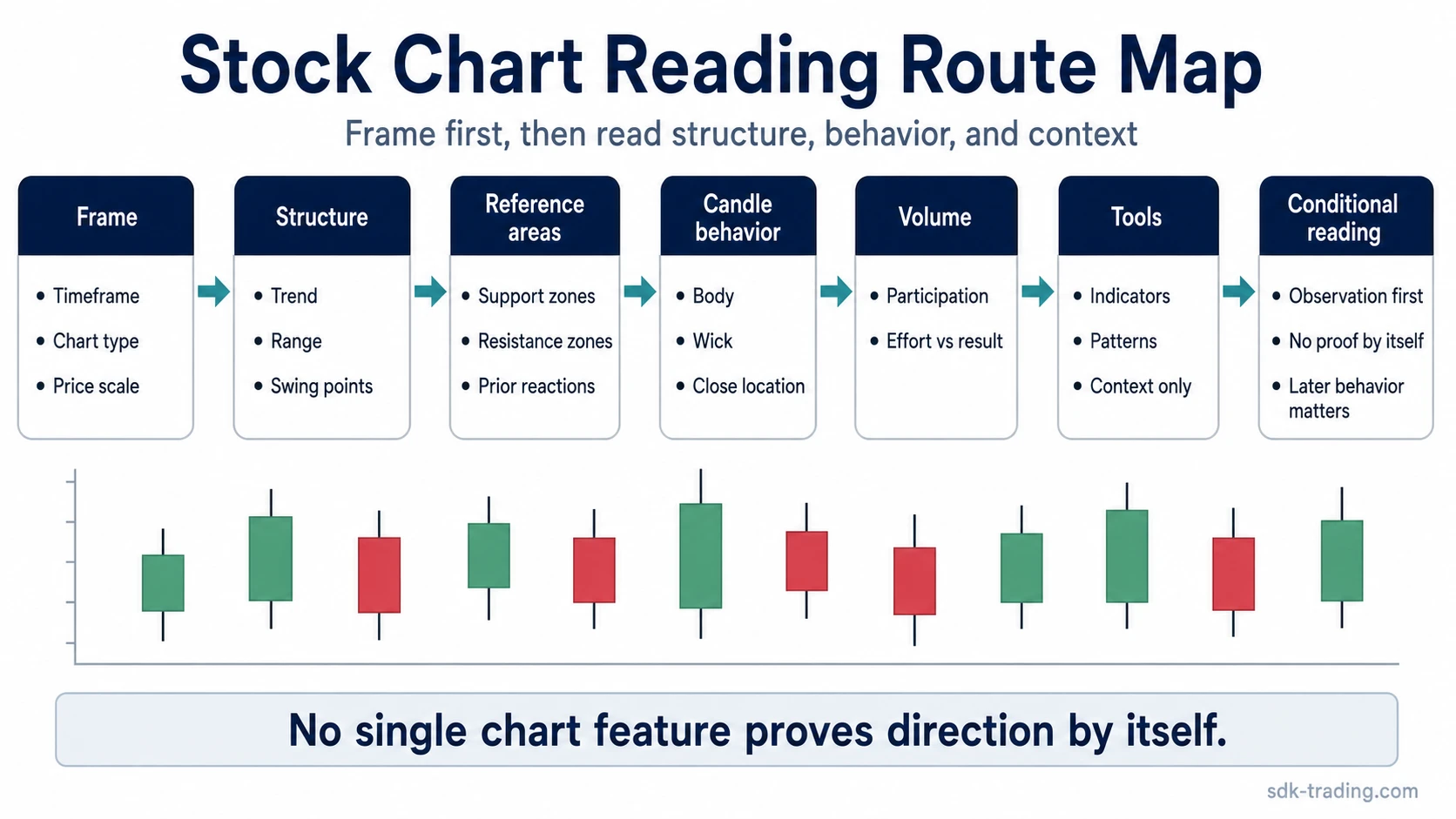
| Reading step | What to check | Why it comes first |
|---|---|---|
| 1. Timeframe | Daily, weekly, monthly, or intraday frame | The same market can look very different on different periods. |
| 2. Structure | Trend, range, correction, expansion, or transition | The larger structure gives the smaller signal its meaning. |
| 3. Reference areas | Prior highs, lows, support, resistance, gaps, or boundaries | Location matters before candles and signals are interpreted. |
| 4. Local price behavior | Candles, break attempts, reversals, pauses, and closes | The signal should be read inside the already defined structure. |
| 5. Participation | Volume compared with the actual price result | Activity matters more when it is tied to what price accomplished. |
| 6. Supporting tools | Indicators or pattern labels | They help clarify a question rather than replace the chart itself. |
| 7. Reassessment | Follow-through, retest, failure, or acceptance | Later behavior decides whether the first reading holds up. |
What to Check on Any Stock Chart
A stock chart contains several layers of information. They should not all be read with the same weight.
| Chart layer | Main question | Typical mistake |
|---|---|---|
| Timeframe | What period does each candle or bar represent? | Switching timeframe after a view is already formed. |
| Price structure | Is price trending, ranging, or changing character? | Ignoring the larger sequence and reacting only to one move. |
| Reference areas | Where are the main prior highs, lows, and reaction zones? | Treating every nearby price as equally important. |
| Candles and OHLC | How did the current period open, move, and close? | Assuming one candle proves the next move. |
| Volume | How much participation accompanied the move? | Calling high volume automatic confirmation. |
| Indicators and patterns | Does a tool clarify a real chart question? | Using labels and tools before the basic chart is understood. |
Market Structure helps define whether price is building a trend, rotating in a range, or beginning to change its sequence.
Support and Resistance Levels explains how to treat reaction areas as references rather than guaranteed turning points.
Candlestick Patterns become more useful when candle shape is read together with structure and location. A doji, for example, records hesitation inside one period, but it does not carry the same meaning everywhere on the chart.
A Simple Moving Average can help summarize the path of price, but it is still a derived tool rather than a substitute for direct chart reading.
Chart Patterns organize repeated structural shapes. A head and shoulders pattern, for example, still needs the right surrounding trend, neckline behavior, and follow-through before the label becomes useful.
Complete Stock Chart Reading Walkthrough
The video below applies the full reading process to real charts. It combines timeframe analysis, market structure, channels, support and resistance, candlesticks, volume, Volume Profile, moving averages, RSI, Elliott Wave, confirmation, and risk without treating any single tool as a complete trading system.
The examples include Microsoft, Silver and SLV, LYFT, POWL, Bitcoin, PGNY, Adobe, IJR, and DigitalOcean. The key lesson is that chart reading is a process. The same observation can carry different weight when timeframe, structure, or later behavior changes.
Real Example: When a Higher High Does Not Mean the Same Thing
The POWL weekly chart shows why a familiar label can still require a different interpretation when the surrounding structure changes.
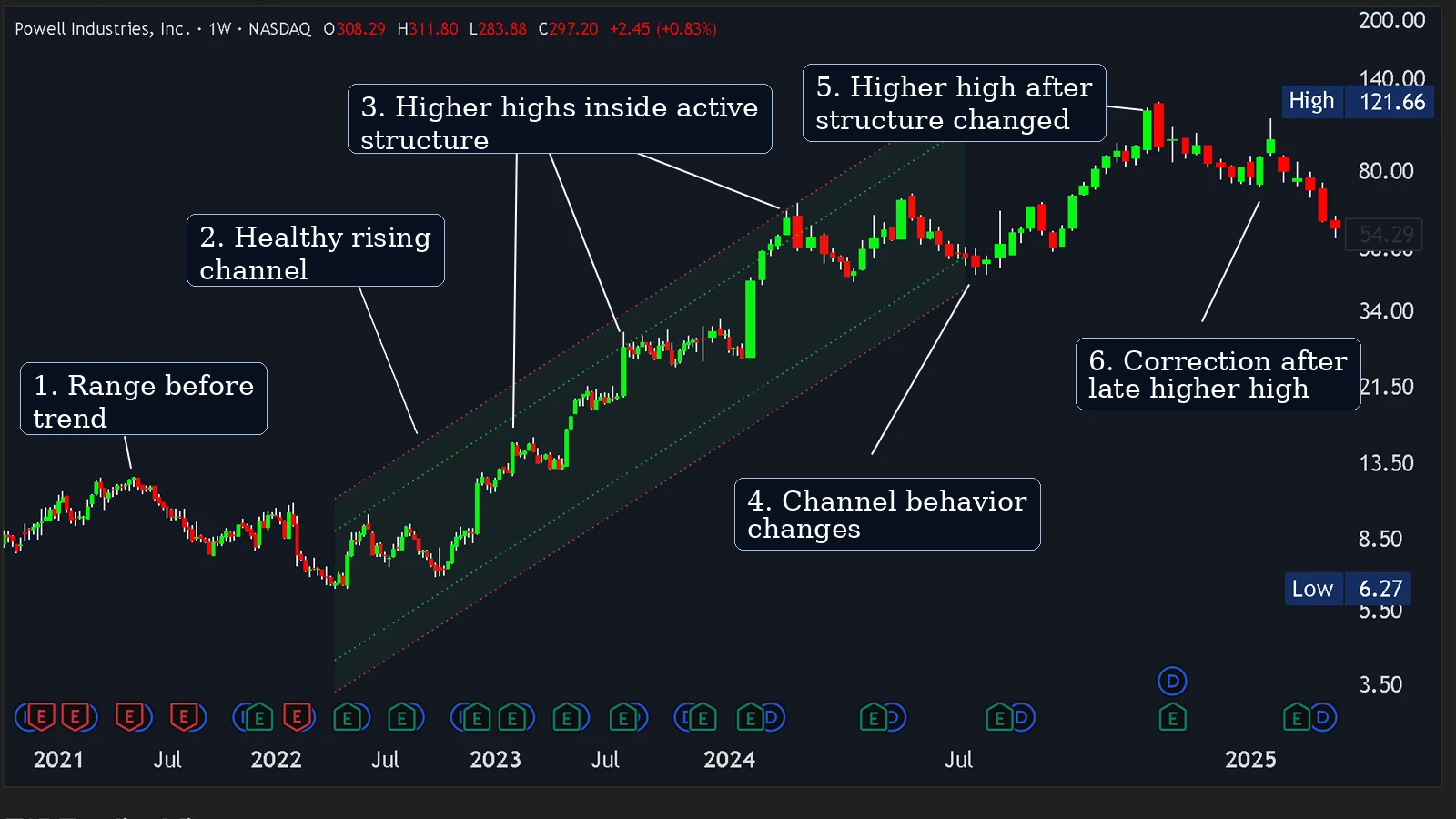
During the stronger phase, higher highs developed while the advance still held its earlier structure. Later, price printed another higher high after the previous rhythm had already weakened. The visible label was the same, but the context was not.
| Observation | Context | Safer reading |
|---|---|---|
| Higher highs inside the rising structure | The advance remained more organized. | The trend reading still had better structural support. |
| Structural behavior begins to weaken | Price no longer behaves as cleanly as before. | The earlier interpretation deserves reassessment. |
| Later higher high | The new high appears after structure already changed. | The higher high alone is not enough to confirm continuation. |
Reading lesson: the chart feature starts the question, but the surrounding structure decides how much weight that feature deserves.
Common Mistakes When Reading Stock Charts
| Mistake | Why it weakens the reading | Better check |
|---|---|---|
| Starting with one candle or one indicator | The broader chart is then forced to support a small signal. | Start with timeframe and structure first. |
| Reading the chart as a prediction | A chart records prior behavior, not a guaranteed future path. | Keep forward conclusions conditional. |
| Treating support and resistance as exact lines | Real reactions often include overshoots, wicks, and imperfect retests. | Use zones and check the actual response. |
| Calling every wick a rejection | A wick records intraperiod movement, not a completed market verdict. | Check the close and the next response. |
| Treating high volume as confirmation by itself | High activity can accompany expansion, friction, or exhaustion. | Compare volume with the price result. |
| Forcing a pattern name too early | The visible shape may be incomplete or poorly located. | Check boundaries, structure, and follow-through first. |
| Using too many tools at once | The chart becomes crowded and several tools may repeat the same message. | Use tools that answer a specific question. |
| Moving straight from chart reading to execution | Interpretation and risk planning are different tasks. | Separate analysis from trade planning. |
What Stock Chart Reading Can and Cannot Do
Chart reading can help organize price behavior, identify structure, compare participation, and frame possible scenarios. It cannot remove uncertainty or make one signal deterministic. A market can still fail at an obvious level, ignore a clean pattern, or change character as new price behavior appears.
The most useful approach is therefore procedural: define the frame, read the structure, mark the key areas, study the local evidence, and then reassess the chart as new information develops.