A trading timeframe is the interval of market activity represented by each price bar or candle. A one-minute chart groups one minute of trading into each bar, while a daily, weekly, or monthly chart compresses progressively more activity into each bar.
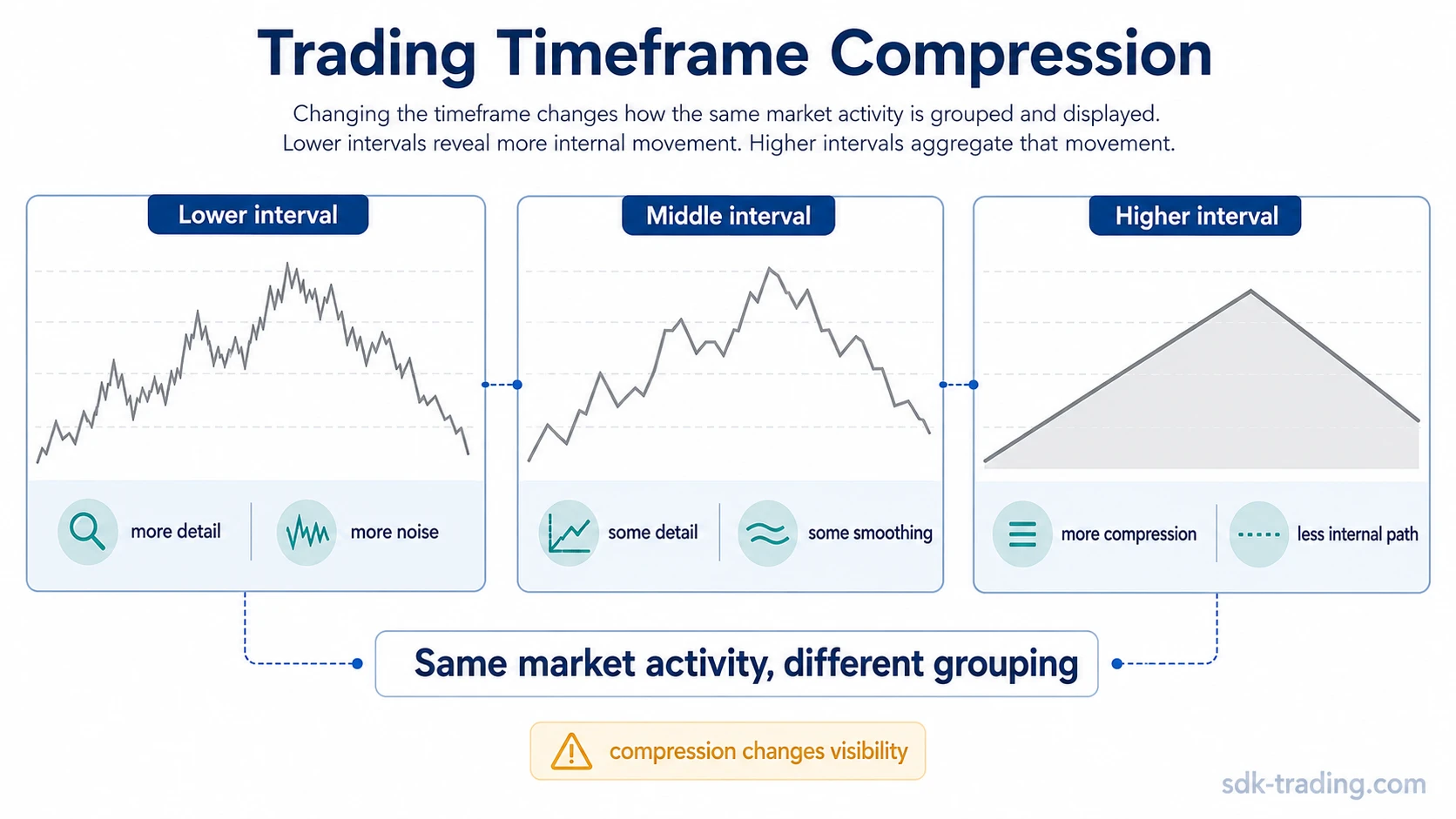
Changing the timeframe changes how the same underlying price activity is grouped. As the interval becomes larger, individual lower-timeframe movements disappear from view even though their open, high, low, and final close are still incorporated into the larger candle.
Definition: A trading timeframe is the chart interval used to organize price data into bars or candles, such as 1-minute, 15-minute, 1-hour, daily, weekly, or monthly intervals.
How Trading Timeframes Change a Chart
- Each timeframe determines how much market activity is grouped into one candle or bar.
- Lower intervals preserve more of the internal price sequence.
- Higher intervals retain the OHLC result while hiding more of the path that produced it.
- Two charts can describe the same market activity and still show very different visible structures.
What a Trading Timeframe Represents
Every candle summarizes activity inside a fixed interval. A 5-minute candle records the first price, highest price, lowest price, and final price reached during those five minutes. A 1-hour candle performs the same job across sixty minutes. A weekly candle compresses several trading sessions into one OHLC record.
The underlying activity has not changed when the chart interval changes. What changes is the amount of that activity that remains individually visible. A short advance and pullback may appear as several candles on a lower chart, then become only part of a wick or body after those candles are aggregated into a higher interval.
Why the Same Move Looks Different Across Timeframes
Suppose price advances during the morning, reaches a new intraday high, pulls back, rallies again, and finishes the session near the middle of its total range. A 5-minute chart can display each stage as a separate sequence of swings. An hourly chart compresses those swings into a much smaller number of bars. The daily chart may reduce the entire session to one candle with an upper wick and a relatively neutral close.
All three charts describe the same activity. The difference comes from how much of the internal path remains visible after aggregation.
What Survives Timeframe Compression?
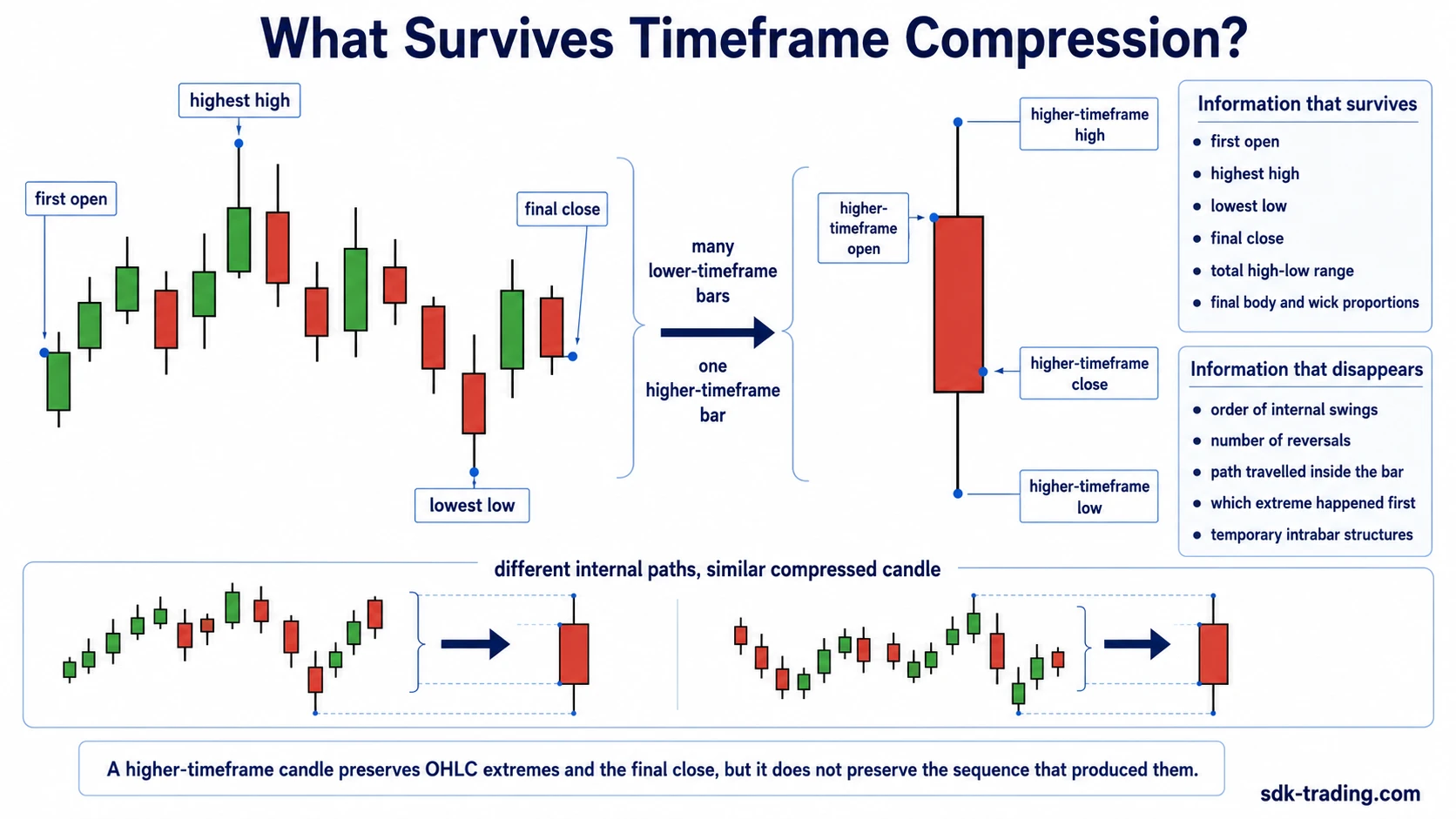
When lower-timeframe candles are combined into one higher-timeframe candle, only specific parts of the sequence determine the final OHLC bar.
| Lower-timeframe information | What happens after compression |
|---|---|
| Open of the first bar | Becomes the open of the higher-timeframe candle. |
| Highest price reached anywhere in the interval | Becomes the higher-timeframe high. |
| Lowest price reached anywhere in the interval | Becomes the higher-timeframe low. |
| Close of the final bar | Becomes the higher-timeframe close. |
| Total distance between the highest high and lowest low | Remains visible as the full candle range. |
| Relationship between the final OHLC values | Remains visible through the body and wick proportions of the compressed candle. |
The higher-timeframe candle therefore retains the boundary values of the interval and its final close. It does not retain the full sequence that connected those values.
What Disappears Inside a Higher-Timeframe Candle?
OHLC compression removes much of the sequence information between the opening and closing observations. The higher-timeframe bar does not tell you how many times price reversed internally, which intermediate swing came first, or how directly price travelled between its extremes.
| Information lost after compression | Why it can matter when reading the chart |
|---|---|
| Order of internal swings | The final candle does not show whether price moved directly toward an extreme or reached it after several reversals. |
| Number of reversals | A smooth-looking higher-timeframe candle can contain repeated lower-timeframe direction changes. |
| Internal path travelled | Two very different sequences can finish with similar OHLC values. |
| Which extreme occurred first | The final bar can show both a high and a low without revealing their chronological order. |
| Temporary lower-timeframe structures | Short ranges, small breakouts, and local swing sequences can disappear completely after aggregation. |
This creates an important boundary when reading higher-timeframe candles. The candle accurately records its OHLC values, while much of the path between those values is no longer recoverable from that candle alone.
Different Price Paths Can Produce Similar Candles
Imagine two trading sessions with the same opening price, the same session high and low, and almost the same closing price.
In the first session, price may rally early, pull back once, and then settle near the close. In the second, price may move repeatedly between both sides of the range before finishing at nearly the same level. Their intraday structures are very different, yet the resulting daily candles can look almost identical.
The higher-timeframe candle preserves the final OHLC geometry. The lower-timeframe chart preserves more information about how that geometry was produced.
Short, Medium, and Long Trading Timeframes
Timeframe labels vary between traders and markets, but shorter intervals generally expose more internal movement while longer intervals compress more of that movement into each bar.
| Timeframe group | Common intervals | Visible detail | Typical compression effect |
|---|---|---|---|
| Short timeframe | 1-minute, 5-minute, 15-minute | Local swings, short pauses, quick reactions, and small rotations. | More of the internal sequence remains visible. |
| Medium timeframe | 30-minute, 1-hour, 4-hour | Intermediate swings and connections between smaller movements. | Some short-term movement is absorbed into broader bars. |
| Long timeframe | Daily, weekly, monthly | Broader ranges, directional phases, and larger structural transitions. | Many internal swings can disappear inside a single candle. |
Higher and Lower Timeframes Can Show Different Structures
A lower timeframe can show a sequence of local higher highs and higher lows while the higher chart still sits inside one larger range. It can also show a short decline that occupies only a small part of a broader bullish candle.
The apparent disagreement comes from scale. Lower intervals expose internal structures that are progressively absorbed as the observation window becomes larger.
The reverse is also useful. A higher timeframe can reveal a broad directional phase that is difficult to recognize when attention stays on every small lower-timeframe rotation.
How Multiple Timeframes Change Context
Multiple timeframes allow broader compression and internal detail to be viewed separately. A higher interval can show whether current activity belongs to a larger range, advance, decline, or transition. A lower interval reveals more of the movements taking place inside that broader structure.
Higher chart intervals can also make broader market cycles easier to observe because many smaller rotations are absorbed into larger phases. Lower intervals preserve more of the sequence occurring inside those phases.
The useful comparison comes from knowing which information survives the change in interval. A lower chart adds internal sequence detail. A higher chart removes much of that sequence and makes the broader OHLC structure more visible.
Choose the Timeframe for the Observation
Timeframe selection becomes clearer when the observation is defined before the chart interval is changed.
| Observation | What the timeframe needs to show |
|---|---|
| Internal price path | An interval short enough to preserve the swings being studied. |
| Intermediate rotation | An interval that compresses minor fluctuation while retaining the swing sequence of interest. |
| Broad structure | An interval large enough to absorb smaller rotations and expose the wider price phase. |
| Relationship between internal and broad structure | Two or more intervals viewed with distinct roles rather than repeatedly switching until one supports a preferred interpretation. |
Common Timeframe Mistakes
| Mistake | What goes wrong |
|---|---|
| Treating every lower-timeframe move as broad structure | A local swing can occupy only a small part of a larger candle or range. |
| Assuming a smooth higher-timeframe candle had a smooth internal path | Aggregation removes the reversals and intermediate swings that produced the final OHLC bar. |
| Switching intervals until the chart supports a preferred view | Different levels of compression can make the same activity look stronger, weaker, smoother, or more volatile. |
| Searching for one universally correct timeframe | Different observations require different levels of retained detail. |
Trading Timeframe Example Across Chart Intervals
Suppose price opens at 100, trades up to 105, falls to 98, rebounds, and finishes at 102. On the lower timeframe, the sequence may contain several distinct advances, pullbacks, and reversals.
After the entire interval is compressed into one higher-timeframe candle, the bar records an open of 100, a high of 105, a low of 98, and a close of 102. Those values survive. The order of the intermediate swings does not.
Another session could travel through a very different internal sequence and still produce the same four values. That is why higher-timeframe compression can simplify chart structure without preserving the full path that created it.
The Main Limitation of Timeframe Compression
Limitation: A higher timeframe preserves the OHLC result of the aggregated interval, but it removes sequence information. A lower timeframe restores more of that sequence at the cost of showing more short-term fluctuation.
Reading timeframes therefore involves a tradeoff between internal detail and compression. The appropriate interval depends on which part of price behavior needs to remain visible for the observation being made.
FAQ
Does changing timeframe change the market data?
Changing timeframe does not change the underlying market activity. It changes how the activity is grouped, compressed, and displayed on the chart.
Why can lower and higher timeframes look different?
Lower timeframes show more internal movement, while higher timeframes aggregate that movement into larger candles. The charts can appear to disagree because they show different levels of detail.
Is one trading timeframe better than another?
No timeframe is inherently better in all situations. A timeframe is useful when it matches the observation being made: lower intervals show more detail, while higher intervals show broader compression.