Risk management in trading separates the risk planned before a trade from the loss that can actually reach the account. The process begins with exposure and a loss boundary, converts that boundary into position size, checks how orders may execute, and then tracks how realized losses accumulate into drawdown.
Definition: Risk management in trading is the process of defining and controlling exposure, loss boundaries, position size, execution risk, and cumulative account pressure before those risks become realized losses.
The important distinction is that these are separate layers. A clear stop does not determine an appropriate position size. An appropriate position size does not guarantee the intended exit price. A manageable single-trade loss does not show what a sequence of losses will do to the account.
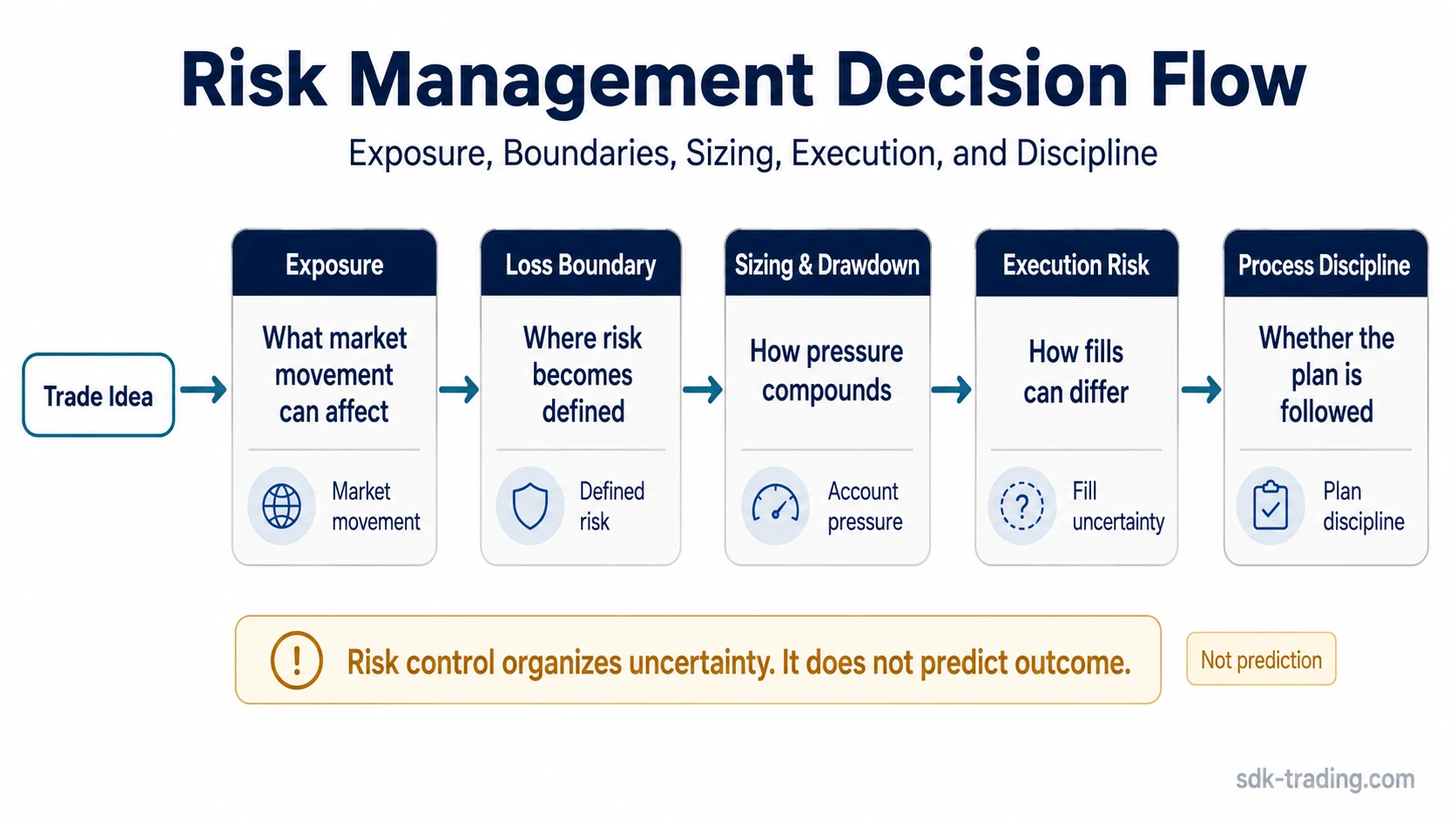
How Trading Risk Moves Through the Process
Risk management becomes easier to diagnose when the process is read in sequence. Each stage changes a different part of the final account outcome.
| Stage | Question | What can change |
|---|---|---|
| 1. Exposure | What market movement is the account being exposed to? | Instrument, direction, leverage, concentration, and amount of capital exposed. |
| 2. Loss boundary | What price or event makes the planned position no longer acceptable? | The distance between the current position and the intended exit boundary. |
| 3. Position size | How much account loss does that boundary represent? | The same price movement can create very different account impact at different sizes. |
| 4. Execution | Can the actual transaction occur at a different price from the plan? | Slippage, gaps, liquidity, order behavior, and fast-market conditions can alter the realized result. |
| 5. Realized loss | What did the position actually cost after execution? | The realized result can differ from the loss implied by the original boundary. |
| 6. Drawdown | What happens when losses accumulate across multiple positions or decisions? | Repeated losses can create account pressure that is not visible from one trade in isolation. |
Risk boundary: Planned risk and realized risk are related, but they are not identical. Position size translates a planned boundary into account exposure, while execution determines how closely the realized exit matches that plan.
Four Areas of Trading Risk Management
The four sections below separate the main problems. Each owns a different part of the risk process.
| Risk area | Main question | Use this section when… |
|---|---|---|
| Core risk management | What limits and principles define the overall risk process? | The issue involves risk planning, leverage awareness, risk/reward, loss limits, or the structure of the trading risk process. |
| Execution risk | Can the market or order mechanism produce a different result from the planned transaction? | The issue involves slippage, liquidity, gaps, fills, margin behavior, or fast-market execution. |
| Orders, stops, and exits | How is the intended loss or exit boundary expressed? | The issue involves stop-loss logic, take-profit planning, order types, exit conditions, or invalidation boundaries. |
| Position sizing and drawdown | How does an individual trade translate into account-level loss and cumulative pressure? | The issue involves position size, risk per trade, risk/reward, drawdown, or risk of ruin. |
A Stop Does Not Define the Full Account Risk
A stop or other loss boundary identifies where an exit is intended to occur. Position size determines how much that price distance represents for the account. These two inputs therefore solve different problems.
Execution creates another layer. If price gaps through the intended boundary or available liquidity changes, the actual fill may occur away from the planned level. This means a trade can have a defined boundary and a calculated size while still carrying execution uncertainty.
| What is defined | What is still unresolved |
|---|---|
| Loss boundary only | The amount of account exposure remains unknown until position size is defined. |
| Loss boundary + position size | The planned account risk is clearer, but the actual execution price can still differ. |
| Boundary + size + execution assumptions | The single-position plan is more complete, but cumulative drawdown and total exposure still need separate control. |
How to Identify the Unresolved Risk Layer
When a trading plan feels incomplete, the useful question is not whether it has a stop or a favorable risk/reward ratio. The useful question is which layer still has no defined control.
| Situation | Unresolved layer | Risk area |
|---|---|---|
| The idea has no clear loss or exit boundary | The planned exit condition is undefined. | Orders, stops, and exits |
| The boundary is clear but the position can create an excessive account loss | The price boundary has not been translated into appropriate account exposure. | Position sizing and drawdown |
| The planned loss is acceptable but a gap or poor fill could materially change it | The realized transaction can differ from the planned transaction. | Execution risk |
| Each position looks manageable but total exposure or leverage is becoming excessive | The individual trade checks do not capture the broader risk policy. | Core risk management |
| A sequence of normal losses is creating increasing account pressure | Single-trade risk is being viewed separately from cumulative drawdown. | Position sizing and drawdown |
Planned Risk vs Realized Risk
A useful risk plan describes what should happen under the assumptions available before exposure. Realized risk describes what actually reached the account after price movement, order execution, and any other market constraints were applied.
| Planned component | Realized counterpart |
|---|---|
| Intended loss boundary | Actual exit price |
| Calculated position size | Actual quantity filled and maintained |
| Expected transaction conditions | Actual spread, liquidity, slippage, or gap behavior |
| Planned maximum loss | Realized account loss |
| Expected series of independent decisions | Actual cumulative exposure and drawdown path |
This distinction is why one risk metric cannot represent the entire process. Risk/reward, stop distance, position size, execution quality, and drawdown describe different parts of the same chain.
Simple Risk Management Scenario
A trader identifies a chart setup and defines where the idea would no longer be acceptable. That creates a loss boundary, but the account risk is still unknown. Position size is then used to translate the distance to that boundary into planned account exposure.
The position can still carry execution risk. If the market moves through the boundary before the order can fill at the intended price, the realized loss can differ from the planned amount. After the trade closes, that realized result becomes part of the account’s cumulative drawdown rather than remaining an isolated setup-level calculation.
The example shows why risk management is a chain rather than one control. A problem at one stage does not disappear because another stage was defined correctly.
What Risk Management Can Control
Risk management cannot control the path of the market or guarantee a specific loss amount under every execution condition. It can define the exposure taken, the intended loss boundary, the position size, the assumptions behind order execution, and the account limits used when losses accumulate.
The purpose of the Hub is to identify which risk layer needs attention. Detailed calculations, stop mechanics, execution problems, and drawdown measures belong to their respective sections rather than being compressed into one universal rule.