Charting methods organize market data according to different construction rules. Some charts create a new element after each fixed time interval, Heikin Ashi keeps that time sequence but recalculates candle values, and non-time-based charts advance only when a price-movement or reversal condition is met.
Definition: A charting method determines how market data is converted into visible chart elements. The construction rule controls when the next element appears and which parts of the underlying price history are preserved, transformed, or filtered.
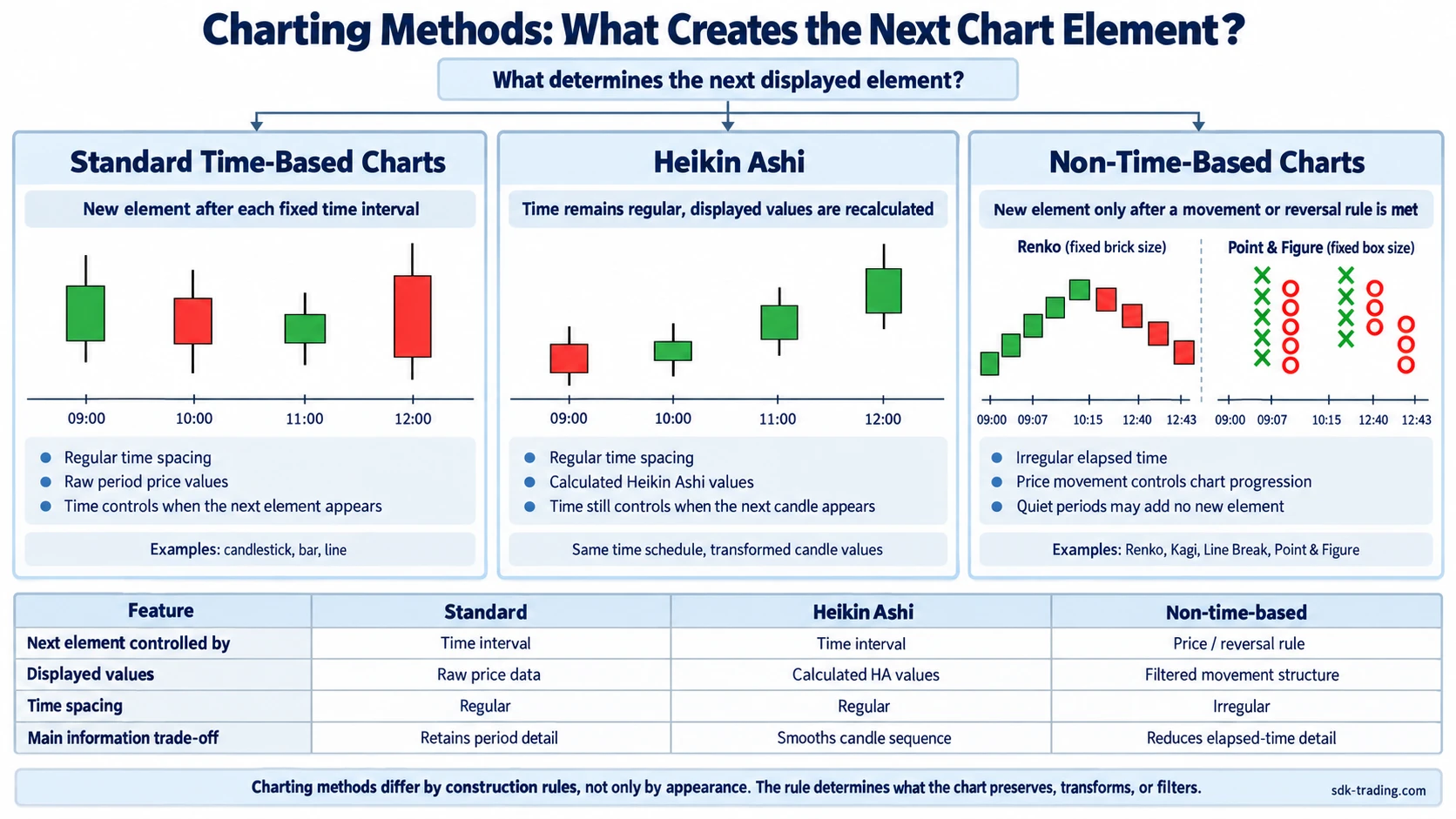
What Creates the Next Chart Element?
The most useful way to separate charting methods is to ask what causes the chart to advance. Two charts can use the same underlying market data while producing very different visual sequences because they use different rules for creating the next bar, candle, brick, column, or line.
| Charting family | What creates the next element? | What happens to time? | What happens to price data? |
|---|---|---|---|
| Standard time-based charts | The next fixed time interval ends. | Intervals remain regular. | Period price data is displayed directly through formats such as bars or candlesticks. |
| Heikin Ashi | The next fixed time interval ends. | Intervals remain regular. | The displayed candle values are recalculated from price inputs and the Heikin Ashi sequence. |
| Non-time-based charts | A selected price-movement, reversal, or construction rule is satisfied. | Elapsed time between visible elements can vary. | Price movement is filtered into method-specific structures. |
Construction boundary: charting methods differ not only by appearance. The rule that creates the next chart element determines what information remains explicit and what becomes transformed or compressed.
Standard Time-Based Charts
Standard time-based charts advance at a regular clock interval. On a one-hour chart, for example, another bar or candle is created for each completed one-hour period regardless of whether price moved a little or a lot.
The visual format can still vary. A line chart, bar chart, and candlestick chart may display the same underlying market through different visual conventions, but the horizontal sequence is still organized around regular elapsed time.
For a broader comparison of these display formats, types of trading charts covers the dedicated chart-type taxonomy.
Heikin Ashi: Regular Time, Transformed Candle Values
Heikin Ashi keeps the regular time sequence of a standard candle chart, but the displayed candle values are calculated rather than copied directly from the raw period open, high, low, and close.
This means the chart still advances once per selected interval. What changes is the representation inside each candle. The transformation can make directional sequences appear smoother, but the chart has not become non-time-based.
Key distinction: standard candlesticks and Heikin Ashi can share the same time axis while showing different candle bodies because one displays raw period values and the other displays calculated values.
Non-Time-Based Charts: Movement Controls Progression
non-time-based charts do not require another visible element simply because a fixed amount of clock time has passed. Their progression depends primarily on method-specific price-movement or reversal rules.
Renko can wait for sufficient price displacement before printing another brick. Point and Figure can extend or reverse columns according to box-size and reversal rules. Kagi and Line Break use their own construction conditions.
As a result, a quiet period can add little or nothing to the visible sequence, while a faster market move can generate several structural changes over a relatively short amount of clock time.
What Each Method Preserves or Reduces
Choosing a charting method means choosing which dimension of the market should remain most explicit in the main display.
| Method | Information kept explicit | Information transformed or reduced |
|---|---|---|
| Standard time-based chart | Regular time progression and period price values | Little structural filtering is performed by the chart construction itself |
| Heikin Ashi | Regular time progression | Raw candle values are transformed into calculated Heikin Ashi values |
| Non-time-based chart | Price movements that satisfy the method’s construction rules | Regular elapsed-time detail and sub-threshold movement can become less visible |
This is why two charting methods can produce different-looking structures from the same price history without either chart using different market data. The difference can come entirely from the construction rule.
Charting Methods vs Chart Types and Chart Patterns
A charting method describes how market data is converted into the chart sequence. A chart type is the visual format used to display that information, such as a line, bar, or candlestick chart. A chart pattern is a structure identified inside the resulting price display.
| Concept | Main question |
|---|---|
| Charting method | What rule creates and structures the displayed chart elements? |
| Chart type | How is the resulting market information visually presented? |
| Chart pattern | What recurring multi-swing structure can be identified inside the chart? |
Keeping these layers separate prevents a visible pattern or a cleaner-looking chart from being confused with the construction method that produced the display.
Choosing the Right Charting Family
| If the question is… | Start with… |
|---|---|
| How do line, bar, candlestick, and other standard displays differ? | Standard time-based chart types |
| How does smoothing change the appearance of a regular candle sequence? | Heikin Ashi |
| How can the chart progress according to price movement instead of equal time intervals? | Non-time-based charts |
The useful distinction is therefore mechanical rather than cosmetic: identify what creates the next chart element, then examine what that construction rule keeps visible and what it filters.