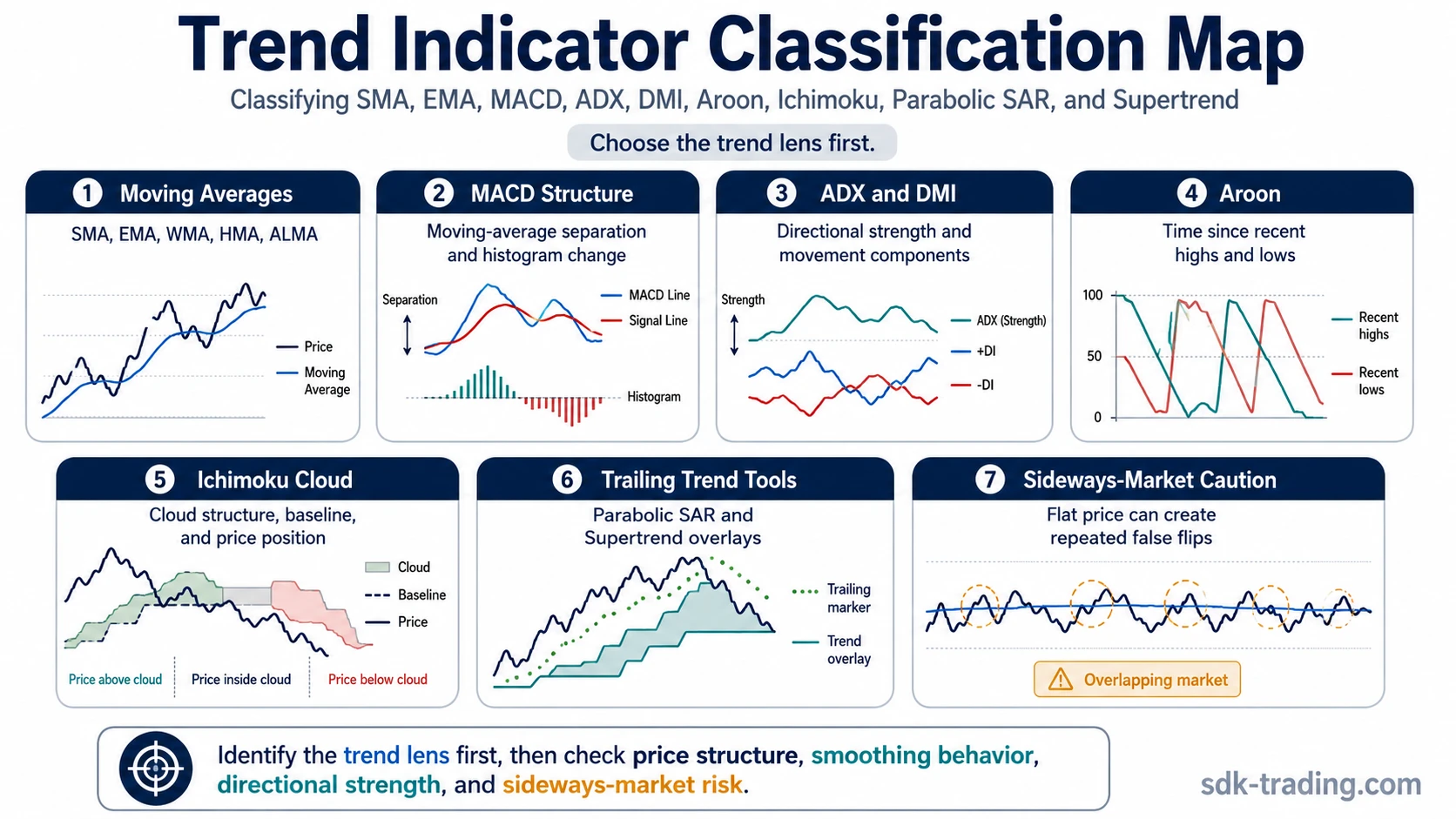
Trend indicators in trading are technical tools that transform price data into different views of directional movement. A moving average smooths price. MACD tracks the relationship between moving averages. ADX and DMI work with directional movement and trend strength. Aroon looks at how recently highs and lows occurred, while Ichimoku Cloud, Parabolic SAR, and Supertrend build broader trend structures around price.
Definition: Trend indicators are price-derived technical indicators used to organize trend direction, persistence, momentum, strength, timing, or trailing structure. Their readings can differ because the calculations use price in different ways and react over different lookback periods.
Key Points
- Trend indicators use different calculations, so they can describe different parts of the same price move.
- Moving averages mainly show smoothed price behavior, while MACD measures relationships between moving averages.
- ADX measures trend strength, while DMI separates positive and negative directional movement.
- Aroon uses the timing of recent highs and lows instead of averaging price.
- Ichimoku Cloud, Parabolic SAR, and Supertrend add multi-line or trailing structure to the trend reading.
- Differences between indicators become especially visible during pullbacks, transitions, and sideways markets.
What Different Trend Indicators Actually Measure
The calculation matters because the word trend covers several different things. Direction, strength, moving-average separation, the timing of new highs and lows, and the position of a trailing band are related, but they are not the same measurement.
| Indicator family | How price is processed | Main reading |
|---|---|---|
| Moving averages | Price is averaged or weighted across a selected lookback. | Smoothed direction and the relationship between current price and its recent average. |
| MACD | Faster and slower moving averages are compared, with additional signal-line smoothing. | Convergence, divergence, and changing separation between averages. |
| ADX and DMI | Directional movement and true-range-related data are calculated and smoothed. | Positive and negative directional movement together with trend strength. |
| Aroon | The calculation measures how much time has passed since recent highs and lows. | Whether important highs or lows are occurring more recently inside the lookback period. |
| Ichimoku Cloud | Several high-low midpoint calculations are combined across different periods. | Price position, baseline relationships, cloud structure, and broader trend context. |
| Parabolic SAR | A trailing calculation follows price and accelerates as the move develops. | A trend reference that changes position as directional structure changes. |
| Supertrend | Price is combined with ATR-based volatility. | A volatility-adjusted trailing band around price. |
So an ADX reading and a moving-average reading can move differently without creating a contradiction. ADX is trying to describe strength. The moving average is smoothing price. Aroon is looking at another feature again, the timing of recent extremes. Once the calculation is clear, the difference between the outputs makes more sense.
Trend Indicator Learning Path
Moving averages are usually the easiest place to start because the relationship with price is visible. After that, the other tools make more sense as separate extensions of trend analysis rather than as interchangeable versions of the same indicator.
| Reader question | Best route | Calculation boundary |
|---|---|---|
| What is the simplest trend-smoothing baseline? | SMA indicator | Uses equal weighting across the selected lookback period. |
| What changes when recent prices receive more weight? | EMA indicator | Recent prices have greater influence, so the average generally responds faster than an SMA with the same period. |
| How does linear weighting change a moving average? | WMA indicator | Newer observations receive progressively larger linear weights. |
| How can weighted-average calculations be combined to change lag and smoothness? | HMA indicator | Combines weighted moving-average calculations to produce a more responsive smoothed line. |
| How does a different weighting distribution affect smoothing? | ALMA indicator | Uses Gaussian-style weighting to control where emphasis falls inside the lookback window. |
| How are faster and slower moving averages separating? | MACD indicator | Measures the relationship between faster and slower moving averages. |
| How is the distance between MACD and its signal line changing? | MACD Histogram | Shows expansion or contraction in the gap between MACD and the signal line. |
| How strong is the directional movement? | ADX indicator | Measures trend strength without independently identifying bullish or bearish direction. |
| How do positive and negative directional movement compare? | Directional Movement Index | Separates positive and negative directional movement before strength is evaluated. |
| How recently did price make an important high or low? | Aroon indicator | Uses time since recent highs and lows rather than averaging price. |
| How can several trend relationships be combined in one framework? | Ichimoku Cloud | Combines several high-low midpoint calculations and plotted relationships. |
| Where is a price-following trend reference? | Parabolic SAR | Creates an accelerating trailing reference that can change sides as price structure changes. |
| Where is a volatility-adjusted trailing trend band? | Supertrend indicator | Uses ATR-derived volatility to position a trailing band around price. |
Direction, Strength, Momentum, and Timing
Take a rising market as an example. A moving average can slope upward because recent prices are higher than older prices. At the same time, ADX can fall if directional movement is losing strength. MACD can contract as its faster and slower averages move closer together. Aroon can also change once the most recent high starts moving further back inside the lookback window.
Those readings describe different changes inside the same price sequence. The market can still have an upward smoothed direction while momentum separation or directional strength is already fading.
| Question | Measurement | What changes the reading |
|---|---|---|
| Which way has price been moving on average? | Smoothed direction | The location and weighting of prices inside the lookback period. |
| How strong is the directional movement? | Trend strength | The magnitude and persistence of directional movement. |
| Are faster and slower averages moving farther apart or closer together? | Moving-average separation | The relative movement of the two averages. |
| How recently did price make an important high or low? | Trend timing | The number of periods since the relevant extreme occurred. |
| Where is a trailing reference relative to price? | Trailing structure | The indicator’s own price-following or volatility-adjusted calculation. |
Why Trend Indicators Start to Disagree in Sideways Markets
A directional move gives many trend tools broadly compatible inputs. Once price starts overlapping the same area, their different lookbacks and formulas become much easier to see.
Suppose price has been rising and then spends several bars inside a narrow range. A fast moving average can begin flattening quite quickly. A slower average may still slope upward because more of the previous advance remains inside its calculation. MACD usually contracts as the averages move closer together. Aroon changes as the latest high gets older, and a trailing indicator can begin switching sides if price repeatedly crosses its boundary.
ADX can also behave differently from the faster price-sensitive tools because directional movement is smoothed through its own calculation. A previous trend can therefore leave strength in the reading for a while even after the chart has started to look less directional.
Sideways-market limitation: Repeated overlap makes trend classification harder because the calculations react at different speeds. Faster tools can change direction several times inside the range, while slower tools may continue reflecting the move that came before it.
Fast and Slow Indicators During a Pullback
The same issue appears during a pullback. A fast EMA contains more recent price information, so a sharp countertrend move can change its slope quickly. A slower moving average still includes more of the earlier trend and may barely change.
This difference is useful information about timeframe and sensitivity. If the pullback continues, the slower calculation eventually has to absorb more of it. If price resumes the previous direction quickly, the fast indicator may have reacted to a temporary countertrend move while the slower trend measure changed very little.
There is no universal speed that solves this problem. Shorter lookbacks react sooner and also react to more short-term movement. Longer lookbacks filter more of that movement, with the tradeoff that they recognize genuine changes later.
Related Trend Indicator Comparisons and Frameworks
Individual indicator pages explain the calculations in more detail. Comparison and strategy pages become more useful once the underlying measurement is already clear.
| Reader problem | Best route | Use when |
|---|---|---|
| The reader needs to separate moving average types. | Moving average types explained | The question is about SMA, EMA, WMA, HMA, ALMA, and their weighting or smoothing behavior. |
| EMA and WMA seem similar but react differently. | EMA vs WMA | The issue is exponential weighting versus linear weighting. |
| The reader needs a broader explanation of the trend-indicator category. | Trend indicators explained | The question is wider than one specific calculation or indicator. |
| The reader wants a framework built around ADX behavior. | ADX strategy framework | The issue has moved from ADX definition into conditional interpretation. |
| The reader wants a framework built around Ichimoku structure. | Ichimoku strategy framework | The question involves the interaction between several Ichimoku components. |
| The reader is comparing Ichimoku with moving-average logic. | Ichimoku vs moving average | The issue is multi-line high-low structure versus simpler price averaging. |
| The reader is selecting trend tools for swing trading. | Best indicators for swing trading | The question is broader and includes tool selection for a trading style. |
How to Read Trend Indicators Together
Start by identifying what each indicator calculates. If one tool measures trend strength and another smooths price direction, a difference between them may be completely normal.
Then look at the market condition and the indicator speed. A clean directional move, a pullback, and a sideways range place very different demands on the same calculation. When the readings begin to separate, check the reason for that separation: lookback length, weighting, directional-movement smoothing, timing of recent extremes, or the position of a trailing boundary.
That gives the disagreement a useful role in the analysis. Instead of reducing several trend indicators to a collection of bullish and bearish signals, the readings show which part of the previous trend is still present and which part has already started to change.