Support and resistance indicators mark price references that come from different sources. Some levels are observed directly from prior price structure, some are calculated from previous-period data, some divide a measured swing into retracement ratios, and others project ratios beyond that swing.
Definition: Support and resistance indicators are technical-analysis tools used to organize potential price-reference areas. The first distinction is how the level was produced: observed from price, calculated from prior-period data, measured inside a selected move, or projected beyond that move.
Two lines can appear at nearly the same price while representing different evidence. A prior reaction zone, a standard pivot, a Camarilla level, and a Fibonacci retracement should therefore not be treated as interchangeable simply because they overlap on the chart.
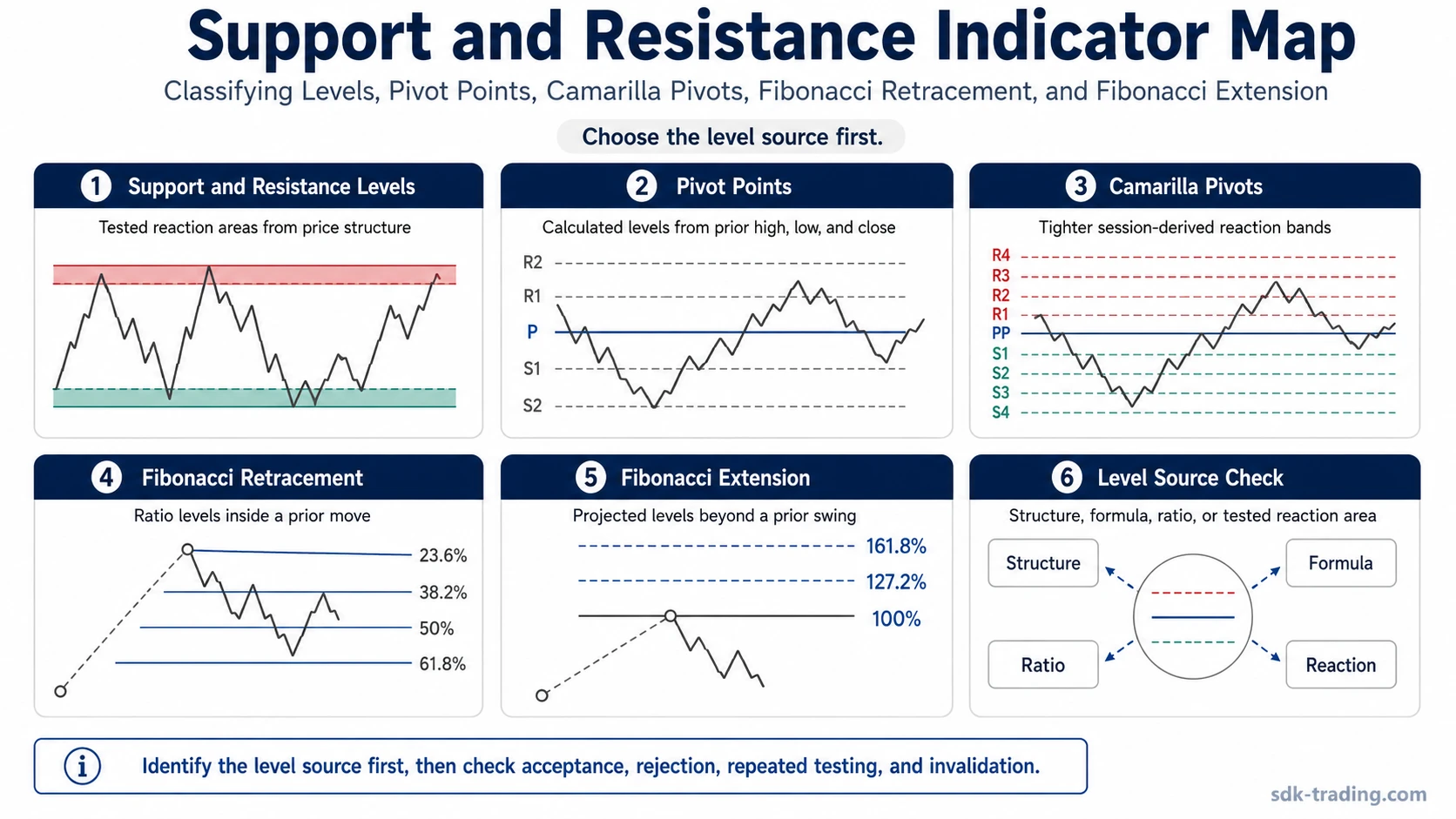
Four Sources of Support and Resistance Levels
The source of the level determines what the line actually represents. This prevents a calculated reference from being mistaken for an observed market structure level or a projected Fibonacci level from being treated as if price had already reacted there.
| Level source | How the level is created | What it represents |
|---|---|---|
| Observed | Prior highs, lows, reaction zones, consolidation boundaries, or repeated price interaction | A price area already visible in market structure |
| Calculated | A formula applied to previous-period price data | A predefined reference such as a standard or Camarilla pivot level |
| Measured | A ratio applied between two selected swing points | A Fibonacci retracement level inside the measured move |
| Projected | A ratio projected beyond the measured swing | A Fibonacci extension level outside the original move |
Support and Resistance Tool Families
Once the level source is known, the individual tool can be selected without mixing several different calculations into one category.
| Tool | Level source | Primary distinction |
|---|---|---|
| Support and Resistance Levels | Observed price structure | Horizontal levels or zones derived from prior reactions, highs, lows, and surrounding structure |
| Pivot Points | Calculated | Standard pivot and support-resistance levels derived from prior-period price data |
| Camarilla Pivots | Calculated | A different pivot formula that produces its own ladder of support and resistance levels |
| Fibonacci Retracement | Measured | Ratio levels positioned inside a selected swing |
| Fibonacci Extension | Projected | Ratio levels projected beyond the measured move |
| Support and Resistance Indicator | Depends on implementation | Automated tools may derive levels from pivots, repeated reactions, clustering, or another defined method |
| Fibonacci Retracement vs Extension | Measured versus projected | Direct comparison of ratio levels inside a move with levels projected beyond it |
Observed Levels and Calculated Levels Are Different Evidence
An observed support area exists because price has already created visible structure there. A calculated pivot can appear at a price where no previous swing or reaction occurred. Both may become useful chart references, but the reason each level exists is different.
This matters when several lines cluster in the same area. A prior swing low and a standard pivot may overlap. A Fibonacci retracement from a selected swing may also pass through the same region. The overlap shows that several methods point to a similar price area. It does not turn three separate derivations into three independent observations of buying or selling pressure.
Evidence boundary: Level overlap is a relationship between different calculations or observations. It should not automatically be counted as multiple confirmations of the same underlying market behavior.
Standard Pivots and Camarilla Pivots
Standard and Camarilla pivots belong to the same broad calculated-level family, but they should remain separate tools. Standard pivot systems commonly derive a central pivot and surrounding support-resistance levels from prior-period high, low, and close data.
Camarilla calculations also use prior-period price data, but apply a different formula to create a separate set of levels around the previous close. The important Subhub distinction is therefore not which formula is better. It is that both are calculated references rather than levels discovered from a prior reaction at the same price.
Fibonacci Retracement and Extension
Fibonacci tools depend on the swing chosen for measurement. That makes the anchor points part of the level definition.
A retracement divides the distance between two selected extremes and places ratio levels inside that measured move. An extension takes the measurement beyond the original swing and produces projected levels outside it.
| Fibonacci tool | Required input | Where levels appear |
|---|---|---|
| Retracement | Selected swing extremes | Inside the measured move |
| Extension | Selected swing measurement and projection | Beyond the original move |
If two traders select different swing anchors, they can produce different Fibonacci levels while using the same ratios. The disagreement comes from measurement choice rather than a change in the ratios themselves.
Why Support and Resistance Tools Can Disagree
Different tools can draw different levels on the same chart because they use different inputs. A horizontal level may come from a visible swing. A pivot system uses previous-period price data. A Fibonacci tool depends on selected measurement points.
| Source of disagreement | Example |
|---|---|
| Different construction method | Observed swing level versus calculated pivot |
| Different formula | Standard pivot versus Camarilla pivot |
| Different swing anchors | Two Fibonacci measurements beginning or ending at different points |
| Different timeframe | Daily structural level versus weekly structural level |
| Different indicator logic | Automated tools using different pivot, clustering, or lookback rules |
A Practical Classification Order
A support or resistance chart becomes easier to interpret when the construction method is identified before the reaction around the line is evaluated.
- Identify the source: observed, calculated, measured, or projected.
- Identify the inputs: prior price structure, previous-period data, or selected swing anchors.
- Check the timeframe: the same method can produce different references on different periods.
- Check for overlap: note where unrelated methods happen to cluster near the same price.
- Observe price interaction: only then examine whether price trades through, stalls, rejects, or reorganizes around the area.
Common Support and Resistance Classification Mistakes
| Mistake | Why the classification breaks down |
|---|---|
| Treating every horizontal line as the same evidence | Observed, calculated, measured, and projected levels have different origins. |
| Calling a pivot an observed support zone | The pivot exists because of a formula, not because price previously formed structure at that exact level. |
| Ignoring Fibonacci anchor selection | The selected swing determines where the ratio levels are placed. |
| Counting clustered levels as independent confirmation | Several tools may share inputs or derive nearby prices from the same market move. |
| Using every plotted level equally | The chart loses the hierarchy created by source, timeframe, construction method, and current location. |