Pivot points convert price data from a completed period into a fixed grid for the next selected period. The usual inputs are the prior high, low, and close. From those values, the calculation produces a central pivot and a series of resistance levels above it and support levels below it.
Definition: Pivot points are calculated technical-analysis levels derived from a previous period’s price data. In the traditional calculation, the prior high, low, and close determine the central pivot P, which is then used with the prior range to calculate the surrounding R and S tiers.
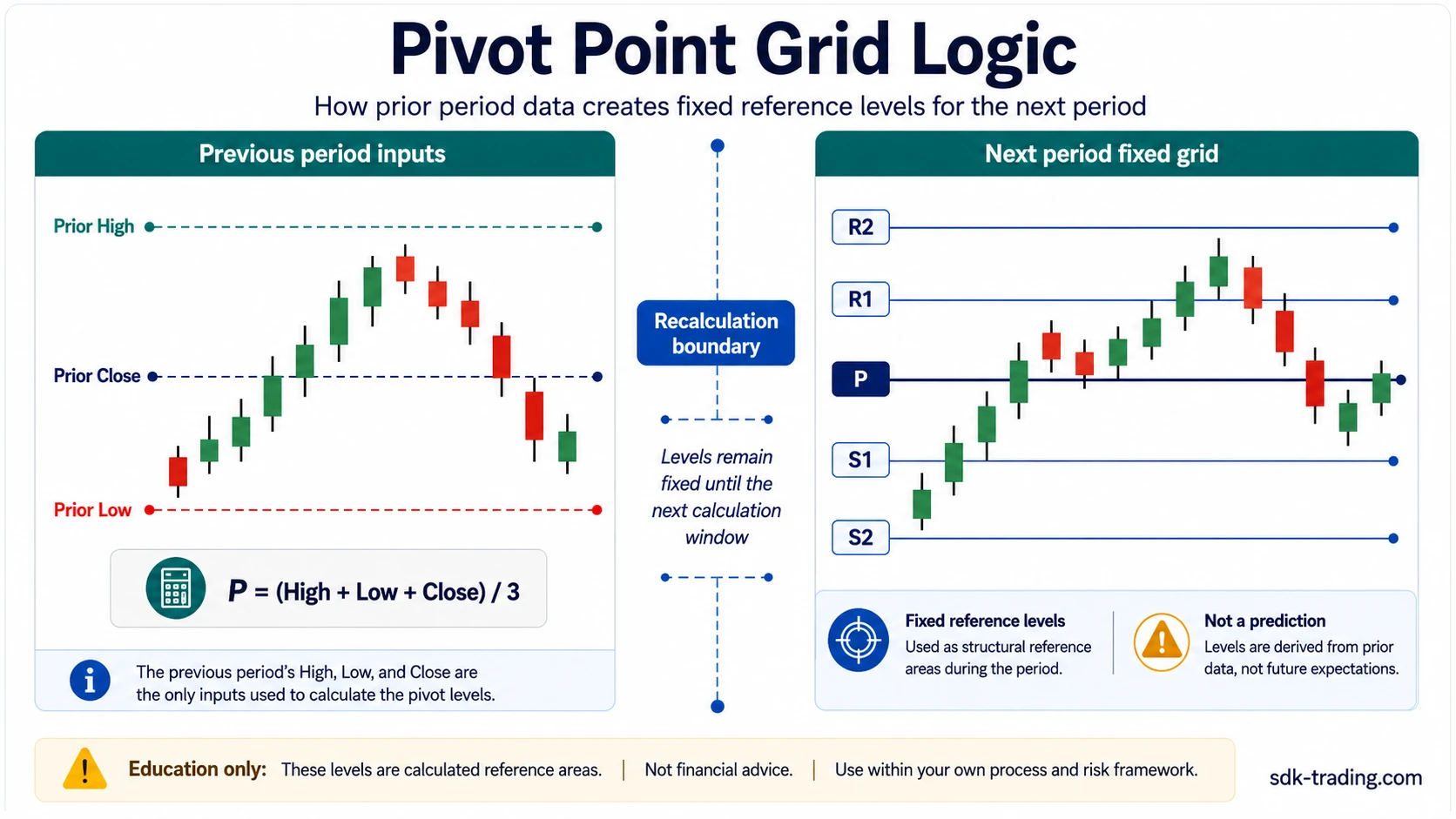
How Pivot Points Are Calculated
The calculation begins with a completed source period. For daily pivots, that source is normally the previous daily period. Weekly pivots use the previous week, and monthly pivots use the previous month.
The formulas below use the traditional pivot calculation. Let H represent the prior high, L the prior low, C the prior close, and P the central pivot.
| Level | Traditional formula | Position in the grid |
|---|---|---|
| P | (H + L + C) / 3 | Central pivot |
| R1 | (2 × P) – L | First resistance tier |
| S1 | (2 × P) – H | First support tier |
| R2 | P + (H – L) | Second resistance tier |
| S2 | P – (H – L) | Second support tier |
| R3 | (2 × P) + H – (2 × L) | Third resistance tier |
| S3 | (2 × P) – (2 × H) + L | Third support tier |
Formula naming: Pivot labels are not completely standardized across platforms. Traditional and Classic calculations may match through R2 and S2 while using different formulas for higher tiers such as R3 and S3. Compare the actual formulas, not only the variant name.
Pivot Point Calculation Example
Suppose the completed prior period has a high of 110, a low of 100, and a close of 106.
| Level | Calculation | Result |
|---|---|---|
| P | (110 + 100 + 106) / 3 | 105.33 |
| R1 | (2 × 105.33) – 100 | 110.67 |
| S1 | (2 × 105.33) – 110 | 100.67 |
| R2 | 105.33 + (110 – 100) | 115.33 |
| S2 | 105.33 – (110 – 100) | 95.33 |
Those values are known before the next selected period develops. Price does not determine where R1 or S1 is placed after the fact. The source-period data already fixed the coordinates.
How the Pivot Grid Resets
A fixed pivot grid belongs to a specific calculation window. Once the prior period is complete, its high, low, and close generate the next grid. Those levels remain unchanged until a new source period is completed and the calculation is repeated.
| Pivot timeframe | Source data | Recalculation boundary |
|---|---|---|
| Daily | Previous daily period | Next daily calculation period |
| Weekly | Previous completed week | Next weekly calculation period |
| Monthly | Previous completed month | Next monthly calculation period |
This fixed-period behavior is one of the defining differences between pivot points and observed support and resistance levels. A pivot exists because the formula produced it. An observed level exists because previous price structure created a visible reference area.
What the Prior Range Does to Pivot Spacing
The prior high-low range directly affects the distance between several pivot tiers. R2 equals P plus the prior range, while S2 equals P minus that range. A wider source period therefore pushes those levels farther from the central pivot. A narrower source period pulls them closer.
| Prior-period condition | Mechanical effect on the grid |
|---|---|
| Wide high-low range | Several R and S tiers are placed farther from P. |
| Narrow high-low range | The grid becomes more compressed around P. |
| Close near the prior high | The central pivot shifts upward within the prior range. |
| Close near the prior low | The central pivot shifts downward within the prior range. |
This relationship explains why identical formulas can produce very different grids from one period to the next. The indicator is reacting mechanically to different inputs rather than adapting the levels to current-period volatility after they have been calculated.
What a Pivot Level Touch Tells You
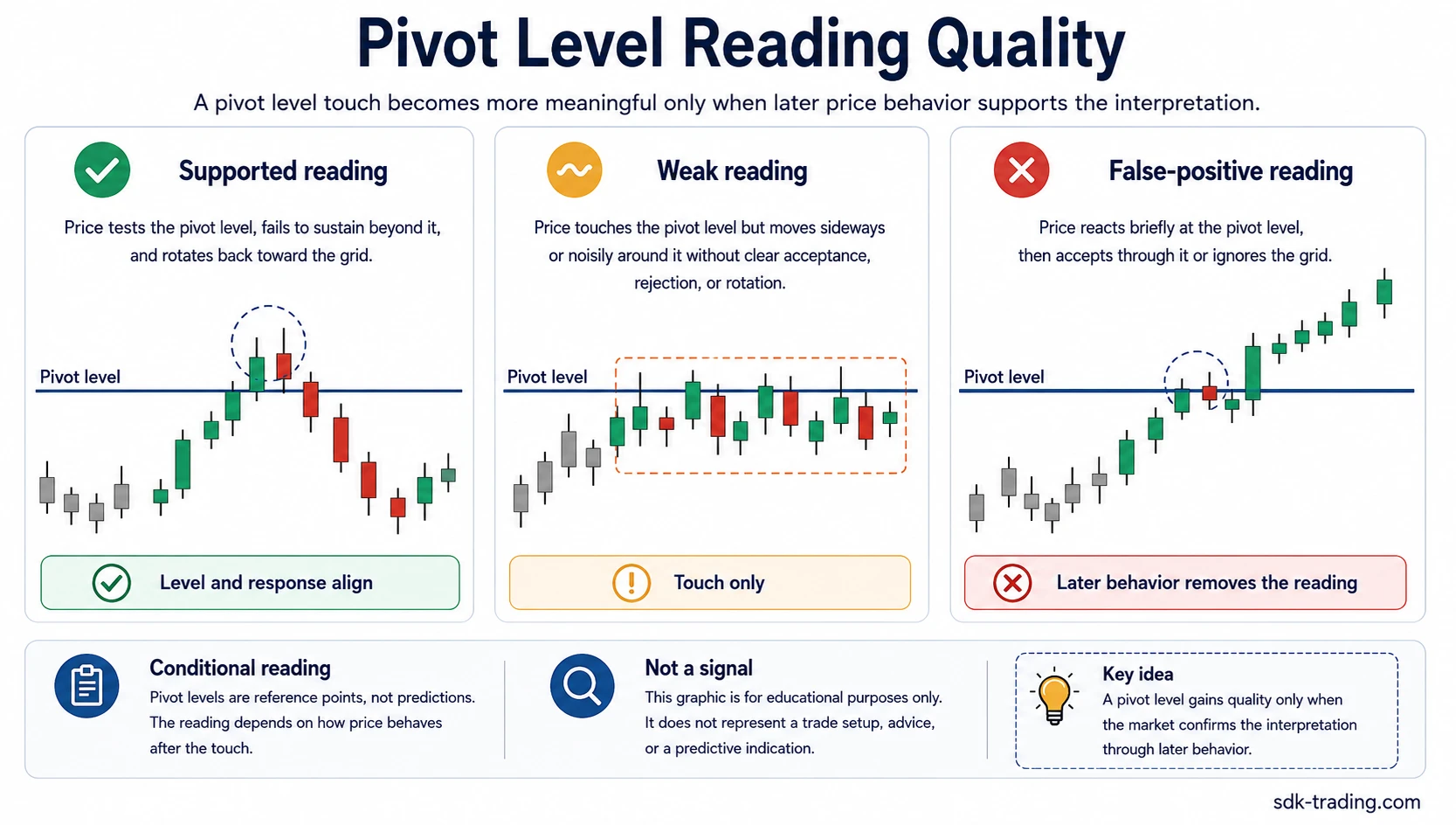
A calculated pivot tier already exists before price reaches it. A touch therefore establishes only that current price has intersected one of the predefined levels. The market’s response is separate from the calculation itself.
| Observed interaction | What can be established |
|---|---|
| Price reaches a pivot and moves back away | The calculated level was tested and price returned from it during the observed period. |
| Price repeatedly crosses the same pivot | The level is sitting inside two-way trade rather than clearly separating price behavior. |
| Price moves through a pivot and remains beyond it | The fixed tier did not contain price during that observed move. |
| Price moves rapidly through several tiers | The session is traversing the static grid faster than the individual levels are organizing price. |
Why Pivot Levels Can Differ Between Platforms
Two charts can display different pivot levels even when both indicators are functioning correctly. The difference usually comes from the inputs or the selected calculation method.
| Source of difference | What changes |
|---|---|
| Pivot variant | Traditional, Classic, Fibonacci, Woodie, DeMark, and Camarilla methods use different formula sets. |
| Calculation timeframe | Daily, weekly, and monthly pivots use different completed source periods. |
| Session definition | Regular-session and extended-session charts can produce different prior highs, lows, or closes. |
| Market data source | Differences in source data can alter one or more calculation inputs. |
| Higher-tier formula convention | Platforms using different Traditional or Classic conventions can agree on early tiers while differing farther from P. |
A useful comparison therefore starts with the underlying H, L, and C values and the selected formula type. Comparing only the plotted lines can hide the reason for the discrepancy.
Traditional, Fibonacci, Woodie, DeMark, and Camarilla Pivots
Pivot points are a family of calculated frameworks rather than one universal formula beyond every level. Traditional pivots use the familiar P, R, and S structure shown above. Other variants alter the calculation or weighting.
| Variant | Main calculation distinction |
|---|---|
| Traditional | Uses prior high, low, and close to calculate P and tiered R/S levels. |
| Classic | Uses the same basic P calculation but may differ from Traditional at higher R/S tiers. |
| Fibonacci pivots | Uses the prior range with Fibonacci multipliers around the central pivot. |
| Woodie | Uses a different weighting convention and can incorporate the current open in the central calculation. |
| DeMark | Uses a conditional calculation based on the relationship between the prior open and close. |
| Camarilla | Builds close-centered levels from the prior range using a separate set of multipliers. |
The variants should not be mixed inside one calculation sequence. If an indicator is set to Camarilla or Woodie, its plotted levels should not be checked against Traditional formulas and expected to match.
Pivot Points vs Fibonacci Retracement
Pivot points and Fibonacci retracement can both place multiple horizontal reference levels on a chart, but their inputs are different.
| Tool | Inputs | How levels are positioned |
|---|---|---|
| Pivot points | Completed prior-period data | A calculated grid for the next selected period |
| Fibonacci retracement | User-selected swing extremes | Ratio levels inside the measured swing |
A pivot grid changes when the calculation period or source data changes. A Fibonacci retracement changes when the selected swing anchors change. The two methods can produce nearby levels for completely different reasons.
Common Pivot Point Calculation Mistakes
| Mistake | Why the result becomes unreliable |
|---|---|
| Using the wrong source period | The grid is calculated from data that does not match the intended daily, weekly, or monthly pivot framework. |
| Comparing different pivot variants as if they use one formula | Traditional, Classic, Fibonacci, Woodie, DeMark, and Camarilla calculations can produce different levels. |
| Ignoring session settings | Different session definitions can change the source high, low, or close. |
| Ignoring an abnormal prior range | The formula mechanically expands or compresses several tiers according to the prior high-low distance. |
| Assuming a precise formula creates a precise market reaction | The calculation establishes the level location, while current price determines what actually happens there. |
FAQ
What are pivot points in trading?
Pivot points are calculated technical-analysis levels derived from a completed prior period. Traditional pivots use the prior high, low, and close to calculate a central pivot with resistance tiers above it and support tiers below it.
What is the standard pivot point formula?
The central pivot is commonly calculated as (High + Low + Close) / 3. R1, S1, R2, S2, and higher tiers are then derived from the pivot and the prior high-low range. Formula conventions can differ at higher tiers, so the selected pivot variant should be checked.
Do pivot points change during the trading period?
A fixed pivot grid based on a completed prior period normally remains unchanged until the next calculation boundary. Daily pivots reset with the next daily calculation period, while weekly and monthly pivots reset less frequently.
Why are pivot points different on two platforms?
The platforms may be using different pivot variants, calculation timeframes, session definitions, or source data. Traditional and Classic conventions can also differ at higher support and resistance tiers.
Are pivot points the same as observed support and resistance?
No. Pivot points are calculated from period data. Observed support and resistance levels are derived from visible prior price structure and reactions around a price area.