Support and resistance levels are not fixed prices where the market must reverse. They are price zones created by earlier reactions, and their current relevance depends on how price behaves when it returns to the same area.
Definition: A support level is a lower price area associated with an earlier reaction away from lower prices. A resistance level is an upper price area associated with an earlier reaction away from higher prices. Both are historical reference zones rather than guaranteed future barriers.
Common misunderstanding: marking an earlier reaction identifies a location to watch. It does not establish that the same zone will hold on the next test.
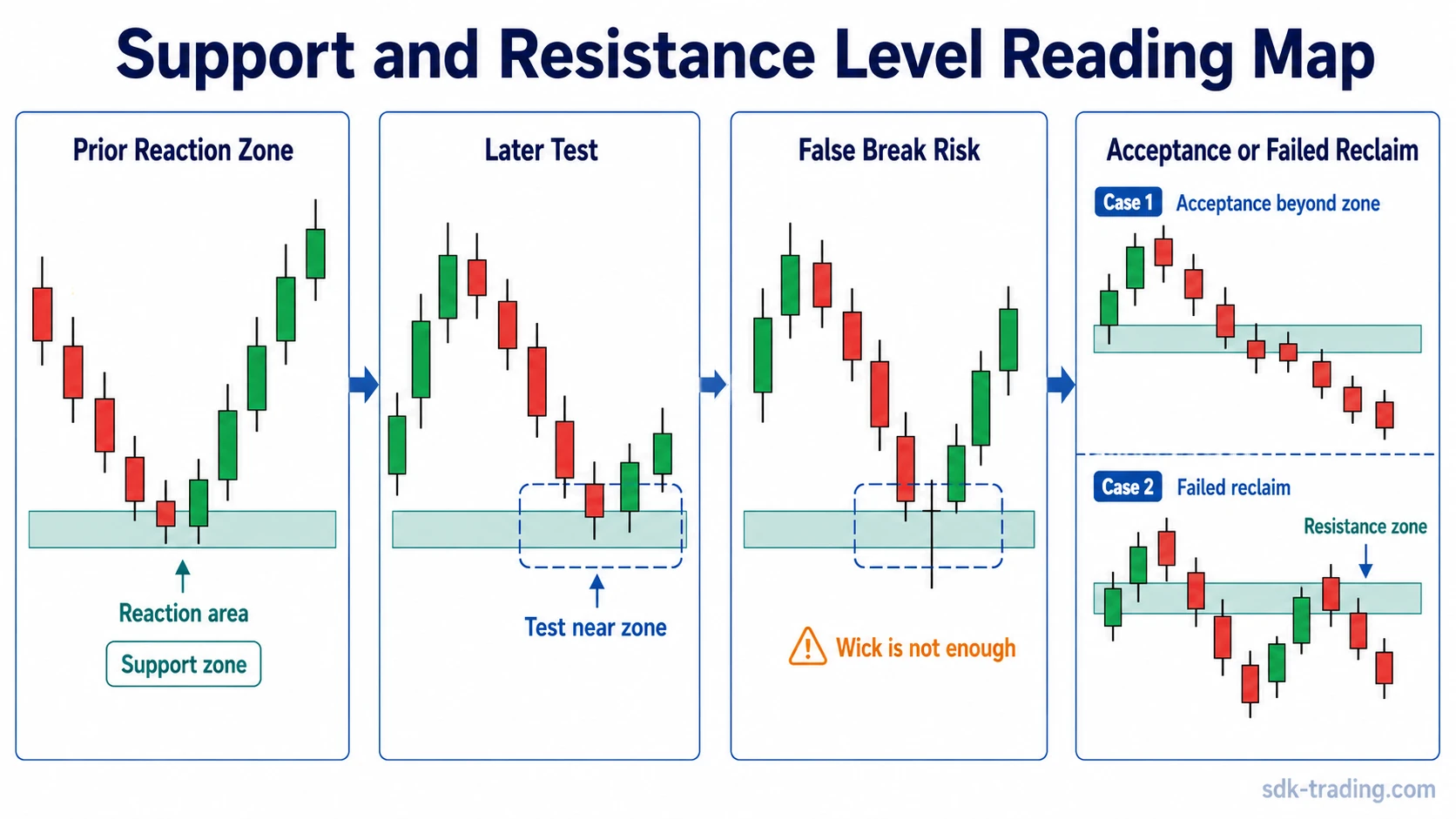
How Support and Resistance Levels Form
A useful level begins with observable price behavior. The chart first shows an area where movement stopped, reversed, stalled, or changed character. That earlier reaction creates the candidate reference.
| Source | Earlier price behavior | Possible later reference |
|---|---|---|
| Prior swing low | A decline stopped and price moved higher. | Possible support zone. |
| Prior swing high | An advance stalled and price moved lower. | Possible resistance zone. |
| Range boundary | Price repeatedly reacted near the same upper or lower area. | A visible boundary for later tests. |
| Breakout area | Price moved through an earlier structural boundary. | A possible role-reversal zone on a later return. |
The level exists because price reacted there before. Its future importance remains conditional.
Why Support and Resistance Are Usually Zones
Real price reactions rarely repeat at one identical number. A later test can stop slightly before the earlier extreme, trade briefly through it, leave a wick beyond it, or close on the other side before returning.
A narrow zone captures those variations without pretending that one exact price controls the market.
| Too narrow | Useful zone | Too wide |
|---|---|---|
| One exact price makes normal wicks and small overshoots look like structural failures. | The area contains the prices that actually participated in the earlier reaction. | An excessively broad zone makes almost any nearby movement appear relevant. |
Zone width should therefore come from the observed reaction rather than from an arbitrary amount of space around a line.
See Support and Resistance Zones on Real Stock Charts
This section of the stock-chart walkthrough shows why real support and resistance often appear as areas rather than exact lines. Wicks, closes, overshoots, and retests can all occur around the same structural reference.
The purpose of the zone is to preserve the structural location while allowing for normal variation in how price interacts with it.
What Happens When Price Returns to a Level
A historical level becomes more informative when price reaches it again. The next interaction can preserve the reference, weaken it, or change its role.
| Later behavior | What it suggests about the zone |
|---|---|
| Price reaches the area and moves away again. | The historical zone remains visible in the current structure. |
| Price briefly trades through the area and returns. | The boundary may still be intact despite the temporary probe. |
| Price moves through the area and continues trading beyond it. | The old support or resistance is losing its previous role. |
| Price repeatedly trades through the zone in both directions. | The level may be decaying as a useful structural reference. |
A false breakout is a separate structural event in which price moves beyond an apparent boundary but fails to establish the expected continuation.
Support and Resistance Can Change Roles
Former resistance can later act as support, and former support can later act as resistance. The role change is not created by the initial break alone.
If resistance is broken and price later returns from above, the old resistance becomes a stronger support candidate when price continues to hold above or rejects movement back through the zone.
The opposite process applies after support breaks. A later recovery into the old support area can establish resistance if price cannot reclaim the zone and begins moving lower again.
Boundary: an old level changes role only when current price behavior supports the new relationship. Historical labels do not transfer automatically.
When a Support or Resistance Level Weakens
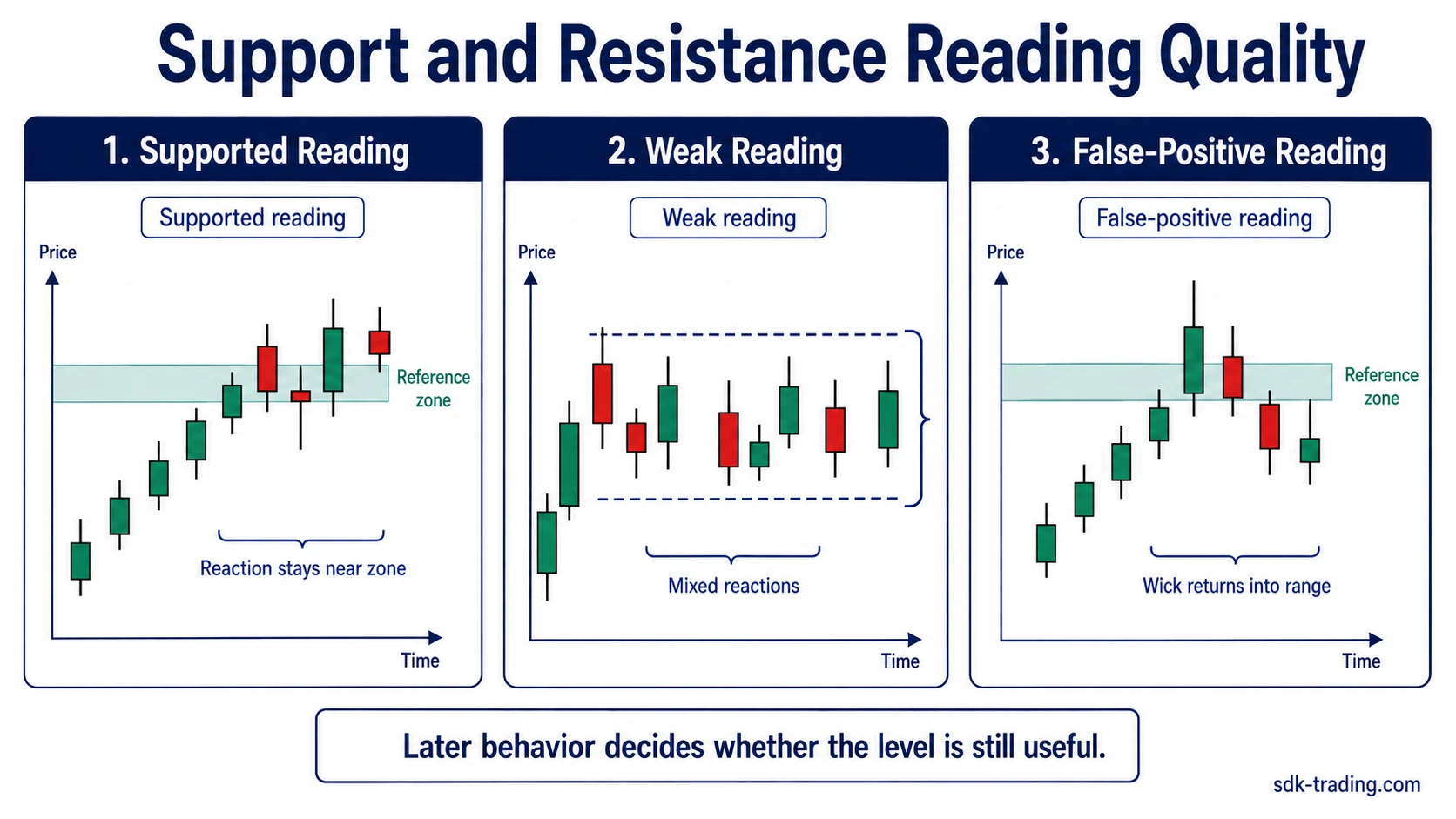
More touches do not always make a level stronger. The important distinction is between repeated reactions away from the area and repeated acceptance through it.
| Behavior | Effect on the level |
|---|---|
| Distinct reactions remain separated and price repeatedly moves away from the area. | The zone continues to organize visible price behavior. |
| Price spends increasing time overlapping the zone. | The boundary becomes less distinct. |
| Price repeatedly crosses the area without meaningful reaction. | The historical level can become stale. |
| A newer structural area becomes more relevant. | The older level may no longer deserve the same chart priority. |
Limitation example: a prior swing high can initially act as clear resistance. If price later trades above and below that area many times without a distinct response, keeping the old line on the chart does not preserve its original importance.
Observed Levels vs Calculated Levels
Support and resistance levels can come directly from observed price behavior or from a calculation or automated tool. Those sources should not be treated as identical.
| Level source | How the reference is created |
|---|---|
| Observed support and resistance | Prior swings, ranges, reactions, breaks, and retests create visible price zones. |
| Pivot points | Prior-period inputs are converted into predefined calculated levels. |
| Support and resistance indicator | A tool applies defined rules or calculations to plot candidate areas automatically. |
Observed support and resistance is therefore a price-structure concept. A calculated or automated level can identify another reference, but its origin and interpretation are different.
Interpretation Limit
Support and resistance levels identify locations where earlier price behavior may still matter. They do not determine whether price must hold, reverse, break, or continue.
Core limit: a historical reaction creates a candidate reference zone. The level remains useful only while current price behavior continues to organize around that area.