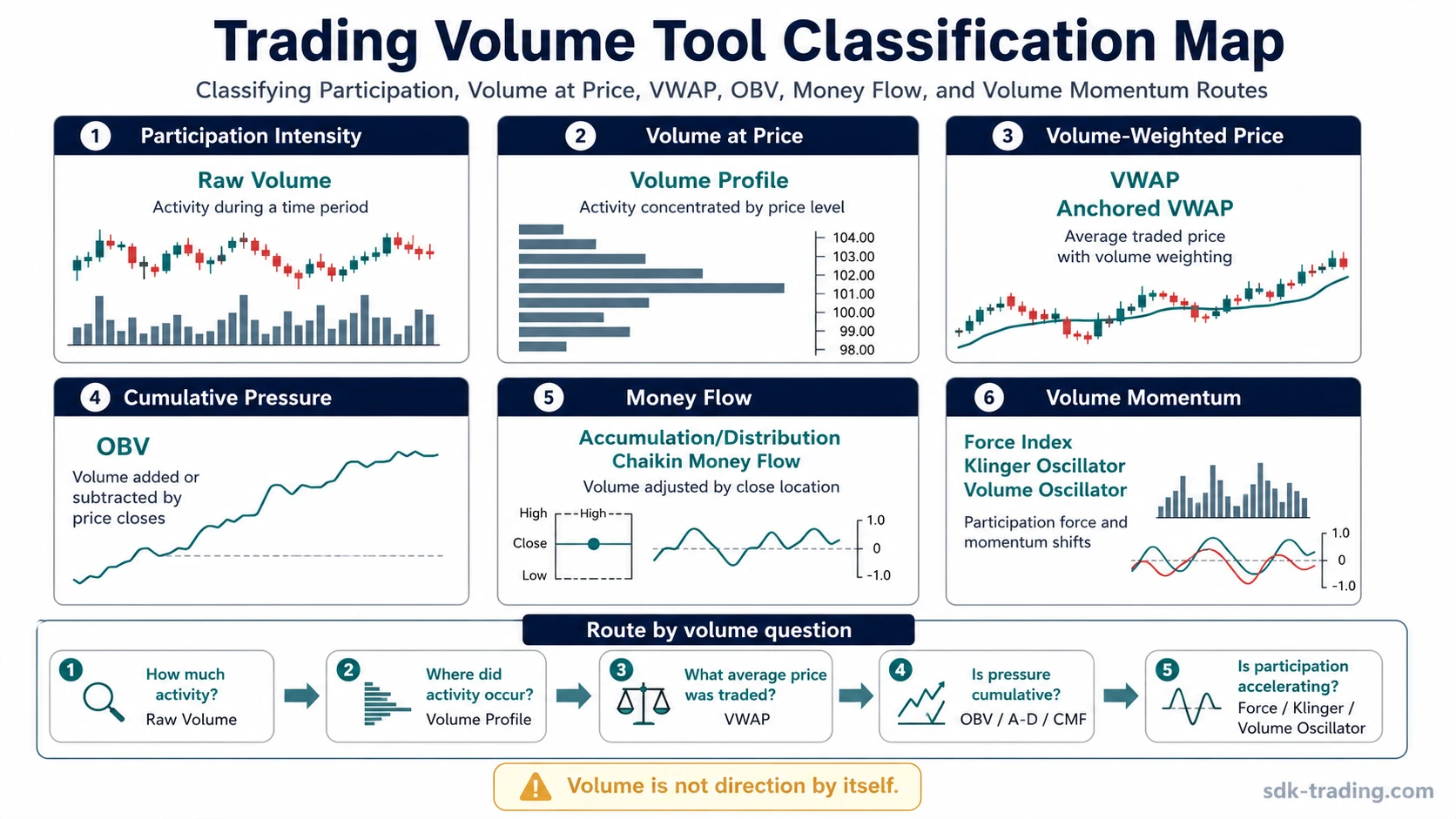
Volume in trading measures market activity over a selected period, but the underlying volume data is not identical across every market. Depending on the instrument and data feed, volume may represent traded shares, contracts, exchange-specific activity, or tick activity. Volume indicators then transform that input in different ways to show activity by time, activity by price, volume-weighted price, cumulative pressure, money flow, or volume momentum.
Definition: Trading volume is a measure of market activity during a selected period. The exact unit depends on the market and data source. A volume indicator takes that activity data and applies a specific calculation or distribution method, so two volume tools can use related inputs while answering very different questions.
Key Points
- Raw volume measures activity, but the unit being measured depends on the market and data feed.
- Volume Profile reorganizes activity by price level instead of showing only how much traded during each time period.
- VWAP and Anchored VWAP use volume to weight average traded price over a defined period or from a selected anchor.
- OBV, Accumulation/Distribution, Chaikin Money Flow, Force Index, Klinger Oscillator, and Volume Oscillator transform volume through different calculation rules.
- Two volume indicators can disagree because they are measuring or transforming different parts of the same market activity.
Volume Indicator Types and What They Measure
The first distinction is what the tool is designed to measure. Raw volume answers how much activity occurred during a period. Other tools reorganize that activity by price, combine it with price, accumulate it over time, or compare recent volume with a longer benchmark.
| Reader question | Best route | What the tool mainly measures |
|---|---|---|
| Where did the most activity occur by price level? | Volume Profile | Volume distributed across price levels rather than only time periods. |
| What is the average traded price adjusted by volume? | VWAP | Volume-weighted average price for a defined trading window. |
| How does VWAP change when the start point is chosen manually? | Anchored VWAP | Volume-weighted average price from a selected event, swing, or reference point. |
| Is cumulative volume pressure rising or falling with price direction? | OBV | Cumulative volume added or subtracted according to price closes. |
| How does price location inside the range affect volume interpretation? | Accumulation/Distribution | Volume weighted by where the close sits inside the period range. |
| Is money flow strengthening or weakening over a lookback window? | Chaikin Money Flow | Volume-adjusted accumulation or distribution pressure over time. |
| How much force is behind a price move? | Force Index | Price change multiplied by volume to estimate movement force. |
| Is volume momentum expanding or contracting? | Volume Oscillator | Difference between shorter and longer volume averages. |
| How does longer-term money-flow behavior compare with shorter-term movement? | Klinger Oscillator | Volume-force behavior across trend and shorter-term fluctuation. |
What Volume Data Are You Actually Measuring?
Before comparing volume indicators, check what the platform is calling volume. The number displayed on a chart can represent different types of activity depending on the market. This matters because every indicator built from that volume inherits the characteristics and limitations of the underlying data.
| Market or data type | What volume can represent | Why the distinction matters |
|---|---|---|
| Stocks | Shares traded through the market data represented by the feed. | The reading is based on actual reported trading activity, although coverage can still depend on the data source. |
| Exchange-traded futures | Contracts traded on the relevant exchange. | The volume belongs to a centralized contract market and can be compared across periods for that contract. |
| Spot forex | Many retail platforms use tick volume or feed-specific activity rather than total global traded volume. | Tick volume measures changes or updates in the feed, so it should not be treated as a complete count of all spot forex transactions worldwide. |
| Crypto | Trading activity reported by a specific exchange or data source, sometimes expressed in base or quote volume. | Crypto trading is distributed across venues, so one exchange’s volume does not necessarily represent the entire market. |
| CFD or broker-specific feeds | Tick activity, broker-specific volume, or another platform-defined measure. | The indicator can still describe activity inside that feed, but the source should be understood before comparing it with centralized exchange volume. |
Data check: Before interpreting a volume indicator, identify what the platform is measuring. A formula cannot add information that is missing from the underlying volume feed.
How Volume Tools Transform the Same Market Activity
The main difference between volume tools is not simply that one is more advanced than another. Each tool changes the raw input along a different measurement axis. That is why two indicators can react differently to the same candle without either calculation being internally inconsistent.
| Tool family | Transformation | Main output | What can be missed |
|---|---|---|---|
| Raw volume bars | Activity grouped by time period. | How much activity occurred during each candle or interval. | Where inside the price range that activity occurred. |
| Volume Profile | Activity regrouped by price level. | Where traded volume concentrated across price. | The sequence in which that activity occurred through time. |
| VWAP and Anchored VWAP | Price averaged with volume weighting. | A volume-weighted price benchmark. | The full distribution of volume around individual price levels. |
| OBV | Full-period volume assigned according to close-to-close direction. | A cumulative line based on whether price closed higher or lower. | Where the close finished inside the current candle’s range. |
| Accumulation/Distribution and money-flow tools | Volume weighted by price or close location. | A cumulative or rolling estimate of price-volume pressure. | Some broader price context that is not part of the formula. |
| Force-based tools | Price change combined with volume. | The magnitude of price movement relative to participation. | Where the volume was distributed within the period. |
| Volume oscillators | Recent volume compared with a longer volume benchmark. | Whether volume activity is expanding or contracting relative to its own history. | Price direction and price momentum unless those are evaluated separately. |
This is the main reason volume indicators should not be treated as interchangeable. Volume Profile asks where activity accumulated. VWAP asks for a volume-weighted average price. OBV assigns volume from close-to-close direction. Accumulation/Distribution uses the close’s location inside the range. A Volume Oscillator compares recent volume with a longer volume average. The input is related, but the calculation changes the question.
Related Volume Frameworks
Once the measurement type is clear, the next step depends on whether the reader needs a broader explanation, a specific workflow, or a direct comparison between two volume tools.
| Reader problem | Best route | Use when |
|---|---|---|
| The reader needs an overview of the indicator family. | Volume indicators explained | The question is about the category, not one specific formula. |
| The reader wants to understand how Volume Profile is used conceptually. | How to Use Volume Profile | The question has moved from definition into interpretation workflow. |
| The reader is comparing cumulative volume pressure tools. | OBV vs Accumulation/Distribution | The issue is how two cumulative tools process volume and price location differently. |
| The reader wants a VWAP-based framework. | VWAP strategy framework | The question is about conditional interpretation, not the definition of VWAP. |
| The reader is comparing a volume-weighted benchmark with a simple average. | VWAP vs Moving Average | The issue is volume-weighted price versus time-based smoothing. |
Matching Volume Indicators to the Right Problem
The cleanest starting point is the measurement question. Use raw volume when the question is simply how much activity occurred during a period. Use Volume Profile when the question is where that activity concentrated by price. Use VWAP or Anchored VWAP when the question is the average traded price after volume weighting.
Cumulative and money-flow indicators answer another set of questions because they combine volume with close direction, range position, or price movement. Volume oscillators make a different comparison again, measuring whether recent participation is expanding or contracting relative to a longer volume benchmark.
Volume is therefore better understood as an input family than as one indicator. First identify the volume data being measured, then identify how the tool transforms it. Once those two pieces are clear, the output is much easier to interpret and much harder to confuse with a different volume measure.