Triple candlestick patterns are three-candle formations where the relationship across all three candles creates the pattern identity. The first candle establishes the starting condition, the second changes or develops that condition, and the third completes the relationship required for the named pattern.
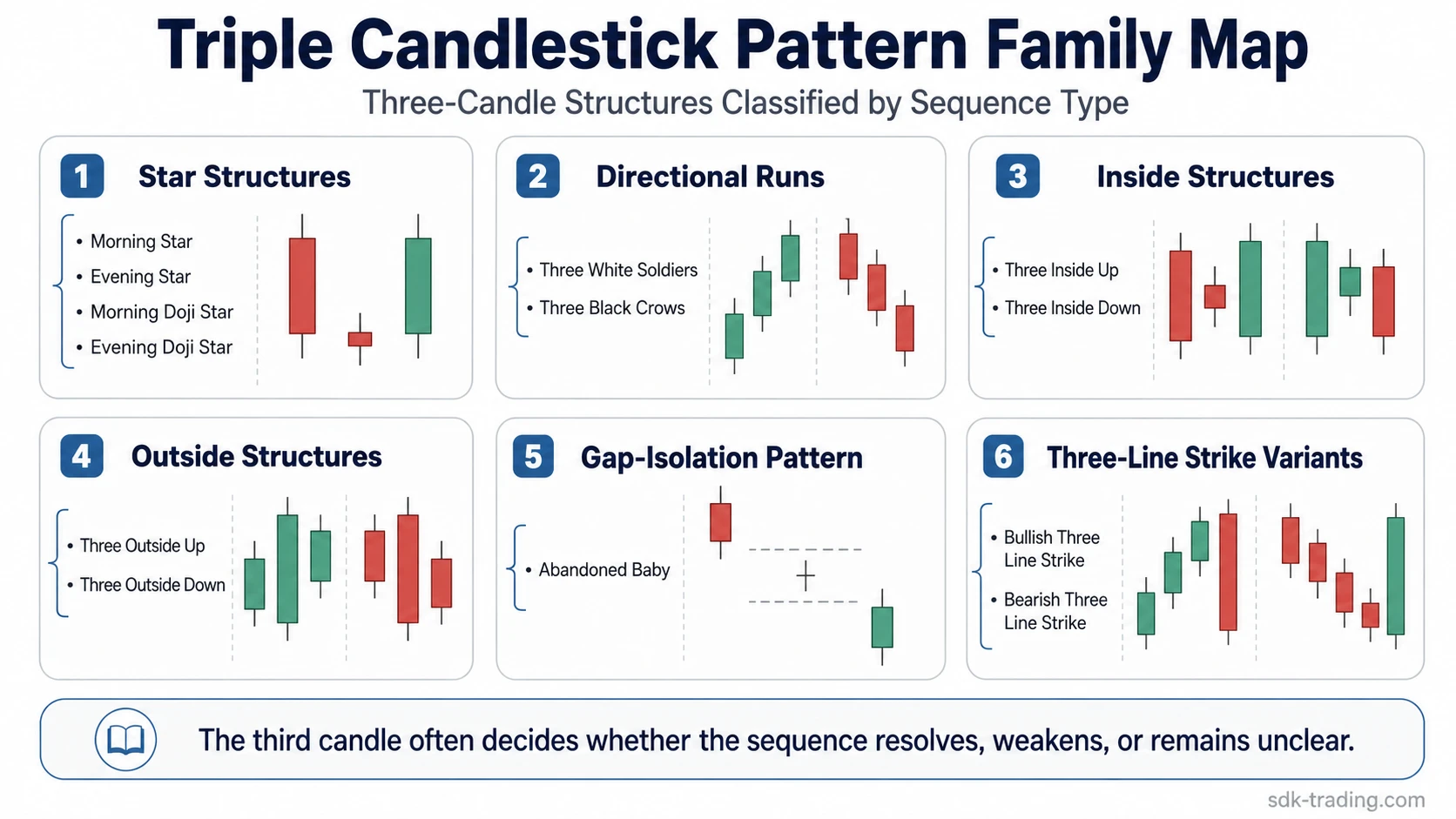
Definition: A triple candlestick pattern is a formation that requires exactly three consecutive candles for classification. Depending on the pattern, the sequence may use a star structure, directional persistence, an inside relationship, an outside relationship, or gap isolation.
Key Points
- A strict triple candlestick pattern requires three candles for classification.
- The first candle establishes the starting condition, while the second and third candles determine how that condition develops or changes.
- Star patterns, directional runs, inside structures, outside structures, and gap-isolation patterns use different three-candle relationships.
- The pattern name should follow the actual candle sequence rather than a general bullish or bearish impression.
- Three Line Strike is related within the current site architecture but is technically a four-candle pattern.
Triple Candlestick Pattern Classification
Start with the relationship formed across the three candles. Some patterns use a smaller middle candle followed by opposite-side resolution. Others use three candles moving in one direction, a two-candle inside or outside relationship completed by a third candle, or an isolated middle candle created by gaps.
| Three-candle relationship | Relevant pattern | Structural identity |
|---|---|---|
| A prior decline is followed by hesitation and then stronger bullish movement. | Morning Star | A bearish first candle, a smaller middle candle, and a bullish third candle. |
| A prior advance is followed by hesitation and then stronger bearish movement. | Evening Star | A bullish first candle, a smaller middle candle, and a bearish third candle. |
| The bullish star structure uses a doji as the middle candle. | Morning Doji Star | A three-candle Morning Star variant with a doji in the middle. |
| The bearish star structure uses a doji as the middle candle. | Evening Doji Star | A three-candle Evening Star variant with a doji in the middle. |
| The middle candle is isolated from the surrounding candles by gaps. | Abandoned Baby Candlestick | An isolated middle doji separated from the first and third candles by gaps. |
| Three bullish candles show sustained directional persistence. | Three White Soldiers | Three consecutive bullish candles form the pattern itself. |
| Three bearish candles show sustained directional persistence. | Three Black Crows | Three consecutive bearish candles form the pattern itself. |
| An inside relationship is followed by bullish third-candle resolution. | Three Inside Up | The first two candles establish an inside relationship and the third completes the bullish structure. |
| An inside relationship is followed by bearish third-candle resolution. | Three Inside Down | The first two candles establish an inside relationship and the third completes the bearish structure. |
| An outside relationship is followed by bullish third-candle resolution. | Three Outside Up | The first two candles establish an engulfing-style relationship and the third completes the bullish structure. |
| An outside relationship is followed by bearish third-candle resolution. | Three Outside Down | The first two candles establish an engulfing-style relationship and the third completes the bearish structure. |
How the Three-Candle Sequence Changes by Pattern Family
The function of each candle is not identical across every triple pattern. In star structures, the middle candle interrupts the prior directional pressure and the third candle completes the opposite-side response. In Three White Soldiers and Three Black Crows, all three candles contribute to directional persistence.
Inside and outside structures work differently again. The first two candles create the initial relationship, while the third candle extends that relationship into the named three-candle formation. Abandoned Baby uses a different mechanism because the middle candle is separated by gaps.
Sequence check: Counting three candles is not enough. The formation must contain the specific relationship required by the named pattern.
Triple Candlestick Patterns vs Other Pattern Groups
| Pattern group | Defining unit | Classification boundary |
|---|---|---|
| Single candlestick patterns | One candle | The body, shadows, range, or close of one candle is sufficient for classification. |
| Double candlestick patterns | Two candles | The relationship between the first and second candle creates the pattern. |
| Triple candlestick patterns | Three candles | The pattern is incomplete until the required third-candle relationship is present. |
| Broader chart patterns | Price structure across an extended sequence | The formation is defined by broader price geometry rather than exactly three candles. |
Related Three Line Strike Structures
Three Line Strike is grouped under the current Triple Candlestick Patterns site family, but it is a technical boundary case. Despite its name, the complete pattern contains four candles: three directional candles followed by a fourth counter-directional strike candle.
| Related structure | Relevant page | Boundary |
|---|---|---|
| Bullish Three Line Strike | Bullish Three Line Strike | The full formation requires four candles, so it is related to this site family but is not a strict triple candlestick pattern. |
| Bearish Three Line Strike | Bearish Three Line Strike | The full formation requires four candles, so it is related to this site family but is not a strict triple candlestick pattern. |
Morning Star vs Evening Star
Morning Star and Evening Star share the same broad three-candle star structure. Their main difference is the direction of the preceding move and the direction in which the third candle completes the formation.
| Comparison question | Relevant comparison | Core distinction |
|---|---|---|
| How is a bullish star structure different from a bearish star structure? | Morning Star vs Evening Star | The distinction is directional context and the way the third candle resolves the middle hesitation candle. |