The Three Outside Up candlestick pattern is a three-candle bullish recovery structure that appears after downside pressure. It starts with a bearish candle, continues with a bullish candle that engulfs the first candle’s real body, and finishes with a third bullish candle closing above the second candle.
The pattern is best read as a diagnostic change in pressure, not as a standalone trading instruction or reversal guarantee. The important question is whether sellers were first in control, then lost control through a real-body engulfing candle, and then failed to regain acceptance on the third candle.
Key Points
- Three Outside Up needs prior downside pressure or a clear bearish context.
- The second candle must engulf the first candle’s real body, not merely overlap its wick.
- The third candle should close above the second candle to show continued recovery acceptance.
- A weak or failed reading appears when the recovery is shallow, incomplete, or quickly rejected.
What Is the Three Outside Up Candlestick Pattern?
Three Outside Up is a bullish three-candle pattern used in technical analysis to describe a shift from bearish pressure into a stronger bullish recovery attempt. The first candle shows selling pressure. The second candle challenges that pressure by engulfing the first real body. The third candle confirms that buyers were still able to close higher after the engulfing candle.
The word “outside” matters because the second candle extends outside the real body of the first candle. A candle that only sits inside the first candle’s body belongs to a different structure. That distinction separates Three Outside Up from Three Inside Up, where the middle candle is contained rather than engulfing.
The useful reading is not that a reversal must follow. The bearish reference candle has been overtaken by a stronger bullish body, then followed by another bullish close. That sequence can mark a recovery attempt, but the reading weakens if the pattern appears without prior downside pressure or if lower prices are accepted soon after.
How the Three Outside Up Pattern Forms
The structure forms through a pressure sequence: sellers create the first bearish candle, buyers respond with a larger bullish body, and the third candle closes above the second candle. Each candle has a separate job.
| Candle | Required behavior | Diagnostic meaning |
|---|---|---|
| First candle | Bearish real body after downside pressure | Defines the bearish reference candle that buyers must overcome |
| Second candle | Bullish real body that engulfs the first candle’s real body | Shows a stronger recovery response than a small bounce or inside candle |
| Third candle | Bullish close above the second candle’s close | Shows follow-through rather than immediate rejection of the recovery |
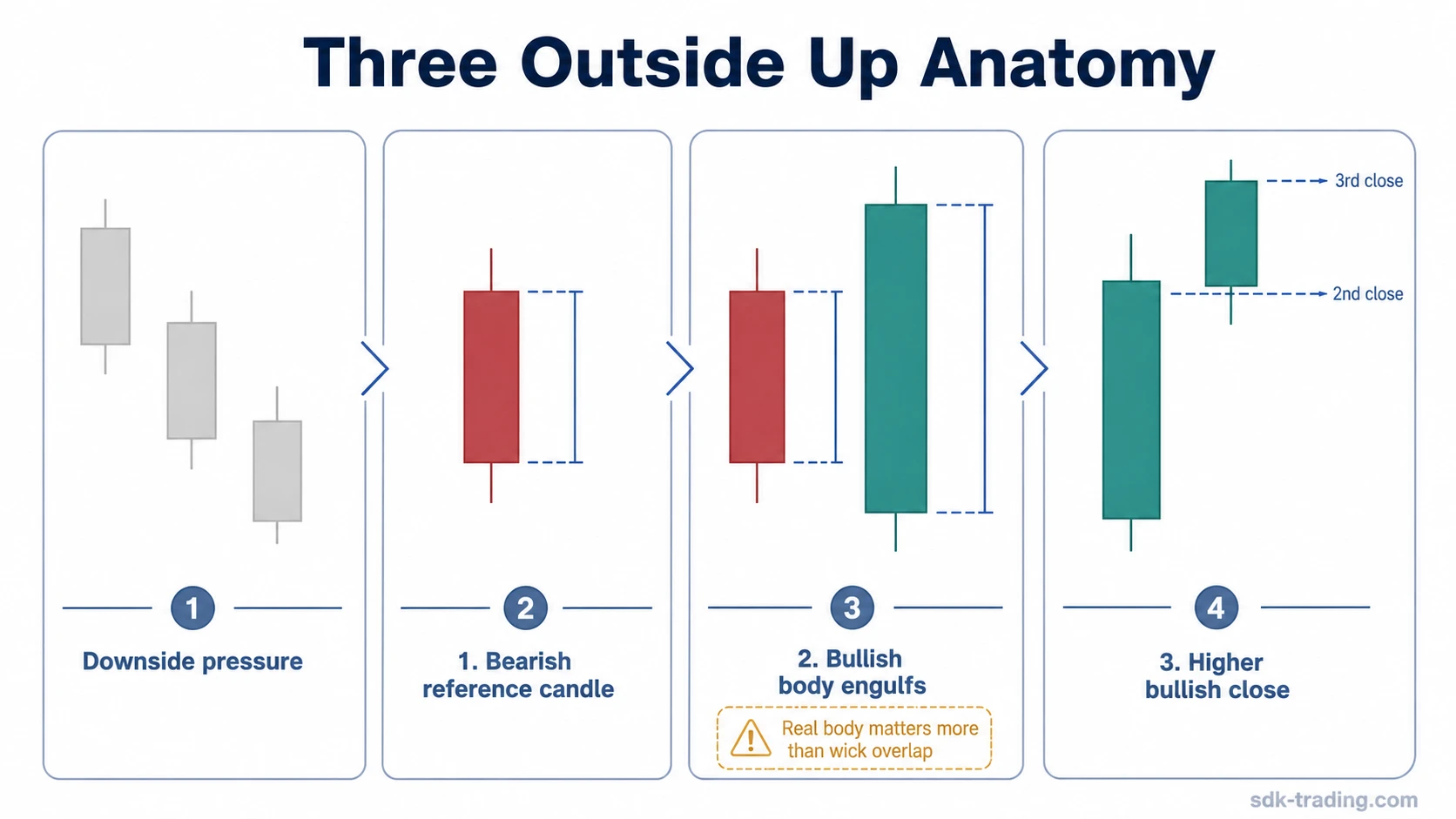
The real body is the main test. Wick overlap alone is not enough. A second candle with a long lower wick and only a small bullish body may look dramatic on a chart, but it does not create the same outside-body structure if the real body does not engulf the first candle’s real body.
How to Identify a Clean Three Outside Up
A clean Three Outside Up begins with a visible bearish context. That context may be a short decline, a pullback, or a sequence where sellers have been pressing price lower. Without that background, the same three candles may still be bullish, but the reversal-reading logic becomes weaker.
The second candle should open within or near the first candle’s range and then close above the first candle’s open, creating a bullish body that fully engulfs the first bearish real body. The cleaner the engulfing body, the easier it is to separate the pattern from ordinary candle overlap.
The third candle is not decorative. Its job is to show that the bullish response did not immediately fail. A third candle that closes only marginally higher may still complete a textbook label, but the diagnostic quality is weaker than a candle that closes clearly above the second candle and does not give back most of the recovery.
Clean identification checklist:
- Downside pressure appears before the pattern.
- The first candle is bearish and meaningful enough to act as a reference candle.
- The second candle is bullish and engulfs the first candle’s real body.
- The third candle is bullish and closes above the second candle’s close.
- The structure is judged by real bodies first, not by wick overlap alone.
Clean, Weak, and Invalid Three Outside Up Readings
The same broad shape can carry different quality. A clean reading shows a clear pressure shift. A weak reading shows only partial recovery quality. An invalid reading lacks the structural requirements or quickly fails as a diagnostic recovery sequence.
| Reading quality | What it looks like | Safer interpretation |
|---|---|---|
| Clean | Clear downside pressure, bearish first candle, strong bullish body engulfing the first real body, and a higher bullish third close | A complete bullish recovery structure with visible follow-through |
| Weak | Prior pressure is unclear, the engulfing body is marginal, or the third close is only slightly above the second close | A possible recovery attempt, but not a strong diagnostic reading |
| Invalid | The second candle does not engulf the first real body, the third candle fails to close higher, or the sequence is immediately followed by lower acceptance that fails the diagnostic reading | Do not treat the sequence as a clean Three Outside Up reading |
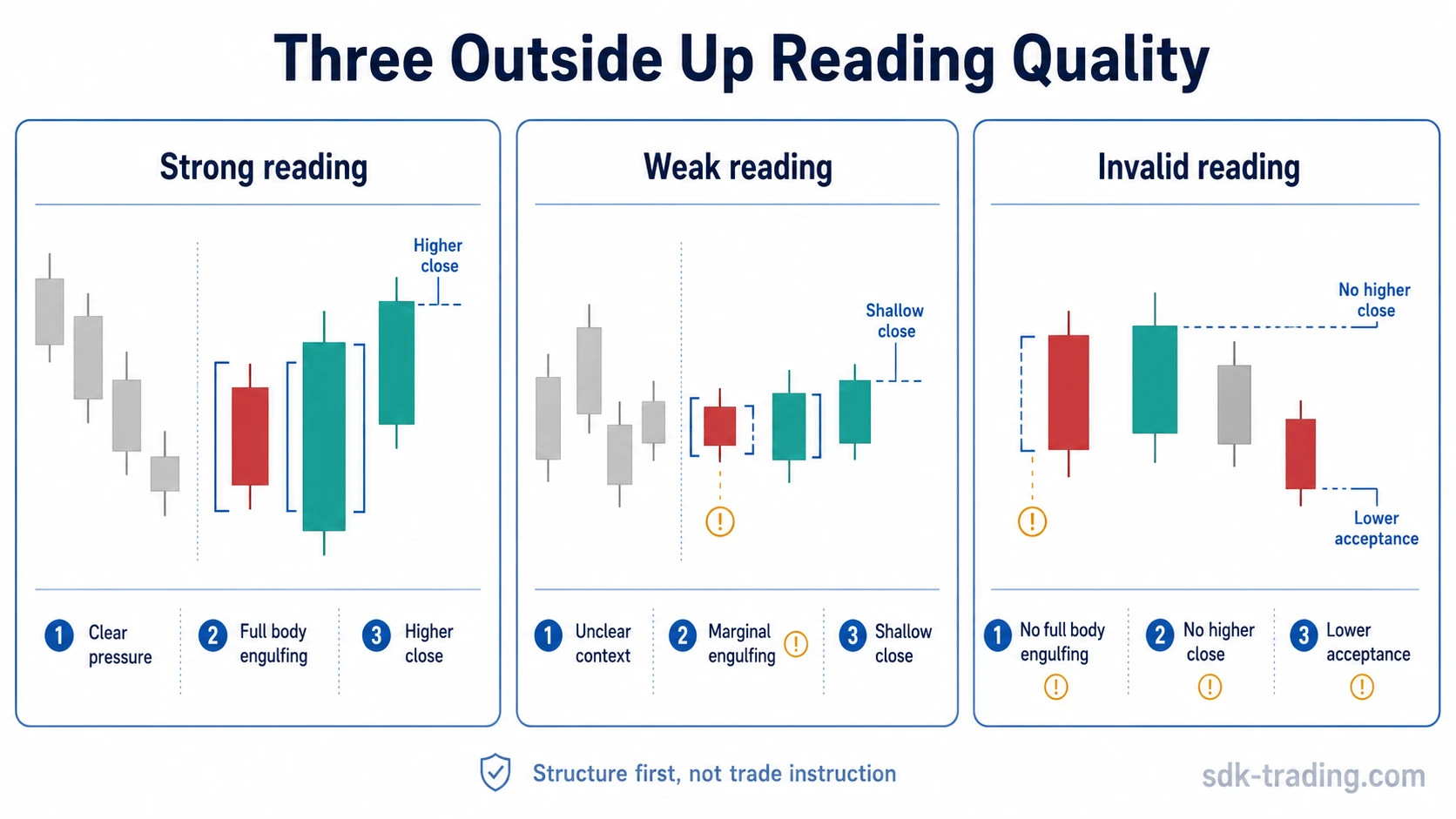
A practical diagnostic scenario is a pullback where sellers create a wide bearish candle, buyers immediately print a larger bullish candle that engulfs the prior real body, and the next candle closes higher again. That sequence is cleaner than a chart where the second candle only overlaps the wick or where the third candle closes flat and leaves the recovery unresolved.
Three Outside Up vs Bullish Engulfing
Three Outside Up is closely related to the Bullish Engulfing pattern, but it is not the same label. Bullish Engulfing is a two-candle structure: bearish candle first, bullish candle second, with the second real body engulfing the first real body.
Three Outside Up adds a third candle. That third candle matters because it tests whether the engulfing candle received follow-through. A bullish engulfing candle with no higher third close may still be a valid two-candle pattern, but it has not completed the Three Outside Up sequence.
| Pattern | Main structure | Boundary |
|---|---|---|
| Bullish Engulfing | Two candles: bearish candle followed by bullish real-body engulfing | No third candle is required for the label |
| Three Outside Up | Three candles: bearish candle, bullish engulfing candle, then higher bullish close | The third candle completes the recovery sequence |
Three Outside Up vs Three Outside Down
Three Outside Down is the bearish opposite of Three Outside Up. Both patterns use the same outside-body idea, but they appear in opposite pressure contexts and resolve in opposite directions.
| Feature | Three Outside Up | Three Outside Down |
|---|---|---|
| Prior pressure | Downside pressure | Upside pressure |
| First candle | Bearish | Bullish |
| Second candle | Bullish candle engulfs the first real body | Bearish candle engulfs the first real body |
| Third candle | Bullish close above the second close | Bearish close below the second close |
| Diagnostic reading | Bearish pressure is challenged by bullish recovery | Bullish pressure is challenged by bearish rejection |
The comparison is useful because it keeps the label tied to direction. The outside candle alone is not enough. The prior pressure, engulfing direction, and third-candle close all have to match the pattern being named.
Common Misreadings and Limitations
The most common mistake is labeling any three-candle bounce as Three Outside Up. A valid reading needs the outside-body relationship on the second candle and a higher bullish third close. Without those parts, the chart may show recovery pressure, but it is not the same pattern.
Another common mistake is treating the pattern as a complete trading plan. Three Outside Up does not define an entry, stop, target, position size, or expected return. It only describes a pressure sequence. Any later decision would require separate context, risk control, and confirmation that are outside the pattern label itself.
The pattern also becomes weaker when the first candle is too small to act as a meaningful bearish reference, when the second candle engulfs only by a tiny margin, or when the third candle closes higher but leaves a long upper wick that shows rejection. These details do not always erase the label, but they can reduce the quality of the reading.
Context remains important. A Three Outside Up shape in the middle of choppy sideways movement is less informative than the same structure after a visible decline or pullback. The pattern is strongest as a pressure diagnostic when the prior move gives sellers something to lose and the second and third candles show that buyers were able to challenge that pressure.
Related Candlestick Patterns
Three Outside Up is part of the triple-candlestick pattern family, but its boundary is specific. It uses a bearish reference candle, a bullish outside-body candle, and a higher third close.
Three Inside Up has the opposite middle-candle relationship: the second candle is contained inside the first candle’s body rather than engulfing it. Three Outside Down flips the pressure direction and turns the sequence bearish.
Morning Star uses a compressed middle candle rather than an engulfing second candle, while Three White Soldiers uses three advancing bullish candles without the bearish reference-and-engulfing sequence.
Three Black Crows is useful as a broader bearish triple-candle reference, but it does not share the same outside-body recovery mechanism. It belongs nearby as a related triple-candle structure, not as a direct opposite of Three Outside Up.