Three Inside Up is a bullish three-candle recovery pattern that extends the Bullish Harami idea with a third-candle acceptance test. It starts with a bearish reference candle, adds a smaller candle contained inside that body, and finishes with a bullish candle that tests whether the recovery is being accepted.
Definition: Three Inside Up is a bullish candlestick pattern in which a long bearish candle is followed by a smaller inside body and then a bullish third candle that closes above the contained pause. It describes a recovery attempt after downside pressure, not a standalone trading instruction.
The key boundary is containment plus acceptance. A bearish-bullish-bullish sequence alone is not enough: the second candle should sit inside the first candle’s real body, and the third candle should show enough recovery pressure to avoid reading the pattern as a weak color sequence.
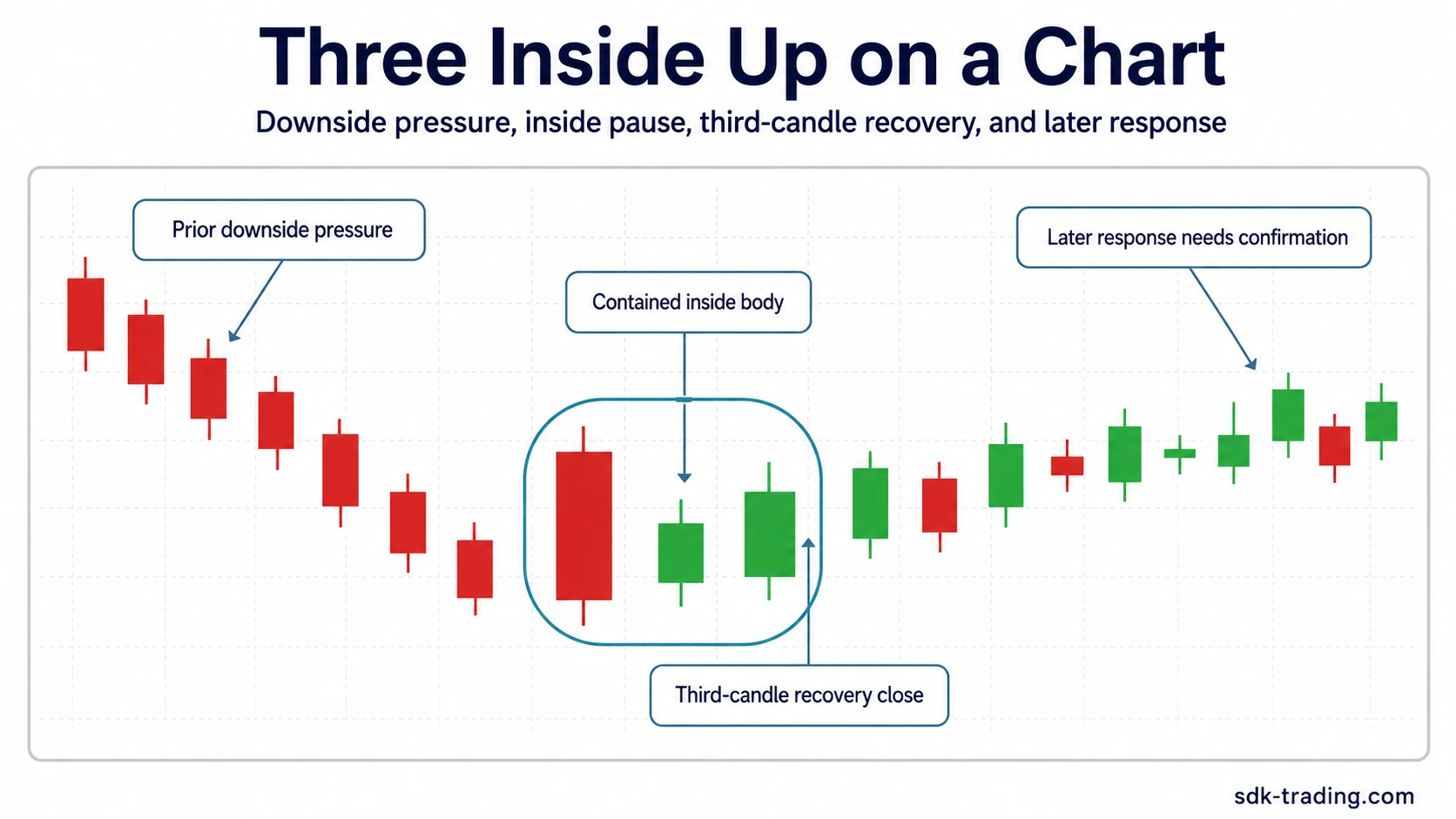
Key Points
- Three Inside Up normally appears after a decline or visible downside pressure.
- The first candle is bearish and acts as the main reference body.
- The second candle is smaller and should sit inside the first candle’s real body.
- The third candle is bullish and should close above the second candle with meaningful recovery pressure.
- A clean reading depends on containment and acceptance, not only on candle color.
- The pattern can fail when the third candle is shallow, the second candle is not really contained, or price quickly accepts lower again.
What Is the Three Inside Up Candlestick Pattern?
Three Inside Up belongs to the triple candlestick patterns group because its meaning depends on all three candles working together. The first two candles create an inside relationship, while the third candle separates the pattern from a simple contained pause.
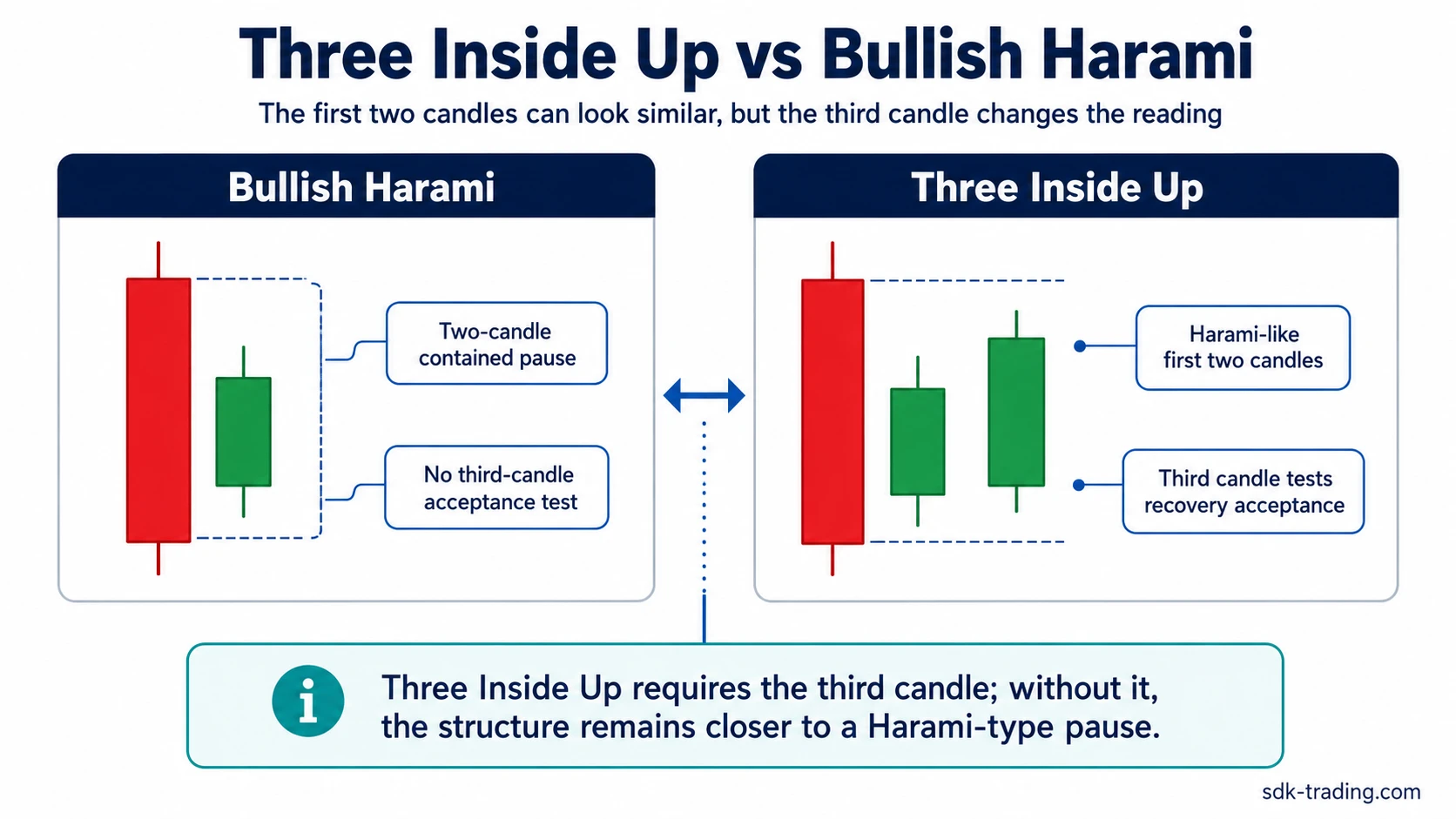
The pattern is closely related to the Bullish Harami, but it adds a third candle. A Bullish Harami can show hesitation after selling pressure; Three Inside Up requires an additional bullish close that tests whether that hesitation is turning into recovery acceptance.
How the Three Inside Up Pattern Forms
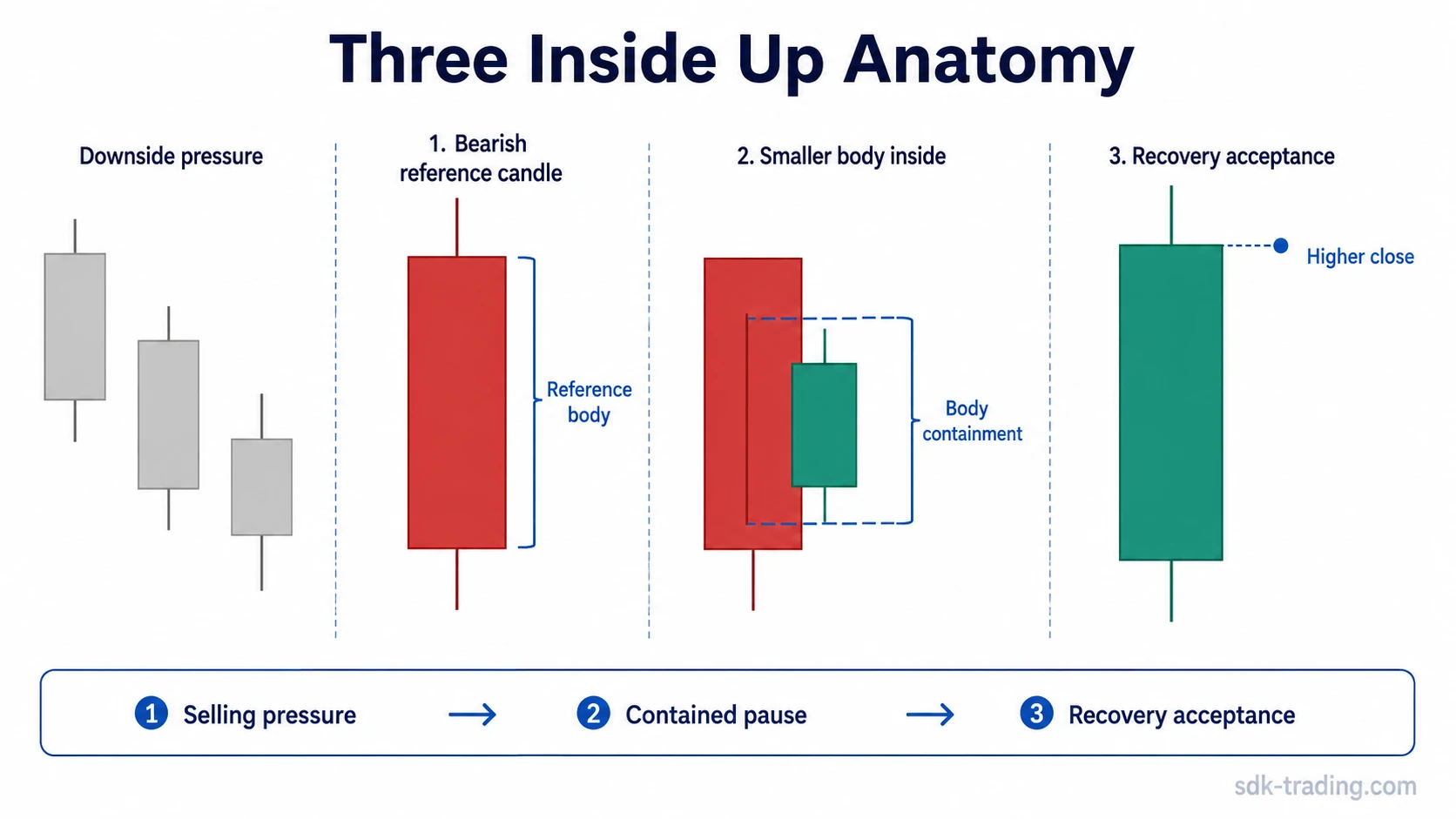
The formation begins with a bearish candle that represents the prior selling pressure. That first candle is the reference candle because the second candle must be measured against its real body, not only against the full high-low range.
The second candle is smaller and usually bullish, although the important feature is not only its color. Its body should remain inside the first candle’s body. This shows that sellers have not extended pressure cleanly, while buyers have started to create a contained recovery attempt.
The third candle is bullish and should close above the second candle. A stronger version closes deeply enough into the first candle’s body to show that the market is accepting higher prices after the inside pause. A shallow third candle can complete the visual shape but still leave the reading weak.
| Candle | What it shows | What weakens the reading |
|---|---|---|
| Candle 1 | A larger bearish reference body after downside pressure. | The candle is small, neutral, or not connected to a prior decline. |
| Candle 2 | A smaller recovery body contained inside the first candle body. | The body breaks outside the first candle body or only appears contained by wick range. |
| Candle 3 | A bullish close showing acceptance above the contained second candle. | The close is shallow, hesitant, or quickly rejected by later price action. |
Why Body Containment Matters
Body containment is the central diagnostic feature. The second candle should be small enough to show that the previous selling pressure has paused inside the first candle’s real body. If the second candle is too large or breaks meaningfully outside that body, the structure no longer reads like an inside pattern.
Wicks can make this confusing. A candle may look visually contained if the viewer focuses only on the full high-low range, but the cleaner test is the real body relationship. The first candle’s body defines the pressure zone; the second candle’s body should sit inside that zone rather than fully rejecting or engulfing it.
Diagnostic note: The second candle does not need to erase the first candle. It needs to show a controlled pause or recovery attempt inside the first bearish body. If it already overwhelms the first candle, the pattern begins to resemble another structure.
Third-Candle Acceptance
The third candle is the acceptance test. A clean version closes high enough to show that price has moved beyond the contained pause, while a shallow close keeps the reading weak even if the candle sequence looks visually correct.
The third candle should be treated as a classification boundary, not as a reversal guarantee. It completes the Three Inside Up structure, but later price action still decides whether the recovery attempt is accepted or rejected.
Limitation: A completed Three Inside Up pattern can still fail if price quickly accepts lower again. The pattern identifies a recovery attempt; it does not prove that the recovery will continue.
Three Inside Up vs Bullish Harami
Three Inside Up and Bullish Harami are closely related, but they are not identical. Bullish Harami focuses on the first two candles: a larger bearish candle followed by a smaller contained candle. Three Inside Up adds a third candle that tests whether the contained recovery is being accepted.
The practical distinction is confirmation depth. A Bullish Harami can show compression or hesitation after selling. Three Inside Up requires the market to move beyond that pause with a bullish third candle. If the third candle is missing, weak, or rejected immediately, the structure should not be treated as a clean Three Inside Up reading.
Clean, Weak, and Invalid Three Inside Up Readings
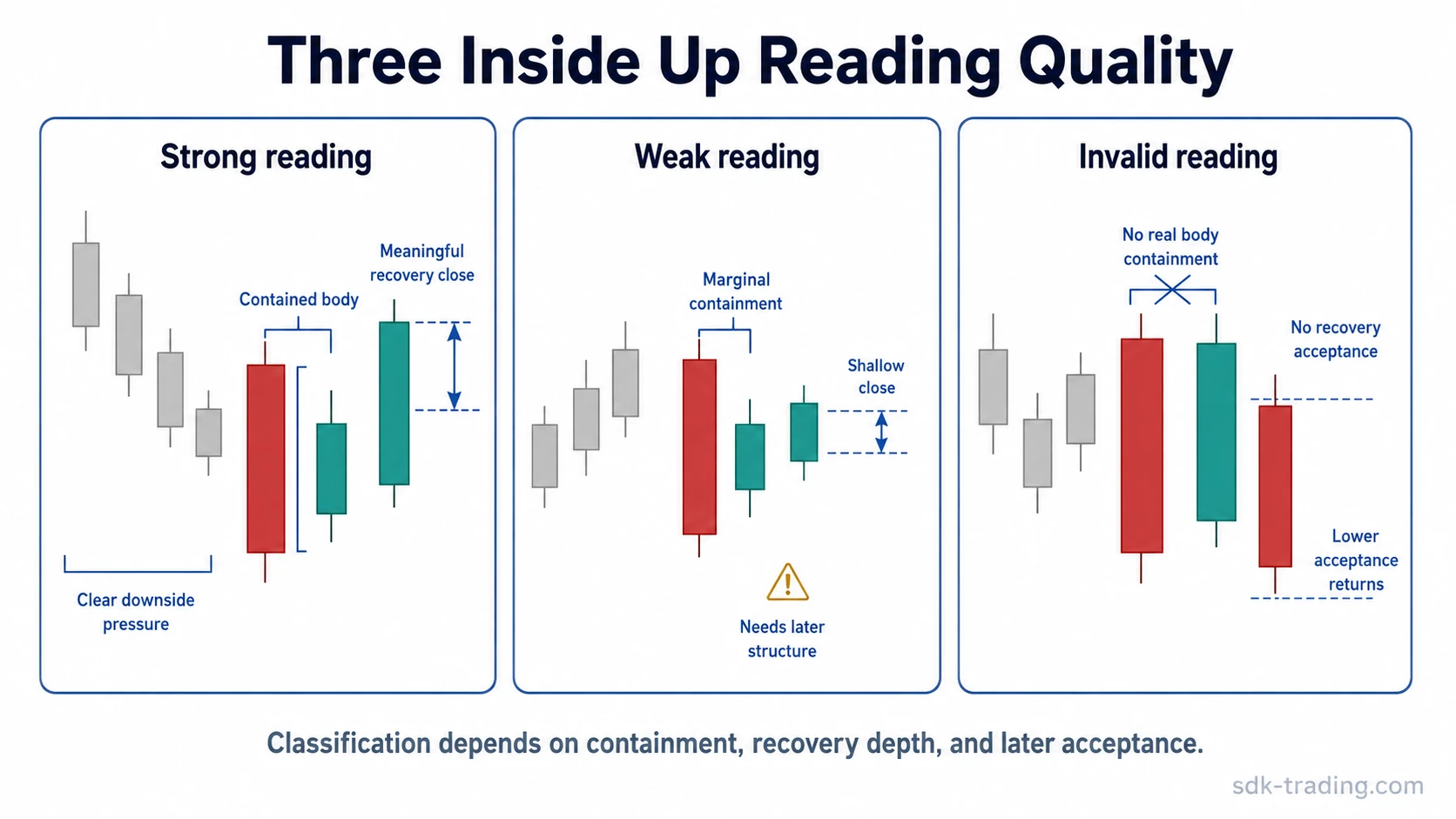
A clean reading has clear downside pressure first, a strong bearish reference candle, a smaller second candle contained inside the first candle body, and a third bullish candle that closes with meaningful acceptance. The sequence should feel like selling pressure, compression, then recovery.
A weak reading has one or more compromised parts. The prior decline may be unclear, the second candle may only be marginally contained, or the third candle may close only slightly higher. Weak readings can still be useful for classification, but they should not be treated as strong evidence on their own.
An invalid reading fails the structure. The second candle may not be inside the first candle body, the third candle may lack real recovery pressure, or later candles may quickly accept lower prices again. In those cases, the label becomes less useful than the failure condition.
| Reading type | Diagnostic condition | Why it matters |
|---|---|---|
| Clean | Downside pressure, contained second body, strong bullish third close. | Shows a complete shift from pressure to compression to recovery acceptance. |
| Weak | Marginal containment, unclear prior pressure, or shallow third-candle close. | The pattern exists visually, but the recovery message is less convincing. |
| Invalid | No real body containment, no meaningful third-candle recovery, or quick lower acceptance. | The structure no longer supports the Three Inside Up classification. |
Three Inside Up vs Nearby Candlestick Patterns
The pattern is easiest to understand when it is separated from nearby triple-candle formations. The opposite Three Inside Down structure uses a similar inside relationship but resolves with bearish pressure after prior upside movement. Three Inside Up is the bullish counterpart after downside pressure.
The Three Outside Up pattern is different because its second candle is not contained. It typically expands beyond the prior candle, creating an outside or engulfing relationship before the third candle adds continuation. Three Inside Up is built on contained pressure first, not expansion first.
The Morning Star also describes a bullish three-candle recovery, but its middle candle is usually read as a separated or compressed indecision candle rather than a body contained inside the first candle. That makes the recognition test different even when both structures appear after downside movement.
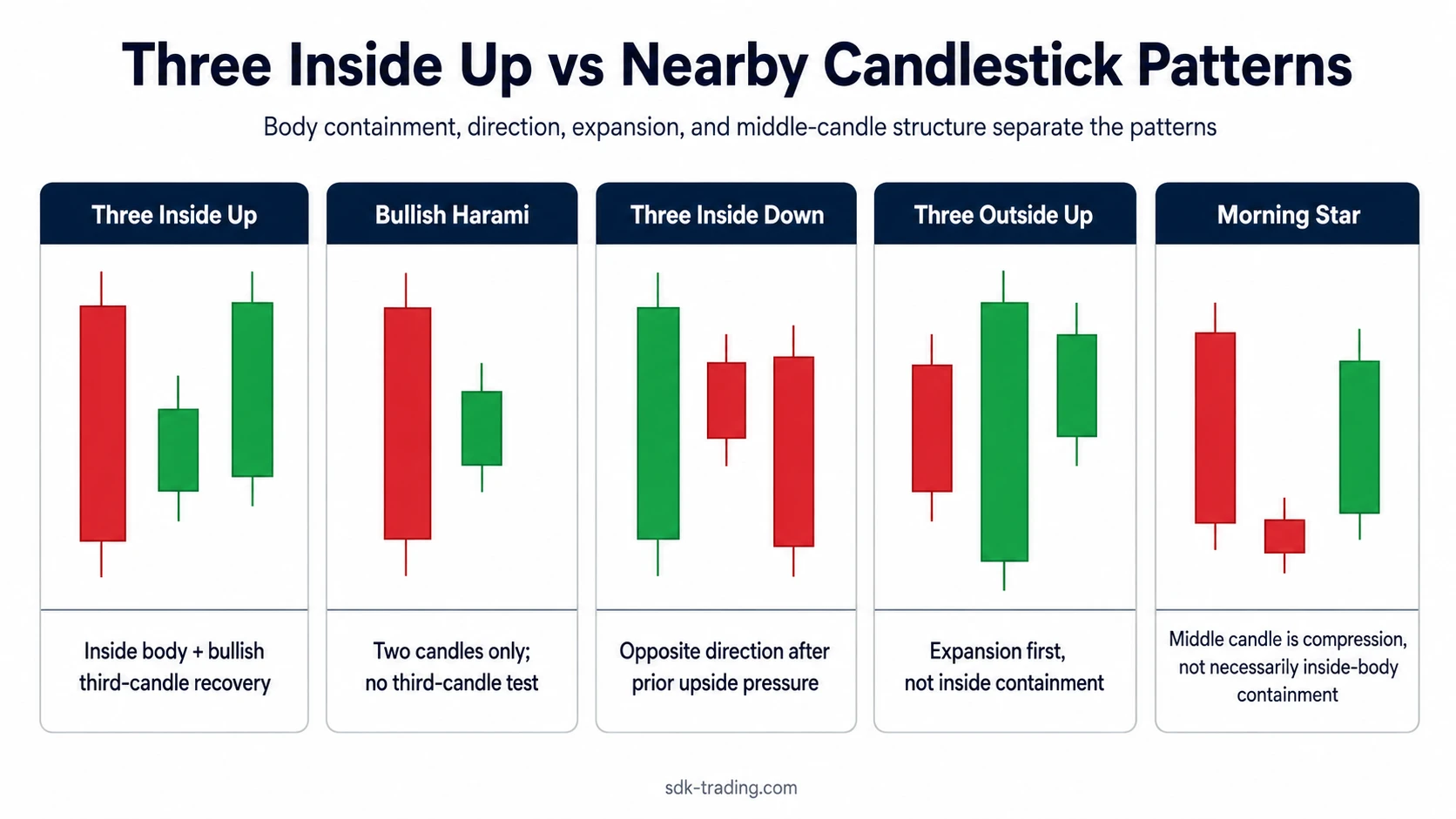
| Pattern | Main structure | Boundary against Three Inside Up |
|---|---|---|
| Three Inside Up | Bearish candle, smaller inside recovery candle, bullish acceptance candle. | Requires body containment and a third bullish recovery close. |
| Bullish Harami | Two-candle contained recovery after a bearish candle. | Does not require the third bullish acceptance candle. |
| Three Inside Down | Bullish reference candle, smaller contained candle, bearish third candle. | Opposite pressure direction and bearish third-candle resolution. |
| Three Outside Up | Bearish candle, bullish outside candle, bullish continuation candle. | Uses expansion or engulfing, not inside-body containment. |
| Morning Star | Bearish pressure, small middle candle, bullish recovery candle. | The middle candle is read as compression or indecision, not necessarily body containment. |
Common Three Inside Up False Positives
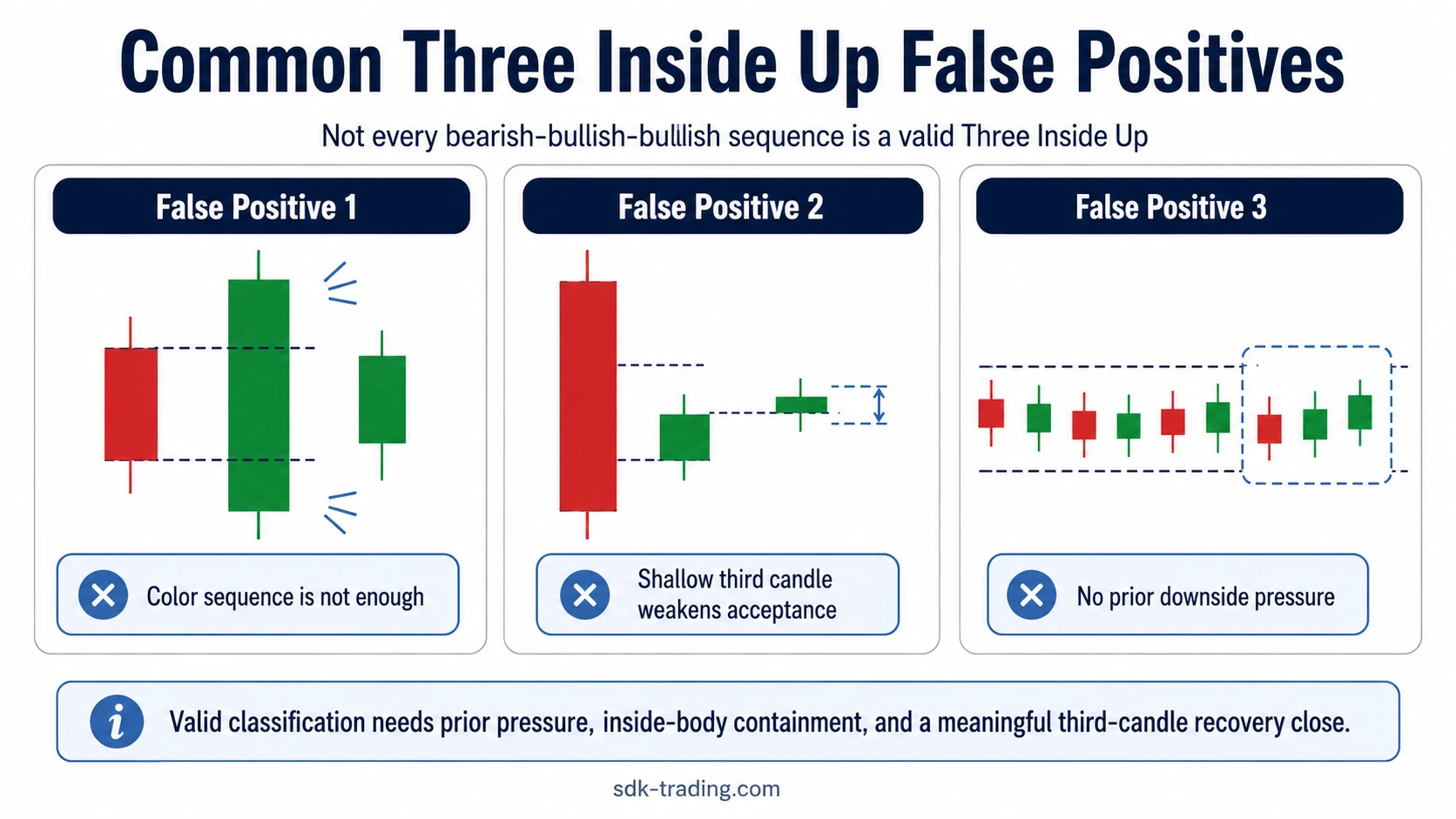
Most false positives come from reading the candle colors before checking the structure. A Three Inside Up reading should start with prior downside pressure, real body containment, and a third candle that shows more than a shallow recovery attempt.
| False positive | Why it is weaker | Safer check |
|---|---|---|
| Any bearish-bullish-bullish sequence | The colors may match, but the second candle may not be contained. | Check whether the second real body sits inside the first real body. |
| Shallow third candle | The third candle may close higher without showing meaningful recovery pressure. | Check whether the close moves clearly beyond the contained pause. |
| No prior downside pressure | The pattern loses context if it appears inside a noisy sideways range. | Check whether selling pressure existed before the three-candle sequence. |
How to Read the Three Inside Up Pattern Safely
The safest way to read Three Inside Up is as a diagnostic pattern, not as an entry, exit, target, stop, or expected outcome. It shows a possible shift from selling pressure into recovery pressure, then requires the reader to check whether the structure is clean enough to matter.
A simple filter is structure first, context second, follow-through third. If containment is weak, prior downside pressure is missing, or price quickly accepts lower again, the reading should be downgraded rather than treated as a strong bullish reversal label.
FAQ
What is the Three Inside Up candlestick pattern?
The Three Inside Up candlestick pattern is a bullish three-candle structure that appears after downside pressure. It uses a bearish reference candle, a smaller contained recovery candle, and a bullish third candle that closes with recovery acceptance.
Is Three Inside Up the same as Bullish Harami?
No. Bullish Harami is mainly a two-candle contained structure. Three Inside Up adds a third bullish candle that tests whether the contained recovery is being accepted.
What makes a Three Inside Up pattern weak or invalid?
The pattern becomes weak when the second candle is only marginally contained or the third candle closes shallowly. It becomes invalid when there is no real body containment, no meaningful third-candle recovery, or quick acceptance lower afterward.
What is the opposite of Three Inside Up?
The opposite pattern is Three Inside Down. It uses a similar inside relationship but appears after upward pressure and resolves with a bearish third candle.
Does Three Inside Up guarantee a bullish reversal?
No. Three Inside Up does not guarantee a bullish reversal. It can show a recovery attempt after selling pressure, but it should be read with broader structure, follow-through, and failure conditions.