Reversal Chart Patterns

Reversal chart patterns are technical-analysis structures that classify possible direction changes after a prior advance or decline. The label is useful only when the prior move, the developing structure, and follow-through after the structure point toward the same interpretation.

A reversal pattern does not predict that a market must turn. It separates different forms of possible transition: sharp rejection, repeated failure, rounded pressure, or a more complex shift from one directional phase into another.

Definition: A reversal chart pattern is a price-structure formation that appears after an established move and suggests that the prior direction may be weakening or changing, but only if later price behavior supports that reading.

Key Points

  • Reversal chart patterns begin with a prior directional move; without that background, the label is usually weak.
  • Top reversal structures and bottom reversal structures should be separated before choosing a specific pattern name.
  • Sharp reversals, rounded transitions, repeated tests, and complex structures describe different market behavior.
  • Continuation context should stay on the table when the market pauses but does not reject the prior direction.

What Are Reversal Chart Patterns?

Reversal chart patterns classify structural change after a market has already moved in one direction. After an advance, a top reversal pattern may describe repeated failure, exhaustion, or loss of upside acceptance. After a decline, a bottom reversal pattern may describe selling pressure losing control and demand beginning to absorb the lower area.

The important distinction is classification rather than prediction. A pattern name is only a starting label. The quality of the reading depends on where the structure appears, how price behaves around its boundaries, and whether later movement accepts or rejects the prior trend direction.

How Reversal Patterns Are Grouped

Reversal structures are easier to classify when they are grouped by the type of transition they represent. A repeated failure near an upper area is different from a sharp rejection. A rounded shift is different from a sudden V-shaped reversal. A complex topping or bottoming structure needs more context than a single break or one dramatic candle.

Group Typical background What the structure tries to classify
Top reversal structures Prior advance Repeated failure, loss of upside acceptance, or a transition away from buyer control.
Bottom reversal structures Prior decline Repeated support, seller exhaustion, or a transition away from downside control.
Rounded structures Slowing directional pressure A gradual change where the market rotates instead of reversing sharply.
V-shaped structures Fast rejection after an extended move A sudden rejection that needs later acceptance before the reversal label carries more weight.
Complex reversal structures Extended trend or unstable transition A broader shift where the pattern needs more context than one boundary test.
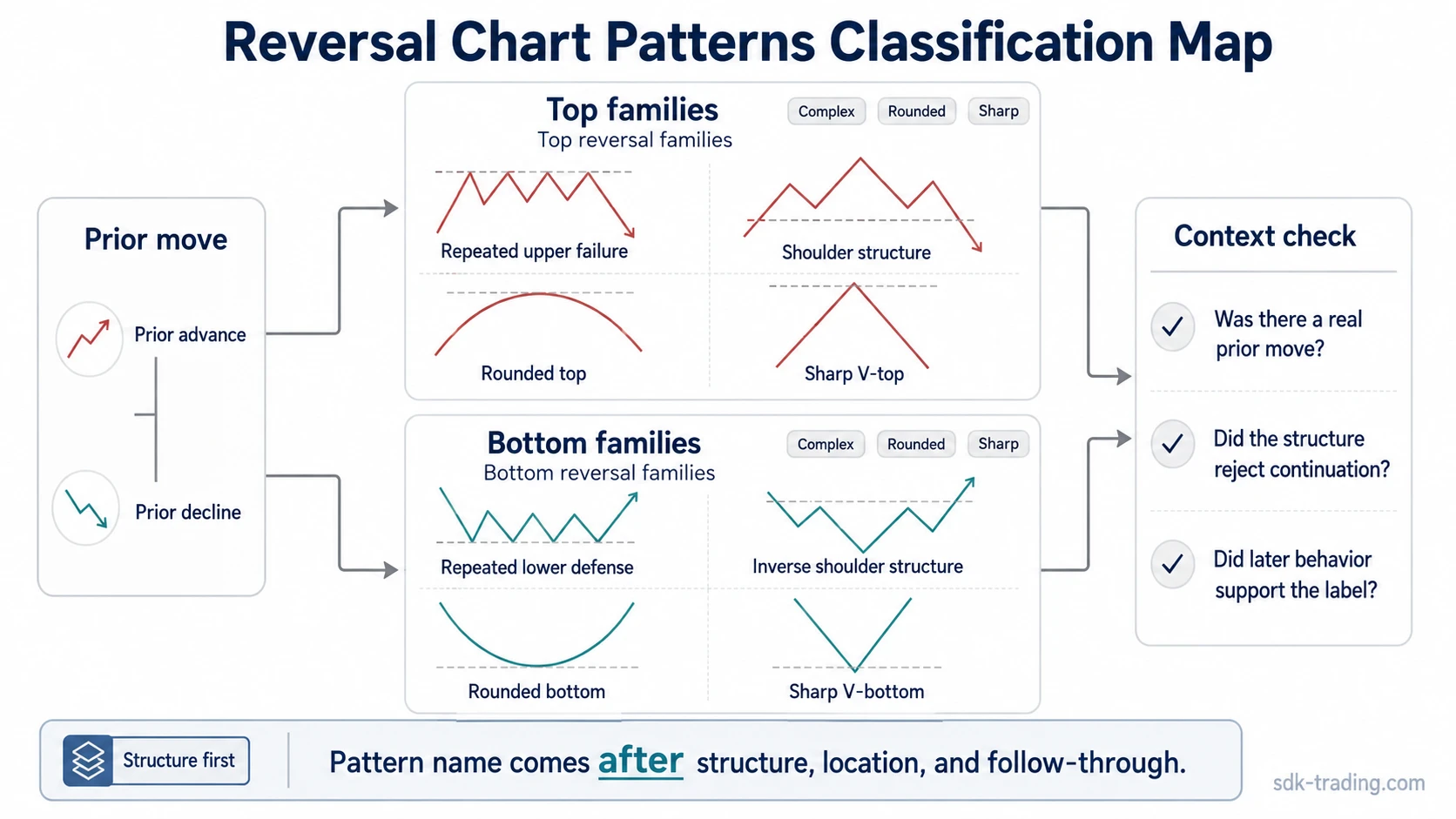
Classification map of reversal chart patterns showing prior move, top families, bottom families, rounded structures, sharp structures, and context checks
Reversal patterns are easier to classify when the prior move, structure family, and follow-through are separated first.

Choose the Structure That Matches the Chart

The safest classification starts with the observed structure, not with the desired reversal label. Choose the pattern family first, then study the individual structure that best matches the chart behavior.

Observed structure Pattern to study next Classification note
Repeated failure near an upper area after an advance double top pattern Useful when the market tests a similar upper area more than once and later struggles to hold continuation.
Several failed attempts near a similar upper area triple top pattern More relevant when the upper area is tested repeatedly rather than only twice.
Left shoulder, higher central peak, and right shoulder after an advance head and shoulders pattern Fits a more developed topping sequence than a simple two-test structure.
Repeated defense near a lower area after a decline double bottom pattern Relevant when the lower area is tested again and sellers fail to gain clear continuation.
Several defended tests near a similar lower area triple bottom pattern Better suited to repeated lower-area defense than to a single sharp rejection.
Left shoulder, deeper central low, and right shoulder after a decline inverse head and shoulders pattern Fits a more developed bottoming sequence with a central low and later recovery attempt.
Gradual transition after an advance rounding top pattern More appropriate when upside pressure fades gradually instead of failing through one sharp rejection.
Gradual transition after a decline rounding bottom pattern More appropriate when downside pressure weakens through rotation rather than a sudden reversal.
Fast rejection after an extended advance V-top reversal Useful for sharp upside rejection, but one violent move can remain unstable until later acceptance or rejection becomes clearer.
Fast rejection after an extended decline V-bottom reversal Useful for sudden downside rejection, but a durable reading needs more than the first recovery candle.
Steep late advance followed by a structural break bump-and-run reversal pattern Fits a more complex late-stage acceleration and reversal sequence rather than a simple test of one level.

Top, Bottom, Rounded, and Sharp Reversal Structures

Top reversal patterns usually begin after a prior advance. The market may push into a familiar upper area, fail to hold above it, or form a more developed topping sequence. The same upper-area failure can have different meanings depending on whether the structure is a double top, triple top, head and shoulders, rounding top, V top, or bump-and-run sequence.

Bottom reversal patterns usually begin after a prior decline. The market may test a lower area more than once, reject a lower probe quickly, or form a slower transition where selling pressure fades over time. That difference separates double bottom, triple bottom, inverse head and shoulders, rounding bottom, and V-bottom classifications.

A sharp structure and a rounded structure should not be treated as the same reading. A sharp rejection focuses attention on immediate failure or recovery behavior. A rounded structure focuses more on gradual pressure change and repeated inability to continue in the prior direction.

Reversal vs Continuation Context

A market pause after a strong move is not automatically a reversal. Some structures represent exhaustion or a change of control, while others are only pauses before the prior direction resumes. The difference depends on whether the market rejects the prior direction or simply consolidates within it.

Reversal context: the prior move loses acceptance, boundaries fail to support continuation, and later behavior begins to favor a directional change.

Continuation context: the market pauses, compresses, or pulls back without clearly rejecting the prior directional structure.

The label should stay flexible until the chart behavior separates a failed continuation attempt from a real transition. A reversal reading is weaker when the market only pauses and then resumes the same direction.

Two-column context map comparing reversal behavior with continuation behavior after a prior market move
A market pause becomes a weaker reversal reading when the prior direction is not clearly rejected.

When a Reversal Reading Is Weak

A reversal label is weak when the chart does not show a real prior move. Without a meaningful advance or decline, the structure may be a range, a pause, or ordinary volatility rather than a reversal setup.

Weak reading Stronger reading Why it matters
No clear prior move The structure appears after a visible advance or decline A reversal needs something to reverse.
Pattern label forced from hindsight The structure is visible before the later move is fully known Hindsight labeling can make random swings look cleaner than they were.
One dramatic candle does all the work Follow-through confirms rejection, defense, or failed continuation A single candle can start the question, but structure decides the classification.
The market only pauses The prior direction fails to regain acceptance A pause can still become continuation if the prior direction remains intact.
The pattern name ignores location The structure is read together with surrounding market context The same shape can carry different meaning depending on where it forms.

Common Classification Mistakes

The first mistake is treating every pullback as a reversal. A decline inside an advance can be only a correction if the market does not reject the broader upside structure.

The second mistake is naming the pattern before the structure is complete. A possible double top, head and shoulders, or rounding top can fail as a reversal idea if later price behavior restores upside acceptance.

The third mistake is mixing sharp and rounded structures. A V-top reversal describes a different type of transition from a rounding top pattern, even though both belong to the top reversal family.

The fourth mistake is comparing only the pattern name instead of the structure. When the top has repeated peaks, the distinction between a double top, triple top, and head and shoulders can change the classification. The comparison between two-peak failure and head-and-shoulders structure is useful when the upper area is not cleanly symmetrical.

The fifth mistake is treating repeated upper tests as identical. The difference between a double top and a triple top can matter when the market makes several attempts near the same area, which is why repeated top structures should be separated before assigning the label.

A Basic Classification Scenario

Price advances into a prior upper area and briefly trades above it, but the close does not hold the higher area. The next recovery attempt stalls below the same zone, and sellers begin to control the following reaction. That behavior may point toward a top reversal family, but the exact classification depends on the structure: a simple repeated failure may fit a double top, a more developed shoulder pattern may fit head and shoulders, and a sharp rejection may fit V-top behavior.

The same logic works in reverse after a decline. A lower-area test can begin a bottom reversal question, but the pattern name should depend on whether the behavior is a repeated defense, a rounded transition, a sharp V-shaped rejection, or a more developed inverse-head-and-shoulders sequence.

FAQ

What is a reversal chart pattern?

A reversal chart pattern is a price-structure formation that appears after a prior advance or decline and suggests that the previous direction may be weakening or changing. The reading needs later price behavior before it becomes more defensible.

Are reversal chart patterns the same as candlestick reversal patterns?

No. Reversal chart patterns describe broader price structures such as tops, bottoms, rounded transitions, or head-and-shoulders formations. Candlestick reversal patterns focus on one or a few candles and should not replace the larger structure.

What makes a reversal pattern reading weak?

A reversal reading is weak when there is no clear prior move, the structure is incomplete, the market only pauses, or the pattern name is forced after the later move is already visible.

How do top reversal and bottom reversal patterns differ?

Top reversal patterns appear after an advance and classify possible loss of upside control. Bottom reversal patterns appear after a decline and classify possible loss of downside control.