A head and shoulders is a bearish reversal chart pattern that develops after an advance. It uses a three-peak hierarchy with a left shoulder, a higher head, a right shoulder, and a neckline formed by the reaction lows between those peaks.
Definition: A head and shoulders chart pattern is a reversal structure in which an existing advance stops extending in the same way. The middle peak becomes the highest point, the later rally fails to reproduce that extension, and the neckline provides the main boundary for evaluating whether the developing structure is being completed or rejected.
Three peaks alone are not enough. The pattern needs the correct prior context, a clear peak hierarchy, reaction lows that belong to the same sequence, and a neckline that can be evaluated as the structure develops.
| Classification | Prior context | Internal structure |
|---|---|---|
| Head and shoulders | Advance | Three peaks with a higher middle peak and a neckline through the reaction lows |
| Double top | Advance | Two main upper tests without a higher central head |
| Inverse head and shoulders | Decline | Three troughs with a lower middle trough and a neckline through the reaction highs |
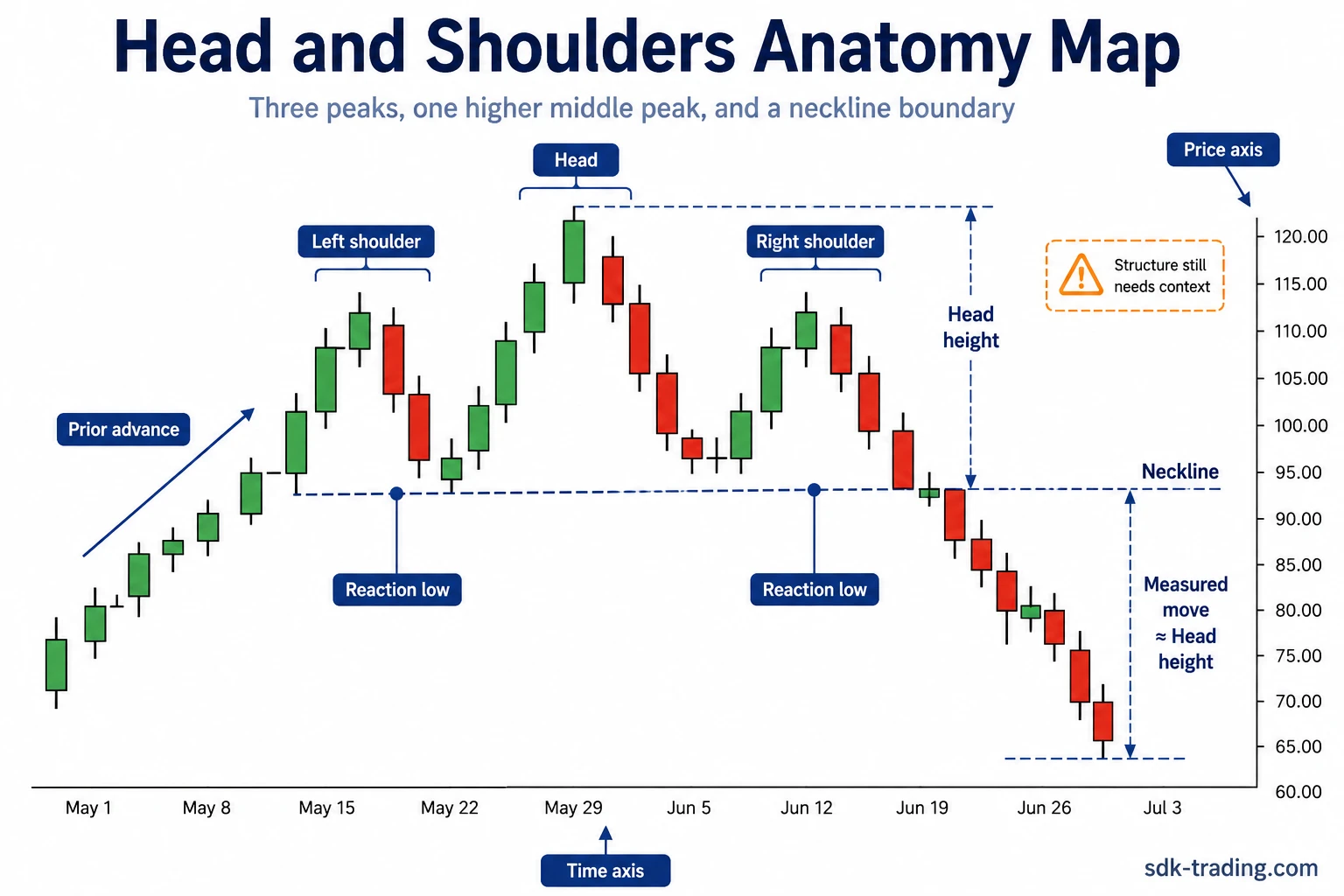
Head and Shoulders Anatomy
| Component | Structural role | What to check |
|---|---|---|
| Prior advance | Provides the directional structure that may be reversing. | Confirm that price was advancing before the shoulder sequence developed. |
| Left shoulder | Creates the first peak and first reaction low. | Identify a distinct rally and pullback inside the developing structure. |
| Head | Extends above the left shoulder and becomes the highest peak. | The middle peak should be visibly higher than both shoulders. |
| Right shoulder | Shows a later recovery that does not reproduce the head’s upside extension. | The rally should remain below the head if the peak hierarchy is still intact. |
| Neckline | Connects the reaction lows and creates the main structural boundary. | Use lows that clearly belong to the same shoulder-head-shoulder sequence. |
| Later behavior | Shows how price behaves after interacting with the neckline. | Distinguish sustained behavior below the boundary from a quick probe and reclaim. |
How the Structure Develops
The sequence starts with an existing advance. Price forms the left shoulder, reacts lower, then rallies to a higher peak that becomes the head.
The next reaction creates another low in the neckline area. Price then recovers again, but the new rally remains below the head and forms the right shoulder.
Perfect symmetry is not required. The two shoulders can differ in height, width, and duration. What matters more is whether the central head remains the dominant peak and whether the reaction lows create a coherent structural boundary.
Why the Neckline Matters
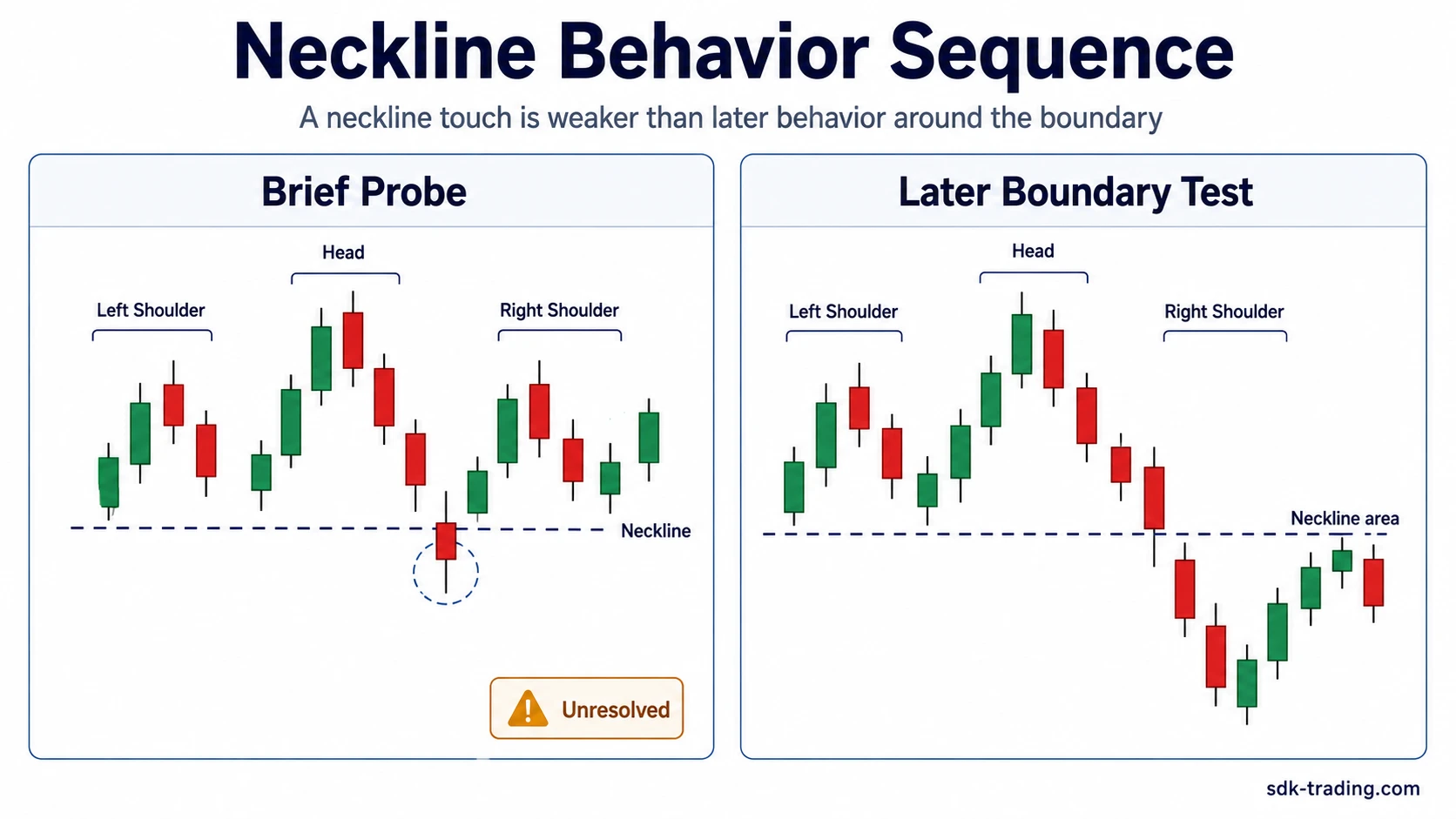
The neckline separates a developing three-peak outline from a more complete reversal structure. Before meaningful behavior develops around that boundary, the pattern can remain unfinished even when the shoulders and head are visually clear.
A brief move below the neckline can still be rejected. If price quickly reclaims the area and rebuilds the previous structure, the bearish interpretation weakens. If later recovery attempts remain below the neckline area, the market is showing a different relationship with the former boundary.
This is why chart pattern failures should be evaluated through what happens to the structural boundary after the initial break rather than from the pattern outline alone.
Core boundary: the neckline is part of the pattern’s completion logic. Drawing a neckline after three peaks appear does not by itself establish a completed reversal structure.
See the Pattern on a Real Chart
This short example shows the left shoulder, head, right shoulder, neckline break, retest, and a common measured-move projection on a real chart.
The measured move shown in the video is a projection method. The structural question remains whether price establishes behavior beyond the neckline or returns into the earlier pattern.
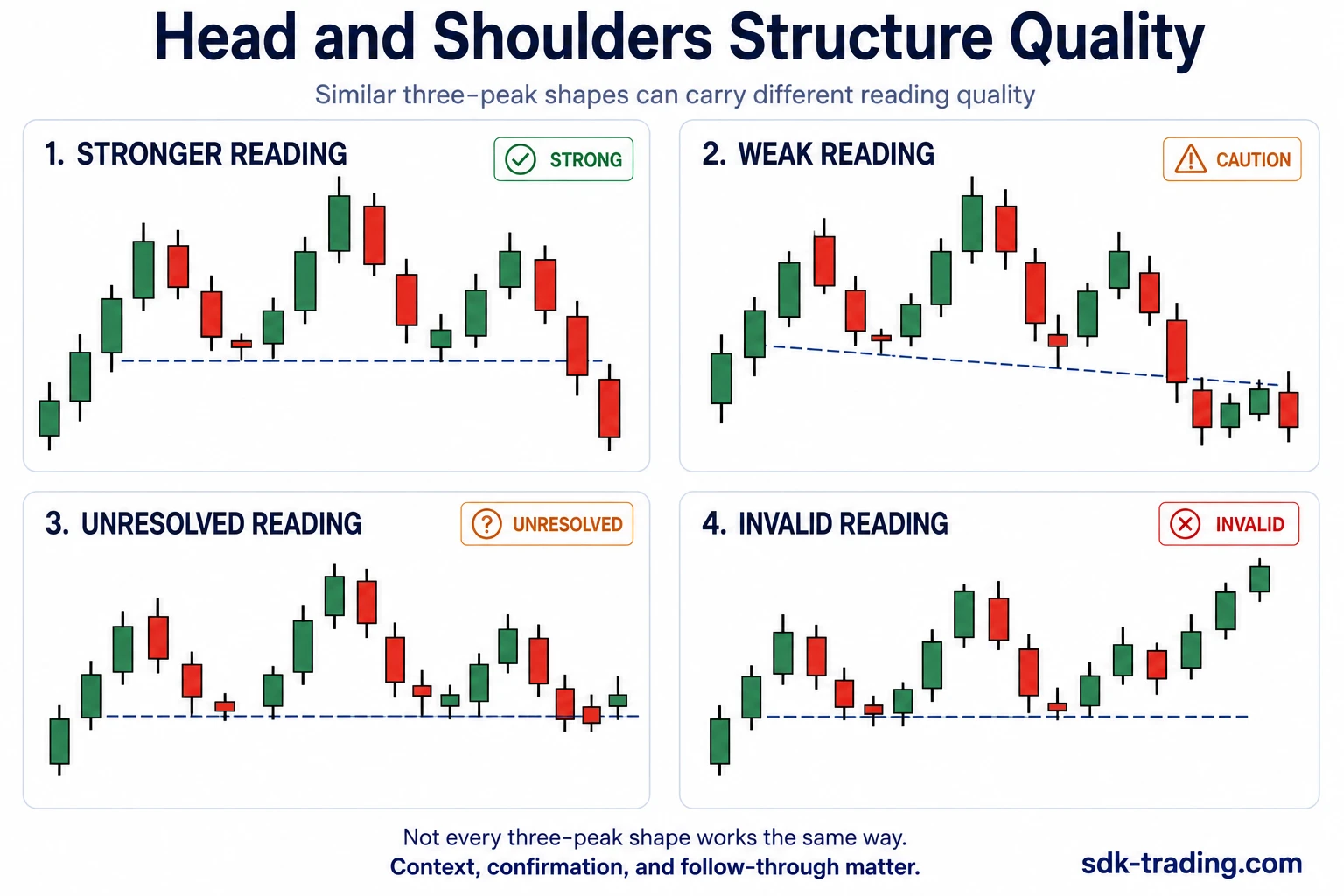
Clean, Developing, Weak, and Failed Structures
| Reading | Typical structure | What separates it |
|---|---|---|
| Clean | Clear prior advance, higher head, readable shoulders, coherent neckline, and persistent behavior below the boundary. | The main structural components support the same classification. |
| Developing | The shoulders and head are visible, but neckline behavior has not resolved. | The pattern geometry exists, while completion remains open. |
| Weak | The peak hierarchy is unclear, the neckline is forced or poorly defined, or the right shoulder does not separate cleanly from the head. | The structure requires increasingly subjective interpretation. |
| Failed | Price reclaims the neckline and restores upside structure that contradicts the reversal reading. | The later market structure no longer supports the original classification. |
Head and Shoulders vs Related Reversal Patterns
| Pattern | Main geometry | Prior context | Key distinction |
|---|---|---|---|
| Head and shoulders | Three peaks with the middle peak highest | Advance | A shoulder-head-shoulder hierarchy develops around a neckline. |
| Double top | Two main upper tests | Advance | There is no higher central head between two shoulder regions. |
| Inverse head and shoulders | Three troughs with the middle trough lowest | Decline | The same broad shoulder logic is inverted into a bottoming structure. |
Interpretation Boundaries
A head and shoulders structure is partly judgment-based because real peaks, reaction lows, and neckline slopes rarely form with perfect symmetry. A strongly sloped or poorly defined neckline increases that subjectivity.
Volume can provide additional participation context, but it does not repair weak geometry or replace the structural sequence. Measured-move techniques can describe a projection method, but they remain separate from whether later price actually follows that path.
Interpretation limit: the pattern classifies a possible deterioration in an existing advance. It does not determine the later market path by itself.