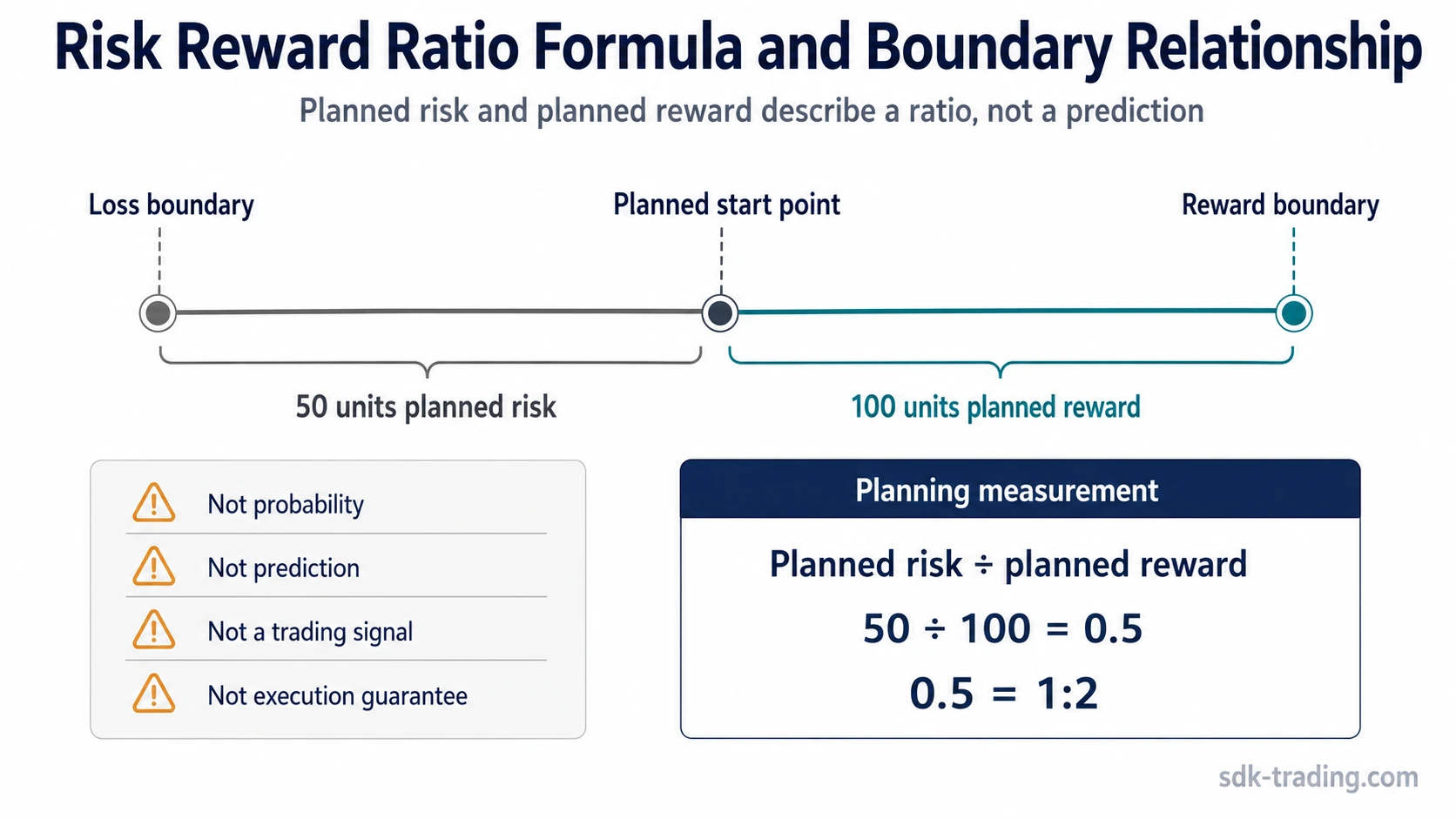
Risk reward ratio compares planned downside with planned upside before the trading outcome is known. A plan that risks 50 units for 100 units of potential reward is written as 1:2 in risk-first notation.
The ratio compresses two planned boundaries into a proportion. It does not preserve their absolute distance, estimate how likely either boundary is to be reached, or guarantee that execution will match the original plan.
Definition: Risk reward ratio is the relationship between planned risk and planned potential reward. Because trading sources use more than one display convention, the order of the numbers matters: risk-first 1:2 and reward-to-risk 2:1 can describe the same underlying plan.
Key Points
- A 1:2 risk-first ratio means one unit of planned risk for two units of planned reward.
- Risk-first and reward-to-risk conventions can reverse the displayed numbers while describing the same relationship.
- The same ratio can represent very different absolute stop and target distances.
- Multiplying both planned distances by the same factor leaves the ratio unchanged.
- Probability, position size, volatility, execution costs, and boundary quality require separate evaluation.
What Is Risk Reward Ratio?
Risk reward ratio compares the unfavorable side of a planned trade with the favorable side. Both sides need to be measured on the same basis. On a chart, that may mean the price distance from entry to stop compared with the distance from entry to target. For a fixed position size, the same relationship can also be expressed as planned monetary loss versus planned monetary gain.
The ratio describes payoff geometry before the result is known. A clean 1:3 calculation does not establish that the target is realistic or that the stop belongs where it was placed. Those decisions come from the underlying trade structure and risk process.
Position size is separate. Changing quantity changes the monetary amount exposed, while equal scaling of both risk and reward leaves the proportional ratio unchanged.
Risk Reward Ratio Formula and Notation
Two closely related conventions are common, so the notation should be identified before comparing ratios.
Risk-first notation: planned risk : planned reward
Risk-first decimal: planned risk / planned reward
Reward-to-risk multiple: planned reward / planned risk
If planned risk is 50 units and planned reward is 100 units, the risk-first relationship is 50:100, which simplifies to 1:2. The risk-first decimal is 50 / 100 = 0.5. Reversing the calculation gives a reward-to-risk multiple of 2.0, which may also be displayed as 2:1.
| Convention | Calculation | Same example |
|---|---|---|
| Risk-first notation | Risk : Reward | 1:2 |
| Risk-first decimal | Risk / Reward | 0.50 |
| Reward-to-risk multiple | Reward / Risk | 2.00 |
| Reward-first notation | Reward : Risk | 2:1 |
How to Read 1:2 and 1:3 Risk Reward Ratios
In risk-first notation, the first number represents planned risk and the second represents planned reward. A 1:2 ratio therefore means two units of planned reward for each unit of planned risk. A 1:3 ratio means three units of planned reward for each unit of planned risk.
| Risk-first notation | Risk-first decimal | Reward-to-risk multiple | Plain meaning |
|---|---|---|---|
| 1:1 | 1.00 | 1.00 | One unit of planned risk for one unit of planned reward |
| 1:2 | 0.50 | 2.00 | One unit of planned risk for two units of planned reward |
| 1:3 | 0.33 | 3.00 | One unit of planned risk for three units of planned reward |
This convention check prevents a common numerical confusion. A risk-first decimal of 0.50 and a reward-to-risk multiple of 2.00 describe the same 1:2 relationship.
Risk Side vs Reward Side
The risk side can be expressed as an adverse price distance or as the planned loss amount derived from that distance and the chosen position size. The reward side can likewise be expressed as favorable price distance or planned gain.
For a chart-based ratio, the starting point is commonly an entry reference. The distance from entry to the unfavorable boundary defines the price-risk side. The distance from entry to the favorable boundary defines the price-reward side.
The ratio only compares those two measurements. It does not determine where the entry, stop, or target should be placed.
| Part of the plan | What it represents | Role in the ratio |
|---|---|---|
| Planned risk side | Adverse distance or loss amount measured on the chosen basis | Defines the first side in risk-first notation |
| Planned reward side | Favorable distance or gain amount measured on the same basis | Defines the second side in risk-first notation |
| Ratio | The proportion between the two planned measurements | Normalizes the relationship |
| Actual result | The realized outcome after market movement and execution | Can differ from the planned relationship |
The Same Risk Reward Ratio Can Hide Different Trade Geometry
Risk reward ratio is scale-invariant. If both sides of a 1:2 plan are multiplied by the same factor, the ratio stays 1:2.
A plan with 0.50 units of planned risk and 1.00 unit of planned reward therefore has the same proportional relationship as a plan with 5.00 units of risk and 10.00 units of reward. The second plan requires ten times as much absolute price movement on both sides, but that difference disappears after the measurements are reduced to a ratio.
| Plan | Planned risk distance | Planned reward distance | Risk-first ratio |
|---|---|---|---|
| Compact geometry | 0.50 units | 1.00 unit | 1:2 |
| Wide geometry | 5.00 units | 10.00 units | 1:2 |
This normalization makes ratios easy to compare across different price scales, while removing information about absolute distance. The ratio alone cannot show how large the stop is relative to normal volatility, how much price must travel to the target, or whether the planned boundaries line up with meaningful market structure.
Execution friction also does not necessarily scale with the planned geometry. Spread, slippage, or another small execution difference can consume a larger share of a compact stop distance than of a much wider one, even when both plans display the same 1:2 ratio.
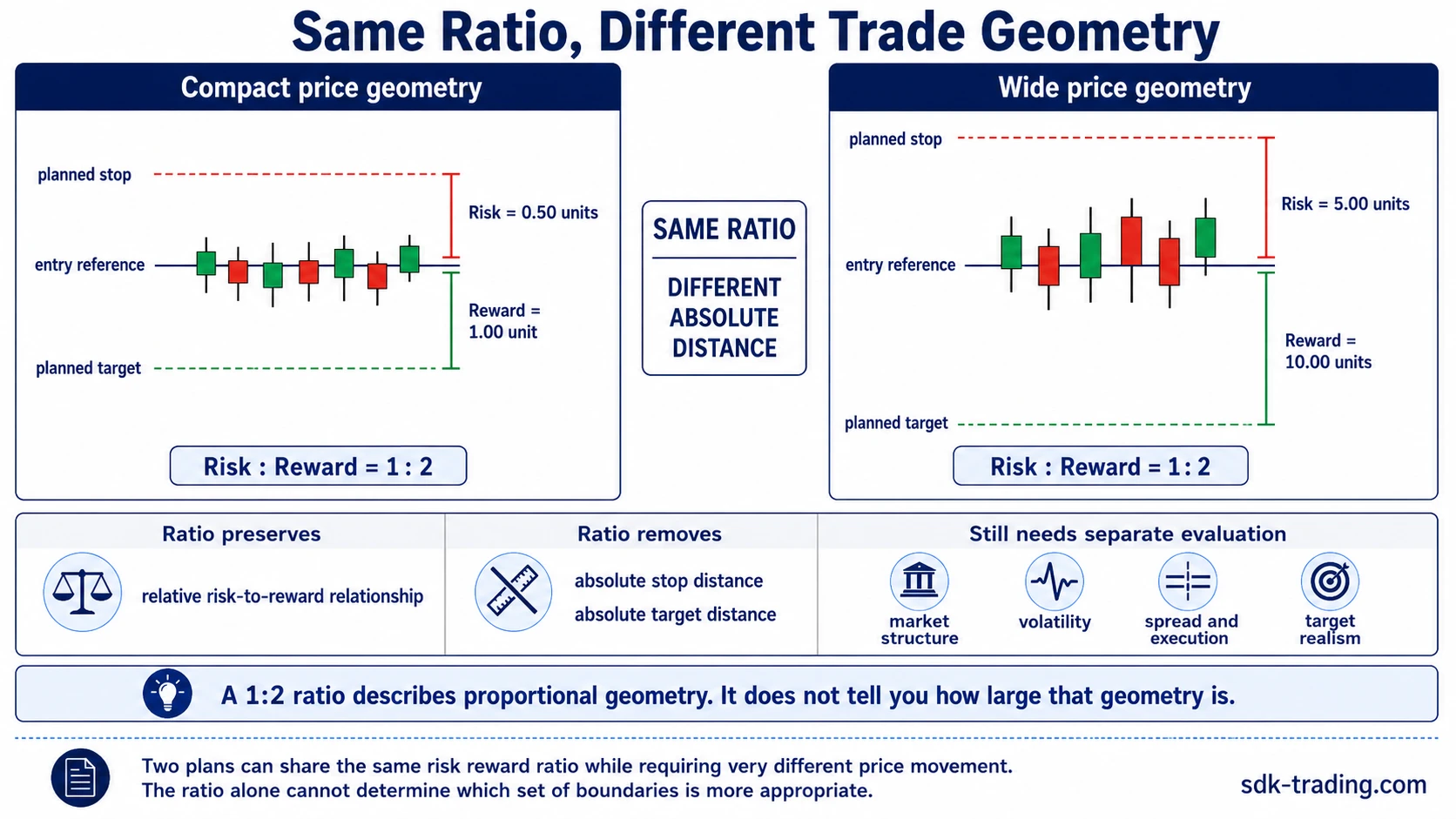
Scale boundary: The ratio preserves relative risk-to-reward geometry. Absolute distance, volatility exposure, execution sensitivity, and target realism remain separate properties of the trade plan.
Risk Reward Ratio Example
Illustrative example: A planned position has 50 units of risk and 100 units of potential reward. The risk-first relationship is 50:100, which simplifies to 1:2.
If the risk boundary is later widened so that planned risk becomes 75 units while planned reward stays at 100 units, the relationship changes to 75:100, or approximately 1:1.33 in risk-first notation.
The original 1:2 label no longer describes the updated geometry. Any change to either planned boundary requires the relationship to be calculated again.
Is a Higher Risk Reward Ratio Always Better?
The phrase “higher risk reward ratio” can be ambiguous because the display convention changes what a larger number means. In risk-first notation such as 1:2 and 1:3, a larger second number means more planned reward per unit of risk.
That larger reward multiple does not establish that the plan is better. Moving a target farther away can improve the displayed ratio while making the target less consistent with the surrounding price structure. Tightening the risk boundary can create the same mathematical effect while placing the stop inside ordinary market movement.
Probability and expectancy remain separate. Two plans can have the same 1:2 geometry and still produce different long-run results if their target-hit frequency, execution costs, or realized losses differ.
Limitation: Risk reward ratio measures planned payoff proportion. Probability, expectancy, position size, absolute geometry, boundary quality, and execution are separate variables.
| What the ratio can show | What it cannot show by itself |
|---|---|
| The proportional relationship between planned risk and reward | Whether either boundary is likely to be reached |
| The amount of planned reward per unit of planned risk | The absolute stop or target distance |
| Whether the plan has payoff asymmetry on paper | Whether the boundaries fit current structure or volatility |
| The planned geometry before the outcome | The final realized fill, costs, slippage, or execution quality |
Common Misunderstandings
| Misunderstanding | More precise reading |
|---|---|
| Reading 1:2 and 2:1 without checking the convention | The two expressions can describe the same relationship when one is risk-first and the other reward-first. |
| Confusing risk reward ratio with position size | The ratio compares two planned sides; position size determines how much account capital those distances expose. |
| Assuming identical ratios mean identical trade geometry | The same ratio can represent very different absolute stop and target distances. |
| Assuming a larger reward multiple means a higher probability of success | The ratio contains no estimate of target probability. |
| Changing a boundary while keeping the original ratio label | Changing either side changes the relationship and requires recalculation. |
Risk Reward Ratio and Related Risk Concepts
Risk reward ratio is separate from risk per trade. The ratio compares planned downside with planned upside, while risk per trade deals with how much account exposure is placed at risk on a single idea.
It is also different from risk of ruin. Risk reward ratio looks at one planned payoff relationship, while risk of ruin deals with account survival across repeated losses and capital depletion.
Maximum drawdown and position sizing answer different questions again. Maximum drawdown describes decline from a prior peak to a later trough, while position sizing controls the amount of exposure. Risk reward ratio remains a comparison between the planned risk and reward sides of one trade plan.
FAQ
How do you calculate risk reward ratio?
First identify the convention being used. In risk-first notation, compare planned risk with planned reward. If risk is 50 units and reward is 100 units, 50:100 simplifies to 1:2. The risk-first decimal is 0.5, while the corresponding reward-to-risk multiple is 2.0.
What does a 1:2 risk reward ratio mean?
In risk-first notation, a 1:2 risk reward ratio means one unit of planned risk for two units of planned reward. It describes the payoff relationship before the result is known.
Is a higher risk reward ratio always better?
No. If “higher” means more planned reward per unit of risk, the larger reward side still needs realistic boundaries. Probability, expectancy, volatility, execution, and position size are not contained in the ratio itself.
Is risk reward ratio the same as position sizing?
No. Risk reward ratio compares planned risk with planned reward. Position sizing determines how much account capital is exposed to the planned risk.