Trading styles and trading strategies describe different parts of the trading process. A trading style defines the participation profile, especially holding period, decision frequency, screen time, and exposure duration. A trading strategy defines the repeatable rules used to interpret conditions and make decisions.
Core classification: style defines how the trader participates, analytical method defines how market information is read, strategy defines the decision rules, and validation tests whether those rules remain coherent under changing conditions.
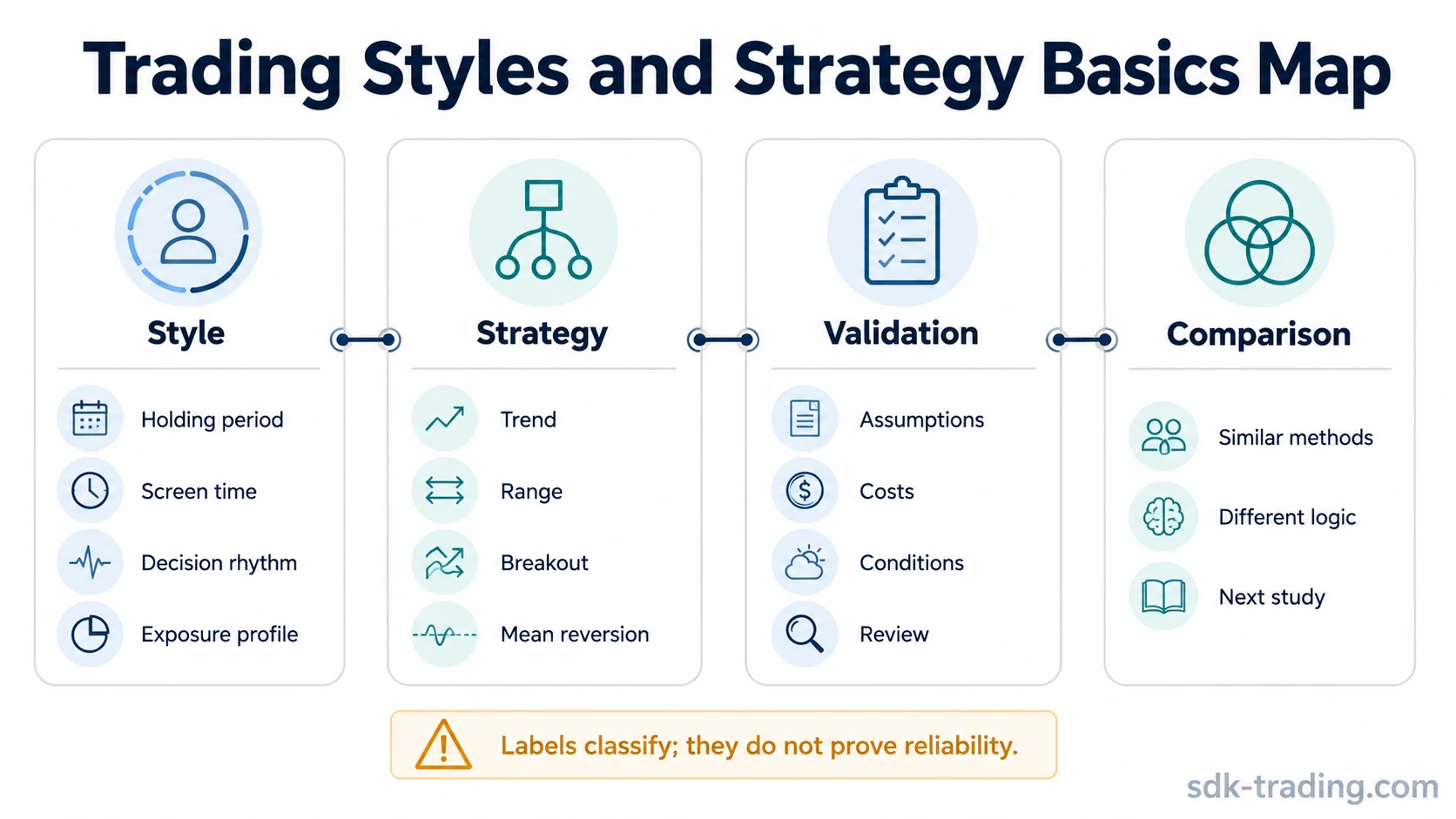
Trading Style, Method, Strategy, and Validation
These terms can appear together in one trading process, but they answer different questions.
| Layer | Main question | What it defines | Example |
|---|---|---|---|
| Trading style | How long and how actively is the market followed? | Holding period, decision frequency, screen time, and exposure profile. | Swing trading or day trading. |
| Analytical method | How is market information organized? | The evidence used to interpret market conditions. | Price action or indicator-based analysis. |
| Trading strategy | What conditions lead to a defined decision? | Rules, setup conditions, confirmation, invalidation, and execution logic. | Trend-following or mean-reversion rules. |
| Validation | Do those rules behave as expected across different conditions? | Testing, review, assumptions, failure conditions, and execution constraints. | Backtesting and post-trade review. |
For the narrower definition of the rules layer, start with what a trading strategy means.
Trading Styles Classify Participation
Trading styles are commonly separated by how long positions remain open and how frequently decisions are made. The style changes the practical environment in which a strategy has to operate.
| Style | Typical participation profile | What changes with the style |
|---|---|---|
| Scalping | Very short holding periods with frequent decisions. | Execution speed, spread sensitivity, transaction frequency, and continuous attention become more important. |
| Day trading | Positions are normally opened and closed within the same trading session. | Intraday timing, session conditions, and frequent monitoring have greater influence. A day trading strategy still needs its own decision rules. |
| Swing trading | Positions usually remain open across multiple sessions. | The process accepts overnight movement and uses a slower decision rhythm. A swing trading approach can use several different strategy families. |
| Position trading | Positions are held over longer market movements with fewer decision points. | Broader structure and longer exposure windows become more important. A position trading strategy still requires defined rules and risk controls. |
For the holding-period classification itself, see types of trading styles.
Analytical Method Is Separate From Trading Style
A holding period does not determine how the chart or market is analyzed. Two swing traders can operate on similar time horizons while using very different evidence.
| Analytical approach | Primary input | What it changes |
|---|---|---|
| Price action | Price structure, swings, levels, candles, ranges, and related chart behavior. | Market conditions are interpreted directly from visible price relationships. |
| Indicator-based analysis | Calculated measures derived from price, volume, or both. | Trend, momentum, volatility, or other conditions are summarized through formulas. |
The distinction is explored directly in price action vs indicator strategies.
The analytical method can then feed into different strategy logic. For example, both price-based and indicator-based frameworks can be used inside trend-following vs mean reversion approaches.
Strategy Logic Defines the Decision Rules
A strategy goes beyond the label attached to the trading style or analytical method. It needs conditions that can be identified before a decision is made and reviewed afterward.
| Strategy component | Question it should answer |
|---|---|
| Market condition | What environment must exist before the strategy becomes relevant? |
| Setup condition | What observable event makes the situation actionable under the method? |
| Confirmation | What additional evidence is required before the decision is accepted? |
| Invalidation | What observation shows that the original logic no longer applies? |
| Execution rule | How is the planned decision translated into an actual order? |
| Review rule | How will the outcome be evaluated against the original conditions? |
Classification boundary: a style can exist without defining a strategy, and an analytical method can provide evidence without defining what action should follow. The strategy is the layer that turns conditions into repeatable decision rules.
Validation Comes After the Rules Are Defined
Testing cannot repair a strategy whose conditions are still vague. The first requirement is a process specific enough that the same observation can be classified consistently across multiple examples.
Validation then asks whether those rules remain coherent when volatility, liquidity, transaction costs, execution quality, or market structure changes. Historical testing can expose weaknesses, but it cannot establish future certainty.
When the issue is why apparently reasonable methods stop working or are misapplied, use why trading strategies fail as the next route.
Choose the Next Topic by the Question You Need to Solve
| If the question is… | You are dealing with… | Focus on… |
|---|---|---|
| How long should positions normally remain open? | Trading style | Holding period, decision frequency, screen time, and exposure profile. |
| Should market information be read from raw price or calculated tools? | Analytical method | The evidence used to interpret conditions. |
| What exactly must happen before a decision is made? | Trading strategy | Conditions, confirmation, invalidation, and execution rules. |
| Why does a method behave differently across market environments? | Validation | Testing, assumptions, costs, execution, and failure conditions. |
Keeping these questions separate prevents a holding-period label from being mistaken for a complete strategy and prevents an analytical tool from being mistaken for a complete decision process.