Trend following vs mean reversion compares two different ways to interpret market behavior. Trend following reads directional persistence after price continues to hold structure in one direction. Mean reversion reads stretched movement away from a reference area and asks whether price is rotating back toward balance.
Both readings can describe the same market at different moments. The important distinction is not which one is better, but what kind of market behavior each one is trying to read. A persistence framework studies continuation, acceptance, and directional follow-through. A reversion interpretation studies deviation, failed extension, and movement back toward a prior area of balance.
Neither reading is a standalone trade signal. Each one needs context: structure, timeframe, volatility, reference areas, and the conditions that would weaken the interpretation.
Key Points
- Trend following studies whether price movement is persisting in one direction.
- Mean reversion studies whether price has stretched away from a reference area and may be rotating back toward balance.
- The same market move can look trend-following on one timeframe and mean-reverting on another.
- Indicators can support a condition check, but they do not decide the comparison alone.
- The comparison becomes clearer when structure, regime, timeframe, and failure conditions are separated.
Trend Following vs Mean Reversion: The Core Difference
Trend following is built around persistence. The approach assumes that once price has started moving with directional acceptance, later behavior may continue to reflect that same imbalance. The focus is on whether the market keeps holding structure, extending through prior areas, and maintaining directional pressure.
Mean reversion is built around stretch and rotation. The logic assumes that price can move too far away from a reference area, such as a prior range, average, value area, or balance zone. The focus is on whether the extension is being accepted or whether price is returning toward a more familiar area.
Simple distinction: trend following asks whether movement is continuing; mean reversion asks whether movement has become stretched relative to a reference point.
The confusion appears because both readings often begin with the same observation: price has moved away from where it was. The difference is what happens next. Continued acceptance supports the persistence reading. Failed acceptance and rotation back toward the reference area support the reversion reading.
Comparison Table: Trend Following and Mean Reversion
| Comparison point | Trend following | Mean reversion |
|---|---|---|
| Underlying assumption | Directional movement can persist when structure keeps accepting the move. | Extended movement can rotate back when price fails to hold away from a reference area. |
| Market structure read | Higher or lower structure remains intact and continuation behavior stays visible. | Price stretches away from balance, then loses acceptance and begins rotating. |
| Typical condition fit | Directional expansion, broad participation, volatility expansion, or sustained trend strength. | Range behavior, rotation, compressed movement, temporary overextension, or failed directional expansion. |
| Useful evidence | Acceptance beyond prior areas, sustained directional structure, and repeated failure to rotate deeply. | Failed extension, loss of momentum away from the reference area, and return toward prior balance. |
| Common tools | Trend-strength and structure tools, such as moving averages, channels, or ADX-style readings. | Deviation and stretch tools, such as oscillators, bands, or distance from a moving reference. |
| Timeframe sensitivity | A move can look persistent on a higher timeframe even if lower intervals rotate inside it. | A move can look stretched on a lower timeframe even if the broader structure still trends. |
| Main failure mode | Choppy or rotational markets can create false continuation readings. | Durable expansion can keep moving away from the reference area longer than expected. |
| What weakens the interpretation | Loss of structure, failed continuation, repeated return into the prior range, or volatility compression. | Strong acceptance away from the reference area, expanding participation, or persistent directional structure. |
| Interpretation boundary | Read persistence only while structure continues to support directional acceptance. | Read reversion only while the market shows failed acceptance away from the reference area. |
Same Market Move, Different Reading
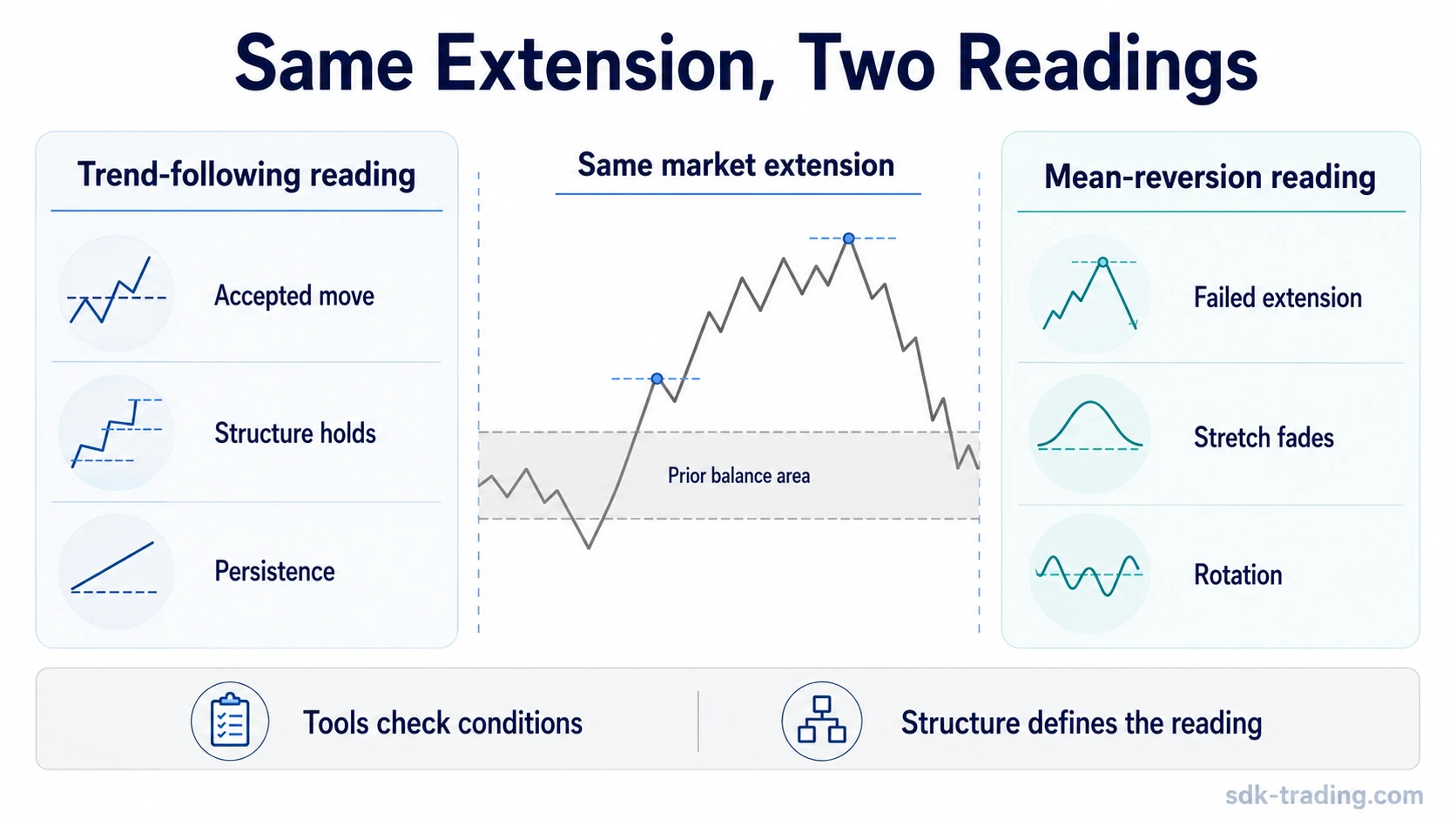
Imagine price extends away from a prior range. A trend-following reading studies whether the market is accepting the move beyond that range. If structure keeps holding in the direction of the extension and pullbacks remain shallow relative to the broader move, the interpretation leans toward persistence.
A mean-reversion reading studies the same extension differently. If price pushes away from the range but cannot hold there, and later movement begins rotating back toward the old reference area, the interpretation shifts toward stretch and failed acceptance.
Same scenario: price moves away from a prior balance area.
Trend-following reading: the move is treated as persistence only if acceptance and directional structure remain visible.
Mean-reversion reading: the move is treated as stretch only if price fails to hold away from the reference area and starts rotating back.
The market did not change labels automatically. The interpretation changed because the later behavior either confirmed continued acceptance or showed a return toward balance.
When Market Conditions Change the Interpretation
Market condition is the main boundary between the two approaches. Trend following needs enough directional expansion for persistence to matter. Mean reversion needs enough rotational behavior for stretch and return-to-balance logic to remain relevant.
In a directional environment, price may continue moving away from old reference areas because new information, participation, or positioning keeps reinforcing the move. In that setting, calling every extension “stretched” can miss the fact that the market is accepting a new area.
In a rotational environment, price may repeatedly leave and return to the same broad zone. In that setting, calling every push a trend can overread movement that is still trapped inside a range or balance structure.
| Market condition | Trend-following interpretation | Mean-reversion interpretation |
|---|---|---|
| Directional expansion | Persistence may be the cleaner reading if structure continues to accept the move. | Reversion reading weakens if price keeps holding away from the reference area. |
| Range or rotation | Continuation readings become less reliable when movement repeatedly returns into balance. | Reversion logic becomes clearer when extensions keep failing away from the range. |
| Transition phase | A trend reading remains conditional until acceptance becomes durable. | A reversion reading remains conditional until failed extension becomes visible. |
Why Timeframe Can Change the Answer
Timeframe can change the answer because each interval creates its own reference area. A higher timeframe may show directional persistence while a lower timeframe shows short-term stretch, pullback, and rotation inside the broader move.
The reverse can also happen: a lower interval may show a clean directional leg while a higher interval still treats it as movement inside a broader range.
This is why holding period should be tied to the structure being evaluated. A trader studying swing trading conditions may interpret a multi-session move differently from someone studying only short intraday rotations.
The practical boundary is alignment. Trend-following logic becomes cleaner when the studied timeframe and the broader structure point toward persistence. Mean-reversion logic becomes cleaner when the studied timeframe shows stretch against a clear reference area and the broader context does not keep accepting the extension.
Timeframe note: one trader’s trend can be another trader’s stretch. The difference comes from the reference area, the interval being studied, and whether the market is accepting or rejecting the move.
Tools as Condition Checks, Not Signals
Indicators and tools can describe conditions, but they should not replace structure. A trend-following reading may use an ADX trend-strength reading to describe whether directional strength is expanding or fading.
A mean-reversion reading may use an RSI oscillator reading to describe stretch, momentum change, or a possible loss of directional pressure.
The tool is secondary because the same indicator value can mean different things in different structures. A strong trend can keep an oscillator elevated or depressed for longer than a range trader expects. A choppy market can make a trend-strength reading rise and fall without producing durable directional structure.
Tool limitation: RSI, ADX, bands, averages, and channels are condition checks. The safer comparison still depends on structure, reference areas, timeframe, and what would weaken the reading.
Where Each Lens Can Fail
Trend-following interpretation weakens when the market cannot maintain directional structure. Repeated returns into the prior range, failed continuation, overlapping movement, and compressed volatility can turn an apparent trend into a rotational environment.
Mean-reversion interpretation weakens when price keeps accepting new territory. A move can look stretched early and still continue if participation, structure, and volatility support directional expansion. Treating every extension as temporary can become misleading when the market is repricing into a new area.
| Lens | Common failure condition | What to check instead |
|---|---|---|
| Trend following | The market chops, overlaps, or repeatedly returns into the prior range. | Check whether directional acceptance is still present or only assumed. |
| Mean reversion | The market keeps accepting distance from the reference area. | Check whether the extension is failing or becoming the new accepted structure. |
| Both | The timeframe or reference area is undefined. | Check timeframe, volatility, reference area, and failure conditions before assigning the label. |
Can Both Lenses Coexist?
Trend following and mean reversion can coexist because they describe different layers of market behavior. A higher timeframe can remain persistent while a lower timeframe repeatedly rotates around shorter-term reference areas. A lower timeframe can also trend inside a larger range that has not yet broken into broader expansion.
Coexistence does not mean combining both labels for a stronger conclusion. It means separating the level of analysis. The persistence reading belongs to the structure where acceptance is visible. The reversion reading belongs to the structure where stretch and rotation are visible.
Breakout logic can sit near this boundary because a break from a range may become part of a persistence reading if acceptance follows. Without acceptance, the same move can remain only a failed extension back into balance.
Decision boundary: trend following studies accepted continuation; mean reversion studies failed extension and rotation toward a reference area.
When Each Lens Fits the Structure
The useful question is which reading fits the structure being studied.
Trend-following logic fits better when the market keeps accepting directional movement, the studied timeframe aligns with that movement, and evidence of persistence remains visible. Mean-reversion logic fits better when movement away from a reference area fails, rotation returns, and the broader context does not keep validating the extension.
When the evidence is mixed, the label should remain conditional. A market can be transitioning from range to trend, from trend to range, or from one reference area to another. The interpretation becomes weaker when the market no longer behaves like the approach assumes.
FAQ
Can trend following and mean reversion both apply to the same market?
Yes. They can apply to different timeframes or reference areas. A broader move may show directional persistence while a smaller interval shows repeated stretch and rotation inside that move.
Why does timeframe change trend following vs mean reversion?
Timeframe changes the reference area. A move that looks like a trend on one interval may look like a temporary stretch on another. The comparison is clearer when the timeframe, structure, and reference area are defined first.
Are RSI or ADX enough to decide between trend following and mean reversion?
No. RSI and ADX can describe conditions, but structure still matters. An oscillator can remain stretched during a strong trend, and a trend-strength reading can be unreliable in choppy movement.