Technical analysis studies market-generated data, especially price and volume, through charts, market structure, patterns, and indicators. The field includes direct observation of price behavior, mathematical transformations of market data, and principles for deciding what those observations can support.
Definition: Technical analysis is a method of examining price, volume, and related market data to describe trend, momentum, volatility, support and resistance, chart structure, and recurring price behavior.
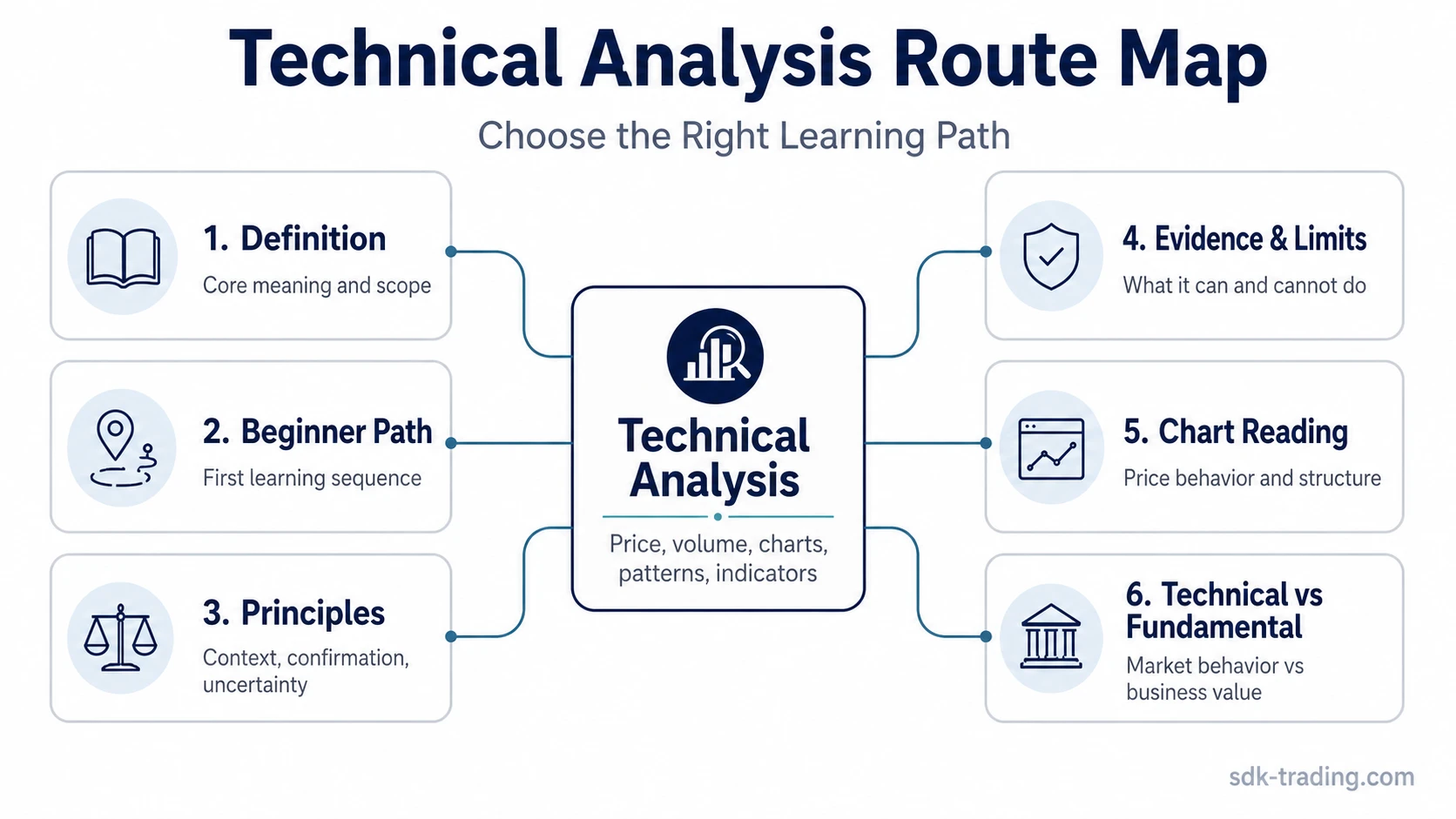
What Technical Analysis Uses
Technical analysis contains several analytical layers. They can appear on the same chart, but they do different jobs. Raw market data provides the inputs. Charts organize those inputs through time. Structural methods classify visible price behavior. Indicators transform data mathematically.
| Layer | Main input or structure | What it organizes |
|---|---|---|
| Market data | Price, volume, and time | The underlying observations used by technical methods |
| Chart representation | Candles, bars, lines, gaps, and plotted volume | The sequence of market data across time |
| Price structure | Swings, trends, ranges, support, resistance, and break behavior | How price is organized spatially on the chart |
| Patterns | Candle relationships or repeated multi-swing geometry | Named configurations within the price sequence |
| Indicators | Mathematical transformations of price, volume, or both | Trend, momentum, volatility, volume, and related measurements |
| Method principles | Assumptions, evidence, limitations, and interpretation rules | How technical observations should be evaluated |
Where to Start With Technical Analysis
The appropriate starting point depends on the part of the method that needs clarification. The pages below separate definition, learning sequence, principles, evidence, chart reading, and comparison into distinct jobs.
| Topic | Section | Primary focus |
|---|---|---|
| The meaning and scope of the method | What is technical analysis | Definition, purpose, core inputs, and the boundary of the concept |
| A first study sequence | Technical analysis for beginners | A structured introduction for readers learning the field from the beginning |
| The assumptions behind technical analysis | Core principles of technical analysis | The ideas that underpin price-based and chart-based interpretation |
| Evidence, usefulness, and limitations | Does technical analysis work | What technical evidence can support and where the method has limitations |
| Reading information directly from a chart | How to read stock charts | Price axes, time, chart structure, movement, and visual interpretation |
| Market behavior compared with business analysis | Technical analysis vs fundamental analysis | The difference between market-generated evidence and company or valuation analysis |
Chart Structure, Patterns, and Indicators Are Different Layers
A chart can be examined without applying an indicator. Swing highs, swing lows, ranges, gaps, support areas, and trend boundaries come directly from the visible price sequence. Candlestick and chart-pattern classifications organize particular arrangements inside that sequence.
Indicators add another layer by transforming market data through a formula. A moving average smooths a price series. A momentum oscillator compares price behavior across a lookback. A volatility indicator measures some property of price dispersion or range. These outputs are derived from market data rather than separate observations of the market.
This distinction explains why different technical tools can describe the same period differently without necessarily contradicting one another. Direct price structure may begin changing before a slower mathematical indicator responds because the two methods process the same market through different mechanisms.
From Raw Data to Technical Interpretation
A useful way to organize technical analysis is to separate the observation from the method applied to it. Price and volume are the source data. A chart arranges that data through time. Structure and patterns classify visible relationships. Indicators calculate additional measurements from the same underlying sequence.
| Stage | Question being answered |
|---|---|
| Observe | What did price and volume actually do? |
| Organize | Is price trending, ranging, compressing, expanding, or testing a visible area? |
| Measure | What does the selected mathematical tool calculate from the available data? |
| Classify | Does the sequence meet the requirements of a specific structure or pattern? |
| Evaluate | What does that observation support, and what remains unresolved? |
Keeping these stages separate reduces a common source of confusion. A calculated indicator value, a named pattern, and an observed price level may all be useful, but they are not the same kind of evidence.
Technical Analysis Has a Defined Boundary
Technical analysis works with market-generated behavior. It can describe price structure, quantify selected properties of price or volume, and compare current conditions with previous market behavior. It does not determine a company’s intrinsic value, earnings quality, balance-sheet strength, or future cash flows.
It also does not make a calculated level, indicator reading, or chart pattern deterministic. Those tools organize information from the market. The separate question of how useful that information is belongs to the evidence, limitations, and method-specific pages within this section.