Technical analysis for beginners becomes useful when chart evidence is treated as probability-based context, not as proof of what price must do next.
A beginner should first learn how price, volume, trend, levels, patterns, and indicators create a conditional reading. Technical analysis can describe what buyers and sellers have already shown on a chart, but it cannot guarantee the next move. A level, trendline, candlestick pattern, RSI reading, or moving average reaction is evidence to evaluate with context, not an instruction by itself.
Beginner framing: Technical analysis starts as chart interpretation. The first task is to separate observation from conclusion: what the chart shows, what it may imply, what would weaken the reading, and what remains unknown.
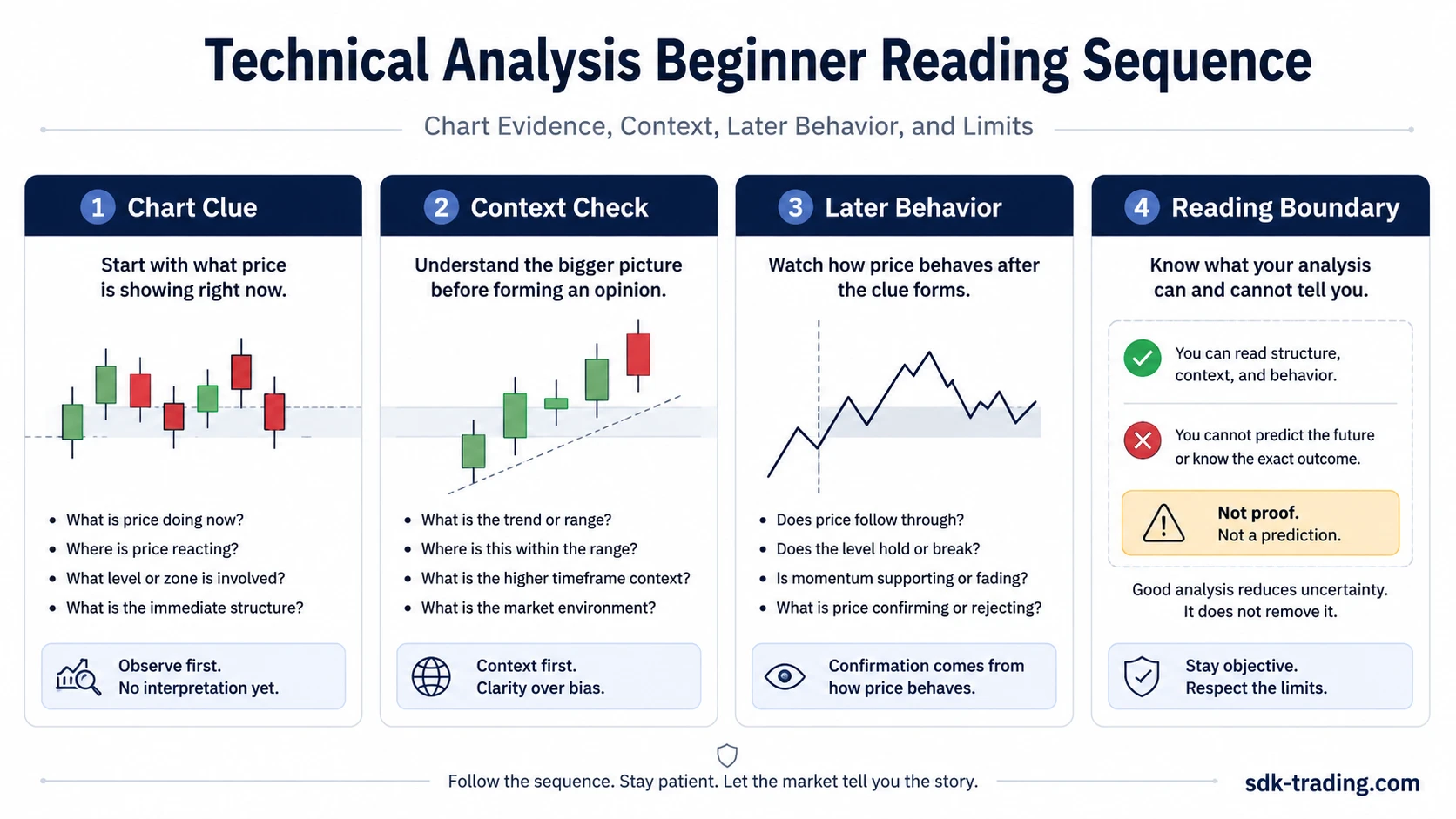
What Beginners Should Learn First
Beginners should start with the structure of price movement before studying complex tools. The chart shows where price has moved, where it has paused, where participation changed, and where buyers or sellers previously reacted.
What is technical analysis explains the broader method. The beginner path starts with a narrower skill: identifying the market condition before adding indicators, patterns, or named signals.
| Beginner focus | What to observe | How it helps probability | What not to assume |
|---|---|---|---|
| Price direction | Whether price is rising, falling, ranging, or changing character. | If price is rising in an orderly way, that can support a bullish reading until the structure changes. | That direction alone proves the next move. |
| Trend behavior | Whether swings are forming higher highs, higher lows, lower lows, or sideways structure. | Higher highs and higher lows can make trend continuation more defensible while that structure remains intact. | That every trend continuation attempt must continue. |
| Support and resistance | Where price has reacted, paused, rejected, accepted, broken, or retested before. | A breakout, retest, and acceptance above a former resistance area can add weight to a bullish scenario. | That a level must hold because it mattered earlier. |
| Volume | Whether participation expands, fades, or fails to confirm the price move. | A breakout on stronger volume can add weight to the move. A correction with fading volume can suggest that pressure is weakening. | That high volume always confirms a clean conclusion. |
| Indicators | Whether a tool supports, conflicts with, or lags the chart reading. | An RSI reading or moving average reaction can add context when it agrees with price structure. | That an indicator reading replaces context. |
| Patterns | Whether a visible structure appears at a meaningful location. | A pattern can add weight when it appears in the right location and later price behavior supports it. | That a named pattern is enough by itself. |
Probability note: Trading is a probability game. Technical analysis does not make the future certain. It can only add small pieces of evidence that may improve the quality of the reading when several independent chart layers point in the same direction.
The First Mistake to Avoid
The first mistake is jumping from a chart clue to a final conclusion. A beginner may see a bearish candle, an RSI extreme, a breakout, or a chart pattern and immediately assume that the next move is obvious. The safer reading is narrower: the chart has shown one clue, but the broader structure still has to be checked.
A clear example is Microsoft on the weekly chart during the 2020 to 2021 advance. Several bearish weekly candles appeared while price was still moving inside a broader rising structure. A beginner looking only at the candle could have assumed that the trend was ending. But the larger structure continued to hold, and price kept moving higher.
The later warning near the mature high was different. The bearish candle was no longer just a red candle inside a healthy advance. It appeared after a long move, near the upper area of the structure, and was followed by a more meaningful correction. The candle did not predict the correction by itself. It became more useful because the broader context gave it more weight.
| Chart clue | Beginner shortcut | Better reading |
|---|---|---|
| Bearish weekly candle inside the rising structure | The trend is ending. | The candle is only a warning while the broader structure still holds. |
| Several red candles during the advance | Repeated red candles must mean reversal. | Repeated selling pressure can still be absorbed if price structure remains intact. |
| Bearish candle near the mature high | The candle caused the correction. | The warning gained weight because location, maturity, and later price behavior supported caution. |
| Correction after the high | The candle predicted the move. | The correction was a probability-based scenario, not a guaranteed outcome from one candle. |
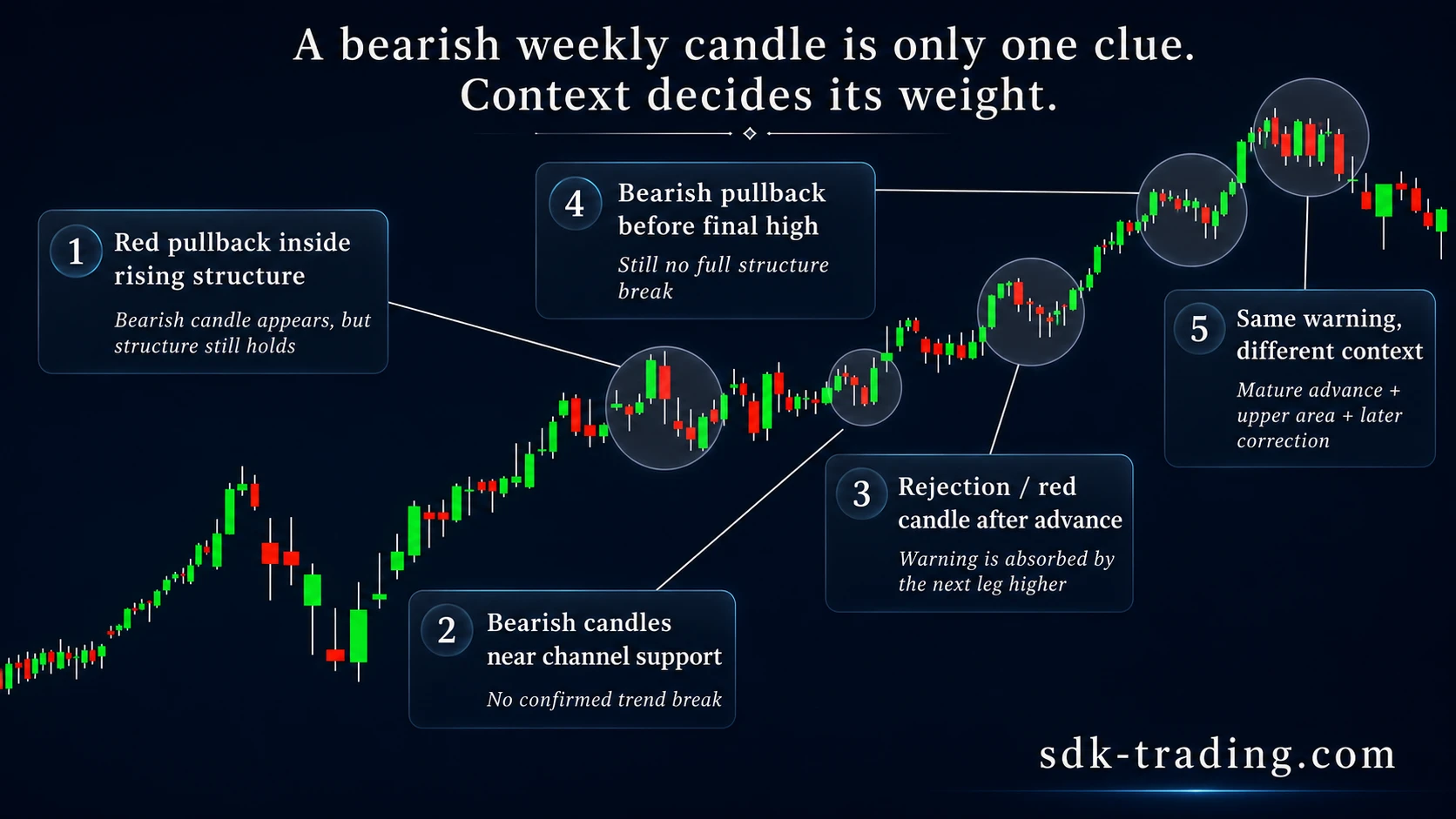
This distinction prevents the common beginner error of treating every pattern, wick, level, or indicator reading as a standalone conclusion. A bearish candle is only one clue. Context decides how much weight that clue deserves.
A Simple Technical Analysis Learning Sequence
A beginner does not need to learn every chart tool at once. The cleaner path is to move from basic observation to context, then to confirmation and limitation. That sequence keeps the learning process focused on interpretation rather than prediction.
| Step | Learning focus | Safer beginner question |
|---|---|---|
| 1 | Read the chart condition | Is price trending, ranging, compressing, or changing behavior? |
| 2 | Mark important areas | Where has price reacted, paused, accepted, or rejected before? |
| 3 | Check participation | Does volume support the move, conflict with it, or add no useful clarity? |
| 4 | Use indicators carefully | Does the indicator add context, or is it repeating what price already shows? |
| 5 | Review pattern location | Does the pattern appear in a place where its meaning is actually relevant? |
| 6 | Define the limitation | What would make the current reading weaker, unclear, or invalid? |
Learning rule: Start with what the chart shows, then ask what would confirm, weaken, or reclassify the reading. That keeps technical analysis educational and conditional instead of turning it into a shortcut for certainty.
Author Note: A Practical Beginner Tool Stack
In my own chart process, I usually start with the state of the chart, not with a long list of indicators. A beginner can keep the tool stack simple and still build a useful reading process.
| Layer | What I usually check | Why it matters | Beginner limit |
|---|---|---|---|
| Chart state | Channel behavior, trend structure, range behavior, and changes of character. | A price channel gives a simple framework for judging whether price is still behaving inside the same structure. | A channel can break, widen, or lose relevance. It is a map, not a guarantee. |
| Important zones | Volume-profile clusters using tools such as Fixed Range Volume Profile. | Volume Profile can show areas where heavy participation previously occurred, which makes them useful planning zones. | A cluster is not a prediction. Price can accept, reject, ignore, or rotate around it. |
| Volume | Volume expansion on breakouts and volume contraction during corrections. | Volume helps test whether participation is expanding with the move or fading during the reaction. | Volume supports context, but it does not confirm direction by itself. |
| Indicators | Moving averages first, RSI last. | Moving averages can help organize trend and mean-reversion context. RSI can help identify momentum stretch when it is used carefully. | Using many indicators often creates noise. RSI is better treated as a momentum-stretch tool, not as a reversal signal by itself. |
| Chart patterns | Mainly Head and Shoulders and Cup and Handle. | These patterns can be useful when their structure is clear and they appear in the right location. | A pattern label is weaker than structure, location, and confirmation. |
| Strongest context layers | Elliott Wave structure together with volume-profile clusters. | For my process, these are among the most useful layers for mapping scenarios and important areas. | This is still scenario work. Even a strong structure can fail or develop into an alternative path. |
Author limitation: This is a practical workflow, not a universal rule. The goal is not to collect more tools. The goal is to decide whether each tool adds a small, useful piece of probability to the chart reading.
How Charts, Trends, Levels, and Indicators Fit Together
Charts provide the visual record. Trends organize direction. Support and resistance mark areas where price behavior changed before. Candlestick patterns and chart patterns describe smaller structures inside that record. Indicators can help summarize momentum, participation, volatility, or relative movement, but they do not replace the chart context.
A safer approach avoids ranking these tools as if one tool always controls the answer. A trend can be visible while momentum weakens. A level can matter until price accepts beyond it. A pattern can look clean but appear in the wrong location. An indicator can support the reading or add noise.
| Tool | Useful beginner role | Main limitation |
|---|---|---|
| Chart | Shows the record of price behavior over time. | The chart still needs interpretation; the shape alone is not proof. |
| Trend | Helps organize direction and swing structure. | Trends can slow, fail, or change character. |
| Support and resistance | Highlights prior reaction areas. | Prior reaction does not guarantee future reaction. |
| Candlestick patterns | Show pressure, hesitation, rejection, or continuation attempts. | A candle pattern is weaker without trend, location, and later behavior. |
| Chart patterns | Describe broader visible structures such as ranges, compression, Head and Shoulders, or Cup and Handle. | A pattern label can change if later price behavior fails to support it. |
| Indicators | Summarize selected data such as momentum, volume, or volatility. | Indicators can lag, conflict, or duplicate information already visible in price. |
What Technical Analysis Cannot Prove
Technical analysis cannot prove that a future price move will happen. It cannot remove risk, replace position planning, or turn a chart pattern into certainty. It can organize evidence, show where a reading is becoming stronger or weaker, and help a learner avoid treating every market move as random.
This is especially important with indicators. For example, RSI overbought does not automatically mean price must fall. In a strong trend, price can stay overbought for one month, two months, or even longer while continuing higher. The RSI reading is useful only as context. It does not replace the trend, structure, participation, or later behavior.
Boundary: A chart reading becomes safer when it stays conditional. The question is not “what does this guarantee?” The better question is “what does the current evidence suggest, what would support that reading, and what would make it unreliable?”
A beginner should also separate technical analysis from fundamental analysis. Technical work studies market behavior through price, volume, trend, levels, and related tools. Fundamental work studies business value, earnings, balance sheets, and economic drivers. The two approaches can inform different questions, but this beginner sequence should not become a full comparison.
Next Step: Combine the Beginner Tools Into One Process
Once the basic concepts are understood separately, the next step is to apply them in a consistent order. A complete chart reading should begin with the higher timeframe, move through structure and location, evaluate the visible signal, and then use later price behavior to confirm, weaken, or reclassify the interpretation.
This prevents a beginner from starting with one candlestick pattern, indicator reading, breakout, or chart formation and then searching the rest of the chart for evidence that supports the first conclusion.
The complete stock chart reading guide shows how these layers work together on real charts. It includes a full video walkthrough covering trend structure, channels, support and resistance zones, candlesticks, Volume Profile, Elliott Wave, moving averages, RSI, volume, confirmation, and risk.
Use that guide when you are ready to move from learning individual tools to building one repeatable chart-reading process.
FAQ
What should beginners learn first in technical analysis?
Beginners should first learn how to read price behavior, trend, support and resistance, volume, and basic chart context. Indicators and patterns are easier to use safely after the beginner understands that chart clues are evidence, not proof.
Is technical analysis for beginners about predicting price?
No. The safer beginner approach is to use technical analysis as conditional chart interpretation. It can help organize evidence and slightly improve the quality of probability-based reading, but it cannot guarantee a future price move.
Are indicators or chart patterns more important for beginners?
Neither should be treated as a standalone answer. Beginners should first understand price structure and context, then use indicators or patterns only as supporting evidence.