Trading for beginners should start with a learning process rather than a tactic. Before choosing setups or trading live, a new trader needs to understand how price is organized, how risk is controlled, what evidence is being used, how market behavior changes, and which time horizon fits the process.
Definition: Trading for beginners is the process of learning the market, risk, analysis, and decision-making basics needed to build a repeatable trading process before relying on individual setups or live execution.
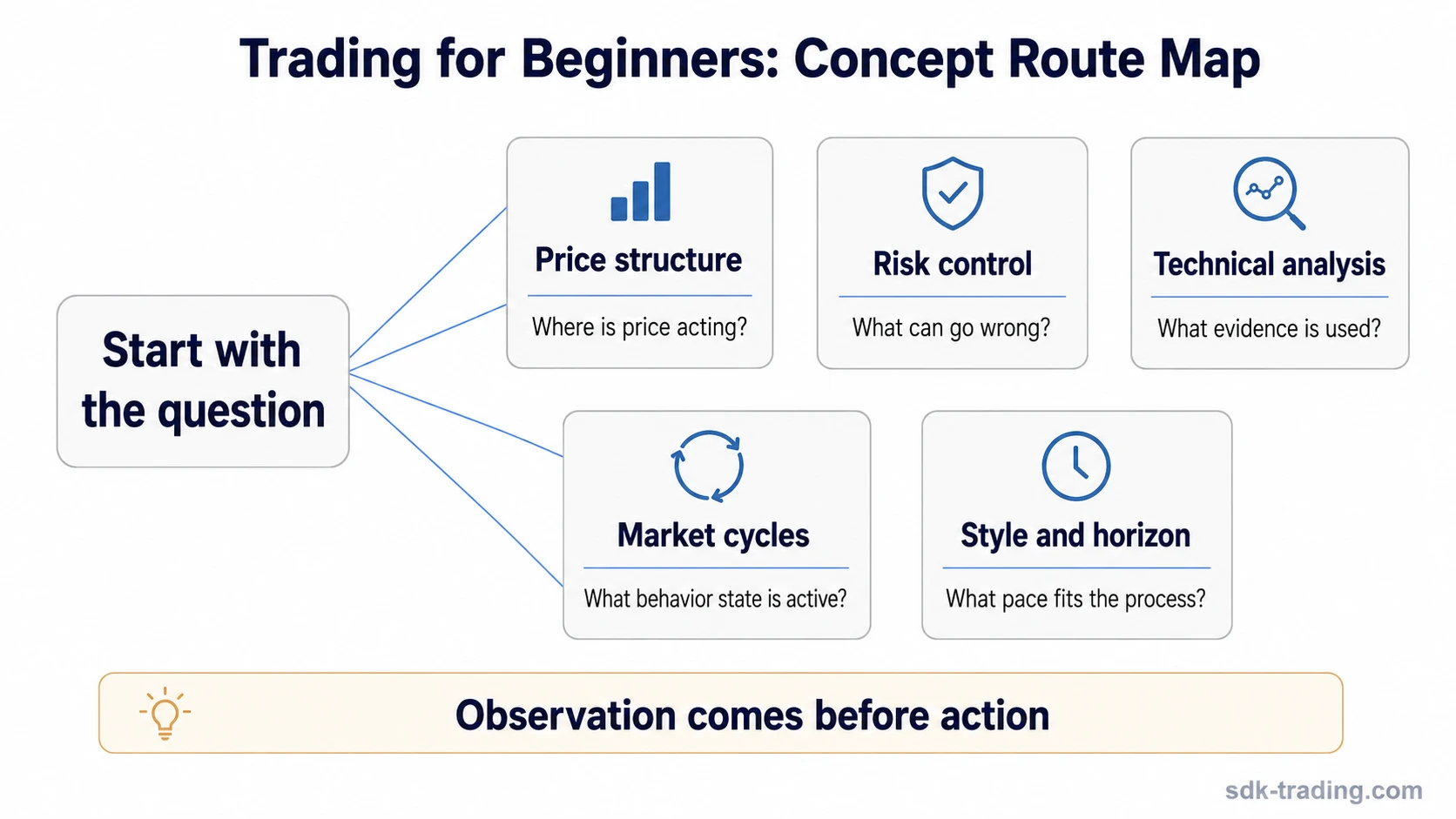
How to Start Learning Trading
A beginner does not need to learn every indicator, pattern, strategy, or market at once. The first goal is to build an order of operations. Each stage answers a different question, and later stages depend on the earlier ones being reasonably clear.
| Learning stage | Question to answer | Why it comes here |
|---|---|---|
| 1. Understand the market | What is being traded, how does price move, and what timeframe is being observed? | The market and timeframe define the environment in which every later decision is made. |
| 2. Read structure | Is price trending, ranging, correcting, expanding, or changing behavior? | A candle or indicator has little meaning if its structural location is unknown. |
| 3. Define risk | What can go wrong, and how much loss or uncertainty can the process tolerate? | A market idea and a risk decision are different problems. |
| 4. Choose evidence | Which chart observations or technical tools answer the current question? | Tools should solve a defined analytical problem rather than create one. |
| 5. Understand market state | Is the market behaving the same way it did previously, or has the environment changed? | A method that fits one phase may become less useful in another. |
| 6. Choose a trading style | How long will decisions normally be held and how frequently must they be managed? | Time horizon changes the amount of noise, execution pressure, and information that matters. |
| 7. Practise the process | Can the same steps be followed repeatedly before real money is involved? | Practice exposes gaps in the process without requiring every observation to become a live trade. |
Five Concepts Beginners Should Keep Separate
One reason trading feels complicated at first is that several different questions can appear on the same chart. Separating them creates a cleaner learning path.
| Beginner question | Concept | Go deeper |
|---|---|---|
| Where is price inside the larger market structure? | Trend, ranges, swings, and structural location | price structure and market context |
| How should uncertainty and potential loss be controlled? | Risk limits, sizing logic, and decision discipline | risk management process |
| What evidence can be read from price and volume? | Charts, patterns, indicators, and technical evidence | technical analysis framework |
| Why does similar price behavior sometimes produce different outcomes? | Changing market phases and behavior states | market behavior states and cycle context |
| How frequently should decisions be made and positions reviewed? | Holding period, trading style, and decision frequency | holding period and style selection |
What Beginners Should Not Learn First
Some subjects are useful later but make a poor foundation when they are learned before market behavior and risk.
| Early shortcut | What is missing |
|---|---|
| Collecting many indicators | A clear question for each indicator to answer |
| Searching for a perfect setup | An understanding of where the setup sits inside market structure |
| Choosing a trading style because it looks exciting | A realistic holding period and decision rhythm |
| Focusing on platform features | A trading process independent of the software used to execute it |
| Copying market opinions | The assumptions, risk, timeframe, and evidence behind the opinion |
| Trying to predict every move | A process for handling outcomes that differ from the initial interpretation |
Practice Before Live Execution
Practice is most useful when it tests a repeatable process. A beginner can mark structure, write down the reason a price area matters, identify what would make the interpretation weaker, and then compare the original reading with what the market actually did.
Paper trading can also help with order mechanics, chart observation, journaling, and process consistency. It should not be treated as proof that live execution will feel identical. Real positions introduce consequences that a simulated position does not reproduce in the same way.
Example: Price breaks above a trading range. Instead of immediately treating the breakout as a trade, the beginner first identifies the range and the location of the break. Next comes the risk question: what price behavior would show that the breakout did not hold? Technical tools can then be used to examine the move, while the broader market state and intended holding period determine whether the observation fits the chosen process. The breakout is therefore one input inside a sequence rather than the entire decision.
How Trading Style Changes What a Beginner Needs
Trading style changes the speed of the process. Shorter holding periods expose the trader to more frequent decisions and more short-term price movement. Longer holding periods place more emphasis on broader structure and reduce the importance of many small intraday fluctuations.
| Process characteristic | Shorter holding period | Longer holding period |
|---|---|---|
| Decision frequency | Higher | Lower |
| Short-term market noise | More important | Less important |
| Execution timing | More sensitive | Usually less sensitive to very small timing differences |
| Structural focus | More local | More emphasis on broader swings and trends |
| Feedback speed | Faster | Slower |
No holding period removes the need for risk control. A slower style changes the timing of decisions, not the requirement for a defined process.
When a Beginner Is Ready to Move Beyond the Basics
The next stage should be based on process competence rather than the number of trading terms learned. A stronger foundation exists when the beginner can explain the timeframe being used, describe the visible market structure, identify the risk of being wrong, explain why a technical tool is relevant, and keep the same decision process across repeated examples.
The objective at this stage is not certainty. It is to reduce random decision-making by knowing which question comes next.
Beginner Trading Mistakes to Watch For
| Mistake | Why it creates a problem |
|---|---|
| Starting with tactics before learning structure | The setup is interpreted without knowing where it sits on the chart. |
| Learning analysis without learning risk | A technically reasonable idea can still create an unacceptable loss. |
| Changing method after every losing example | The process never receives enough consistent observation to be evaluated. |
| Using paper trading as proof of live readiness | Simulation can test mechanics and process but does not reproduce every live decision pressure. |
| Choosing the fastest style by default | Higher decision frequency can add complexity before the basic process is stable. |
| Adding more tools whenever the chart is unclear | More indicators can increase conflicting information without solving the original question. |