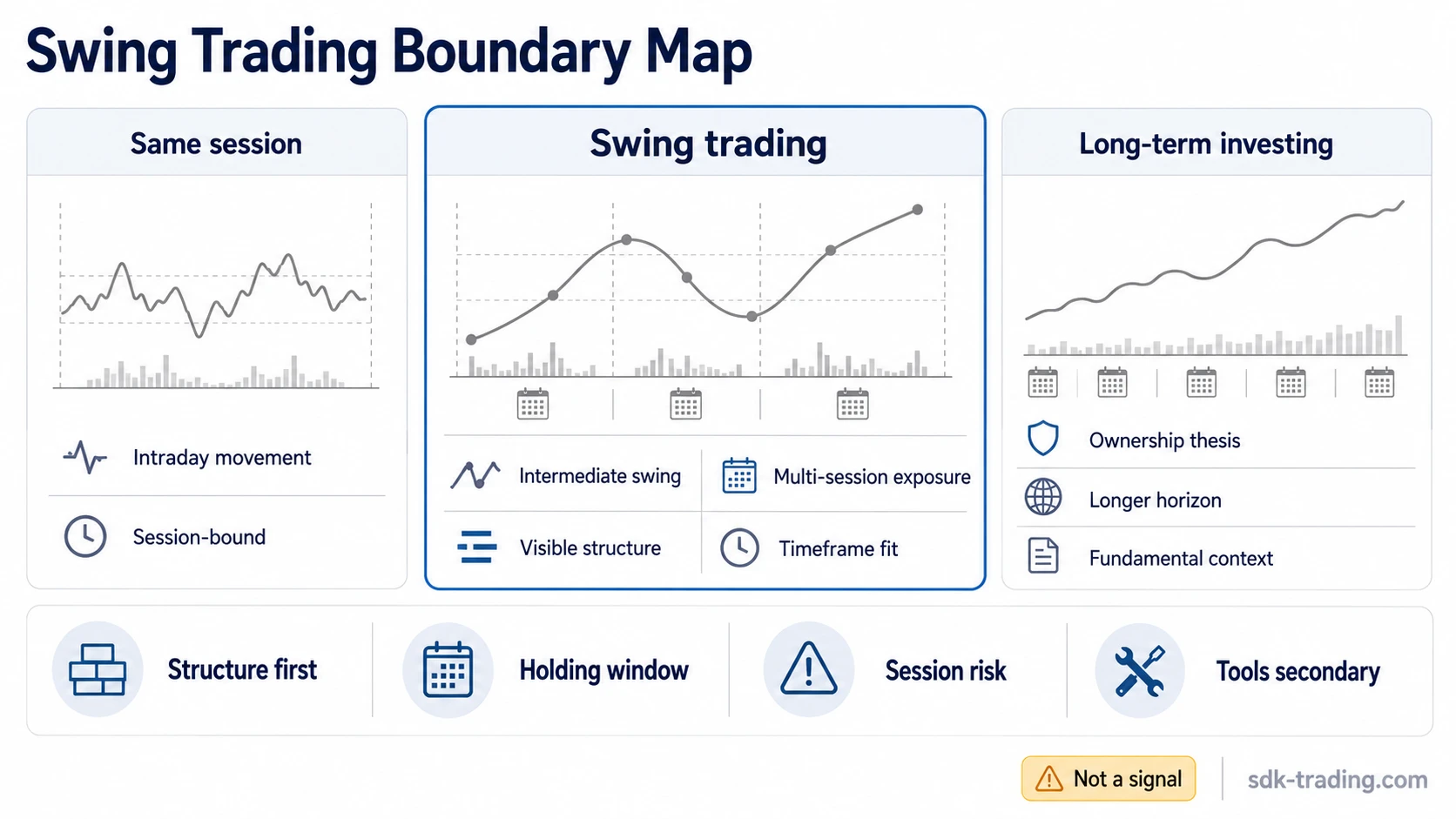
Swing trading is a trading style built around intermediate price movements that usually develop over more than one market session. Positions are commonly held for several days or weeks, placing the style between same-session trading and longer-term position or investment horizons.
Definition: Swing trading focuses on capturing or studying a multi-session price swing rather than movement that begins and ends within one trading session. The defining boundary is the combination of an intermediate price structure, a holding period that extends across sessions, and the additional risk created by remaining exposed between those sessions.
Key Points
- Swing trading usually focuses on price movements lasting several days to several weeks.
- The position may remain open between market sessions, so overnight gaps and changing conditions become part of the risk.
- The style is defined by the holding horizon and the swing being studied, not by one specific indicator or chart pattern.
- Day trading normally ends exposure within the same session, while longer-term trading or investing works with a broader time horizon.
- A swing trading strategy is a separate layer that defines how a trader selects, enters, manages, and exits individual trades.
How Swing Trading Works
Swing trading separates short intraday fluctuations from a larger movement that develops across multiple sessions. The swing may appear as a pullback, recovery, continuation, rotation, or movement between established price areas.
The relevant structure has to remain visible beyond a single candle or isolated reaction. For example, a pullback that develops over several sessions can form an intermediate swing even though lower timeframes contain many smaller movements inside it.
This creates an important distinction between the chart interval and the actual holding horizon. A trader can inspect the same swing on several chart intervals without changing the fact that the underlying idea remains a multi-session position.
Swing Trading Holding Period and Timeframe
Swing trades are commonly held for several days or weeks. There is no single chart interval that automatically defines the style because the same market movement can be displayed differently depending on how price data is grouped.
Lower intervals reveal more internal fluctuations. Higher intervals compress those fluctuations into broader bars or candles. This is why trading timeframes explained matters when evaluating a swing: timeframe and holding period describe different parts of the analysis.
Holding-period boundary: If the position is designed to begin and end inside the same trading session, the idea fits day trading more closely. If the thesis depends primarily on a much longer ownership horizon, the idea has moved beyond the normal swing-trading boundary.
Swing Trading vs Day Trading and Longer-Term Investing
The clearest differences between trading styles appear in the time horizon, the type of price movement being studied, and whether exposure remains open between sessions.
| Feature | Day trading | Swing trading | Longer-term investing or position trading |
|---|---|---|---|
| Typical holding horizon | Same trading session | Several days to several weeks | Weeks, months, or years |
| Primary price focus | Intraday movement | Intermediate price swings | Broader trends or long-term thesis |
| Exposure between sessions | Usually avoided | Common | Expected |
| Importance of overnight gaps | Limited after the position is closed | Directly relevant | Usually absorbed into the longer horizon |
| Main analytical boundary | Session-level movement | Multi-session swing structure | Longer-term trend, business, valuation, or macro thesis |
Market Structure and Swing Trading
An intermediate swing can only be evaluated relative to the surrounding price structure. A move may be part of a larger trend, a pullback inside that trend, a rotation inside a range, or an attempted transition from one condition to another.
Swing highs, swing lows, prior reaction areas, trend direction, volatility, and participation can help describe that environment. Their purpose is to define the movement being studied rather than guarantee where price will move next.
The same visible movement can also carry different weight on different timeframes. A meaningful multi-day pullback on one chart can appear as a minor fluctuation inside a much larger weekly structure.
Tools and Indicators in Swing Trading
Technical tools can help describe conditions around a swing. Moving averages can provide trend context, momentum indicators can show changes in pressure, volatility tools can describe expansion or contraction, and volume measures can add information about participation.
These tools remain secondary to the trading style itself. Using a moving average, RSI, MACD, or another indicator does not make an idea a swing trade. The multi-session holding horizon and intermediate price movement provide the classification first.
Swing Trading and Swing Trading Strategy
Swing trading describes the participation style and time horizon. A strategy defines the rules used to operate inside that style.
A strategy can specify setup conditions, filters, entry logic, invalidation, trade management, and exit rules. That deeper decision process belongs in swing trading strategy rather than in the basic definition of swing trading.
Risks and Limitations of Swing Trading
The main structural difference in swing trading is exposure between sessions. News, earnings, macro events, liquidity changes, or broader market movement can produce an opening gap before the trader has an opportunity to react.
The underlying swing can also change while the position remains open. A continuation can fail, a pullback can deepen, volatility can expand, or a range can replace the directional structure that existed when the swing was first identified.
Holding a position for several sessions therefore does not remove short-term uncertainty. It changes the type of uncertainty being accepted. Trade-level concepts such as risk-reward ratio belong to the risk-management layer rather than to the definition of swing trading itself.
FAQ
What is swing trading?
Swing trading is a trading style focused on intermediate price movements that usually develop over several days or weeks and may require holding positions across multiple market sessions.
How long does a swing trade usually last?
A swing trade commonly lasts from several days to several weeks. The exact duration depends on the market movement being studied rather than a fixed number of sessions.
Is swing trading the same as day trading?
No. Day trading normally begins and ends within the same trading session, while swing trading commonly keeps positions open across multiple sessions.
What is the main risk of swing trading?
A major risk is that conditions can change while the position remains open between sessions. Overnight gaps, volatility changes, liquidity shifts, news, and broader market movement can alter the original swing structure.