A swing trading strategy is a conditional framework for planning intermediate price swings over days or weeks. It connects market context, setup condition, confirmation, risk boundary, position sizing, and invalidation before a trade idea is treated as coherent.
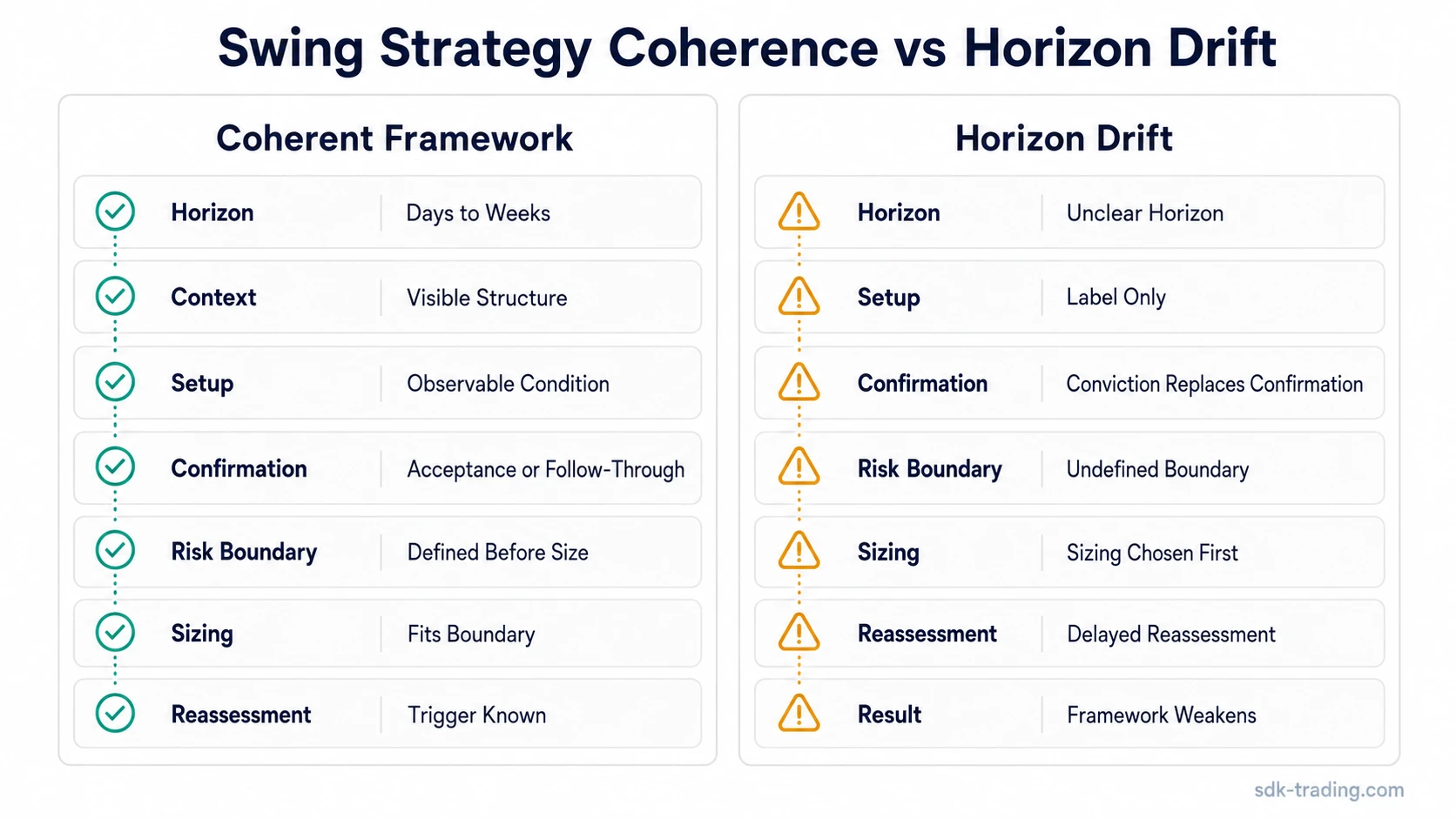
The setup label matters less than whether the idea, holding horizon, risk boundary, and reassessment trigger fit the same plan. Without that fit, a swing setup can become only a loose opinion about direction.
Key Points
- A swing strategy needs a defined holding horizon before setup labels matter.
- Market context and confirmation should come before conviction.
- Indicators can support the framework, but they should not replace invalidation.
- Position size has to fit the risk boundary, not the trader’s preference for the idea.
- A strategy weakens when reassessment is delayed after the original conditions change.
What Is a Swing Trading Strategy?
A swing trading strategy is a structured way to evaluate price movement over an intermediate holding period, usually longer than intraday trading and shorter than position trading. It uses context, setup criteria, confirmation, and risk boundaries to decide whether a multi-day price idea is still coherent.
The broader concept of swing trading defines the trading style. A swing trading strategy defines the process used inside that style. The difference matters because a style describes the time horizon, while a strategy explains how the idea is filtered, constrained, and reassessed.
A swing strategy should not depend on one candle, one indicator crossover, or one chart pattern name. Those inputs may help describe the situation, but the framework becomes stronger only when the surrounding structure, confirmation condition, risk boundary, and invalidation point are visible.
How a Swing Trading Strategy Is Built
A practical swing framework starts with the horizon and the market condition, then moves toward the setup condition, confirmation, risk boundary, position sizing, and reassessment trigger. The sequence matters because a setup label without a risk boundary can look convincing while still being unusable.
| Step | Diagnostic question | Why it matters | What weakens it |
|---|---|---|---|
| Horizon fit | Does the idea fit a days-to-weeks holding period? | The time horizon determines how much noise, gap risk, and reassessment the plan must tolerate. | The idea depends on intraday precision or a long thesis that needs much more time. |
| Market context | Is the market trending, ranging, correcting, or rejecting an area? | The same setup can mean different things in different conditions. | The strategy treats every pattern as identical regardless of broader structure. |
| Setup condition | What observable condition makes the idea worth evaluating? | The setup gives the strategy a testable condition instead of a vague directional view. | The setup is only a label, such as pullback or breakout, without criteria. |
| Confirmation condition | What must happen before the setup is treated as active? | Confirmation separates a possible idea from conviction that has not yet been tested. | The trader assumes the setup is valid before any supporting behavior appears. |
| Risk boundary | Where does the idea stop making sense? | A risk boundary defines the point where the original swing thesis has changed. | The plan has no clear condition that would invalidate the idea. |
| Position sizing | Does the position size fit the distance to the risk boundary? | Size should adapt to the defined risk, not to confidence in the setup label. | Position size is chosen before the risk area is defined. |
| Invalidation / reassessment | What change would require the idea to be reduced, paused, or abandoned? | Swing trades can change over several sessions, so reassessment has to be part of the plan. | The trader keeps the same view after context, confirmation, or risk conditions change. |
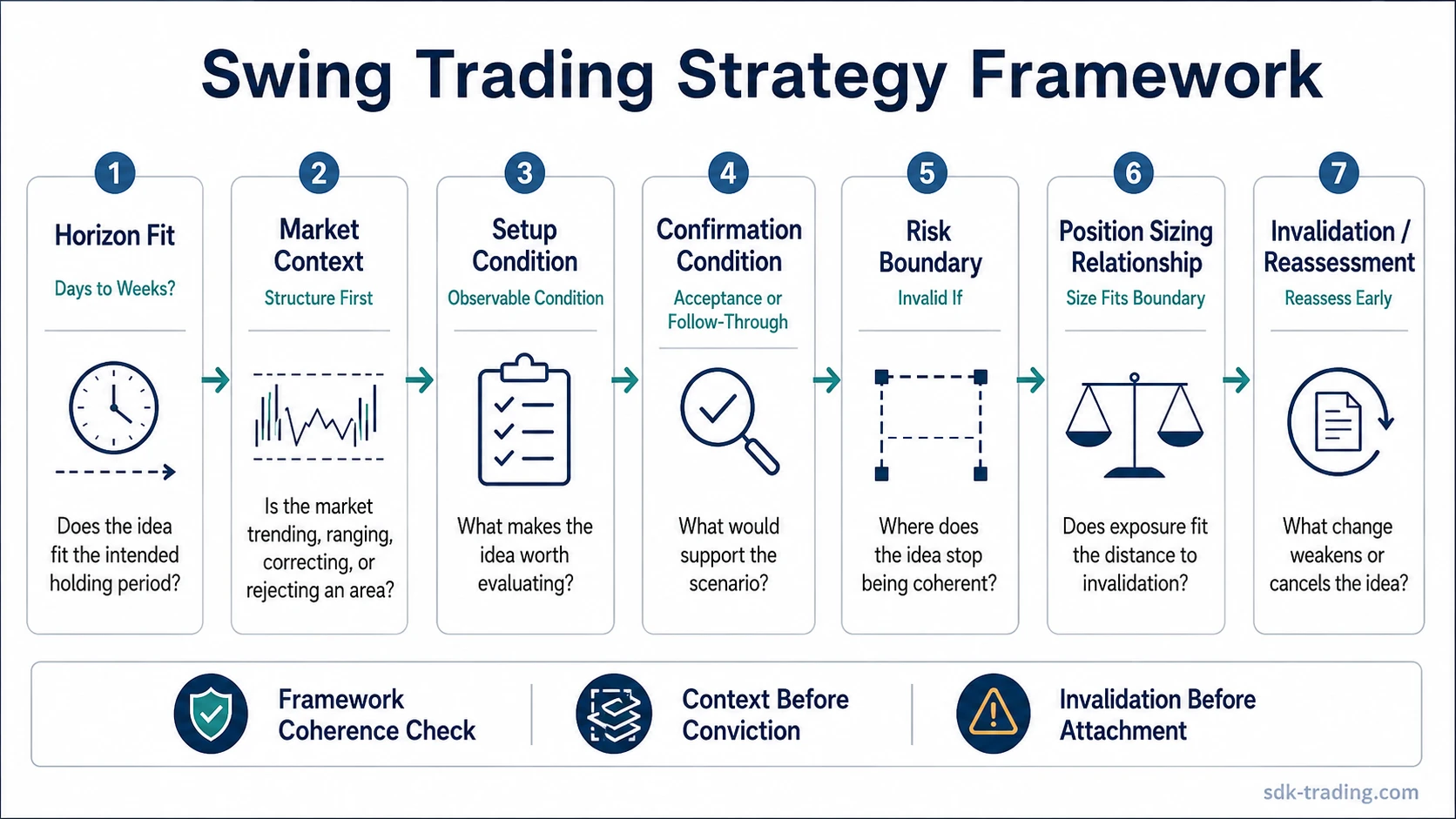
One useful way to test the framework is to ask whether each step still points to the same holding horizon. If the setup needs fast execution, the risk boundary is wide, and the reassessment trigger is vague, the strategy is internally inconsistent.
Common Swing Trading Strategy Types
Swing trading strategies are often grouped by the type of price behavior they try to evaluate. The names are useful only when the underlying conditions are defined clearly.
| Strategy type | Core idea | Useful condition | Main limitation |
|---|---|---|---|
| Trend pullback | Looks for a temporary reaction inside a broader directional move. | The broader trend remains intact while the reaction becomes controlled. | A pullback can become a reversal if structure breaks. |
| Breakout continuation | Evaluates whether price can accept beyond a prior range or reference area. | Acceptance and follow-through appear after the break. | A breakout label alone does not prove acceptance. |
| Mean reversion | Looks for price to move back toward a prior balance or reference area. | The move away from value becomes stretched and loses pressure. | Strong trends can keep extending beyond expected mean-reversion areas. |
| Range rotation | Evaluates movement between visible range boundaries. | The market continues to respect the range instead of accepting outside it. | Range logic fails when price starts accepting beyond the boundary. |
These categories are not complete trading systems by themselves. They only describe the type of swing being evaluated. A complete strategy still needs the same structure: horizon, context, confirmation, risk boundary, sizing, and invalidation.
The Role of Indicators in a Swing Trading Strategy
Indicators can help organize information, but they should not become the entire strategy. A moving average, oscillator, or momentum measure can support a swing framework only when it answers a specific question inside the plan.
For example, an indicator might help identify whether price is extended, whether momentum is slowing, or whether a pullback is still contained. That does not remove the need to read structure, context, and invalidation. The indicator is a supporting filter, not the decision boundary by itself.
The same logic applies to chart patterns and candlestick patterns. They can describe the surface behavior of price, but they become more useful when they appear in a context where the horizon, confirmation condition, and risk boundary are already defined.
Risk, Position Sizing, and Invalidation
Risk control is part of the strategy, not a separate afterthought. A swing trading strategy has to define what would make the idea wrong or no longer worth holding before position size is chosen.
This is where position sizing in trading becomes part of the framework. A wider invalidation area usually requires smaller exposure if the trader wants the same risk boundary. A tighter invalidation area may allow different sizing, but only if the boundary is meaningful and not placed randomly.
The same principle connects to risk management in trading. A swing setup can look clean and still be unsuitable if the distance to invalidation is too large, the expected holding period is too uncertain, or the market context has already changed.
Framework rule: position size should fit the risk boundary. It should not be used to force a weak setup into looking acceptable.
A Diagnostic Swing Strategy Scenario
Consider a market that has been advancing for several sessions and then pauses near a prior reaction area. The pause may look like a pullback opportunity, but the label alone is incomplete.
A swing framework would first check whether the broader context still supports an intermediate move. It would then ask whether the reaction area is being accepted, whether follow-through is still present, whether the risk boundary is visible, and whether position size can fit that boundary without forcing the idea.
A controlled reaction around the area, followed by acceptance back in the direction of the prior move, can support the swing thesis. A fast loss of the same area, weak recovery attempts, or failure to regain prior structure would weaken the thesis.
The framework remains diagnostic rather than predictive. It does not say that the market must continue. It only separates a coherent swing idea from a loose setup label by checking context, confirmation, risk boundary, position sizing, and reassessment in the same sequence.
Swing Trading Strategy vs Day Trading and Position Trading
Swing trading sits between short-horizon day trading and longer-horizon position trading. A day trading strategy usually depends more on intraday execution speed, liquidity, transaction cost, and fast invalidation. A swing trading strategy usually carries the idea across more than one session, so it has to tolerate overnight gaps, changing context, and slower reassessment.
A position trading strategy has a different problem. It often depends on a longer thesis, broader evidence stack, and greater tolerance for drawdown or delayed confirmation. A swing strategy should not borrow that longer horizon unless the evidence and risk plan also change.
The related page on day trading strategy explains the shorter-horizon version of this problem. The related page on position trading strategy explains the longer-horizon version.
Common Mistakes in Swing Trading Strategies
The most common swing strategy mistakes come from mixing time horizons, setup labels, and risk assumptions that do not belong together.
| Mistake | Why it weakens the strategy | Cleaner framework question |
|---|---|---|
| Using a setup label without context | The same pattern can mean different things in a trend, range, correction, or rejection area. | What market condition gives this setup meaning? |
| Treating confirmation as optional | The strategy becomes based on conviction rather than observable behavior. | What must happen before the idea is considered active? |
| Choosing size before defining risk | The position may be too large for the real invalidation area. | Does the size fit the boundary? |
| Ignoring reassessment | The plan can remain attached to an idea after the original conditions have changed. | What would require the plan to be reduced, paused, or abandoned? |
| Letting indicators replace the framework | A signal can look precise while the horizon, context, or invalidation remains unclear. | Which part of the framework does the indicator actually support? |
A swing trading strategy becomes stronger when each part of the plan answers a different question. The horizon defines the time problem. Context defines the market condition. Confirmation defines whether the idea is active. Risk and sizing define whether the idea is usable. Invalidation defines when the idea should be reassessed.
Swing Trading Strategy FAQ
What is a swing trading strategy?
A swing trading strategy is a framework for evaluating intermediate price movement over days or weeks. It connects market context, setup criteria, confirmation, risk boundary, position sizing, and invalidation before a trade idea is treated as coherent.
What is the best swing trading strategy?
There is no single best swing trading strategy for every market condition. A strategy becomes more useful when its horizon, context, confirmation method, risk boundary, and reassessment trigger fit the same market environment.
Do swing trading strategies need indicators?
Swing trading strategies do not have to depend on indicators. Indicators can support the process when they answer a defined question, but they should not replace context, confirmation, risk control, or invalidation.
How long does a swing trading strategy usually hold positions?
A swing trading strategy usually works with a days-to-weeks horizon. The exact holding period depends on the market context, the setup, and whether the original conditions remain valid.
Why do swing trading strategies fail?
Swing trading strategies often fail when setup labels are used without context, confirmation is skipped, position size does not fit the risk boundary, or the plan is not reassessed after market conditions change.