Volatility indicators in trading measure different forms of price movement, including range expansion, statistical dispersion, band width, channel width, and contraction. ATR, Bollinger Bands, Keltner Channels, Donchian Channels, and standard deviation can all describe volatility while reacting to different market inputs.
Definition: Volatility indicators are technical tools that measure or visualize the magnitude, range, dispersion, or changing width of price movement. Their readings describe how movement is changing rather than establishing bullish or bearish direction by themselves.
The indicator matters because the calculation matters. A true-range measure, a standard-deviation measure, and a rolling high-low channel can respond differently to the same chart even though all three are commonly grouped under volatility analysis.
Key Points
- Volatility indicators measure movement magnitude, range, dispersion, band width, channel behavior, or contraction.
- ATR, standard deviation, Bollinger Bands, Keltner Channels, and Donchian Channels use different calculations.
- Two volatility indicators can disagree because they are measuring different properties of the same price movement.
- High volatility can occur during rising, falling, or directionless price movement.
- Some tools in the volatility family measure volatility directly, while others organize price around volatility-derived or rolling boundaries.
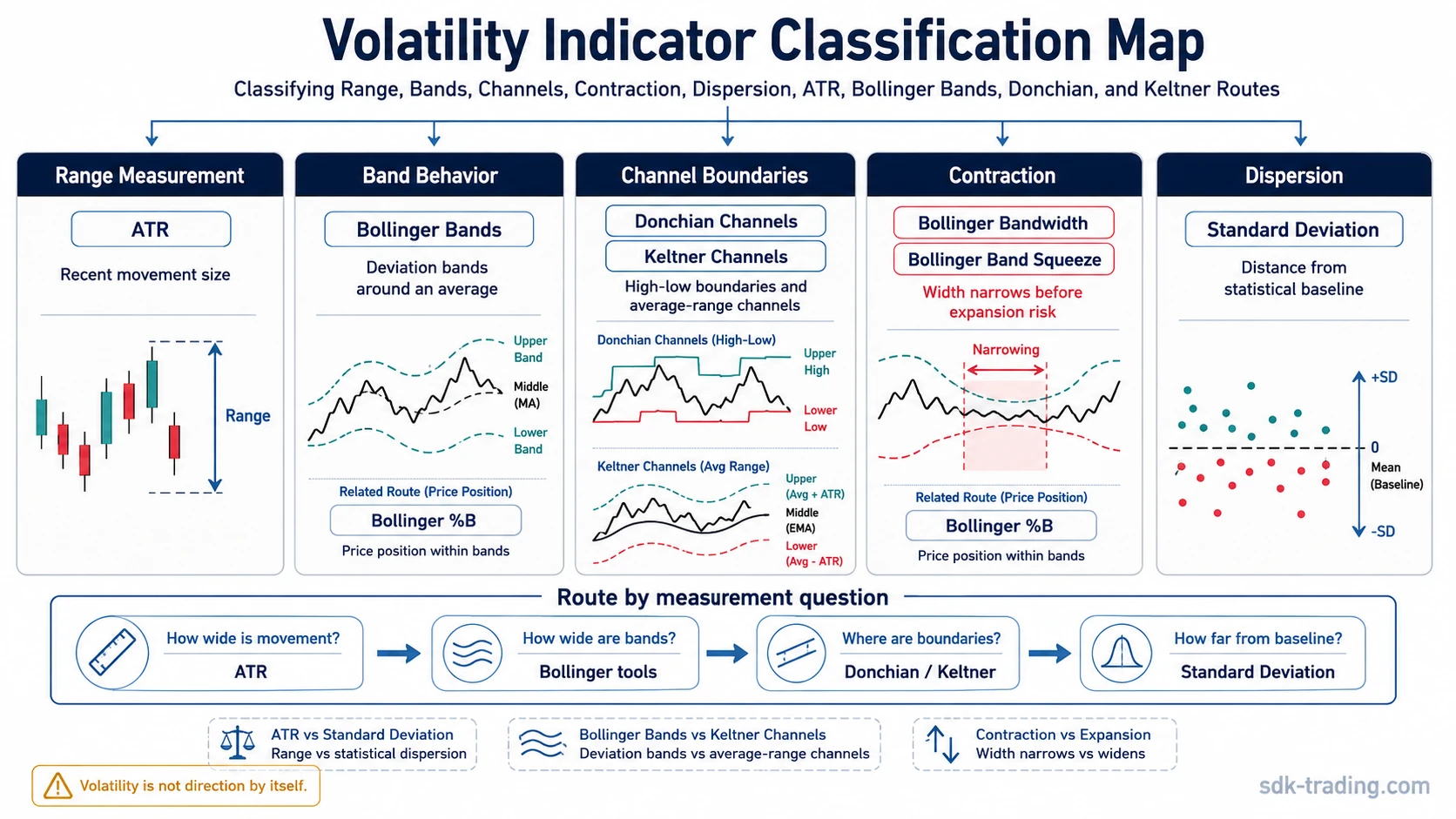
Volatility Indicators by Measurement Type
The clearest way to separate volatility tools is by the input and output produced by the calculation. Some estimate traveled range, some measure dispersion around an average, and some convert recent price extremes into channel boundaries.
| Market question | Indicator | What the calculation measures |
|---|---|---|
| How large has recent price movement been? | ATR indicator | True range averaged across a selected lookback period, including gap effects in true-range calculations. |
| How is dispersion changing around a moving average? | Bollinger Bands | Standard-deviation bands around a central moving average. |
| Has Bollinger Band width contracted unusually? | Bollinger Band Squeeze | Compression in the volatility envelope before a possible later expansion. |
| How wide are the Bollinger Bands? | Bollinger Bandwidth | The distance between the upper and lower Bollinger Bands, usually normalized relative to the center line. |
| Where is price located inside the Bollinger structure? | Bollinger %B | Relative price location inside or outside the bands rather than volatility magnitude itself. |
| How wide is an ATR-based envelope around a moving average? | Keltner Channels | An average-range envelope, commonly constructed from ATR around a central moving average. |
| Where are the recent price extremes? | Donchian Channels | The highest high and lowest low over a selected lookback window. |
| How dispersed is price around an average? | standard deviation indicator | Statistical dispersion around a selected mean or baseline. |
Why Volatility Indicators Can Disagree
Two volatility indicators do not have to rise and fall together. Their calculations may be reacting to different parts of the same price sequence.
ATR responds to true range. A large intraday range or gap can increase the reading even if closing prices remain relatively clustered. Standard deviation reacts to dispersion around an average. Bollinger Bands inherit that dispersion behavior in their width, while Keltner Channels commonly use ATR to set their envelope distance.
Donchian Channels are different again. Their boundaries come from the highest high and lowest low over a lookback period. The channel can remain wide after a large historical extreme even while shorter-term range measures are already falling.
| Price behavior | Possible ATR response | Possible dispersion or channel response |
|---|---|---|
| One unusually large-range candle | True range can rise immediately. | Standard deviation may react differently depending on closing-price dispersion and settings. |
| Repeated moderate ranges moving steadily in one direction | ATR can remain stable or increase gradually. | Bollinger width may expand as prices move farther from the recent mean. |
| A previous extreme remains inside the Donchian lookback | ATR can fall as recent candles become quieter. | The Donchian boundary can remain wide until the old extreme leaves the window. |
| Quiet price action after a volatility burst | ATR usually declines through its averaging process. | Band and channel width can contract at different speeds because their inputs and smoothing differ. |
Measurement distinction: Conflicting volatility readings can come from different inputs, lookback windows, and smoothing methods. Agreement is more meaningful after identifying what each tool is actually measuring.
Volatility vs Trend, Momentum, and Volume
Volatility describes the magnitude or width of movement. Trend tools focus on directional behavior. Oscillators usually organize momentum or relative position, while volume tools describe trading activity or participation.
| Indicator group | Main measurement | What the reading can describe |
|---|---|---|
| Volatility | Range, dispersion, band width, channel width, or contraction | Whether price movement is becoming wider, narrower, calmer, or more variable. |
| Trend | Direction, smoothing, slope, or directional strength | Whether directional behavior is rising, falling, strengthening, or weakening. |
| Oscillators | Momentum, normalized price behavior, thresholds, or relative range position | Whether momentum is accelerating, fading, stretched, or moving around a reference level. |
| Volume | Trading activity and participation | Whether activity is increasing, decreasing, accumulating, or distributing around price movement. |
A market can trend upward with low volatility, trend upward with expanding volatility, or move sideways with high volatility. Direction and volatility therefore need to remain separate parts of the analysis.
Expansion, Contraction, and Volatility Regimes
Volatility often moves through periods of expansion and contraction. ATR may rise as ranges increase. Bollinger Bands may widen as dispersion increases. Keltner Channels can expand as average true range rises. Falling readings indicate that recent movement is becoming smaller relative to the indicator’s own calculation history.
Contraction does not identify the direction of the next expansion. The same is true when volatility is already high. A rising ATR can accompany a strong advance, a sharp decline, or a fast two-sided market.
Interpretation limit: Volatility describes the behavior of movement. Direction, market structure, participation, and the reason for that movement remain separate questions.
Related Volatility Topics
Different volatility questions require different levels of detail. Some focus on the indicator family itself, while others move into risk management, indicator comparison, or structured trading frameworks.
| Question | Topic | Focus |
|---|---|---|
| How do the main volatility indicators work in more detail? | volatility indicators explained | Broader explanation of volatility measurements and their interpretation. |
| How can ATR connect volatility with position sizing or stop distance? | ATR in risk management | Risk use of average true range rather than general volatility classification. |
| How does true range differ from statistical dispersion? | ATR vs standard deviation | Direct comparison of two different volatility calculations. |
| Why do Bollinger and Keltner envelopes behave differently? | Bollinger Bands vs Keltner Channels | Standard-deviation bands compared with ATR-based channels. |
| How can ATR be incorporated into a structured trading process? | ATR strategy framework | Conditional use of ATR beyond the indicator definition. |
| How can Bollinger Band behavior fit into a structured trading process? | Bollinger Bands strategy framework | Conditional interpretation of band behavior. |
How to Choose a Volatility Indicator
Start with the variable that needs to be measured. ATR is suited to recent true-range behavior. Standard deviation measures statistical dispersion. Bollinger Bands convert dispersion into an envelope around a moving average. Keltner Channels build an average-range envelope. Donchian Channels track rolling price extremes.
The choice becomes clearer once the calculation is identified. A range problem, a dispersion problem, and a rolling-boundary problem may all be described as volatility questions, but they are not mathematically identical. Matching the tool to the measurement prevents a familiar indicator from being used for a job its formula was not designed to perform.