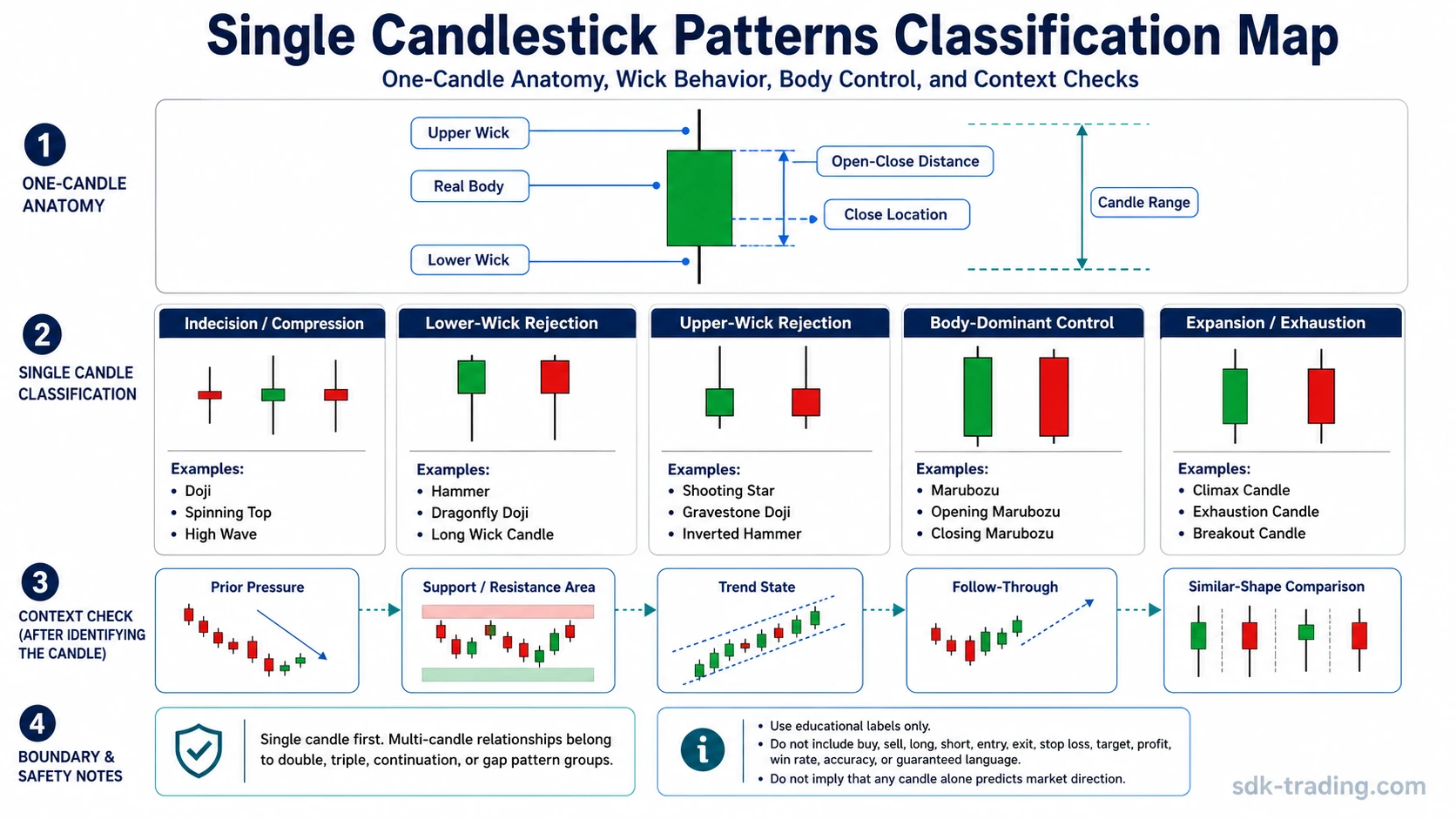
Single candlestick patterns are one-candle formations classified from the relationship between the open, high, low, and close. The main visual variables are real body size, upper and lower wick length, close location inside the candle range, and the candle’s position in the price movement that came before it.
Definition: A single candlestick pattern is a formation where one candle provides the primary visual structure. Some patterns can be identified mainly from the candle’s anatomy, while others need the preceding price movement to distinguish between two names that share nearly the same shape.
Key Points
- A single candlestick pattern uses one candle as its primary evidence unit.
- Body size, wick length, range, and close location describe the candle before a pattern name is assigned.
- Some different pattern names share almost identical anatomy. Hammer and hanging man are a common example.
- Doji, hammer, shooting star, marubozu, spinning top, long wick candles, and several rejection structures belong to the one-candle family.
- Patterns that require a relationship between two or more candles fall outside the single-candle boundary even when one candle carries most of the visual impact.
Shape First, Context Second
A useful way to classify a single candle is to separate two jobs. First describe what happened inside the candle itself. Then check whether the pattern name depends on what price was doing before that candle formed.
| Stage | What to examine | What it tells you |
|---|---|---|
| 1. Candle anatomy | Open, high, low, close, body size, upper wick, lower wick, and total range. | Describes the physical shape of the candle. |
| 2. Body location | Whether the body sits near the high, near the low, or near the middle of the range. | Separates body-dominant candles from upper-wick, lower-wick, and two-sided structures. |
| 3. Open-close compression | How small the body is relative to the total candle range. | Helps distinguish doji-family candles, spinning tops, and larger directional bodies. |
| 4. Prior movement | Whether price was advancing, declining, ranging, or testing a known area before the candle formed. | Separates patterns whose names depend on preceding direction, such as hammer versus hanging man or inverted hammer versus shooting star. |
This sequence avoids a common classification problem. Two candles can have nearly the same dimensions and still receive different names because their position in the preceding move is different.
How to Measure Single Candlestick Anatomy
The visual features of a candle can also be expressed as simple measurements. Exact pattern thresholds vary by methodology, so these calculations are more useful for describing candle shape consistently than for creating universal cutoff rules.
| Measurement | Calculation | What it describes |
|---|---|---|
| Full range | High – Low | The total distance price travelled during the candle. |
| Real body | |Close – Open| | The distance between the opening and closing prices. |
| Upper wick | High – max(Open, Close) | The part of the range above the real body. |
| Lower wick | min(Open, Close) – Low | The part of the range below the real body. |
| Body-to-range ratio | Real Body / Full Range | Shows how much of the candle is occupied by the body rather than the wicks. |
| Close location | (Close – Low) / Full Range | Places the close between 0 at the candle low and 1 at the candle high. |
These measurements help explain why a doji, spinning top, marubozu, and long-wick candle look different without relying only on their names. A small body-to-range ratio points toward compression or wick-dominant structure. A large ratio points toward stronger body dominance. Close location then shows where price finished inside the range.
Core Single Candlestick Pattern Groups
The main one-candle structures can be grouped by the part of the candle that carries the most information.
| Group | Main visual feature | Examples |
|---|---|---|
| Open-close compression | Very small or compressed real body relative to the full range. | Doji, spinning top, high wave candle. |
| Lower-wick structures | Body positioned toward the upper part of the range with a longer lower shadow. | Hammer, dragonfly doji, long wick candle. |
| Upper-wick structures | Body positioned toward the lower part of the range with a longer upper shadow. | Shooting star, gravestone doji, inverted hammer. |
| Body-dominant candles | Large real body with small or absent shadows. | Marubozu, opening marubozu, closing marubozu. |
| Range-expansion structures | Large candle range or unusually strong expansion relative to nearby candles. | Climax candle, exhaustion candle, breakout candle. |
| Same-shape classification pairs | Similar anatomy whose name changes with preceding price movement or taxonomy. | Hammer vs hanging man, inverted hammer vs shooting star, doji vs spinning top. |
Common Single Candlestick Patterns
The following patterns can be separated first by body and wick structure. For candles that share the same basic shape, the preceding price movement becomes part of the classification.
| What the candle shows | Pattern to study | Main classification feature |
|---|---|---|
| Open and close are the same or very close. | Doji candlestick | Extreme open-close compression relative to the candle range. |
| Long lower shadow with open and close near the upper end. | Dragonfly doji | Doji-like body with most of the candle range below it. |
| Long upper shadow with open and close near the lower end. | Gravestone doji | Doji-like body with most of the candle range above it. |
| Long shadows on both sides with a highly compressed body. | Long-legged doji | Large two-sided range relative to a very small open-close distance. |
| Small body near the upper part of the range with a long lower shadow after downside movement. | Hammer candlestick | Lower-wick anatomy combined with preceding downside movement. |
| Hammer-like anatomy after upside movement. | Hanging man candlestick | The anatomy resembles a hammer, but the preceding price direction changes the classification. |
| Small body near the lower part of the range with a long upper shadow after downside movement. | Inverted hammer candlestick | Upper-wick anatomy combined with preceding downside movement. |
| Small body with a long upper shadow after an advance. | Shooting star candlestick | The anatomy can resemble an inverted hammer, but the preceding movement is different. |
| Small real body with visible shadows above and below. | Spinning top candlestick | A small but visible body separates it from a more compressed doji. |
| Large body with little or no wick. | Marubozu candlestick | Most of the candle range is occupied by the real body. |
| Open occurs near one extreme of a large directional candle. | Opening marubozu | The opening side has little or no shadow. |
| Close occurs near one extreme of a large directional candle. | Closing marubozu | The closing side has little or no shadow. |
Other Candle Structures and Classification Boundaries
Not every useful one-candle description is a traditional Japanese candlestick name. Some SDK topics classify wick behavior, range expansion, or broader price-action structure. The evidence unit still needs to be clear before the pattern is assigned.
| Structure | Pattern to study | What separates it |
|---|---|---|
| One shadow occupies a large part of the candle range. | Long wick candle | Wick size and close location are the main anatomy variables. |
| Price moves away from one side of the range and closes well away from the extreme. | Rejection candle | The focus is the excursion beyond the body and the location of the close. |
| Small body near one end of the range with a pronounced opposite wick. | Pin bar | The term belongs to broader price-action taxonomy and overlaps with several named candlestick shapes. |
| Unusually large range during an intense extension. | Climax candle | Relative range expansion and the surrounding move are part of the reading. |
| Large candle appearing late in an extended move. | Exhaustion candle | The candle’s position late in the move separates exhaustion from ordinary expansion. |
| Wide range with substantial movement on both sides. | High wave candle | Large shadows relative to the body show substantial intrabar movement in both directions. |
| Open near one extreme followed by a directional body. | Belt hold candlestick | The open and the direction of the real body are central to the structure. |
| Abrupt repricing between two strongly opposed candles. | Kicker candlestick | A kicker requires a two-candle relationship, so it falls outside the strict single-candle boundary even though the second candle may carry strong visual weight. |
| One candle expands beyond a prior price boundary. | Breakout candle | The candle is described by its range expansion relative to an external price level. |
Single, Double, and Triple Candlestick Pattern Boundaries
The number of candles that must be present before the pattern can be identified defines the evidence unit. A one-candle formation can be classified from a single OHLC bar. A double or triple pattern cannot be completed until the required relationship between candles exists.
| Pattern family | Evidence unit | Category boundary |
|---|---|---|
| Single candlestick patterns | One candle | The primary structure can be described from one candle’s open, high, low, close, body, and shadows. |
| Double candlestick patterns | Two related candles | The relationship between Candle 1 and Candle 2 is required for classification. |
| Triple candlestick patterns | Three-candle sequence | Order and interaction across three candles are part of the definition. |
| Gap candlestick patterns | A gap relationship plus candle behavior | The relationship between prices across periods becomes part of the structure. |
Scope boundary: If the pattern cannot be identified without seeing another candle, the relationship is no longer a strict single-candle pattern.
Common Single-Candle Confusions
The most useful comparisons are the ones where two candles share similar anatomy. The separating variable may be body compression, wick direction, prior price movement, or the taxonomy being used.
| Confusion | Comparison to study | What separates the concepts |
|---|---|---|
| Doji and spinning top both have small bodies and visible shadows. | Doji vs spinning top | A doji has much tighter open-close compression, while a spinning top retains a more visible real body. |
| Dragonfly and gravestone doji have similarly compressed bodies. | Gravestone doji vs dragonfly doji | The dominant shadow is on the opposite side of the candle. |
| Gravestone doji and shooting star can both have long upper shadows. | Gravestone doji vs shooting star | The gravestone belongs to the doji family because its open and close are highly compressed. |
| Hammer and hanging man can have nearly identical anatomy. | Hammer vs hanging man | The preceding price direction separates the two names. |
| Hammer and pin bar overlap in lower-wick structure. | Hammer vs pin bar | One is a named candlestick pattern, while the other is a broader price-action classification. |
| Inverted hammer and shooting star can have nearly identical anatomy. | Inverted hammer vs shooting star | The preceding price direction separates the two names. |
When the Same Candle Needs a More Specific Context
Once the base candle has been identified, a different question may begin. The trader may want to know how that candle behaves inside a trend, near a prior price area, or under a narrower reliability test. Those are context questions rather than new definitions of the candle itself.
| Context question | Focused topic | What changes |
|---|---|---|
| How does a doji behave near a known price area? | Doji at support or resistance | The doji anatomy stays the same; the price location becomes the additional variable. |
| How does a doji behave inside an existing trend? | Doji in trend | The candle is now being examined relative to the direction and maturity of the surrounding move. |
| How do one-candle patterns interact with an existing trend? | Single candlestick patterns in trending markets | The analysis shifts from one pattern definition to trend interaction across several one-candle structures. |
| How reliable is a closing marubozu reading? | Marubozu closing reliability | The question moves from identifying the candle to evaluating how the structure behaves under additional conditions. |
How to Classify a Single Candlestick Pattern
- Measure the candle. Start with the high-low range, real body, upper wick, lower wick, and close location.
- Identify the dominant feature. Decide whether the candle is mainly body-dominant, compressed, upper-wick dominant, lower-wick dominant, or wide on both sides.
- Check whether the name depends on prior movement. A hammer and hanging man can share the same shape. An inverted hammer and shooting star can do the same. In those cases, anatomy alone does not finish the classification.
- Keep multi-candle relationships separate. If the pattern requires another candle, a gap relationship, or a sequence before it can be identified, it belongs outside the strict one-candle category.
This keeps the single candlestick family organized around a clear evidence unit. The candle shape comes first, context is added only where the pattern definition requires it, and multi-candle structures remain separate.