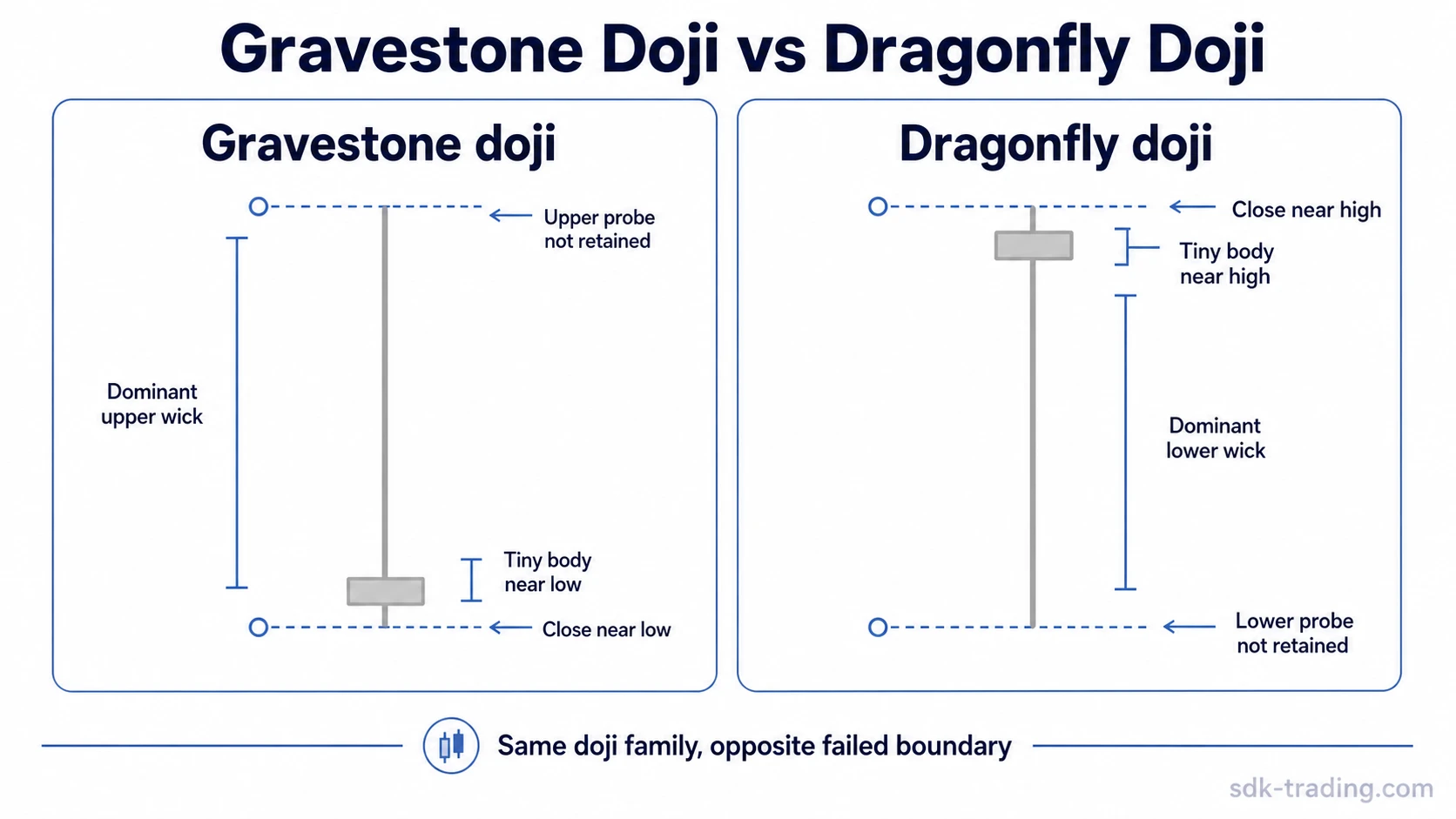
A gravestone doji and a dragonfly doji are not interchangeable doji candles. Both have a compressed real body, but they reject opposite sides of the candle range. A gravestone doji tests higher prices and closes near the low. A dragonfly doji tests lower prices and closes near the high.
The classification depends on the failed probe, not on the trend alone. A candle after an advance, decline, or sideways rotation still needs the same diagnostic question: which side of the range did price explore but fail to keep by the close?
Key Points
- Gravestone doji: tiny body near the low, dominant upper wick, little or no lower wick.
- Dragonfly doji: tiny body near the high, dominant lower wick, little or no upper wick.
- Both belong to the doji family because the open and close are very close.
- Neither candle confirms a reversal by itself. Later candles decide whether the tested area is accepted, rejected, or left unresolved.
What Separates a Gravestone Doji From a Dragonfly Doji?
The main difference is range rejection. A gravestone doji leaves a long upper wick because price moved higher during the candle, then failed to hold that higher area into the close. A dragonfly doji leaves a long lower wick because price moved lower during the candle, then failed to hold that lower area into the close.
The real body should remain very small in both cases. The body location then tells which side won the closing test: near the low for a gravestone doji, near the high for a dragonfly doji.
| Criterion | Gravestone doji | Dragonfly doji |
|---|---|---|
| Real body location | Tiny body near the candle low | Tiny body near the candle high |
| Dominant wick | Upper wick | Lower wick |
| Boundary tested | Upper side of the range | Lower side of the range |
| Failed extension | Higher-price probe was not retained | Lower-price probe was not retained |
| Close location | Near the low | Near the high |
| What later candles clarify | Whether the upper rejection attracts follow-through, gets reclaimed, or stays unresolved | Whether later candles hold the recovery, fail it, or return below the recovered area |
Why “Both Are Doji Candles” Is Not Enough
Both candles share doji body compression, but the shared body feature does not create the same interpretation. The useful distinction is directional pressure inside the range: a gravestone doji shows an upper-side probe that failed into the close, while a dragonfly doji shows a lower-side probe that failed into the close.
A wick-only reading can misclassify the candle. The wick tells where price traveled, but the close tells what part of that travel was retained. A long upper wick without a close near the low may be a different candle type. A long lower wick without a close near the high may also fall outside a clean dragonfly reading.
Same Trend Context, Opposite Boundary Test
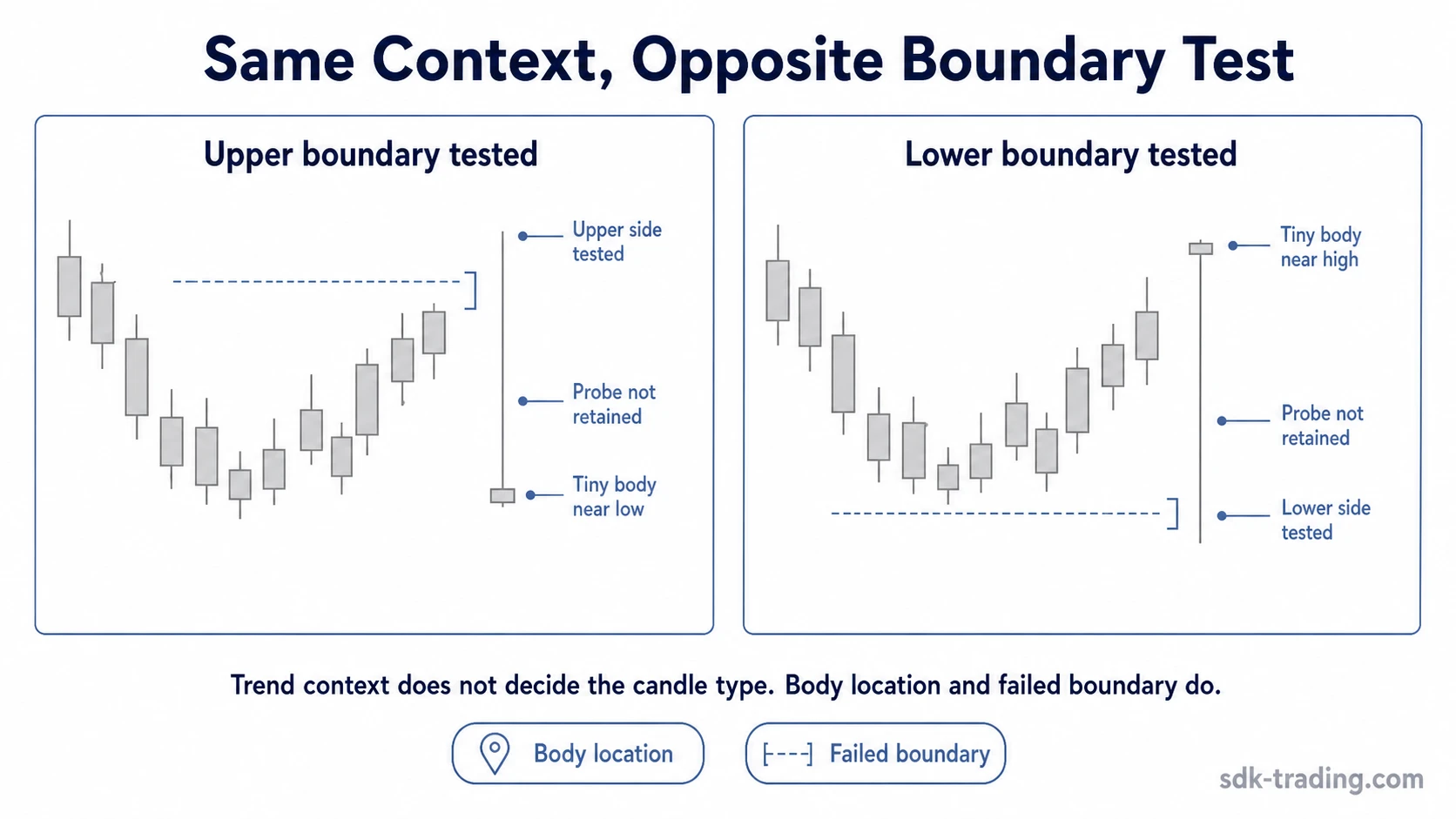
Price advances into a prior reaction area and expands above the recent range. One candle briefly trades higher, then closes back near its low with a tiny real body. The shape points to a gravestone doji because the upper extension was tested but not kept.
Now keep the broader movement similar, but change the intrabar rejection. Price reaches the same area, sells down during the candle, then recovers and closes near its high with a tiny real body. The shape points to a dragonfly doji because the lower extension was tested but not kept.
The trend context may explain why the candle matters, but it does not decide the classification. The classification comes from body location, wick dominance, close location, and which boundary failed.
Use This Lens When Classifying the Candle
| Question | Gravestone reading | Dragonfly reading |
|---|---|---|
| Where is the tiny body? | Near the low | Near the high |
| Which side was probed? | Higher prices | Lower prices |
| Which side failed into the close? | The upper side | The lower side |
| What creates confusion? | Calling any long upper wick a gravestone doji without checking the body and close | Calling any long lower wick a dragonfly doji without checking the body and close |
| What remains unresolved? | Whether later candles reject or reclaim the upper probe | Whether later candles hold the recovery, fail it, or return below the recovered area |
What Later Candles Can Change
A single candle gives classification evidence, not a complete trading decision. Later candles can change the reading in three ways: they can reject the tested area, accept it, or keep price rotating without clear acceptance.
After a gravestone doji, later candles matter because the upper rejection may attract follow-through, or price may reclaim the rejected area. After a dragonfly doji, later candles matter because the lower rejection may hold, or price may return below the recovered area.
The safer interpretation is conditional: candle shape identifies the failed probe, while structure, location, and later response decide whether that failure remains relevant.
Common Misreads
- Trend-only reading: a candle appearing after an advance or decline does not automatically become one pattern or the other. The tested boundary still matters.
- Wick-only reading: a long wick is not enough. The tiny body and close location must support the classification.
- Reversal assumption: neither candle confirms a reversal alone. Later acceptance or rejection is still needed.
- Body-location error: if the real body sits near the middle of the range, the candle may no longer be a clean gravestone or dragonfly doji.
FAQ
Can a gravestone doji and dragonfly doji appear in the same trend?
Yes. The same trend context can contain either candle. The classification depends on which side of the candle range was tested and not retained by the close.
Is wick direction enough to classify them?
No. Wick direction must be checked with real body size, body location, and close location. A long upper wick without a tiny body near the low is not a clean gravestone doji, and a long lower wick without a tiny body near the high is not a clean dragonfly doji.
Do gravestone and dragonfly doji candles confirm reversals by themselves?
No. They show a failed price probe inside one candle. Later candles, structure, and location decide whether the failed probe becomes meaningful or remains unresolved.
What if the body is not near the high or low?
If the body is not near the high or low, the candle may be a different doji variation or a less clean classification. Body location is part of the diagnostic test, not a minor detail.