A gravestone doji is a single-candle structure where the open and close compress near the session low while a long upper wick shows an upside test that failed to hold. The candle can warn that buying pressure was rejected, but it is not a standalone reversal signal. Its meaning depends on location, prior movement, and what later candles do around the upper-wick area.
Definition: A gravestone doji candlestick forms when price opens near the low, trades significantly higher, and then closes back near the opening area. The final shape has a tiny real body near the low, a dominant upper shadow, and little or no lower shadow.
Key Points
- A gravestone doji is defined by open-close compression near the low and a dominant upper wick.
- The upper wick shows that buyers tested higher prices but failed to keep price there by the close.
- The pattern is usually read as potential upside rejection after an advance or near resistance.
- The candle becomes weaker when the body is not near the low, both shadows are large, or later price accepts back above the rejected area.
- Confirmation comes from later candles, not from the gravestone doji shape alone.
Gravestone Doji Anatomy
The anatomy of a gravestone doji starts with a narrow open-close range near the candle low. That compressed body is what makes it part of the doji family. The long upper wick is the diagnostic feature because it shows that price explored higher levels but could not remain there.
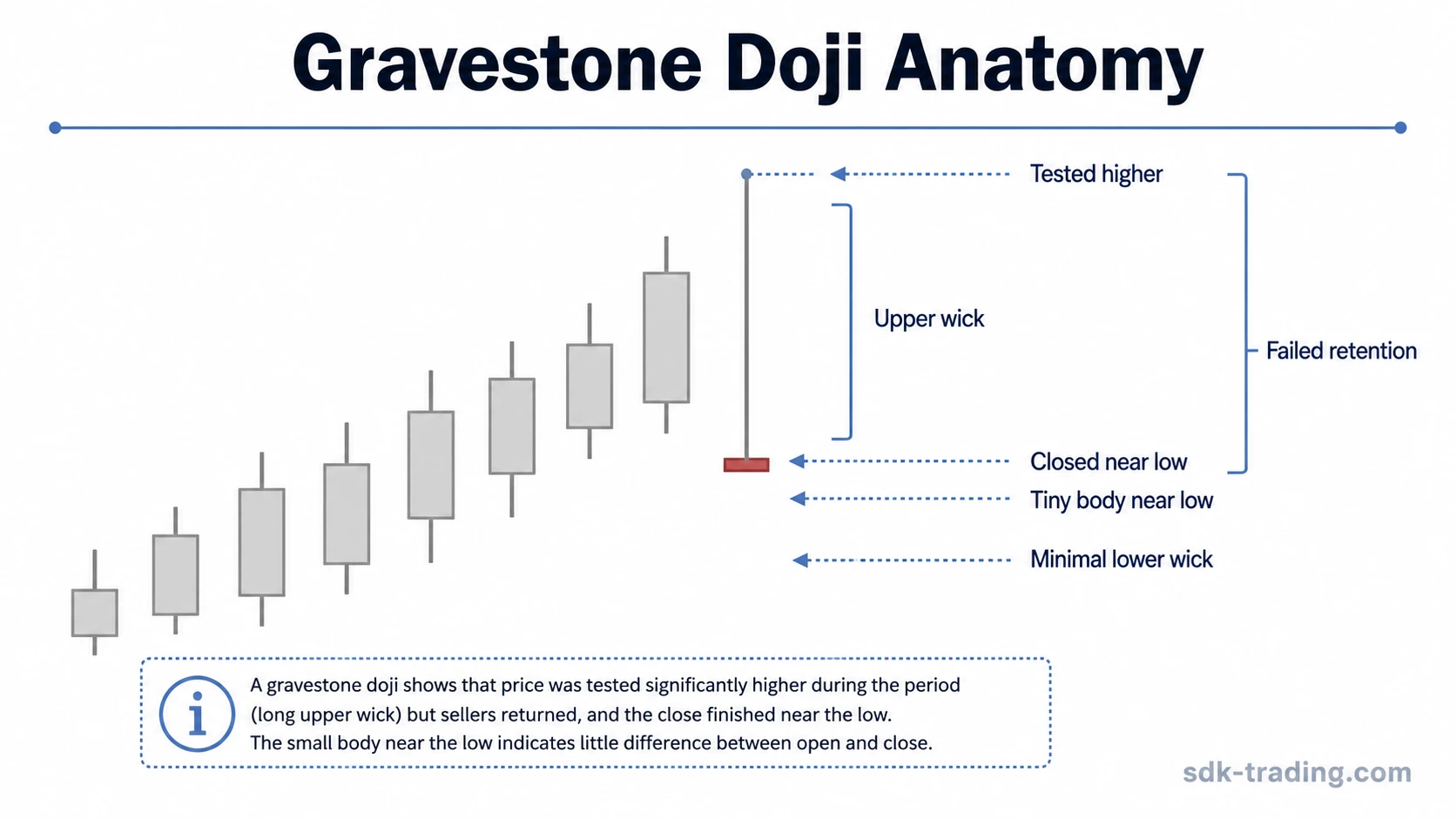
| Feature | What to Look For | Why It Matters |
|---|---|---|
| Open and close | Very close together near the candle low | Shows unresolved balance at the end of the candle instead of a wide directional body |
| Upper wick | Long and visually dominant | Shows a higher-price test that failed to hold into the close |
| Lower wick | Absent or very small | Keeps the candle compressed near the low rather than balanced in both directions |
| Body color | Usually less important than body location and wick dominance | The reading comes from failed retention of the upper test, not from the small body color alone |
What the Candle Means
A gravestone doji means that price tested higher levels during the candle but could not keep that advance by the close. The useful reading is not simply “bearish.” The cleaner interpretation is failed upside retention: the market probed higher, met supply or lack of follow-through, and settled back near the low.
This is why location changes the interpretation. A gravestone doji after an advance, near resistance, or after a fast upside extension has more diagnostic value than the same shape in the middle of random rotation. Without a relevant location, the candle may only show temporary indecision.
| Context | Safer Reading | What Would Weaken It |
|---|---|---|
| After a strong advance | Upside pressure tested higher prices but failed to close there | Immediate continuation above the wick area |
| Near resistance | The market rejected or failed to accept above a watched area | Later candles accepting above resistance |
| Inside a choppy range | Unresolved balance with an upper probe | Lack of trend, lack of location, and mixed follow-through |
| During a strong trend | Possible pause or early warning, not reversal proof | Trend continuation with strong closes above the candle |
Diagnostic Boundary
The gravestone doji should stay a narrow candle classification. It is not the same as every long upper-wick candle, and it should not be stretched until it absorbs nearby patterns. The body must be very small, positioned near the low, and paired with a dominant upper shadow.
| Reading | Candle Quality | Diagnostic Interpretation |
|---|---|---|
| Clean gravestone doji | Tiny open-close body near the low, long upper wick, minimal lower wick | Clear upside test followed by failed retention into the close |
| Weak gravestone doji | Small body but visible lower wick, less dominant upper wick, or unclear body placement | Possible upper rejection, but the candle is less clean and needs more context |
| Invalid reading | Large body, balanced upper and lower shadows, or body not near the low | Better classified as another candle type rather than forced into a gravestone doji label |
Gravestone Doji vs Nearby Candle Types
A gravestone doji is easiest to misread when several single-candle structures share long shadows or small bodies. The boundary depends on body location, wick direction, and whether the candle shows one dominant rejection side or a broader two-sided range.
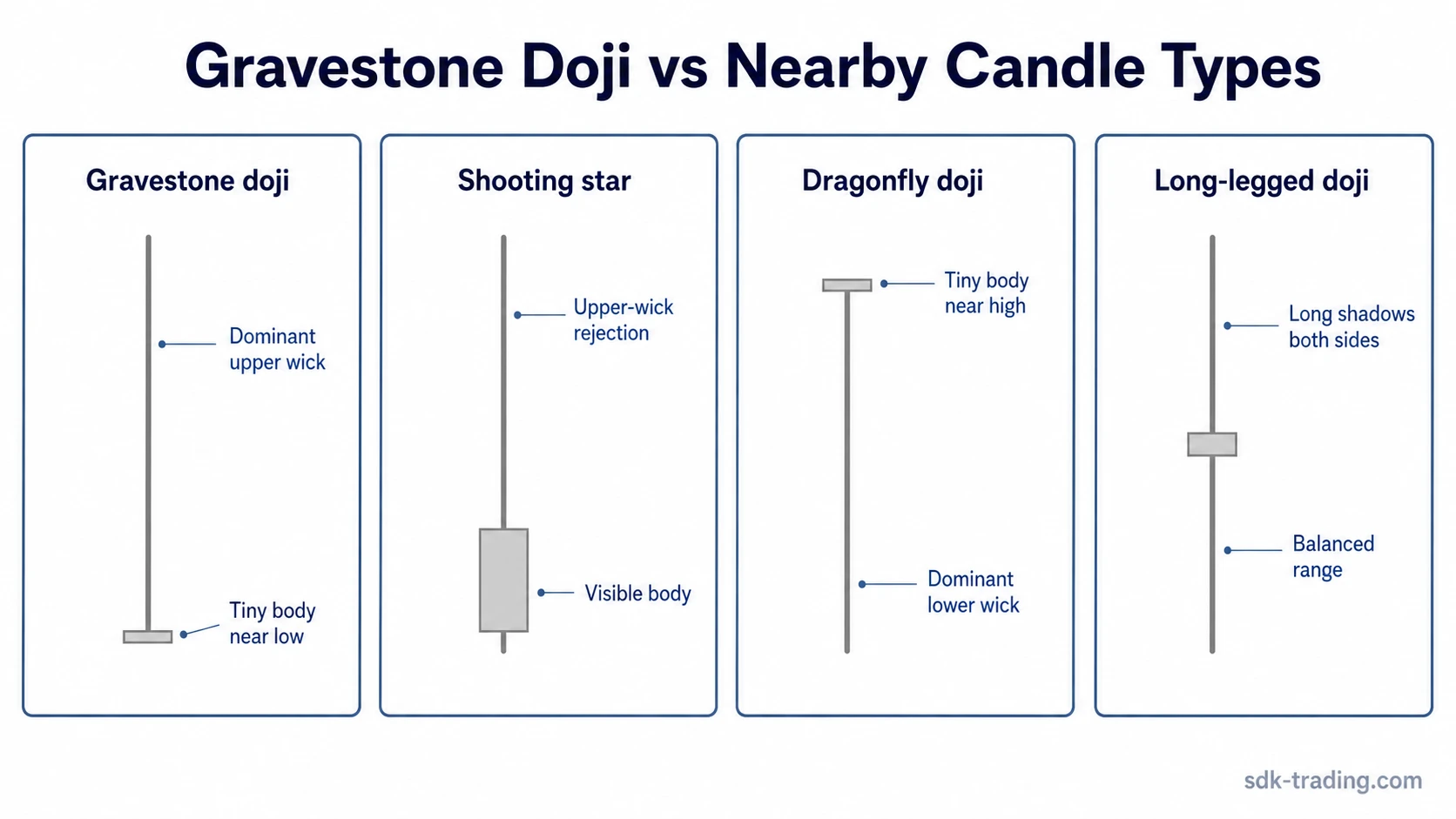
| Candle Type | Main Difference | Why It Should Stay Separate |
|---|---|---|
| Gravestone doji | Tiny body near the low with one dominant upper wick | Shows failed upside retention inside a doji-like structure |
| Shooting star | Long upper wick, but usually a more visible real body | The gravestone doji vs shooting star boundary depends mainly on body size and doji compression |
| Dragonfly doji | Tiny body near the high with a dominant lower wick | A dragonfly doji is the opposite wick-side structure |
| Long-legged doji | Small body with long shadows on both sides | A long-legged doji classification shows wider two-sided range rather than one clean upper rejection |
How the Reading Changes After the Candle
The candle itself shows a failed upper test during one period. The next question is whether the market continues to reject that upper area or accepts back through it. That later response separates a cleaner warning from a weak or invalid reading.
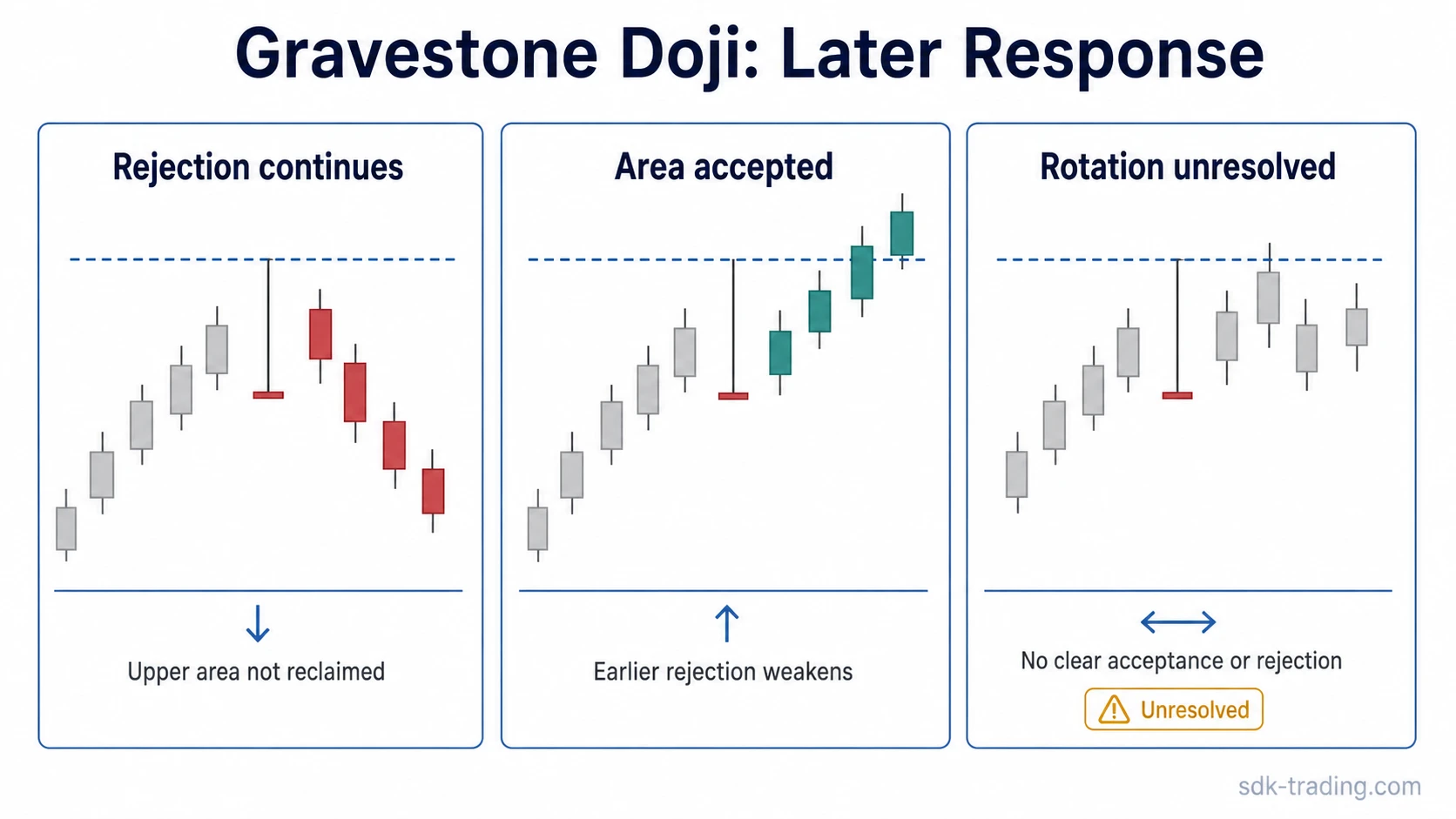
| Later Response | Interpretation | Reading Quality |
|---|---|---|
| Price avoids deep acceptance back into the upper wick | The rejected area remains meaningful | Cleaner reading |
| Price rotates around the body and wick midpoint | The market has not resolved the candle’s message | Weak or unresolved reading |
| Price accepts above the rejected upper area | The failed-retention reading is undermined | Invalid or failed reading |
For a deeper support-page treatment, use the follow-up reaction after a gravestone doji to separate confirmation from premature interpretation.
Gravestone Doji Example in Context
Imagine price has been rising for several sessions and reaches a prior resistance area. During the next candle, buyers push price above that area, but the candle closes back near its low with a tiny body and a long upper wick. The candle does not prove that a reversal has started. It only shows that the higher-price test failed to hold during that period.
The reading becomes more defensible if later candles cannot reclaim the upper-wick area. It weakens if price quickly accepts above the wick or prints strong closes beyond the rejected zone. That distinction keeps the gravestone doji useful as a diagnostic candle without turning it into a prediction.
Common Mistakes
| Mistake | Why It Is a Problem | Cleaner Interpretation |
|---|---|---|
| Treating every gravestone doji as an automatic bearish reversal | The candle only records one failed upper test | Wait for later price behavior to confirm or reject the reading |
| Ignoring where it forms | A random mid-range candle carries less information | Give more weight to candles near resistance, after advances, or at clear decision areas |
| Forcing weak shapes into the pattern | A large body or balanced shadows changes the classification | Require open-close compression near the low and a dominant upper wick |
| Confusing confirmation with prediction | A following candle can change the reading rather than simply validate it | Track acceptance, rejection, and unresolved rotation after the candle |
Common Questions
What is a gravestone doji?
A gravestone doji is a candlestick with a tiny open-close body near the low, a long upper wick, and little or no lower wick. It shows that price moved higher during the candle but closed back near the low.
Is a gravestone doji bearish or bullish?
It is usually treated as bearish evidence when it forms after an upward move or near resistance. The reading remains conditional until later candles show whether the upper area is rejected or accepted.
How is a gravestone doji different from a shooting star?
A gravestone doji has a nearly absent real body near the low. A shooting star usually has a more visible real body while still showing a long upper wick.
What confirms a gravestone doji reading?
A gravestone doji gains confirmation when later candles fail to reclaim the upper wick area or continue rejecting the tested zone. It loses force when price accepts above that area.