A doji candlestick forms when the open and close are nearly equal, leaving little or no real body. The candle shows open-close compression: price may travel above and below the open during the session, but neither side keeps a clear closing advantage.
That makes a doji a balance candle, not a standalone directional signal. Its useful reading comes from the surrounding structure: prior movement, location, wick placement, range size, and whether later candles accept, reject, or keep rotating around the doji range.
Definition: A doji is a single candlestick where the opening and closing prices are at or very near the same level. The body is compressed, while the upper and lower shadows can vary. This marks unresolved directional balance inside one candle.
Key Points
- A doji is defined by open-close compression, not by candle color.
- The real body should be very small compared with the full candle range.
- Wick placement changes the subtype, but the compressed body is the core feature.
- A doji can appear after an advance, after a decline, or inside a range, and each location changes the reading.
- The candle remains unresolved until later price behavior shows acceptance, rejection, or continued balance around its range.
What Makes a Candlestick a Doji?
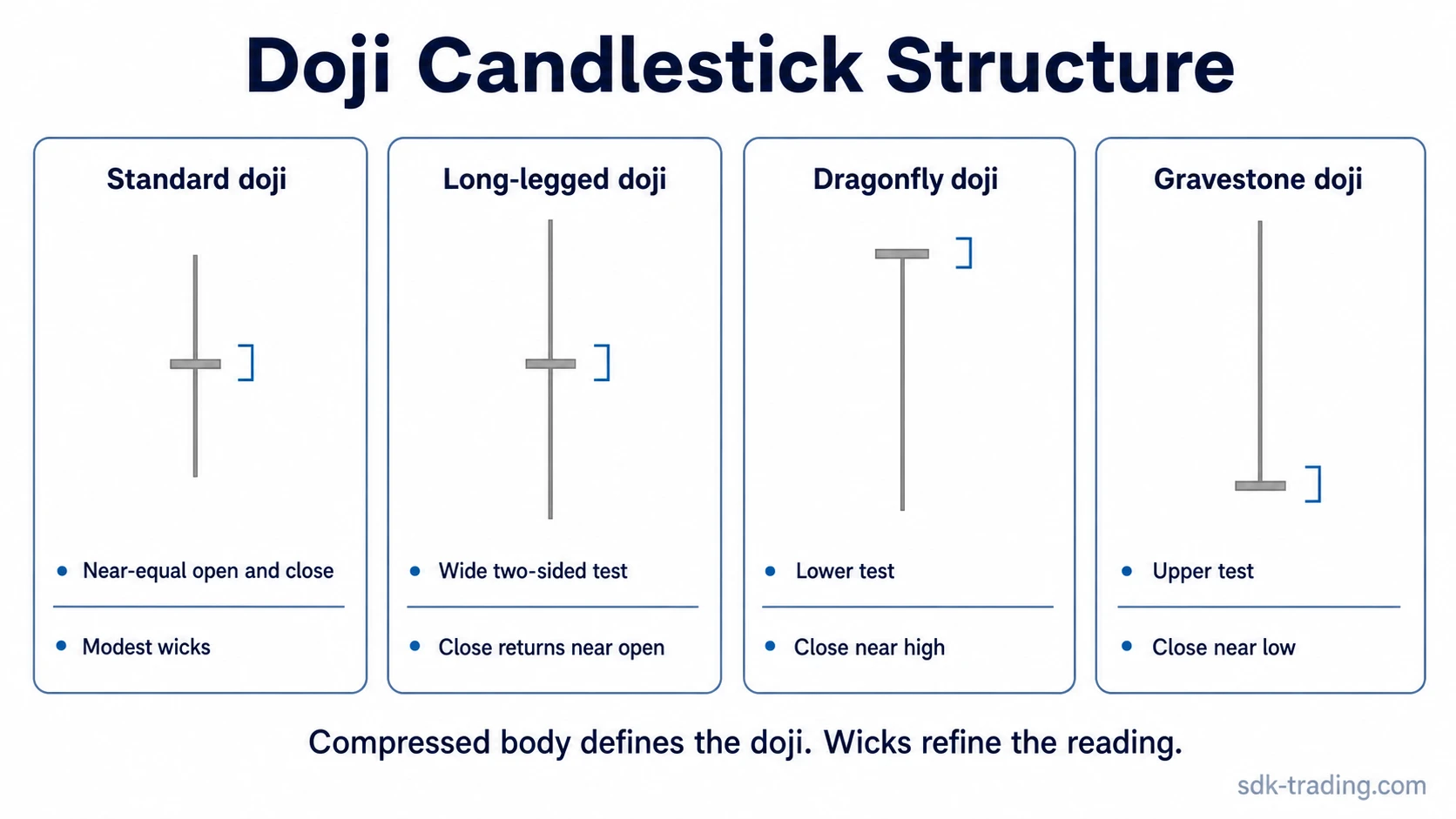
The defining feature of a doji is that the open and close are almost the same. A tiny green or red body can still qualify if the body is compressed enough to show that neither side controlled the close. A slightly larger body may still be a small-bodied candle, but it becomes less clean as a doji.
The high and low still matter because they show how far price moved before returning near the open. A narrow-range doji can show quiet balance. A wide-range doji can show active disagreement, where both sides pushed price but neither side kept control by the close.
| Feature | Cleaner doji reading | Weaker or false-positive reading |
|---|---|---|
| Open and close | Nearly equal, creating a flat or very small body | Close is meaningfully away from the open, creating a normal small body |
| Body size | Small relative to the full candle range | Body is large enough that one side had visible closing control |
| Wicks | Show intraperiod movement away from the open-close area | Too little range to reveal useful disagreement, or too irregular to classify cleanly |
| Location | Appears after a meaningful move, near a tested area, or at a point where balance matters | Appears randomly inside noisy sideways action where indecision is already normal |
| Later behavior | Price respects, rejects, or resolves the doji range in a readable way | Price immediately erases the structure or keeps rotating without useful resolution |
Doji Candlestick Meaning: Bullish, Bearish, or Neutral?
A doji can show that the current candle failed to produce a closing advantage. After a strong advance, that may show that buying pressure no longer closed comfortably near the high. After a strong decline, it may show that selling pressure no longer closed comfortably near the low. Inside a range, it may only confirm that the market is still balanced.
The mistake is treating the candle as a decision by itself. A doji does not prove reversal, continuation, accumulation, or distribution. It marks a compressed body and an unresolved auction. The next useful question is whether price accepts above the doji range, accepts below it, rejects one side of the range, or continues to rotate through it.
| Reading | What the doji shows | What it does not show by itself |
|---|---|---|
| After an advance | Buying pressure failed to create a clear body-close advantage during that candle | It does not automatically confirm a bearish turn |
| After a decline | Selling pressure failed to create a clear body-close advantage during that candle | It does not automatically confirm a bullish turn |
| At support or resistance | Price paused at a tested area and closed near the open | It does not prove that the level will hold or fail |
| Inside consolidation | Balance continued inside an already balanced environment | It may add little new information unless range behavior changes afterward |
Clean, Weak, and Invalid Doji Readings
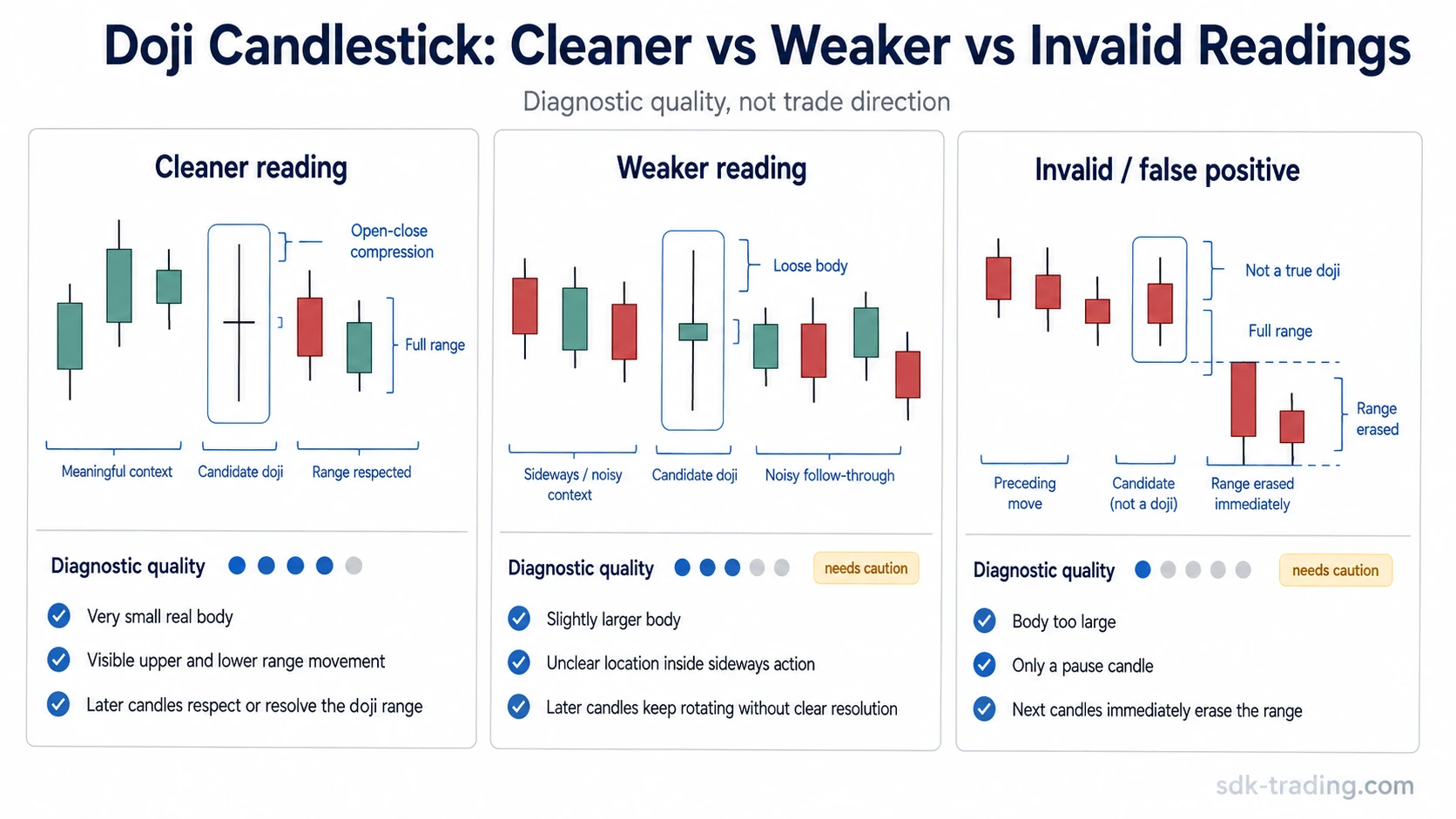
A cleaner doji reading starts with a strict body relationship. The open and close are compressed, the body is tiny compared with the full candle, and the surrounding price action gives the pause a reason to matter. A doji after a visible push into a prior boundary is easier to interpret than a doji buried inside random overlap.
A weaker reading appears when the body is small but not clearly compressed, the candle sits inside noisy sideways action, or the next candles fail to resolve the range. An invalid reading appears when the body is too large to show open-close balance, or when the candle is being labeled as doji only because it looks small at a quick glance.
| Quality | Typical structure | Safer interpretation |
|---|---|---|
| Cleaner | Open and close are nearly equal, range is readable, and location gives the pause relevance | The candle shows unresolved balance at a meaningful point |
| Weak | Body is only somewhat small, wick structure is mixed, or location is not useful | The candle may show hesitation, but the reading should stay low-confidence |
| Invalid / false positive | Body is too large, or the candle is only a normal small-bodied candle | Do not force a doji label when open-close compression is not clear |
Doji vs Similar Small-Bodied Candles
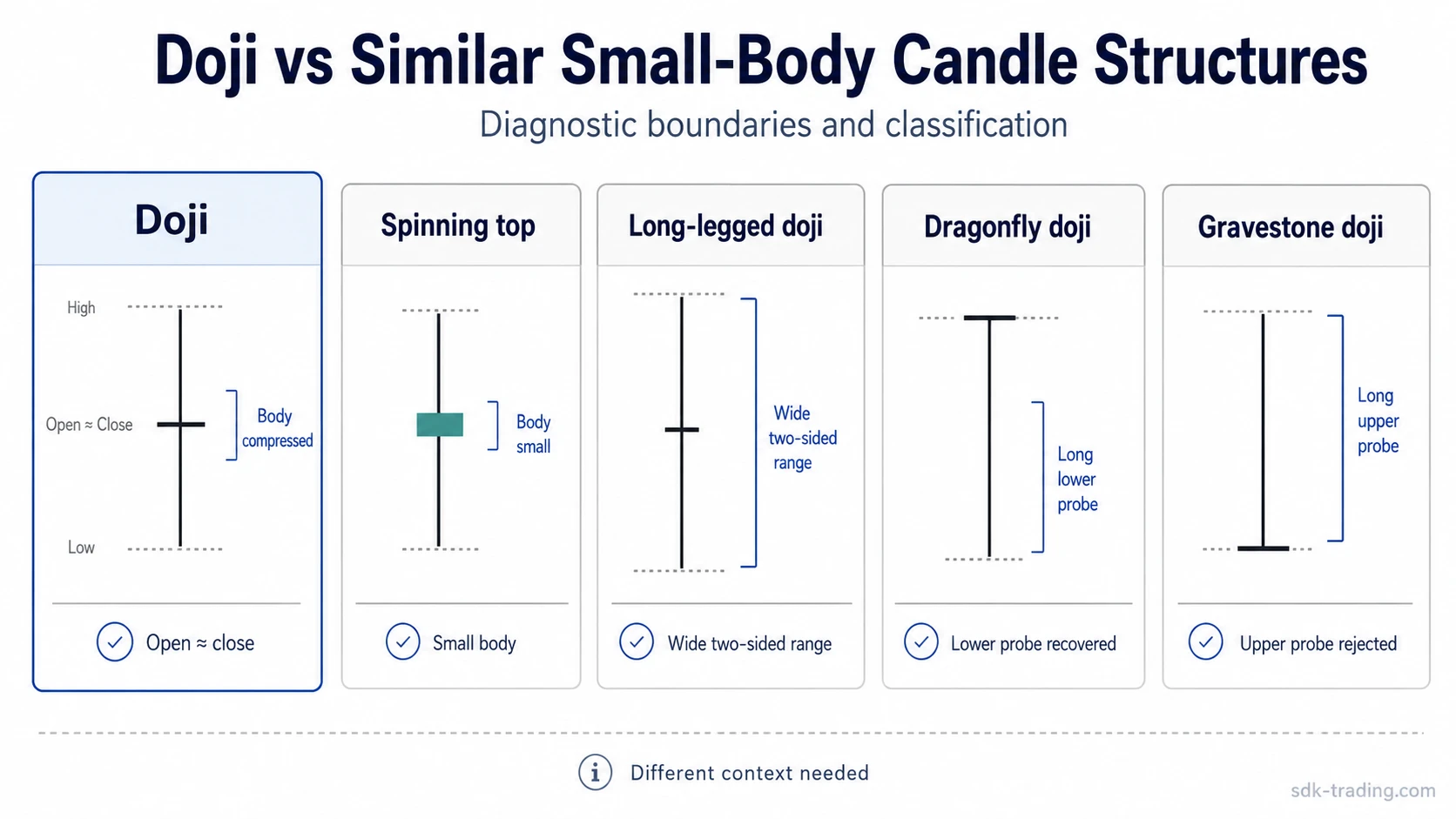
The closest confusion is the spinning top. Both candles can have small bodies and upper and lower shadows, but a doji has a stricter open-close relationship. In a spinning top, the body is small, yet the open and close do not need to be nearly identical.
Other nearby candles are different because the wick structure carries more of the reading. A dragonfly doji emphasizes a lower probe and recovery. A gravestone doji emphasizes an upper probe and failure to hold. A long-legged doji emphasizes a wider two-sided test that still returns near the open-close area.
| Candle | Shared feature | Main difference from a standard doji |
|---|---|---|
| Spinning top | Small body with upper and lower shadows | The body can be larger because open and close do not need to be almost equal |
| Long-legged doji | Open-close compression | The upper and lower shadows are both extended, showing a wider two-sided range |
| Dragonfly doji | Open-close compression | The open-close area sits near the high after a lower-side probe |
| Gravestone doji | Open-close compression | The open-close area sits near the low after an upper-side probe |
Doji Confirmation and Context
The same candle can carry different weight in different surroundings. A doji after several strong directional candles can show that the close no longer followed the prior pressure. A doji inside a range may only show that balance continued. A doji near a prior high, prior low, or range boundary can become more useful because the market is testing an area where acceptance or rejection matters.
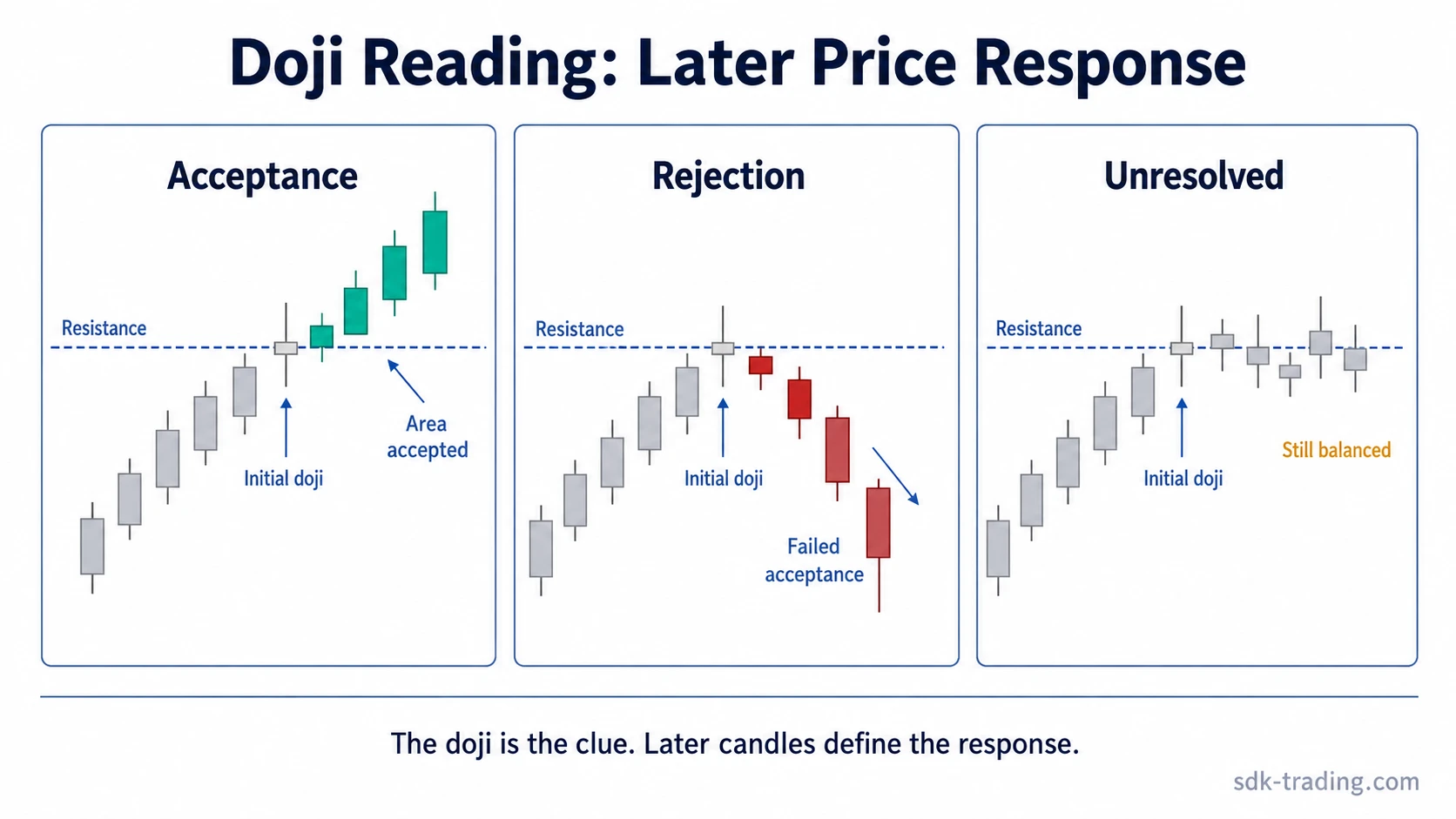
The reading also changes with the next sequence. If later candles close above the doji range and hold there, the market is accepting higher prices relative to that balance area. If later candles reject the upper side and close back inside or below the range, the upper probe failed to attract acceptance. If later candles keep overlapping the doji, the market has not resolved the balance yet.
Example of a Basic Doji Reading
Consider a market that has moved upward for several candles and then forms a doji near the upper part of the recent range. The candle does not prove that the advance is finished. It only shows that the session failed to close with a clear body advantage after testing higher prices.
A cleaner bearish-leaning interpretation would need later candles to reject the upper side of the doji range and stop accepting higher closes. A cleaner continuation interpretation would need later candles to accept above the range instead of falling back through it. If price keeps overlapping the doji, the most accurate reading is continued balance rather than forced direction.
This is why candlestick pattern reliability depends on structure, location, and response, not on the candle label alone.
Common Doji Mistakes
- Treating every doji as directional. A doji shows open-close balance inside one candle. Directional meaning needs a later range response.
- Overweighting candle color. A tiny green or red body matters less than the compressed relationship between open and close.
- Ignoring location. A doji near a tested boundary carries a different reading from a doji inside random sideways movement.
- Forcing subtype labels. Dragonfly, gravestone, and long-legged readings require clear wick structure, not just a small body.
- Confusing pause with reversal. A pause becomes more useful only when later price behavior shows rejection, acceptance, or a change in closing control.
- Reading a doji in trend too aggressively. A doji inside a strong trend may only mark hesitation. A separate doji in trend reading needs trend strength, location, and follow-through to be assessed together.
FAQ
What does a doji candlestick mean in trading?
A doji candlestick means the open and close are at or very near the same price. It shows that neither side produced a clear body-close advantage during that candle. Directional meaning depends on location, prior movement, wick structure, and later price response.
Is a doji candlestick bullish or bearish?
A doji is not automatically bullish or bearish. After a decline, it can mark a pause in selling pressure. After an advance, it can mark a pause in buying pressure. The next closes around the doji range show whether the pause resolves into rejection, continuation, or continued balance.
What makes a candle qualify as a doji?
The open and close must be nearly equal, creating a very small real body. The wicks can vary, but the body must be compressed enough that the candle clearly shows little or no body-close advantage.
How is a doji different from a spinning top?
A doji has a stricter open-close relationship. A spinning top also has a small body, but the open and close do not need to be almost equal. The doji emphasizes compressed closing control more precisely.
Why do later candles matter after a doji?
Later candles show whether price accepts, rejects, or keeps rotating around the doji area. Without that response, the doji remains only an observation of balance inside one candle.