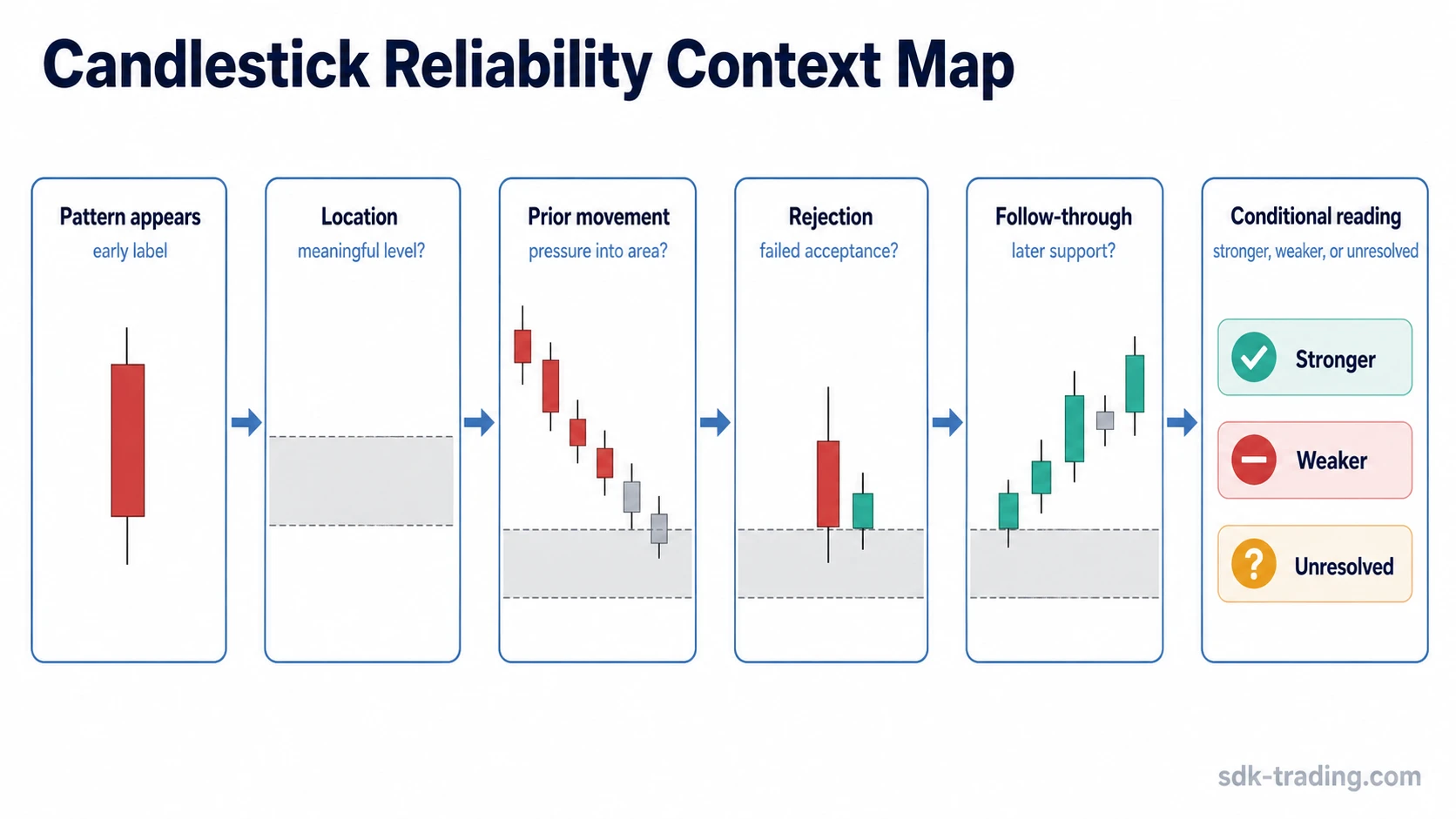
A candle name is only the first label. Reliability comes from the full reading: candle structure, location, prior movement, rejection quality, follow-through, volatility conditions, and later acceptance. Without those conditions, even a familiar pattern can become a weak warning rather than useful evidence.
Key Points
- Candlestick patterns are more reliable when they appear at meaningful locations, not randomly inside noise.
- Prior movement matters because a reaction after pressure has a different meaning from a pattern with no clear setup.
- Rejection and follow-through are more important than the candle name alone.
- The idea of one “most reliable candlestick pattern” is usually too simple because reliability changes with context.
How reliable are candlestick patterns?
Candlestick patterns can be useful as interpretation tools, but they are not reliable in a mechanical sense. A pattern does not become trustworthy simply because it has a recognized name. It becomes more useful when the surrounding evidence supports the same reading.
A bullish-looking candle after extended weakness near a meaningful reaction area has a different reliability profile from the same candle printed in the middle of a sideways range. A bearish-looking candle after an extended advance near resistance has a different profile from one that appears after no clear prior pressure.
The practical issue is not whether candlestick patterns “work” in isolation. The better question is whether the pattern appears in a location where its message can be tested. A candle that cannot be tested by later acceptance, rejection, or follow-through remains only a warning.
Why pattern reliability changes with context
Reliability changes because a candlestick pattern is not a complete market reading. It is a visible response inside a broader sequence. The same shape can reflect absorption, hesitation, exhaustion, failed pressure, or ordinary range movement depending on the surrounding structure.
Location is usually the first filter. A pattern near a prior support area, resistance area, range boundary, breakout zone, or reaction level has more interpretive value than a pattern floating in the middle of a congested range. The candle has a clearer question to answer: did the market accept that area, or reject it?
Prior movement is the second filter. A pattern after a one-sided move can signal a possible shift in pressure, while the same pattern after no meaningful movement may only reflect temporary hesitation. A doji-style candle can show indecision, but indecision is not automatically reversal evidence unless the market location makes that hesitation meaningful.
Later behavior is the final filter. A pattern becomes more useful when the following candles support the implied pressure. It becomes weaker when price immediately returns into the prior range or accepts the area that the pattern was supposed to reject.
What makes a candlestick pattern more reliable
A stronger reliability reading usually requires several conditions to align. The candle does not need perfect textbook shape, but the surrounding sequence should make the interpretation harder to dismiss as random noise.
| Condition | Stronger reliability reading | Weaker reliability reading |
|---|---|---|
| Location | Reaction near a meaningful level | Pattern in the middle of noise |
| Prior movement | Extended move into reaction area | No clear prior pressure |
| Rejection | Failed acceptance beyond the candle extreme | Wick without later response |
| Follow-through | Next candles hold the implied direction | Immediate reversal back into range |
| Market context | Pattern agrees with structure | Pattern fights broader structure |
A hammer candlestick after a long decline into a support area has a different reliability profile from a hammer printed randomly inside a sideways range. The shape is the same, but the evidence around it is not.
The stronger version has a prior decline, a location where reaction is plausible, lower-side rejection, and a later test of whether price can remain above the reaction area. The weaker version only has a familiar shape. That difference is what makes reliability conditional rather than mechanical.
What makes a candlestick pattern less reliable
A candlestick pattern becomes less reliable when the label is stronger than the evidence. This often happens when the candle looks dramatic but appears in a location with no clear structural importance.
A long wick, large body, or strong close can attract attention, but the market still has to show whether that candle changed acceptance. If later candles return into the same area and hold there, the original rejection is weaker because the market did not continue to reject that price zone.
This is especially important with forceful single-candle structures. A belt-hold candlestick can look decisive, but the reliability still depends on whether later candles accept the move or pull price back into the prior area.
Reliability boundary: A candlestick pattern is weaker when it has no clear location, no prior pressure, no rejection test, and no follow-through. In that condition, the pattern is better treated as an observation, not as confirmed evidence.
Microsoft Example: Candlestick Pattern Reliability in Context
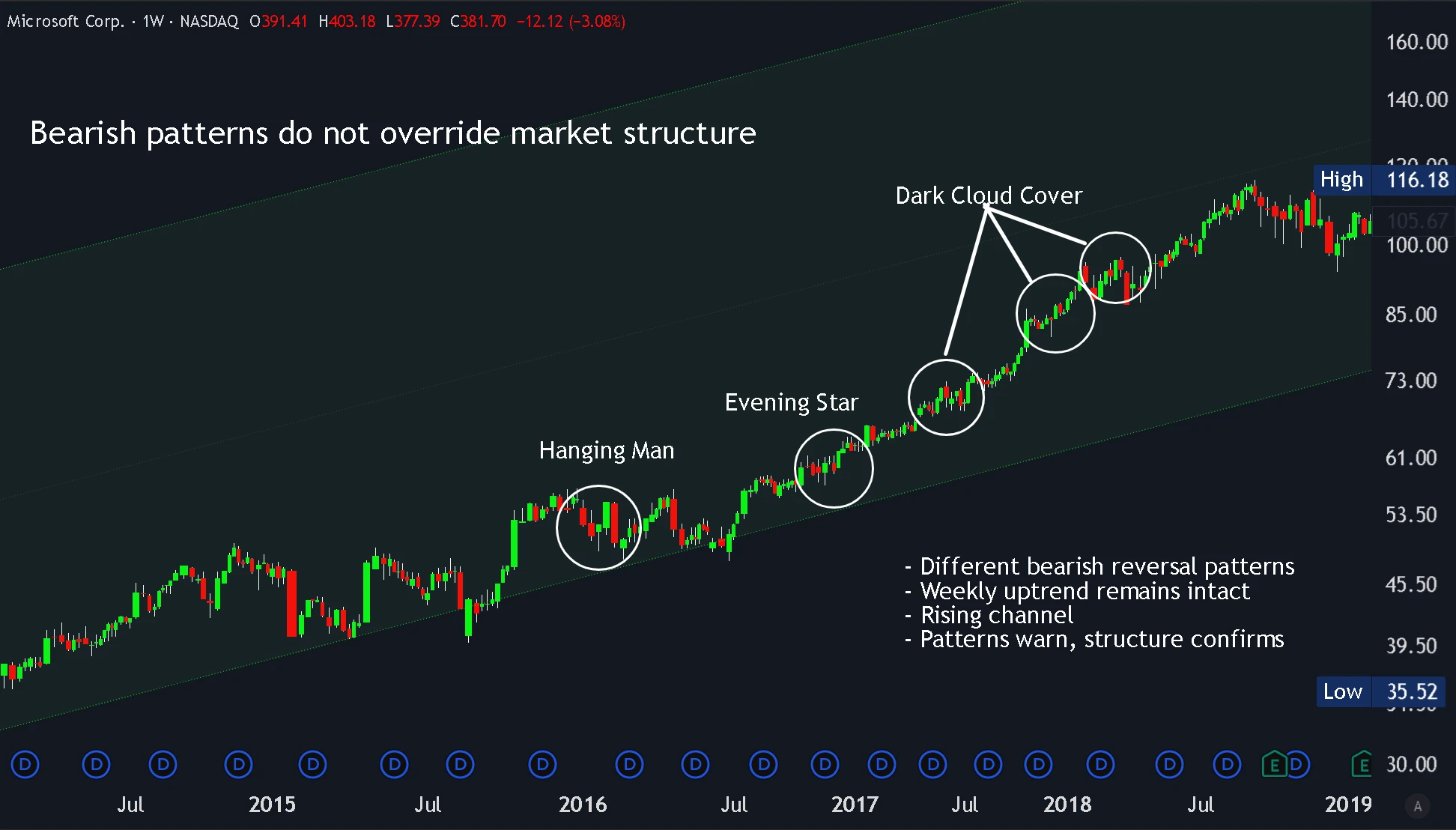
The Microsoft weekly chart shows why candlestick pattern reliability depends on market structure rather than the pattern name alone. During a multi-year advance, the chart produced a Hanging Man, an Evening Star, and several Dark Cloud Cover patterns.
Each pattern warned that short-term selling pressure or hesitation was developing. However, the broader weekly structure continued to support the existing trend. Price remained inside the rising channel, and the bearish patterns did not produce a sustained structural reversal.
Why the Earlier Bearish Patterns Remained Warnings
The earlier patterns appeared inside an established weekly uptrend. Price reacted after some of them, but those reactions did not break the broader channel or establish a sustained sequence of lower highs and lower lows.
The candle labels were bearish, but the surrounding evidence remained mixed:
- Market structure: The rising channel remained intact.
- Trend condition: The broader sequence of higher prices continued.
- Follow-through: Selling pressure did not develop into a sustained structural decline.
- Interpretation: The patterns warned of local weakness without confirming the end of the weekly uptrend.
This distinction matters because a candlestick pattern can identify a temporary change in pressure without identifying a complete trend reversal.
Why the Later Shooting Star Carried More Weight
A later Shooting Star appeared near the upper boundary of the rising channel after a more mature advance. Its location made the warning more relevant because the candle formed at a structural area where rejection could have broader consequences.
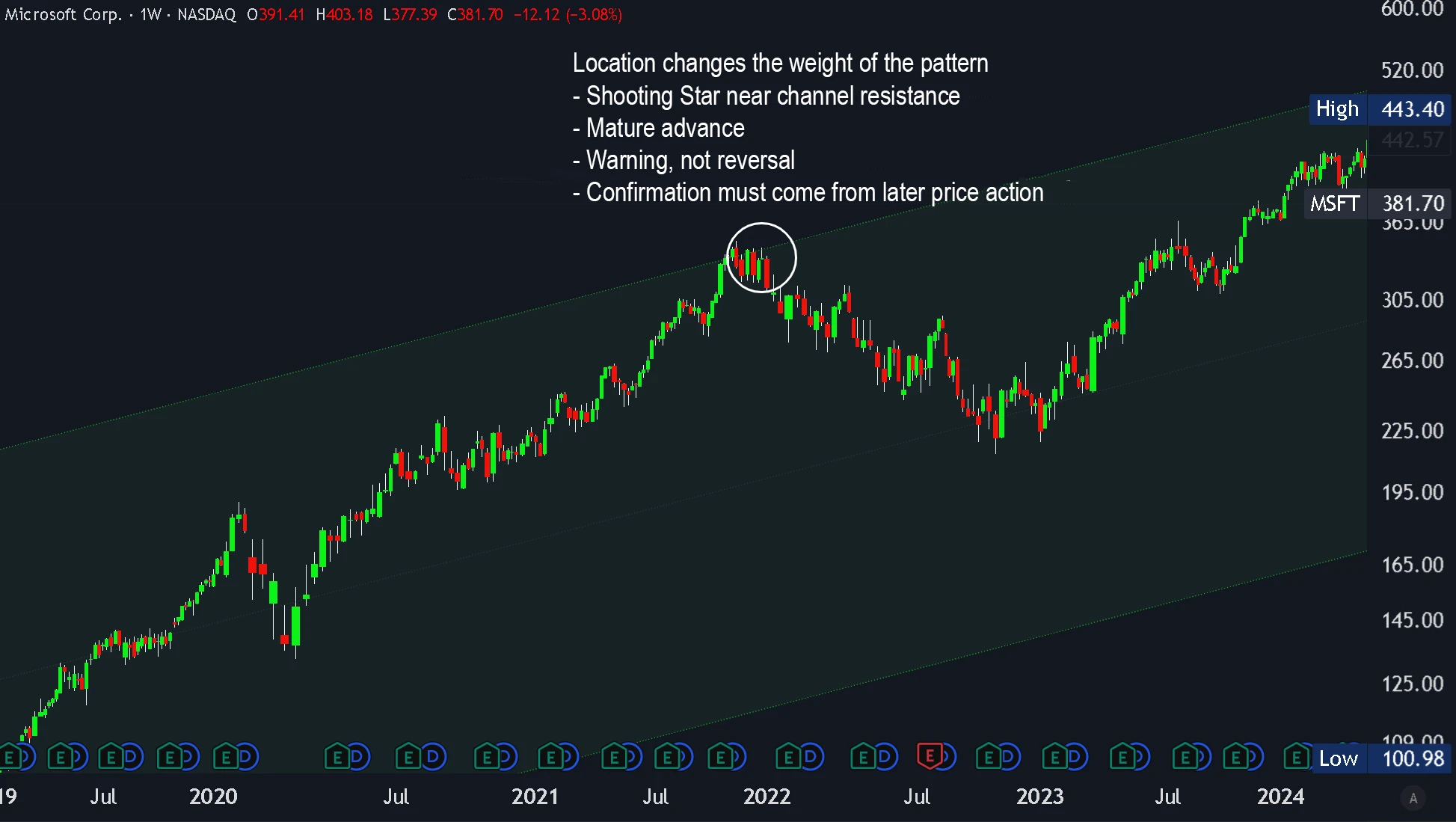
The decline that followed supported the bearish warning, but it did not automatically confirm the end of the long-term trend. Price corrected inside the broader channel and later recovered to new highs.
The pattern was therefore useful as evidence of a possible correction. It was not sufficient evidence that the entire weekly structure had reversed.
What This Case Shows About Candlestick Pattern Reliability
- The pattern name describes the visible candle structure.
- Prior movement shows whether the market had become extended before the pattern appeared.
- Location determines whether the warning formed at a meaningful structural area.
- Follow-through shows whether the initial warning developed into a larger change.
- The broader trend determines whether the pattern supports or conflicts with the active structure.
Candlestick pattern reliability increases when the pattern, location, prior movement, rejection, and later price behavior support the same interpretation. A bearish pattern can correctly warn of short-term pressure without correctly identifying a complete trend reversal.
Why “most reliable candlestick pattern” is the wrong shortcut
The phrase “most reliable candlestick pattern” sounds useful, but it can create a false hierarchy. A hammer, engulfing candle, doji, shooting star, or belt-hold pattern is not reliable in every location. Each pattern changes meaning when the prior move, level, volatility, and later acceptance change.
A universal ranking also hides the main problem: traders often compare names when they should compare conditions. A modest pattern at the right location with clean follow-through can be more useful than a textbook pattern in the middle of an unclear range.
The better shortcut is not a ranked list. It is a reliability checklist:
- Did the pattern form at a meaningful location?
- Was there clear prior pressure into that location?
- Did the candle reject acceptance beyond an important area?
- Did later candles support the implied pressure?
- Does the pattern agree with the broader structure?
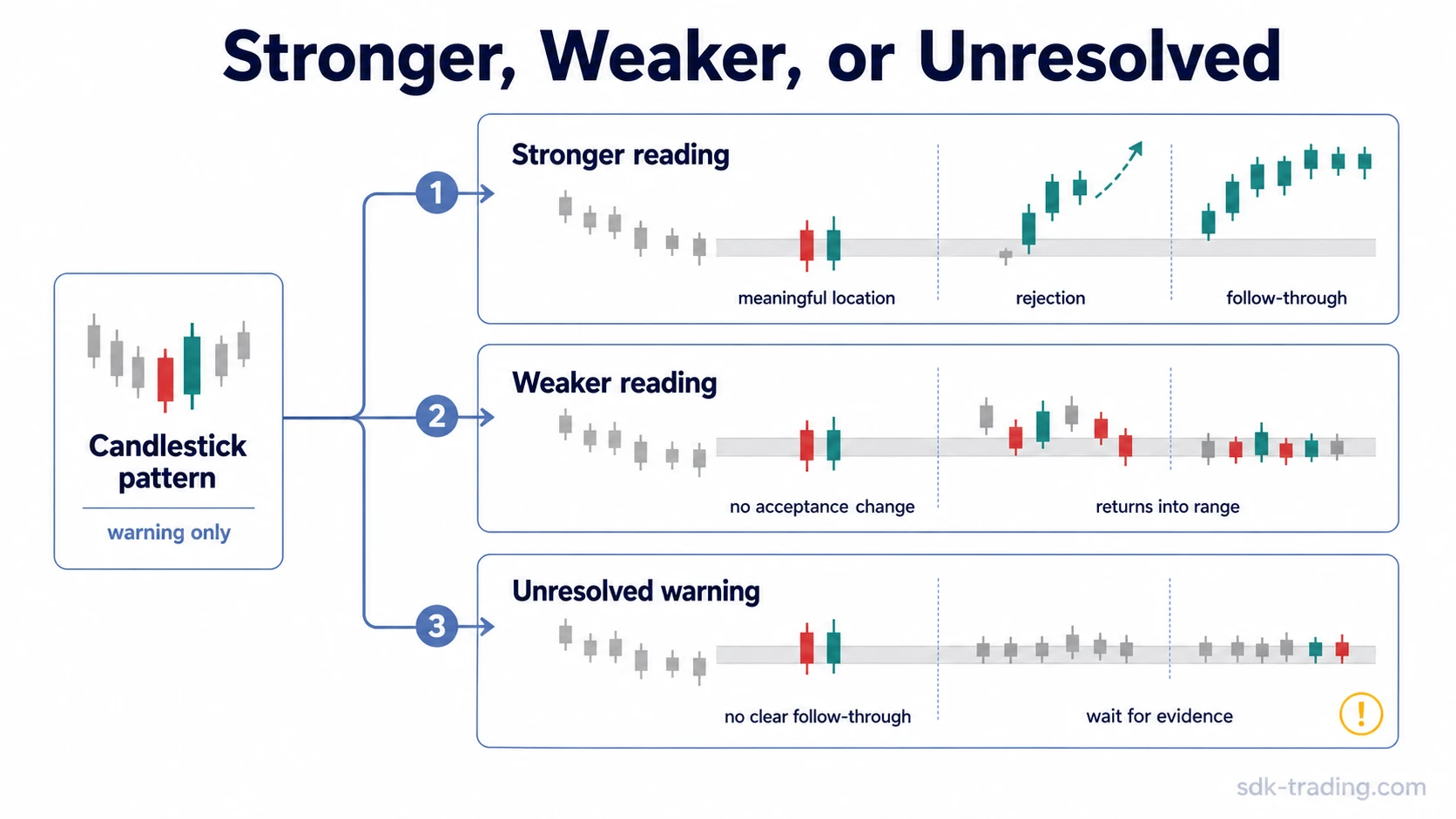
If most answers are unclear, the pattern remains unresolved. If several answers align, the reading becomes more defensible.
A safer way to read reliability
A safer reliability reading starts with the condition, not the pattern name. The first step is to ask what the market was doing before the candle appeared. The second step is to identify whether the candle formed where a reaction would matter. The third step is to watch whether later candles accept or reject the implied direction.
This sequence reduces false confidence. It also avoids treating candlestick analysis as a signal system. The pattern becomes one layer of evidence inside a broader reading, not a standalone conclusion.
The useful order is simple:
- Identify the prior movement.
- Check the location of the pattern.
- Read the candle structure and rejection quality.
- Wait for later acceptance or failed acceptance.
- Decide whether the reading is stronger, weaker, or still unresolved.
That process does not make candlestick patterns certain. It separates the visible candle shape from the evidence that tells whether the market actually rejected, accepted, or ignored that shape.
FAQ
Are candlestick patterns reliable?
Candlestick patterns can be reliable only under the right conditions. They are weaker when read as isolated shapes and stronger when location, prior movement, rejection, follow-through, and market context support the same interpretation.
How reliable are candlestick patterns?
Their reliability is conditional. A pattern with clear location, prior pressure, failed acceptance, and follow-through is more useful than the same pattern printed randomly inside a noisy range.
What is the most reliable candlestick pattern?
There is no single most reliable candlestick pattern in every market condition. A pattern becomes more or less useful depending on where it appears and whether later candles confirm or reject the implied pressure.
Can candlestick patterns work without confirmation?
A candlestick pattern can warn without confirmation, but the reading remains weaker. Later acceptance, failed acceptance, or follow-through is what separates a stronger interpretation from an unresolved warning.