Price action is the direct reading of how price moves on a chart through candles, swings, ranges, breaks, rejections, and other visible relationships. It starts with price itself rather than with a formula-derived indicator, then organizes those observations into structure, location, event types, and possible setup frameworks.
Definition: Price action is the study and interpretation of price movement over time and around visible chart reference areas. It describes what price has done and how that movement is organized before a narrower trading method or setup is applied.
Price action is therefore broader than one pattern or strategy. A swing high, a support area, a structure break, a liquidity sweep, and an imbalance can all belong to price-action analysis, but they describe different features of the chart.
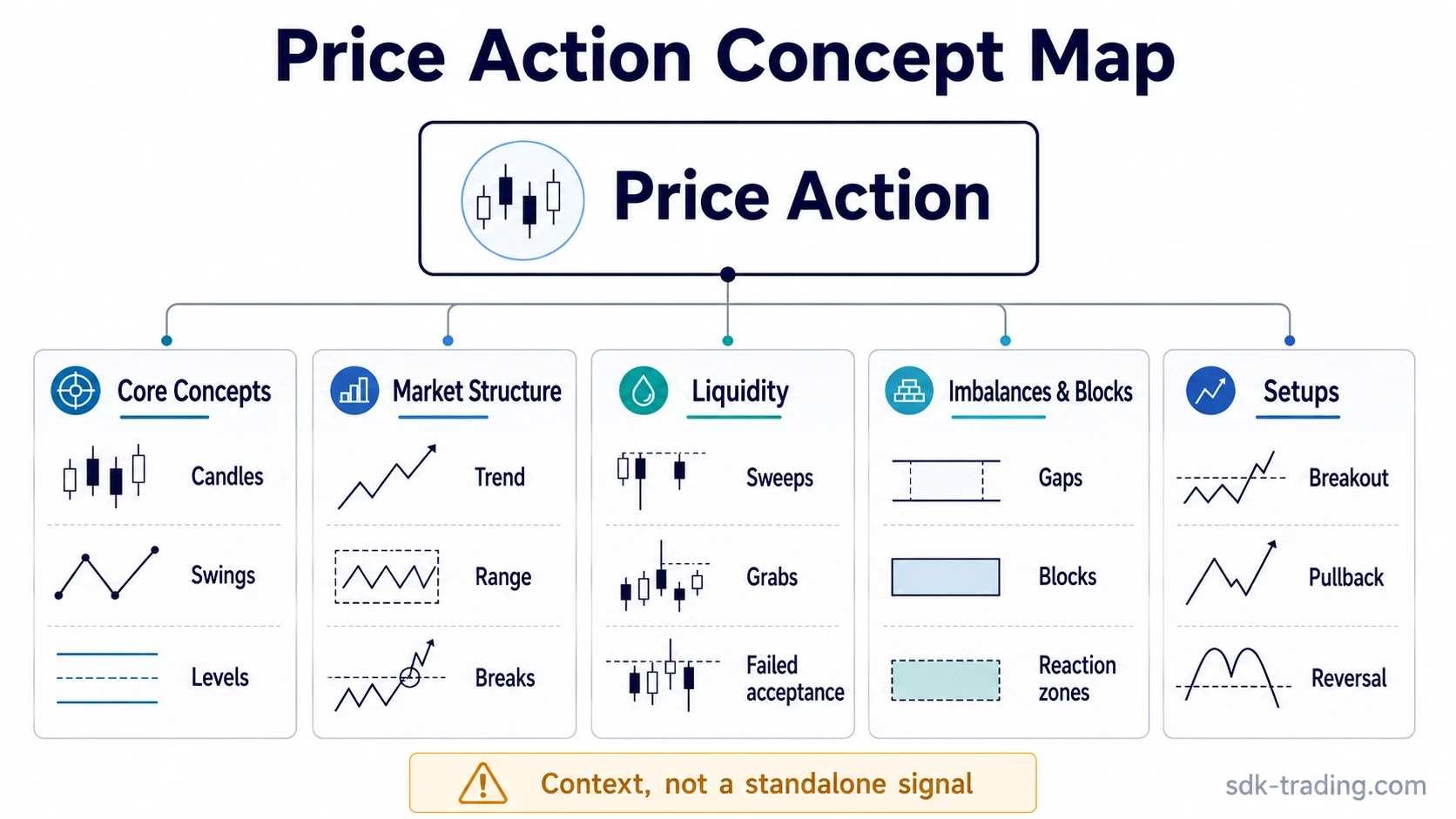
Five Areas of Price Action
The main price-action categories answer different questions. Keeping them separate prevents one chart observation from being treated as several different signals at once.
| Price-action area | Main question | Typical focus |
|---|---|---|
| Core price action concepts | What reference area or basic price relationship is being studied? | Support, resistance, supply, demand, reversals, and multi-timeframe context. |
| Market structure | How is the price sequence organized? | Swings, trends, ranges, structural breaks, shifts, and directional sequences. |
| Liquidity | How did price behave around a visible high, low, range edge, or other watched reference? | Probes, sweeps, grabs, failed movement, and acceptance or rejection around visible areas. |
| Imbalances and blocks | Where did price move rapidly or leave a distinct structural reference zone? | Displacement, imbalances, fair value gaps, order blocks, mitigation areas, and related classifications. |
| Price action setups | How are several observations combined into a defined framework? | Breakout, reversal, pullback, continuation, fakeout, and related setup families. |
A Price Action Reading Sequence
The same chart can contain several price-action concepts at once. A consistent reading order helps separate the raw observation from the label eventually applied to it.
| Stage | What to identify | Example |
|---|---|---|
| 1. Observe price | The candles, swings, ranges, gaps, and movement that are actually visible. | Price moves above a previous swing high. |
| 2. Organize structure | How the current move fits into the larger swing or range sequence. | The new high occurs inside an existing uptrend, a range, or after structural weakening. |
| 3. Define location | The reference area where the event occurred. | Prior high, prior low, support, resistance, range boundary, or another visible zone. |
| 4. Classify the event | What price actually did at that location. | Break, rejection, failed break, sweep, displacement, retest, or continued acceptance. |
| 5. Classify a setup only if needed | Whether several defined conditions together match a broader framework. | A breakout or reversal label comes after the underlying observations are identified. |
Classification boundary: a chart observation and a trading setup are not the same thing. Price can break a level, sweep a prior high, or leave an imbalance without automatically creating a complete setup.
Observation and Interpretation Are Different
Price itself can show what happened on the chart. Some conclusions require an additional interpretation that cannot be read directly from one candle or one movement.
| Visible observation | What can be stated directly | What the observation does not establish by itself |
|---|---|---|
| Price forms a higher high | A previous high has been exceeded. | That the larger trend must continue. |
| Price closes beyond a range boundary | The current period finished outside the prior range. | That the breakout will remain accepted. |
| Price trades beyond a prior high and returns below it | The prior high was exceeded and then reclaimed from below. | The exact quantity of stops, orders, or participant motives behind the move. |
| Price moves rapidly through an area | The move covered distance with relatively little visible overlap. | That the area must produce a reaction when revisited. |
| A recognizable pattern appears | The chart may meet the structural requirements of that pattern. | That the next price move is guaranteed. |
Price Action Is Not the Same as a Trading Strategy
Price action describes and classifies market behavior. A trading strategy adds another layer: defined conditions for when a particular observation matters, what invalidates the idea, how risk is handled, and how the decision is managed.
This distinction matters because the same price-action event can appear in different environments. A breakout inside a mature range, a breakout during an established trend, and a breakout immediately after a failed structural move may share the same basic label while belonging to different analytical situations.
Price Action and Indicators
Price action begins with information visible directly in the price sequence. Indicators use formulas to transform price, volume, or both into another measurement such as trend, momentum, volatility, or participation.
Using an indicator alongside price action does not make the original price observation invalid. It simply adds a separate derived measurement. The important distinction is knowing whether a conclusion comes directly from the chart or from a calculation applied to chart data.
Common Price Action Classification Errors
| Error | What was classified too early | Better sequence |
|---|---|---|
| Calling one rejection candle a reversal | A local candle is treated as a larger structural event. | Identify the location and surrounding structure before applying the reversal label. |
| Calling every move through a level a breakout setup | The price event and the setup framework are compressed into one step. | Classify the break first, then determine whether the remaining setup conditions exist. |
| Calling every sharp movement a liquidity event | Motive is inferred from speed alone. | Start with a visible reference area and describe the actual probe, return, or acceptance behavior. |
| Calling every fast move an imbalance that must be filled | A visible displacement area is converted into a future prediction. | Classify the area first and evaluate any later interaction separately. |
| Using several labels for the same observation | Different concept families are treated as interchangeable. | Identify which chart question each label actually answers. |
What the Price Action Hub Covers
This section organizes the major price-action concept families rather than replacing their detailed explanations. Core concepts define common chart references. Market structure organizes the price sequence. Liquidity pages examine behavior around visible reference areas. Imbalances and blocks classify displacement and related zones. Setup pages combine narrower observations into defined frameworks.
The Hub is therefore the starting map. The detailed definition, calculation, identification rules, limitations, and examples remain in the deeper pages that own each concept.