Price action setups are recurring trading chart-structure situations that help classify what price is doing around highs, lows, ranges, breaks, pullbacks, and failed moves. The label is useful only when it describes the structure clearly. It does not create a complete trading plan by itself.
Definition: A price action setup is a recognizable chart structure built from price movement itself, such as a retest after a break, a failed breakout, a trap pattern, a flip zone, or an inside-bar structure.
Setup names are most useful when they separate one structural situation from another. A break that later retests an old boundary is different from a break that fails back inside the prior range. An inside-bar trap is different from a broad false breakout. A zone that changes role after acceptance is different from a single candle through a level.
Key Points
- Price action setups group recurring chart structures by how price behaves around boundaries, ranges, breaks, and pullbacks.
- The same price move can receive a different label after later candles confirm, weaken, or reclassify the structure.
- Break-and-retest, fakey, false breakout, flip zone, and hikkake patterns describe different structure families.
- A setup label is not a buy or sell instruction, and it does not replace confirmation, invalidation, or risk planning.
- Useful setup recognition starts with structure first, then narrows into the specific pattern that best matches the behavior.
What Price Action Setups Are
Price action setups describe how price behaves without depending on an indicator signal as the main evidence. The focus is usually on swing points, range boundaries, failed breaks, acceptance beyond a level, rejection back inside a range, or compression before expansion.
A setup becomes clearer when the structure has a visible reference point. That reference point might be a prior high, prior low, range edge, candle cluster, breakout area, or reaction zone. Without a visible reference, the label can become too subjective.
Structural note: A setup is a way to classify market behavior. It is not the same thing as a full strategy, complete execution model, or performance claim.
The practical value comes from separating similar-looking situations. A move above resistance can begin a breakout reading, but later price behavior decides whether it behaves more like a break-and-retest, a failed breakout, or a zone flip.
Price Action Setup Types
The main setup families below describe different ways price interacts with a boundary or range. Each label should stay tied to its own structure instead of becoming a generic name for any interesting chart move.
| Setup family | Core structure | Best use of the label |
|---|---|---|
| Break-and-retest | Price breaks a meaningful boundary and later returns to test the area from the other side. | Best matched when the later test is the important structural question, not just the first break. |
| Fakey pattern | Price appears to break from an inside or compact structure, then reverses back through it. | Best matched when the setup depends on a false break and re-entry around the prior structure. |
| False breakout | Price pushes beyond a recognized boundary but fails to hold beyond it. | Best matched when the failed break itself is the main structural feature. |
| Flip zone | An area that acted as resistance or support later changes role after price accepts beyond it. | Best matched when the same zone changes function after a clearer acceptance and return sequence. |
| Hikkake | An inside-bar false break pattern where price traps one side before moving back through the structure. | Best matched when the setup is specifically built around the inside-bar false-break sequence. |
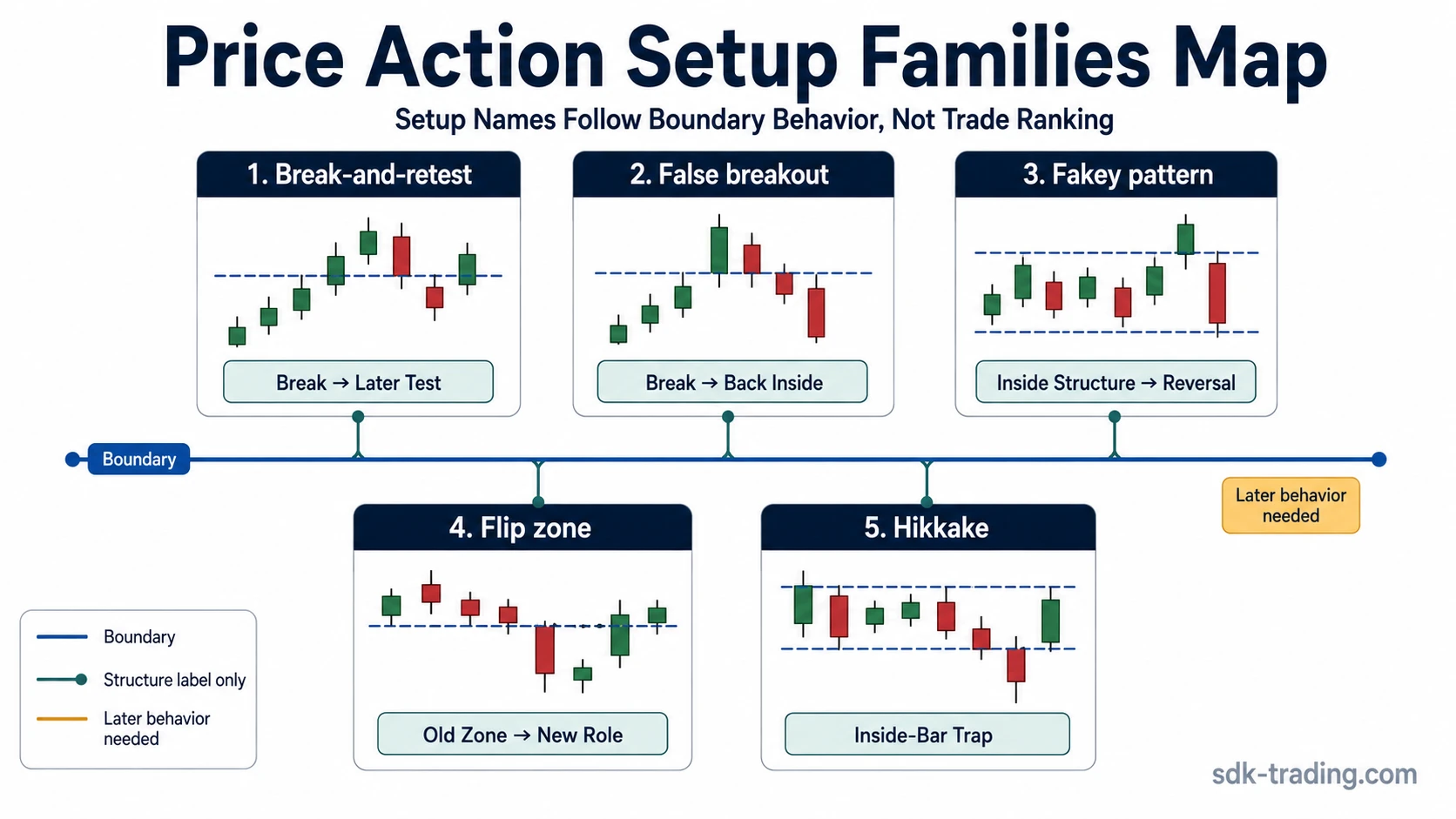
How the Main Setup Families Differ
Many price action setup labels begin with the same raw ingredients: a boundary, a break, a pullback, or a return into the prior range. The difference is the sequence after the first movement.
| Structural question | Setup family usually involved | What changes the reading |
|---|---|---|
| Did price break a level and then test it from the other side? | Break-and-retest | The later test matters more than the first breakout candle. |
| Did price break beyond a boundary but fail to stay beyond it? | False breakout | The return back inside the old structure weakens the original break reading. |
| Did an inside structure produce a false break and reversal? | Fakey pattern or hikkake | The pattern depends on the internal bar structure, not only on a failed level break. |
| Did an old support or resistance area change role after acceptance? | Flip zone | The area becomes more meaningful when later price behavior respects the changed role. |
Example scenario: Price moves above a prior range high. If it later pulls back and holds the old range high from above, the structure may fit a break-and-retest reading. If it returns back inside the range and rejects the breakout area, the same first move may fit a false breakout reading instead.
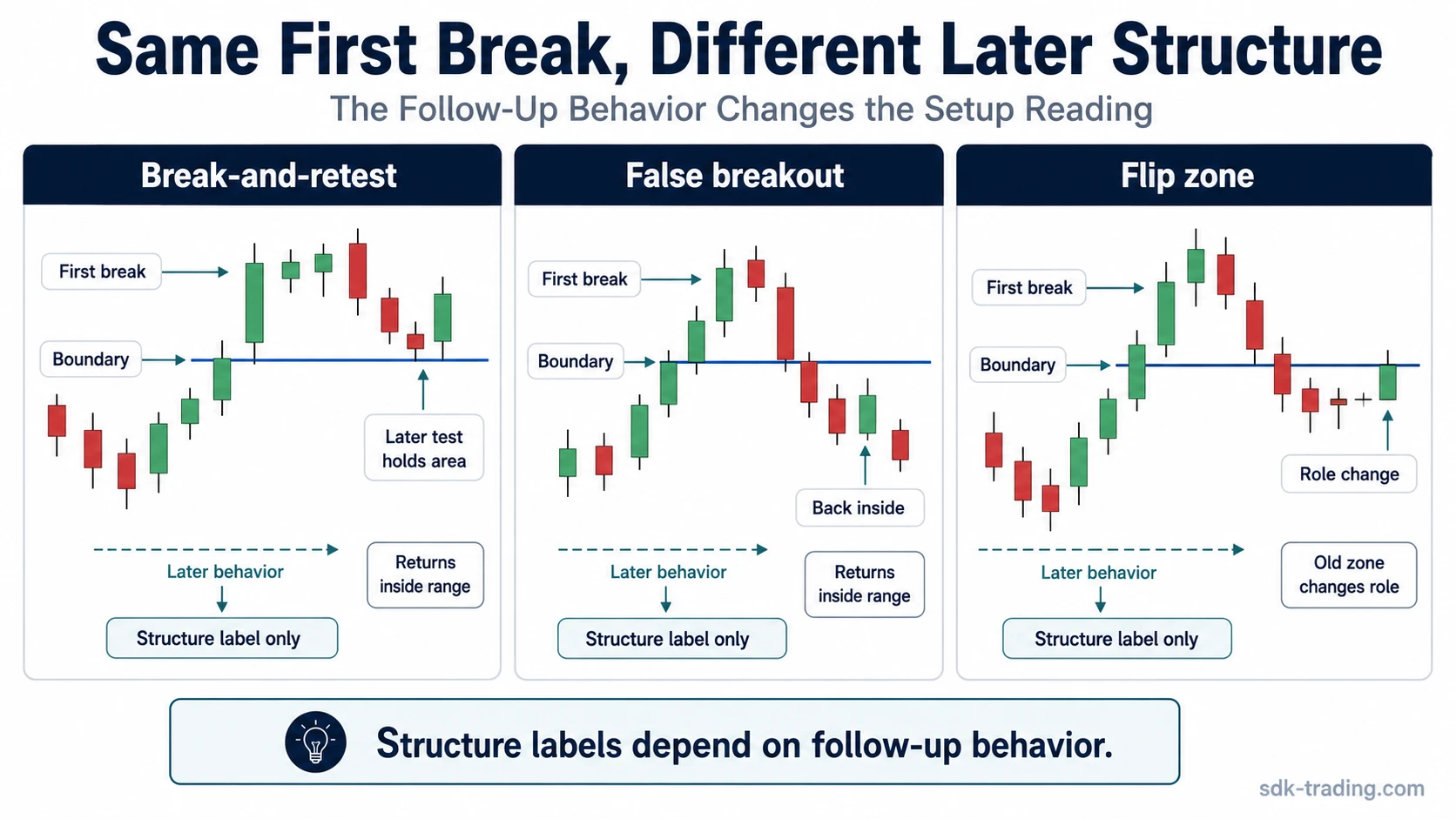
Setup Recognition vs Trading Strategy
Setup recognition names the structure. A trading strategy defines the broader decision process. Those are separate layers.
A named setup does not define position direction, timing, order placement, stop placement, target placement, sizing, or expected outcome. It only describes a chart condition that may need more context before it becomes usable.
Limitation: A clean setup label can still be incomplete if the boundary is weak, the follow-through is unclear, the market is choppy, or later candles reclassify the original reading.
For that reason, price action labels work best as a structure filter. They help narrow the question from “what is happening on the chart?” to “which structure family does this behavior most closely match?”
Where Each Structure Fits
A useful way to choose between price action setup types is to start with the behavior around the boundary, then narrow into the specific structure.
| Observed behavior | Most relevant structure family | What to check next |
|---|---|---|
| Break beyond a prior high or low, then return to the broken area. | Break-and-retest | Whether the retest holds, fails, or becomes noisy. |
| Break outside a range, then move back inside the prior structure. | False breakout | Whether the break failed by wick only, close behavior, or later acceptance back inside. |
| Inside structure breaks one way, then reverses through the prior bar structure. | Fakey pattern | Whether the inside-bar context is clear enough for the label. |
| Inside-bar false break forms a trap-like sequence. | Hikkake | Whether the sequence matches the inside-bar trap structure rather than a broader failed breakout. |
| Old resistance or support later behaves as the opposite side of the market. | Flip zone | Whether the area shows acceptance and later respect rather than a single touch. |
Common Price Action Setup Mistakes
| Mistake | Cleaner interpretation |
|---|---|
| Calling any move through a level a complete setup. | The break starts the question. Later acceptance, rejection, or return behavior changes the reading. |
| Ranking setups as universally better or worse. | Different setups describe different structures. Quality depends on context, clarity, and follow-through. |
| Using a setup label as a trade instruction. | The label names the structure only. Execution and risk decisions require a separate process. |
| Ignoring weak or noisy boundaries. | A setup is harder to classify when the reference level is not visible, repeated, or structurally meaningful. |
| Forcing a specific pattern name too early. | Some structures need later candles before the setup family becomes clear. |
How to Read Price Action Setups Without Overstating Them
Start with the reference structure first: range, swing high, swing low, support area, resistance area, inside-bar structure, or prior breakout zone. Then compare later behavior against that reference.
- Identify the boundary: The setup needs a visible area or structure to react around.
- Watch the first movement: Price may break, reject, compress, or return toward the boundary.
- Check later behavior: Follow-through, failure, re-entry, or acceptance decides whether the first label still fits.
- Choose the closest structure family: Retest, false break, trap, flip-zone, and inside-bar structures should not be blended into one generic label.
- Keep the label limited: The setup name describes the structure, not the final trading decision.