A fakey pattern is a false-breakout structure that forms around an inside bar or mother-bar range when price breaks outside the range, fails to accept beyond it, and returns back toward or inside the prior range.
The pattern is a structural classification, not a standalone trade signal or prediction. The important question is whether the original range, the break, the failed acceptance, and the follow-up candles are clear enough to classify the move as a failed breakout rather than ordinary chart noise.
Definition: A fakey pattern is an inside-bar false-breakout formation. It begins with a visible mother-bar or inside-bar range, moves beyond that range, then fails to hold outside it and rotates back toward the earlier structure.
Key Points
- A fakey pattern needs a clear inside-bar or mother-bar range before the break.
- The first move beyond the range is not enough; failed acceptance is the key test.
- The reading becomes stronger when the boundary, break, rejection, and return are all visible.
- The label weakens when price accepts beyond the broken range or when the original boundary was unclear.
What Is a Fakey Pattern?
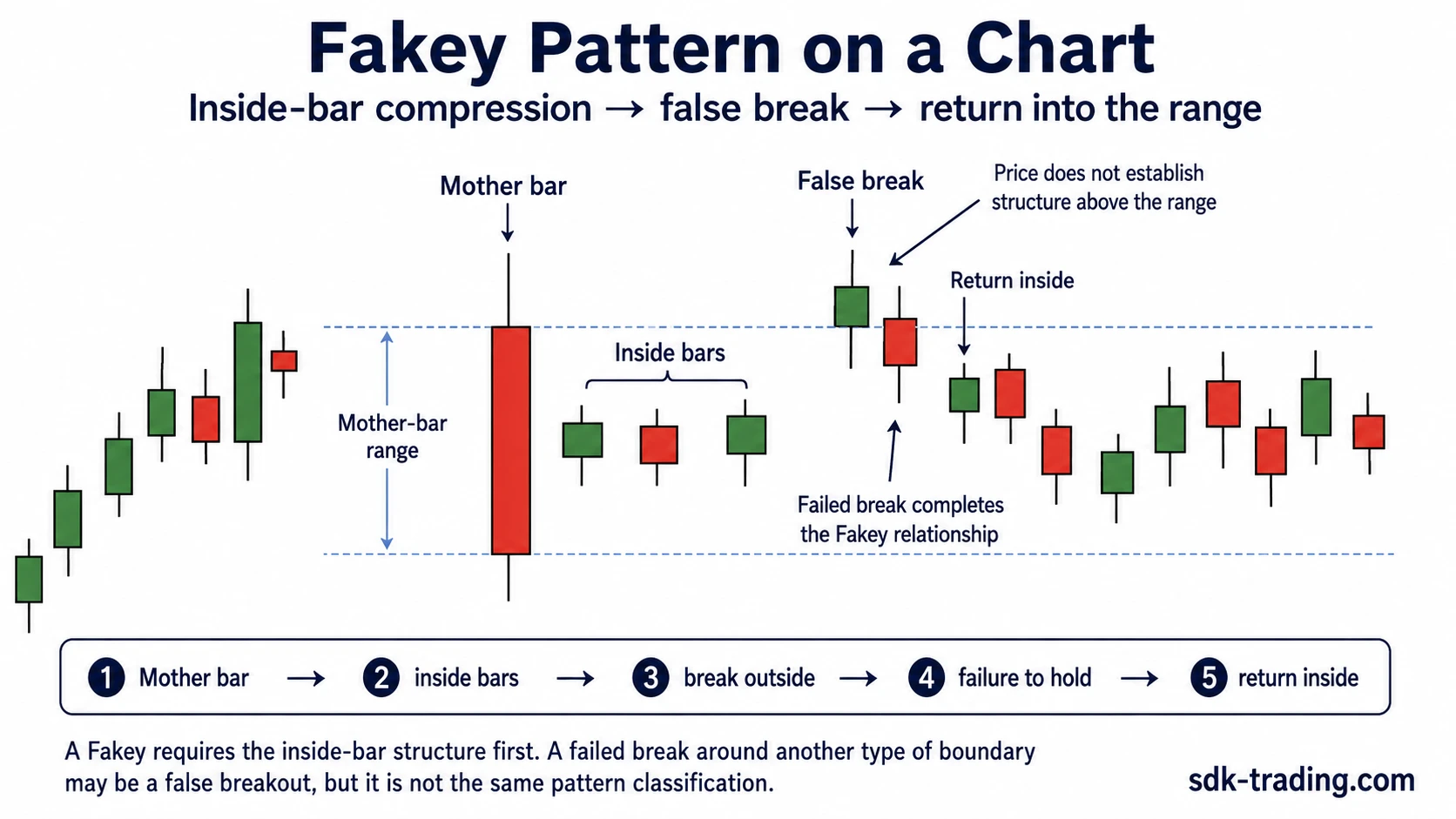
A fakey pattern is built around a failed break of an inside-bar range. The range usually starts with a larger mother bar and one or more smaller candles contained inside it.
The classification depends on price behavior around that range boundary. A wick outside the range may begin the question, but the close, return, and acceptance after the break decide whether the structure remains valid.
Neutral reading: A fakey pattern does not automatically predict reversal, continuation, or follow-through. It only describes a failed attempt to accept outside a prior inside-bar structure.
How a Fakey Pattern Forms
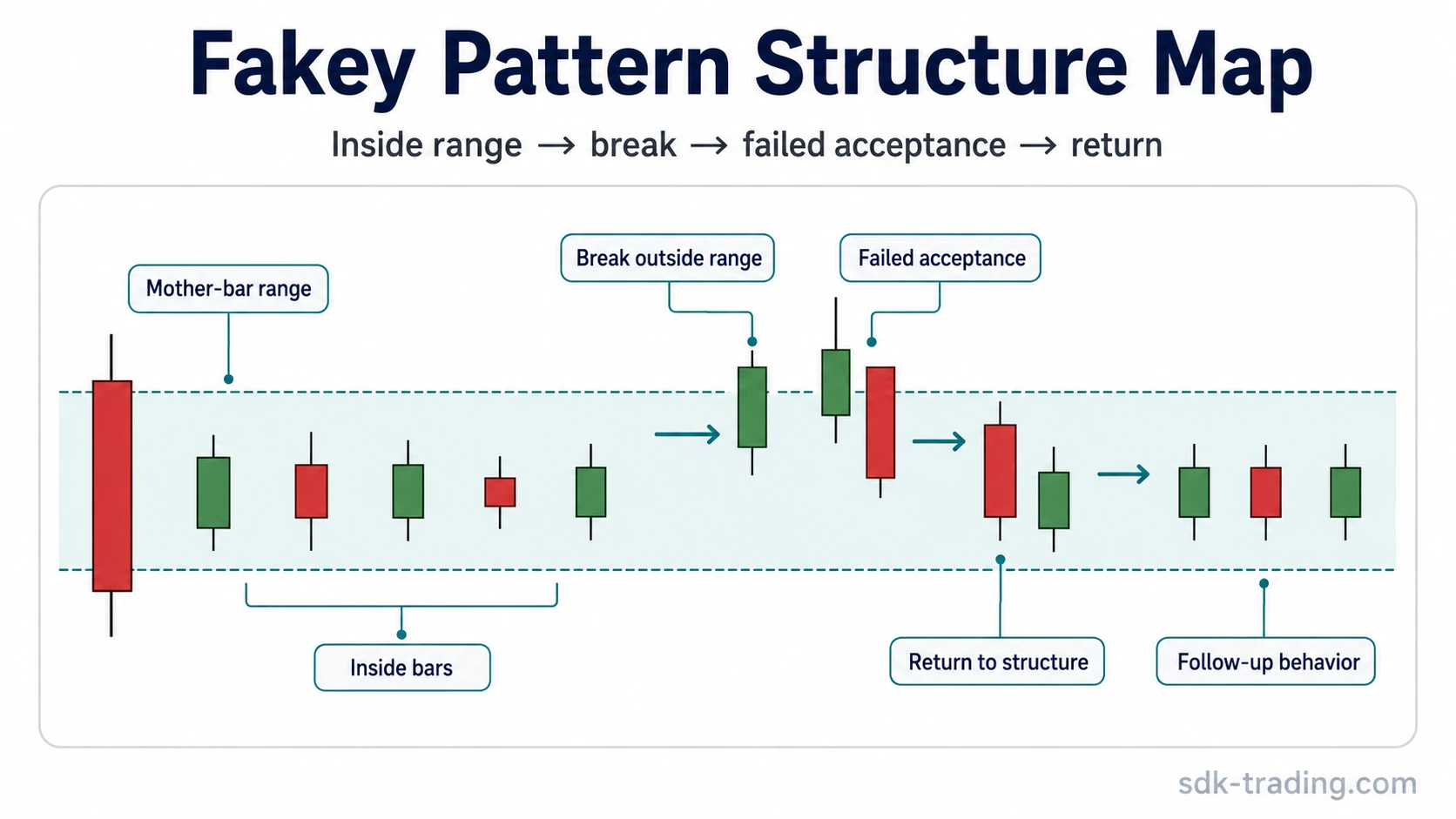
The structure normally develops in a simple sequence. The sequence matters more than the label because a fakey reading is only as strong as the boundary and the failed acceptance around it.
- Mother bar or inside-bar range: Price forms a visible range where the inside bar is contained within a larger prior candle or range boundary.
- Initial breakout: Price moves beyond the high or low of that range.
- Failed acceptance: The move outside the range does not hold cleanly. Price rejects the outside area, closes back inside, or quickly returns toward the prior structure.
- Return into structure: Price moves back into or around the old range, forcing the breakout reading to be questioned.
- Follow-up clarification: Later candles determine whether the failed-break reading remains clean, unresolved, or invalid.
The same basic sequence can appear in either direction. The structural logic is the same: range, break, failure to accept, return, and follow-up clarification.

How to Identify a Fakey Pattern
A clean identification starts with the range. Without a clear mother-bar or inside-bar boundary, the move may still be a broader false-breakout structure, but it is harder to classify as a specific fakey pattern.
| Structural element | What to check | Why it matters |
|---|---|---|
| Inside-bar boundary | The mother-bar or inside-bar range is visible and not arbitrary. | Defines the structure being broken. |
| Break beyond the range | Price moves outside the prior high or low of the range. | Creates the attempted breakout. |
| Failed acceptance | Price cannot hold cleanly outside the broken boundary. | Separates a failed break from accepted continuation. |
| Return into structure | Price closes back inside or rotates back toward the earlier range. | Shows the outside area was not accepted cleanly. |
| Follow-up candles | Later candles clarify acceptance, rejection, or drift. | Refines the final classification. |
Clean, Weak, and Invalid Fakey Readings
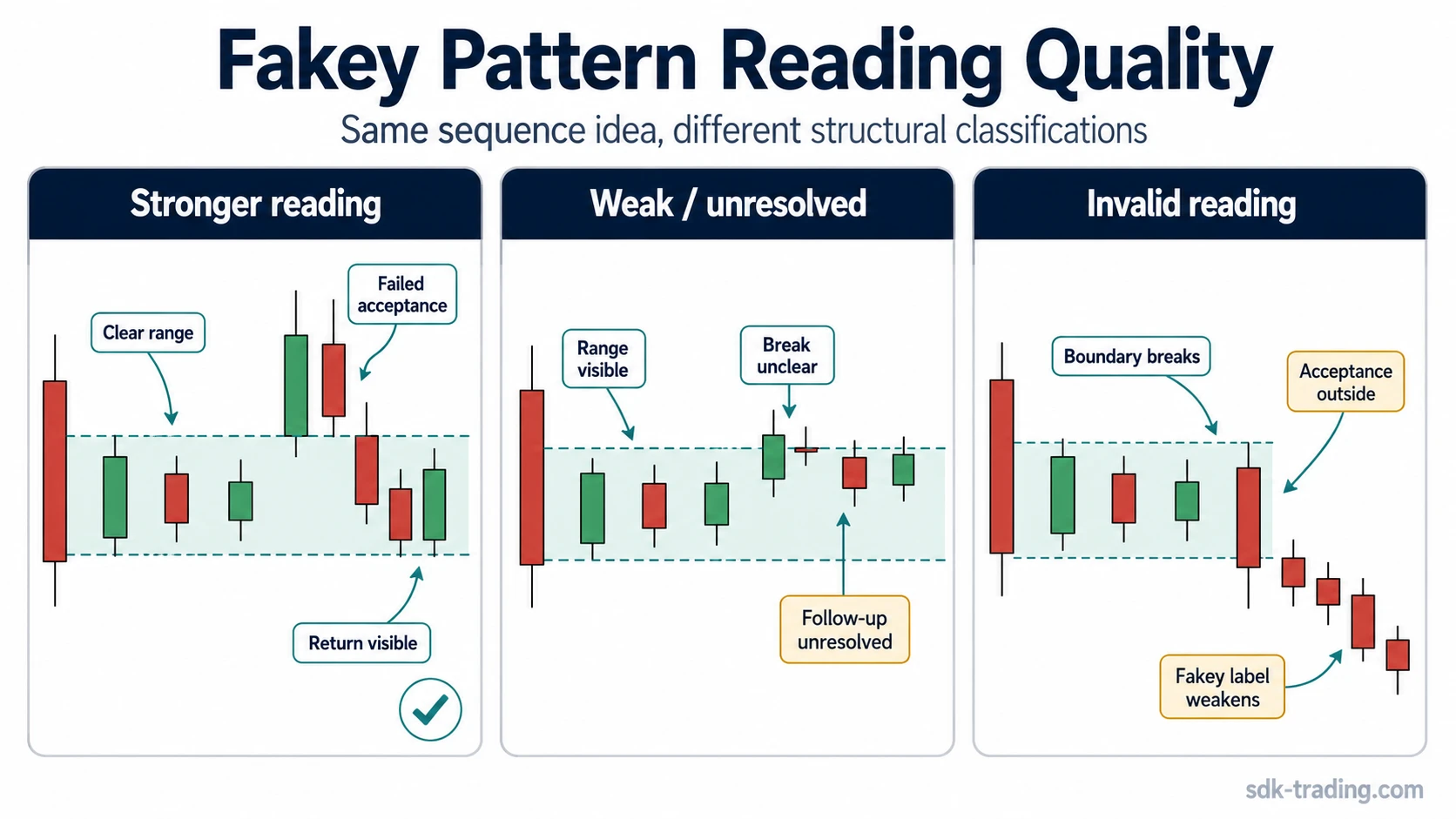
The label becomes more useful when the reading is graded instead of treated as automatic confirmation. A clean fakey reading has a different meaning from a weak or invalid one.
| Reading type | What it looks like | Safer classification |
|---|---|---|
| Clean fakey | Clear range, clear break, failed acceptance, and return into or around the old structure. | Stronger structural reading |
| Weak or unresolved fakey | The range is visible, but the break, rejection, close, or follow-up behavior remains unclear. | Unresolved reading |
| Invalid or false positive | Price accepts beyond the broken range, or the original boundary was too unclear. | Not a clean fakey pattern |
Boundary rule: If the inside-bar range is unclear, the fakey label becomes fragile. A vague boundary makes it too easy to label ordinary volatility as a structured false break.

Fakey Pattern vs False Breakout
A fakey pattern is a specific kind of false-breakout reading. The broader false-breakout idea can happen around many boundaries, including support, resistance, trendlines, ranges, or prior swing levels. A fakey pattern is narrower because it usually depends on an inside-bar or mother-bar range.
| Concept | Typical boundary | Main difference |
|---|---|---|
| Fakey pattern | Inside-bar or mother-bar range | The failed break is classified around an inside-bar structure. |
| False breakout | Any meaningful chart boundary | The failed break can occur around many types of market structure. |
The overlap is useful, but the terms should not be treated as identical in every chart context. A fakey pattern is usually a more specific label inside the larger false-breakout family.
Fakey Pattern Variants
Several versions can appear around the same inside-bar failure idea. The names are less important than the boundary, the failed break, and acceptance after the break.
| Variant | How it appears | Reading caution |
|---|---|---|
| Pin-bar fakey | The break outside the inside-bar range leaves a long rejection wick and returns toward the prior structure. | The wick matters only if the range and failed acceptance are clear. |
| Two-bar false break | One candle breaks the range and a later candle returns back into or toward it. | The return candle should clarify failed acceptance rather than only create a choppy overlap. |
| Multiple-inside-bar variation | Several contained candles form inside the mother-bar range before the attempted break. | The more compressed the range becomes, the more important the boundary clarity and follow-up behavior become. |
Illustrative Fakey Pattern Scenario
A market forms a clear mother-bar range, then several smaller candles remain inside that range. Price briefly moves above the range high, but the next behavior does not hold outside the boundary. It closes back near or inside the prior range and later candles rotate around the old structure.
That scenario can support a fakey reading because the attempted break did not accept outside the inside-bar range. The reading would weaken if the boundary was unclear, if price held beyond the range, or if follow-up candles no longer supported failed acceptance.
Common Fakey Pattern Misreads
Most fakey-pattern mistakes come from labeling the break too early. The classification depends on what happens after the break.
| Common misread | Cleaner interpretation |
|---|---|
| Calling every inside-bar reversal a fakey | The reading needs a visible range, a real break, and failed acceptance outside the range. |
| Treating a wick as enough evidence | A wick can signal rejection, but the close and follow-up candles decide the quality of the reading. |
| Assuming reliability means performance | Reliability is better treated as reading quality unless tested performance evidence is supplied. |
| Ignoring acceptance beyond the range | Clean acceptance outside the broken boundary can invalidate the fakey classification. |
Limitation: A fakey pattern can describe failed acceptance, but it does not remove uncertainty. A clean structure can still fail, and a weak structure should not be upgraded just because the label is familiar.
Related Price-Action Concepts
Several nearby concepts can look similar, but each one solves a different classification problem.
- Inside bar: The contained candle or range that creates the starting boundary for a fakey pattern.
- False breakout: The broader family of failed boundary breaks that includes many structures beyond inside bars.
- Hikkake: A related inside-bar failure concept often discussed with similar range-break behavior.
- Flip zone: A separate boundary concept where prior support or resistance changes role after acceptance.
- Break and retest: A different sequence where price breaks a boundary and later returns to test the area; a fakey pattern depends on failed acceptance rather than clean acceptance beyond the break.
FAQ
Is a fakey pattern the same as a false breakout?
A fakey pattern is a specific false-breakout structure built around an inside-bar or mother-bar range. A false breakout can happen around many other boundaries, so the terms overlap but are not always identical.
Does a fakey pattern require an inside bar?
The classic fakey reading depends on an inside-bar or mother-bar range. Without that boundary, the move may still be a false breakout, but the specific fakey label becomes weaker.
What invalidates a fakey pattern reading?
The reading weakens or becomes invalid when price accepts beyond the broken range, when the original inside-bar boundary is unclear, or when follow-up price behavior no longer supports failed acceptance.