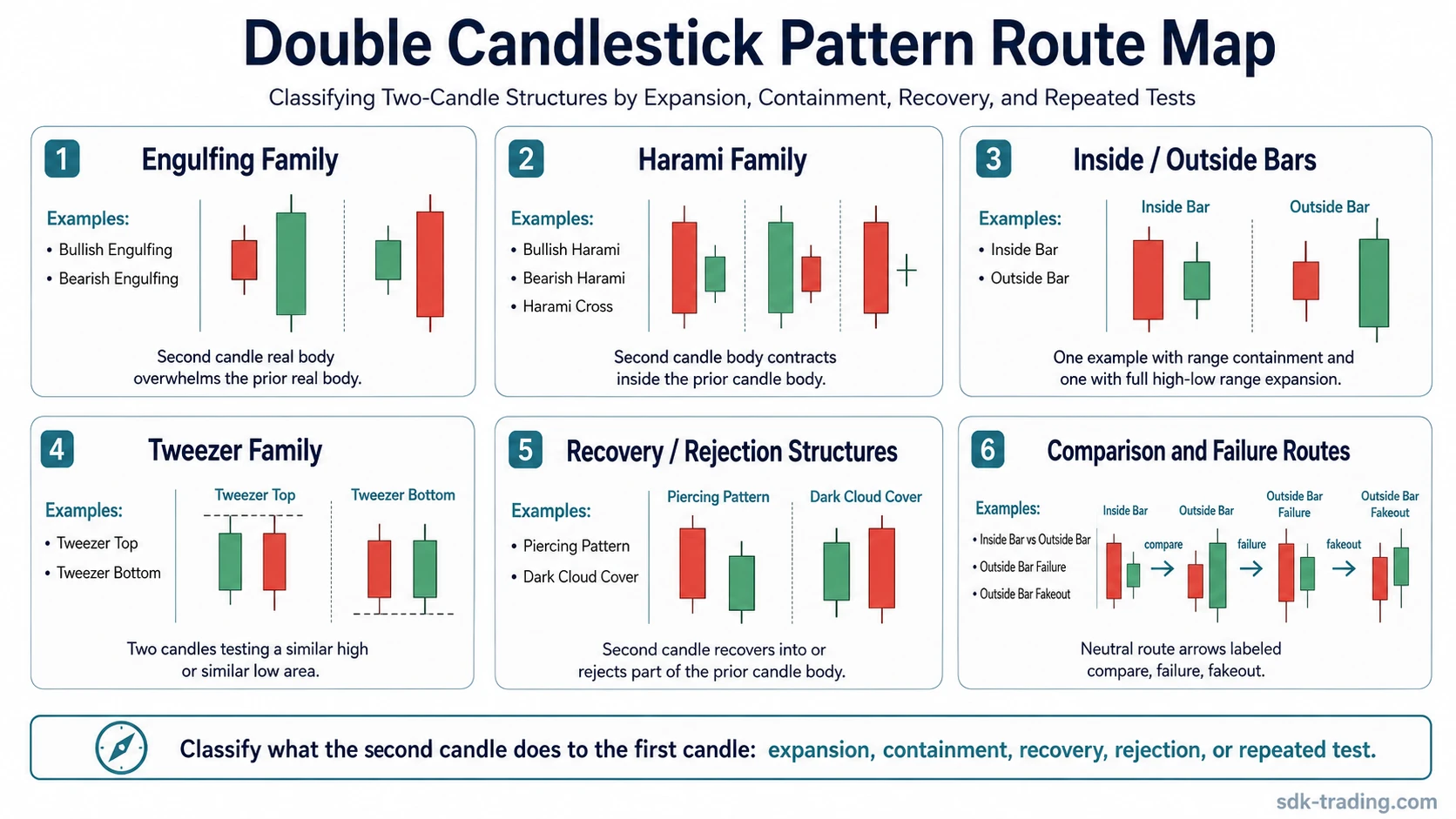
Double candlestick patterns are two-candle formations classified by the relationship between two consecutive candles. The first candle creates the reference, and the second candle determines which named two-candle family the structure belongs to.
Definition: A double candlestick pattern is a two-candle structure where the relationship between the first candle and the second candle determines the pattern classification. Depending on the pattern, the decisive feature may be body engulfment, containment, range expansion, partial recovery, or a repeated high or low.
Key Points
- Double candlestick patterns require two consecutive candles before the structure can be classified.
- Engulfing and harami patterns focus on body relationships, while inside bars and outside bars use the full high-low range.
- Piercing and dark cloud cover depend on how far the second candle moves back into the first candle’s body.
- Tweezer patterns compare repeated highs or lows across the two candles.
Double Candlestick Pattern Classification
Start with the first candle as the reference, then identify the relationship created by the second candle. Different relationships lead to different named pattern families.
| Two-candle structure question | Relevant pattern | Pattern boundary |
|---|---|---|
| Does the second candle fully overwhelm the prior candle’s body in a bullish direction? | Bullish engulfing pattern | Expansion and body engulfment after prior weakness. |
| Does the second candle fully overwhelm the prior candle’s body in a bearish direction? | Bearish engulfing pattern | Expansion and body engulfment after prior strength. |
| Does the second candle sit inside the prior candle after bearish pressure? | Bullish harami pattern | Compression inside the previous candle after a decline. |
| Does the second candle sit inside the prior candle after bullish pressure? | Bearish harami pattern | Compression inside the previous candle after an advance. |
| Does a small doji-like second candle form inside a larger first candle? | Harami cross pattern | Harami structure with a narrow, indecision-style second candle. |
| Does a bullish second candle recover deeply into the prior bearish candle? | Piercing pattern | Two-candle bullish recovery structure after downside pressure. |
| Does a bearish second candle close deeply into the prior bullish candle? | Dark cloud cover pattern | Two-candle bearish rejection structure after upside pressure. |
| Does the second candle remain inside the prior candle’s range? | Inside bar pattern | Range contraction inside the previous candle. |
| Does the second candle expand beyond the prior candle’s high-low range? | Outside bar pattern | Range expansion around the previous candle. |
| Do two candles test a similar low area? | Tweezer bottom pattern | Repeated low test with two-candle rejection behavior. |
| Do two candles test a similar high area? | Tweezer top pattern | Repeated high test with two-candle rejection behavior. |
Classification check: The pattern name should follow the relationship that is actually present. A body-based pattern, a full-range pattern, a partial-recovery pattern, and a repeated-extreme pattern use different boundaries even though all of them contain two candles.
Boundary Against Nearby Candlestick Categories
Double candlestick patterns are limited to structures that require two candles for classification. If one candle is enough to identify the formation, it belongs to a single-candle category. If the structure is incomplete until a third candle appears, it belongs to a triple-candle category.
| Category | Use this group when | Do not use this group when |
|---|---|---|
| Double candlestick patterns | The classification depends on the first candle and second candle together. | The formation can be identified from one candle alone. |
| Single candlestick patterns | A candle’s wick, body, open, close, or range is enough to classify it. | A second candle is required to define the pattern. |
| Triple candlestick patterns | The sequence needs three candles to form the structure. | The pattern is already complete after the second candle. |
| Gap or continuation structures | The gap or continuation rule is the defining feature. | The classification depends on an engulfing, harami, tweezer, inside-bar, or outside-bar relationship. |
Related Double-Candlestick Checks
Some two-candle questions involve comparison, failure, fakeout, or placement rather than the basic definition of a named pattern.
| Interpretation problem | Relevant page | Use when |
|---|---|---|
| The issue is comparing bullish and bearish engulfing behavior. | Bullish engulfing vs bearish engulfing | The issue is direction and surrounding structure, not the definition of engulfment itself. |
| The issue is comparing contraction and expansion bars. | Inside bar vs outside bar | The issue is range containment versus range expansion. |
| The issue is the broader two-candle structure framework. | Double candlestick pattern structures | The question is about the geometry behind two-candle pattern names. |
| The issue is why an outside bar did not lead to clean follow-through. | Outside bar failure | The issue is failed expansion rather than the basic outside-bar definition. |
| The issue is a false break around an outside bar. | Outside bar fakeout | The issue is failed breakout behavior around the range. |
| The issue is bearish engulfing after an advance. | Bearish engulfing in an uptrend | The issue is placement inside prior upward movement. |